Last month, a friend of mine who had been a seo for eight years said something to me, and gave me a few seconds:
"i spent three years making one brand the first page of google, and now users are asking chatgpt, my brand is not in the answer."
He's not complaining, he's presenting a fact。
In 2026, fundamental changes have taken place in the way users search for information. More and more people are not opening google 100-degree searches, but are asking ai — questions about chatgpt, questions about perplexity, questions about kimi, questions about bean bags. And ai answers the questions, and it doesn't give you a list of "ten blue links", it just gives one answer。
What does that mean
It means that the logic of seo, on which we have been living for the last two decades -- "optimizing the ranking, crowding into the first page, and the users will naturally come in" -- is failing. Instead, a whole new set of rules: can your brand be seen by ai, can it be recommended by ai, can it be found in the only answer that ai gives to users。
This new set of rules, called geo-generative engineering optimization, produces engine optimization。
You might say, "seo's not dead, right? Google's still here, 100 degrees. "yes, traditional search engines are not going to disappear, but they're going down from "main access to user information" to "support tools." it's like television didn't disappear, but nobody saw it as the main way to get news。
This is not a prophecy. This is what is happening。
So what's the difference between seo and geo? What do these differences mean? I have broken down five core differences, each of which directly determines your pattern of traffic and the cost of getting people next year。
Distinguished one: flow acquisition logic -- from "waiting search" to "recommended" seo logic: active search by user
The core assumption of seo is that users know what they want to search for, enter keywords, the search engine returns a row of links, and the user selects one from within。
Your job is to get users to search for that keyword and you're in the top。
This logic has a fatal premise — users must first have a clear search intent。
The reality, however, is that the information needs of a large number of users are vague and exploratory. They don't know what to search for, they just have a question and want an answer。
Geo logic: user questions
When the user asks ai, "help me recommend a simple short video marketing tool," ai won't give you 10 links to pick it out. It assesses the various sources of information in an integrated manner, giving a recommended answer — one that may contain your brand or it may not be you at all。
The key shift is that you're not competing for a place on the search result page, but for a place to be mentioned in "ai's recommended answer."。
Seo is waiting in line, geo is asking ai to sell for you。
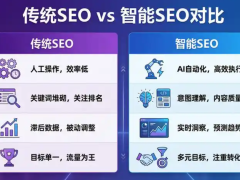
This is not a simple channel migration, but a bottom logical rewrite of flow acquisition:
Dimensions
Seo
Geo
Flow trigger
User input keyword
Users ask questions about natural languages
Your character
Searched, selected
Recommended, quoted
Competition area
Other organiser
Ai generates references in answers
User behaviour
Look at the list click access
Read the answer and act directly

What is the impact of this distinction? I'll give you a data point:
According to monitoring data from brightedge at the end of 2025, in some industries the natural flow of traditional search engines decreased by 15 to 47 per cent compared to the same period in 2024. At the same time, flows from ai-generated searches have increased over the same period - by three to five times in some industries。
It's not volatility. It's structural migration。
Differentiation ii: content form - from "keyword matching" to "knowledge map embedded" seo age: key words are atom units
Seo's tactical system is almost entirely focused on keywords:
This method has worked for 20 years because the bottom logic of the search engine is the matching of keywords + sorting. You get the key, the search engine will find you。
Geo age: ai understands knowledge, not words
Generating ai in answer to questions, it's not in "match keyword." it is retrieving a vast knowledge map, looking for the most relevant, authoritative and complete pieces of information, and then woven them into a coherent answer。
What does that mean
It means that if you only optimized the keyword, your content might be "matched" at the keyword level, but "failed" at the intellectual level. Ai may have found the keyword on your page, but it decided that your content was not authoritative, structured, complete, and it chose another source of information。
Seo let the search engine find your page, geo let ai put your knowledge into its answer。
And that's why you see this weird thing: some of the seos are very well ranked, completely invisible in the results of the ai search, and some of the seos are generally ranked, often quoted in the ai search。
Because ai's standards are different. It looked at:
Information density: do your content provide sufficiently deep and comprehensive information on a subject? Structural clarity: does your content have a clear logical structure (defining problem questions and data conclusions) that allows ai to extract efficiently? Authority signal: are you quoted from other authoritative sources? Does the author have a credible professional background? Unique data: do you have original data, an exclusive view, rather than repeating what has been said
A typical seo article could be: "geo optimization guide 2026: five techniques to uplift you" -- the title has keywords, the text has a list of techniques, enough for the search engine to give you a good ranking。
But the geo-level content of the same subject should be: define geo, then explain why traditional seos are not working, then give specific data and case studies to prove the effect of geo, and finally provide an operational framework for landing — that's what ai can read and be willing to quote。
Differentiation iii: assessment criteria - arctic star indicators from "rank position" to "quote share" seo: ranking
What are the most interesting data for seos。
"what's the number of core keywords?" "how many are the long endings?" "how much is the head page?"
The ranking is the ultimate indicator of seo, as it directly corresponds to the flow. The traffic gap between number 1 and number 5 may be 5-10 and the gap between pages 1 and 2 may be 100 times。
So all of seo's tactics — content optimization, external chain building, technology seo — point to a goal: to push up the ranking。
Geo core indicator: reference share
In the geo era, the concept of ranking became blurred. Ai won't give you a "page 1 number 3" ranking, either in the answer or not。
So the core indicator of geo is the reference share -- the frequency and depth of your brand/content being quoted when ai answers a particular subject。
It's much more complicated than ranking, but it's more valuable:
Indicator dimensions
Seo ranking
Geo reference share
Measure object
Ranking of individual keywords

Overall frequency of reference in a subject area
Gravity
Crude (10 vs not top 10)
Fine (directly recommended vs are mentioned side by side vs not mentioned)
Stability
High volatility (heavy impact of algorithm update)
Relative stability (ai quotes relying on knowledge accumulation)
Competition dimension
Competition with 10 pages of keywords
Competition for all sources of information on the same subject
Value
Traffic entrance
Trust endorsement + flow entrance
Quoting shares are more difficult to track than rankings, but they are also more difficult for competitors to steal quickly. Once you have established an ai-trusted position in a field of knowledge, this position is solid -- because ai quotes you because you're not high, but because your content is really worth quoting。
That explains why the seo ranking can be quickly manipulated by black hats, but it is almost impossible for the geo quotes to be obtained by cheating. - ai's judgement is based on the true quality and authority of the content, not on how much you've done。
Distinction four: technological means - from "overlink king" to "authority signal king" seo three pillars: content + outer chain + technology
There's a classic conclusion in the seo circle: it's about the king, the outer chain, the technology。
In here, the outside chainInk) is the centerpiece of ranking leverage. Google's pagerank algorithm essentially uses the outer chain as a "vote." the more high-quality pages link to you, the more google thinks you're important。
So much of the seo's work is to get out of the chain: to exchange friendship links, to be a guest blog, to submit directories, to buy links (black hats), to create content to be quoted by others
The system has been in operation for 20 years and has provided for an entire industrial chain。
Geo core technology: authoritative signal construction
When the ai engine decides whether to quote you, it looks not at the outside chain, but at the authoritative signals。
Authority signals include, but are not limited to:
Original data and exclusive studies: do you have your own data sets, studies, experiments? Ai prefers to quote original data sources instead of reproducing them. Signature of experts and author authority: is there a clear professional signature of content? Does the author have verifiable influence within the industry? (this is in line with google’s e-e-a-t philosophy, but ai is being implemented more strictly) is cited by other authoritative sources: not quantity, but quality. Have you been quoted in the industry media, academic institutions and official institutions? Knowledge integrity: have you developed systematic knowledge coverage on a particular theme? Not an isolated article, but a "knowledge node". Multiple patterns exist: do your knowledge exist simultaneously in many forms, such as text, graphics and videos? The ai engine is integrating multimodular information, and your reference weights will be significantly increased in text and video results。

Seo is "let someone link you," geo is "let ai trust you"。
The difference has a profound effect on the marketing team:
Sounds like geo's harder? Yeah. But this also means that the barriers to geo are higher - once established, it is very difficult for competitors to quickly replicate it by smashing money。
And here's the good news: you don't need to be authoritative in all fields. All you have to do is focus on your field of focus -- for example, geo optimization, short video marketing -- and get to the source of a. P. D. Focus is more important than breadth。
Distinguishing five: flow characteristics -- from "immediate click" to "continuous impact" seo flows: fast and fast
Seo has a very visible feature: highly bound traffic and ranking. The day you line up, the flow comes; the day you fall, the flow goes。
Google's first algorithm update, one upgrade of the competition's content, one technical malfunction of yours -- could cause your rankings to fluctuate overnight, and the flow to change dramatically。
So the most worrying thing about seo practitioners is: what if they drop the ranking? This anxiety is justified, because seo traffic is essentially a "rent flow" -- you rent the location of the search engine and the lease can expire at any time。
Geo flows: more stable, sustainable and cumulative response
The flow characteristics of geo are completely different。
When the ai engine quotes you in one of its answers, this quote has several unique effects:
Effect one: continued compound interest. Ai's training data and knowledge base is constantly updated, and once your content is included in ai's knowledge profile, it doesn't disappear like a ranking. It will continue to be invoked for a long time to come until you have more authoritative content to replace。
Impact 2: spills across platforms. The same ai answer may appear on multiple platforms such as chatgpt, perplexity, kimi, bean pack. You do not need to optimize each platform separately — once quoted, multiple platforms benefit。
Effect three: transfer of trust. When ai explicitly quotes your brand in the answer
Your brand
This is not a simple flow, but a flow of endorsements with trust. The user didn't "see you" but "ai recommended you." this trust premium is not available from seo traffic。
Effect iv: long end cover. Ai answers questions often cover information that is not clearly asked by users but of practical interest. This means that your brand might be mentioned in a problem scene that goes far beyond the coverage of your seo keyword。
A simple comparison:
Flow dimension
Seo traffic
Geo traffic
Stability
It's very volatile and sensitive
Relatively stable, knowledge deposited