Doi: 10. 1007/s4436-026-0096-9
Microlink:
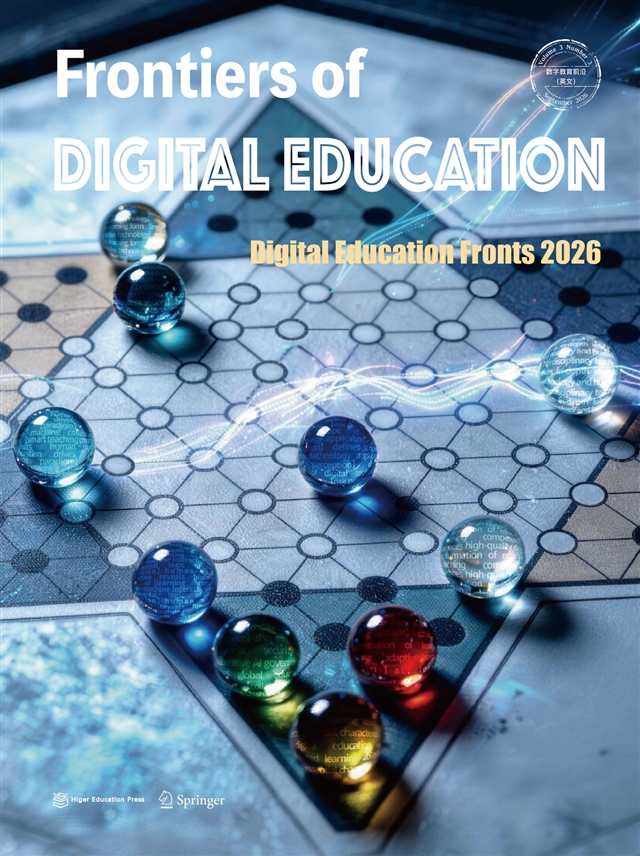
YesDigital educationFrontline (english) vol. 3, no. 3
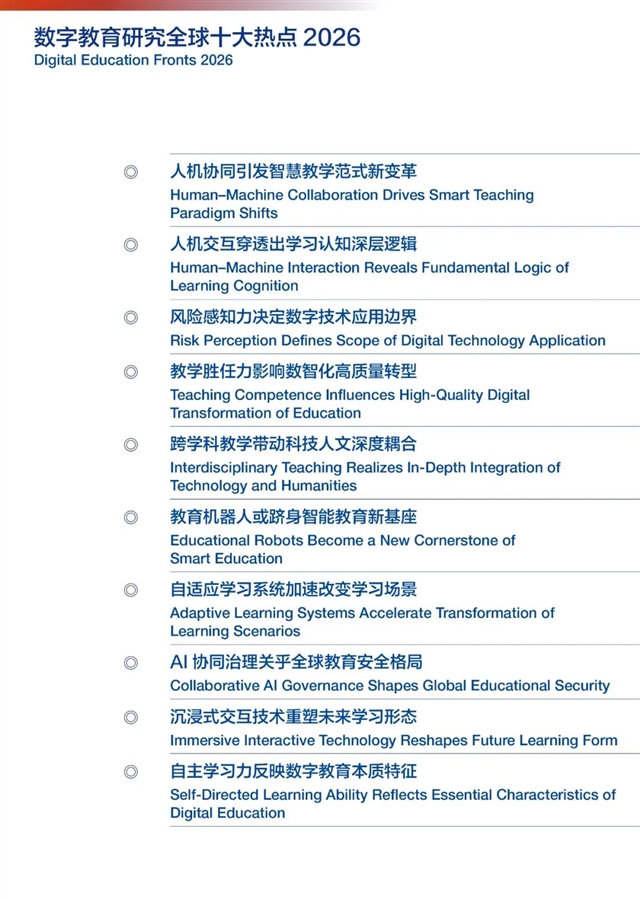
On 12 may 2026, at the closing ceremony of the 2026 world conference on digital education, the journal frontlines in digital education (english) launched “ten hotspots for digital education research worldwide 2026”. This result was based on data from nearly 90,000 digital educational papers from 2020-2025 globally, selected through scientific metrology analysis and in-depth excavation by experts。
Compared to 2025, there was a significant shift in the focus of research in the 10 hotspots in 2026 — from the application of technology to institutional construction, capacity development and developmentRisk managementThe extension presents the overall characteristics of “focusing on the inner core, synergetic development, risk control and people-centred”. This marks a shift in digital education research from the pursuit of new and emerging technologies to deeper scrutiny of human capabilities, systemic mechanisms and governance frameworks。
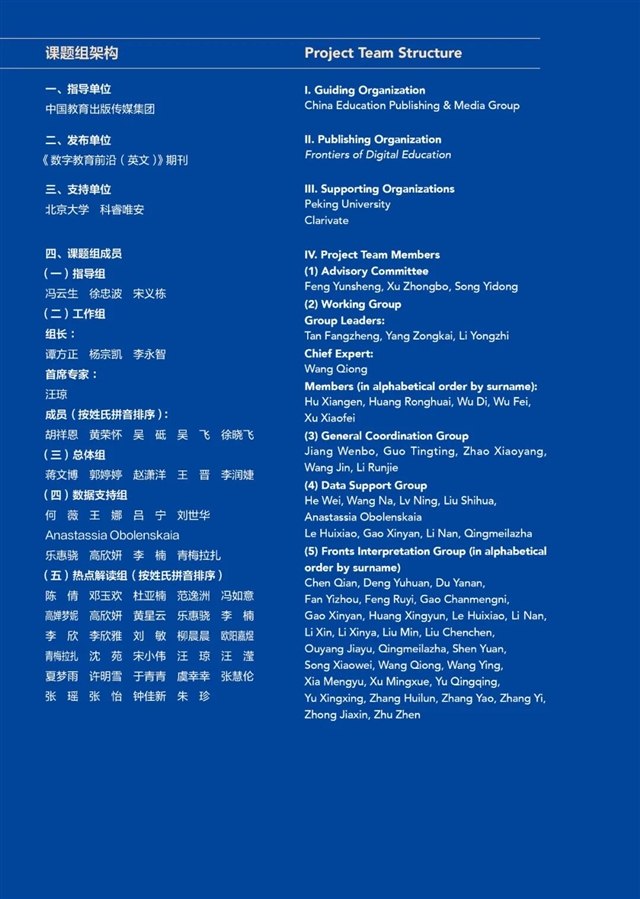
Recently, digital education froNts 2026 (data education research global reading report 2026) was published in the journal front lines in digital education (english)。
1. Research framework and global landscape
The report uses a mixed methodology combining quantitative literature measurement with qualitative expert assessment. Based on the web of sciencetm core collection, the research team systematically retrieved the global digital education literature for 2020-2025, covering periodicals and conference papers from scie, ssci and cpci sources, resulting in the screening of 329 core papers, resulting in 58 research fronts and the identification of 10 hot spots by algorithm clustering and multi-wheeling experts。
The global research landscape has three salient features:
The volume and mass of the study rise simultaneously. The number of articles published annually increased from 2507 in 2020 to 5761 in 2025. China and the united states are leading in volume (5137 and 4977), and chinese scholars are ranked first in terms of influence (cnci index)。
The proportion of high-impact papers is declining. From 31. 1 per cent in 2020 to 15. 9 per cent in 2025, the academic community needs to be alert to the risk of “quantitative increase”。
International cooperation is becoming closer. The share of international co-authorships rose from 19. 7 per cent in 2020 to 23. 8 per cent in 2025, with the united kingdom (52. 6 per cent) and malaysia (50. 1 per cent) having the highest rates of international cooperation。
2. Ten hot spots of interpretation: three core logical clues
Ten major hot spots can be integrated into three interlocking logical clues that reflect the depth of current digital education research。
Thread one: deep re-engineering of human relationships
Hotspot 1 (co-initiating new changes in the teaching paradigm of wisdom) and hotspot 2 (intersecting humans into the deeper logic of learning knowledge) point to qualitative changes in human relationships. Research has shown that teaching is moving from “knowledge transfer” to “cognitive development orientation”: learning spaces have evolved from hybrid spaces to intellectual enhancement; knowledge building has moved from one-way indoctrination to human-induced synergy; and teacher-student relations have moved from teacher-led to multi-student-coherence governance. Particularly critical is hotspot 2, which reveals a shift in the focus of the study — from the answer “is the ai tool effective” to the question “what conditions does ai promote or impede learning” — marking a move from impact validation to institutional modelling。
The transition is supported at the technology carrier level by hotspot 6 (to educate robots or new bases for intellectual education) and hotspot 7 (to accelerate changes in learning scenes from the adaptive learning system). Educating robots (including chattling robots and physical robots) has become an infrastructure for intelligent teaching, and self-adaptation systems have achieved dynamic responses to learners ' cognitive loads, emotional state and learning paths through the generation of ai。
Threshold two: capacity and governance in parallel
Hotspot 3 (risk perception determines the boundaries of digital technology applications) and hotspot 4 (teaching competence impact numbers for high-quality intellectual transformation) constitute “risk-capacity”. Risk perception studies reveal a core paradox of generating ai integration into education: even if ai shows a clear efficiency advantage, there may still be a significant gap in the willingness of teachers and students to adopt it, rooted in risk perception as a “bottom line constraint” that is constantly playing with technological utility. Research has moved from a generic acceptance model to contextualized boundary identification, where the reasonable boundaries of ai application are distinct from low-risk scenarios (class practice) and high-risk scenarios (test assessment)。
The content of teaching competence is also being expanded - from technology literacy to ai literacy, smart tpack (the teaching knowledge framework for the intelligent integration of technology) and ethical competence. Teachers are no longer just knowledge transferers but designers, data readers and innovation facilitators of learning activities. This logic has been pushed to the macro level by hotspot 8, which is about global education security patterns, emphasizing the need for ai governance to go beyond unilateral action to build a global framework for synergistic governance。
Threshold three: learning the essence back and up
Hotspot 5 (interdisciplinary teaching-enabled in-depth integration of the humanities of science and technology) and hotspot 9 (combination interactive technology to reshape future learning patterns), hotspot 10 (self-learning reflects the essence of digital education) point to a fundamental proposition: the ultimate goal of digital education is human development, not the application of technology itself. Interdisciplinary teaching has expanded from stem to the two-way construction of science and technology and humanities, and immersion techniques (including meta-cosm-related research) are reshaping the physical experience of learning, while autonomous learning becomes the essential measure of the effectiveness of digital education。
Academic commentary: from “application of logic” to “existence logic”
The most profound academic contribution of the 10 hotspots in 2026 was in facilitating the completion of a paradigm shift from “application logic” to “existence logic”. While earlier digital education studies focused on “how technology works in education” (appliance logic), the current research frontier is asking “how the nature of teaching and learning has changed after technology is embedded in education” (existence logic). This shift has taken place at three levels: at the level of perception, research has shifted from a focus on “technological utility” to a focus on “cognitive mechanisms”; at the level of methodology, from cross-section effects testing to vertical tracking and process modelling; and at the level of value theory, from efficiency priorities to a balanced assessment of risk-benefit。
In particular, the selection of two hot spots, risk perception and self-learning, is indicative. The former marks a shift in the academic community's reflection on ai education from a passive stance of “how to protect against risk” to a proactive construction of “risk perception how to shape the adoption of borders”, while the latter demonstrates that, in an era of unprecedented technological power, human autonomy has not been weakened, but has become a central variable in determining the success or failure of digital education。
Looking ahead, digital education research may be further deepened in five directions: the analysis of fine particle recognition processes based on multitemporal data; the integrated development of ai literacy, indicative ethos and critical thinking; the functional division and optimal combination of human feedback sources; individualized support frames and situational awareness intervention mechanisms; and vertical causal recognition of ai dependency, cognitive autonomy and mental health. This is both a challenge and an opportunity。
In the future, the journal frontlines in digital education (english) will continue to follow developments in the field of global digital education, track the evolution of the development of disciplines and policy practices, disseminate the results of frontier research and work to provide academic leadership for global digital education development。
Articles information
Project team of digital educationDigital education froI don't knowOf digital education, 2026, 3(3):22
Doi: 10. 1007/s4436-026-0096-9

Two-dimensional code, free access to the original
Review of prior periods
Introduction to periodicals
Features of periodicals
1. Internationalized revision platform scholarone manusCripts
2. Strict peer review (peer review)
3. Free language colour and robust quality assurance
4. No authors ' fees charged
5. Unlimited length of articles
6. Review cycle: 30 days average for first cycle and 60 days average from submission to recruitment
7. Priority online publication (cap)
8. Adoption of springerlInk platform for global outreach
Online browse
♪ china mainland downloads free ♪
Online contributions
Mail code
80-164
Contact us
I don't know,