


May is the traditional working day. It's time for rishha, the farmer zeda, to do the work. Temperature's right, in the mills, all the work。
The authors then arranged a collection of articles, or to visit the traditional craftsmanship of over a thousand years, or to dive into the fate of the craftsmen, or to combe the writings, furniture and the beauty of the gold, in the hope that they would look at the spiritual and aesthetic ideas behind the many arts。
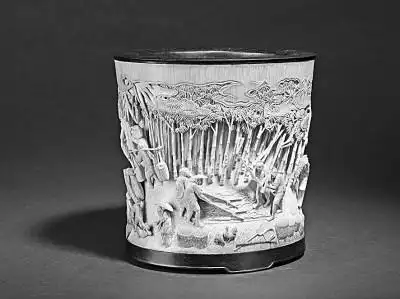
"dreams on your fingertips..KyushuThe trades and crafts book has recently been published by the anhui group for the publication of yellow hill books. This is a book written by the tradesmen of the speculator state, which describes the history of the ink, the ink, the ink, the sculptor, the bricks, the bamboo sculptor, and the seven sculptures of the sculptureNon-geneticHuman growth stories and attempts to comb through the processes of their fingertips, the things that flow through our nation from time to timeCraft spiritI don't know。
Why kyushu
The ancient insignia region is also being transformed at a time when modernization is rapidly sweeping the countryside of china。
But when one sets foot on the soil of the state, it feels different: the white wall of deva's emblems is scattered all over the country, with the plaques, the halls, the villages, the trees, the ancient bridges, the gourmets, the ancient sculptures... They can be felt that the ancient state is still in existence, and that a thousand-year-old styles are passing through。
And in this state, all the masterpieces come from craftsmen. A generation of artisans carved out the unique charm of this land with their own hands. The book " dreams on the top of the finger " is the point of entry for the mind of the peepsmith, because it is a fertile place for craftsmen to grow。
Now it's as if it's an illuminating state, not like an antelope。
The inhospitable nature of the craft in kürk county is dependent on unique natural resources. As tang's battles continued, hebei's waterman fled to ingzhou to escape from the fighting and found a large number of high-quality pine trees in the yellow mountains, which were the best ingredients for making excellent ink, he decided not to stop. At that time, the northern pine trees were almost depleted because of inks, etc., and the “new aromatic ink”, later ink, was gradually born. In addition, one of the country's four leaders has become one of the most reputable. The bricks, wood, stone, bamboo sculptor, which are also crowned with “four by four by four by insignia”, rely on local quality materials. Huangshan is the natural basis for the birth of yuzhou。
The causes of the insignia process are related to the harsh living conditions of the farming age. It is located in the mountains, “eight mountains, one by one”, and is followed by a massive influx of immigrants, exacerbated by the fighting. In order to solve the problem of survival, the people here had to go out to do business or to do a lot of crafts, and the “minority practice” had become a state of survival for the people of kyushu at the time, and had created a process that had been passed on from generation to generation。
The insignia process is well known. It also involves a rich emblem dealer and a “consumption economy”. In the new anthropology worker, wong bin rainbow said, “the rich and the rich and the neighbours look to each other in order to make a difference”. A large number of dignitaries and wealthy traders have returned to their homes and have the means to build houses in their homes. In order to demonstrate their status, they attach particular importance to the construction of houses, in particular the carvings and decorations of the “long face”, at the expense of “gold gold”. Thus, the emblem sculpture process was born and flourished in this context。
The author of this article
Hands and hearts
The insignia process has been transmitted to the world, from the fact that every piece of craft carries the temperature of the craftsmen who touch their dreams with their fingertips. Touching is a way, more a rule, a virtue. For a long time, their hands and hearts were marked, and they became a self-conscious and behavioural norm, the spirit of craftsmen。
In detail, i believe that craftsmanship is first and foremost a self-improvement。
It has traditionally had a tradition of “ten houses of villages, no reading”, and rural education has flourished and is recognized throughout the country. A lot of kwok craftsmen have to learn their art first, read it and deal with famous people, and they've got a lot of work to doCultural backgroundI don't know. As zheng jin-do wrote in the painting of ming dynasty, “they know that what they do is a work of art, which is precious, as well as poetry and novels and drawings. So they did not take it lightly; they were engraved with great care, and they did not take it lightly.”
The national non-remunerated brick sculptor project is a representative legacy of the new people's party, born in the education world, whose grandfather and zheng are the implementers of the teaching philosophy. Both their uncles and fathers work in education. Xing xinxiang, who had received better family education from an early age, regretted that he had been unable to pursue higher education for special historical reasons. He also regularly studied cultural and professional books sent by his grandfather after encouraging him to follow the path of carving. Against this background, the new china has developed its evolving character on the art path. In "dreams on the finger," fang xin wrote about his understanding of the spirit of the craftsmen: "the legacy. It's important to do something good for the society and, more importantly, the artist's virtue." he said that if the artist had no talent, not only the son of a human being would have missed the nation. He criticized those who had been able to collage bricks in order to make multiple layers of carving, which he believed was a forgery. He even has a “pity”: the sculpture of the present will become a relic of the future。
Craft spirit is also a fine sense of excellence。
Processes emerge from human activities and are a necessity for self-sufficiency. However, the insignia process, which had developed a large part of the cultural industry 100 years ago, had to be used to meet market demands. For example, ink, the country has a high-quality cosmopolitan, not a cosmopolitan state, and in the face of the great demand for ink from the human ink, the craftsmen remain convinced that only by being too hard-quality and made into first-class ink can they have a lasting reputation and competitiveness in the market. The production skills of the ink were so great that li tin ting zheng's "new an xian mo" was so famous that the ink maker's house was so confident that it said, "i can melt gold for 100 years."。
In the book " dreams on the top of the finger " , the author made an in situ visit to the ink factory, which is being followed by craftsmen who are now following li's rule of law, with more than a dozen lines of procession, ink precipitating, and ink drying. "it's better to use ink juice than to make ink process discounts." zhou mei hong, the national heir to the intangible cultural heritage ink project, the director of the hukven ink factory, said to the author that he needed skilled people to do his job, and that he needed someone to do his job quietly. Unheard, error of procedure is catastrophic for a craftsman who seeks the best. Ink-making is a labour-intensive industry, and more than a dozen processes must not be lost, with one less or one less person missing from the process, which is to steal less。
Precise awareness depends to some extent on competition in the market, but non-competition is a misperception of craftsmanship. In the eyes of the first-class craftsmen of kyushu, precision has long become an intrinsic dynamic. The national intangible cultural emblem project, which represents the heir, wang jin-sheng, and which has been engraved for nearly three years at the age of 80, is a giant carving of the qingming river map, whose work is far more complex than can be imagined, with hundreds standing on a single bridge. This piece is now hidden in his own logo gallery. The famous scholar feng chi-yu wrote a poem to that effect: “the name of chiyu is a map of the river, and it's a miracle. It's good to see tokyo's festive day, when the king's sword straddles together. "dreams on the top of the finger" recorded wang kim-sheng's intention to create this work: to make a carving for life, to leave a piece for himself and a fine piece for the carvings of kyozhou。
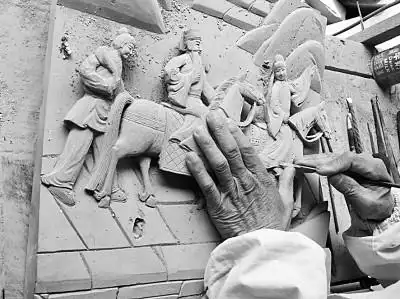
Fong xinxing is helping students to modify their brick sculptures
Open a window and wait for later
The succession of distinguished workers in kyushu has focused on the inheritance of crafts, and li ting zheng's ink-making process from nantang to north song has been well known for five generations. Today, the inheritance of the insignia process is no longer confined to family inheritance but has wider social dimensions。
Despite the fact that the factory was “95 years later”, the national heirs of the project had said frankly that there were too few young people who had learned for some time and thought that it was too hard and too tired to escape, so that more than a dozen young people had come in and out. Young people are at risk of losing their skills。
Young people are also scarce resources for ink. Zhou mi-hong said that it was 35 years of age before the craft matured, that 55 years of age would have to leave for reasons of physical strength, eyesight and so on, and that 20 years of gold, many young people were afraid of this boring, monotonous life. According to zhou meihong, for a labour-intensive process such as ink, craftsmen are in a group, not one less。
As is said, the key to the continuity of craftsmanship and the transfer of craftsmanship lies in human beings. It is a matter of some relief to the author that many of the art processes in the canton have opened the door to young people。
The logo, a representative heir to the non-inheritance project, pan yong ming, is a teacher at the school of the depth district centre of huangshan city, where, in the corner of his office, a large number of well-dressed student drawings are regularly displayed on the campus. One of the classrooms in the school's juvenile palaces is marked by a “non-genetic base”, and the school has been characterized by the teaching of two classes on mondays and wednesdays. Here, it's no longer a slogan for non-inheritance from a doll。
The logo, which is intended to be a national representative of the project, includes more than 20 students. Today, he has organized the emblem museum and the sculpture school. The museum has a total of 6,000 square metres and contains more than 10,000 different collections of traditional carvings and other genres, from which visitors can learn a history of the development of carvings and engraving techniques. There are workshops for carving, furniture and experience at higher education. Hong jianhua wants to marry higher education institutions and move non-removable classes into carving workshops, which are inherited in practice. In this way, he would like to develop more high-standard technological heritage and resuscitation。
To date, many of the insignia crafts have disappeared as a result of technological advances and changes in market demand. Even many of the old crafts that survived were more or less faced with real difficulties, and innovation had come to terms. The sculptor is hand-carved, but many places are now industrialized, waterlined, and the sculptor sits in a troubled city or seeks another way out? How can we not be eliminated from the market and better feed this old craft by reaping benefits? The legacy of the sculptor project is also changing in thinking, and on the basis of the preservation of the core manual production process, he has entrusted the peripherals of mapping, embryoning, etc., to scientific and technical means to save human costs, “to preserve tradition, innovation is necessary”。
In writing the book " dreams on the point " , in addition to documenting and combing the spirit of the craftsmen, the author hopes that a window will be opened to make more people aware of the history and legacy of traditional crafts. If the book is fortunate enough to be read by more young people, it is a legacy of traditional crafts, with little effort。
(author: hongbing, author of the book "dreams on the point of the finger -- the trades and crafts secretary of insignia " , executive editor of big bang news)


