Hello, i'm shigeko. Recently, the vip audience consulted the design of the licence plate recognition system, which was relatively simple and allowed for the preparation of one or two programme materials, and this time shared a simple practical design of the licence plate recognition system for information purposes only。
This complete word program package is downloaded by vip members
Garage subsystem
1 system overview
With rapid development, such as economic and social construction, people's lifestyles have undergone profound changes. The massive increase in the population of motor vehicles and cities, which has been influenced by a number of factors, has led to a breakdown of access, parking areas, an increase in violations and a serious challenge to social and public security, which has forced people to find effective and high-tech solutions to outstanding problems. The garage management system is a high-technology product that responds to the needs of this era. Not only would he be able to effectively address traffic disruptions at entry and exit points and in the parking lot, but he would also minimize the fear of theft of the owner's vehicle and the theft of items. In addition, at the technical level, it is highly technical and compatible with other existing smart systems and is highly open and easily integrated into a more robust integrated system with other anti-aircraft systems, adapted to multiple integrated approaches of senior management。
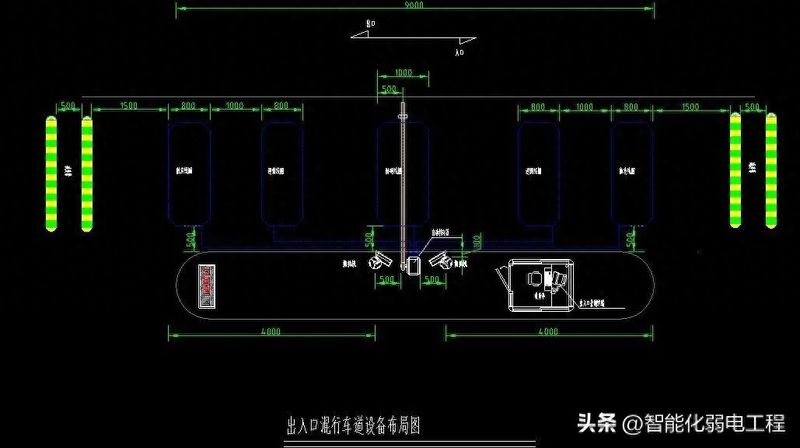
Depending on the physical situation on the site of the building, a vehicle control system was installed at the entry and exit points of the underground and ground parking areas, respectively。
2 plates recognition system
The licence plate recognition system uses electrical blockers, access control terminals, licence plates, wire detectors and other access equipment for the purpose of integration, which can also be calculated or limited for each vehicle's parking time, and enhances the anti-piracy/facility function to enable more effective identification and management of vehicles passing through the entrance。
3 system architecture
The licence plate recognition system consists of the front end, transmission and centre subsystems, which provide 24-hour round-the-clock control coverage of vehicles, record all incoming vehicles and automatically capture, record, transmit and process them, while the system also completes such features as licence plates and owner information management。
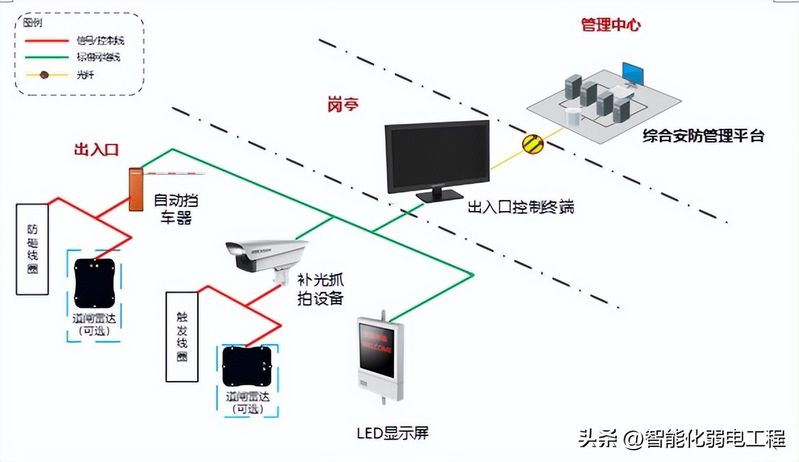
Figure 1
1) frontend subsystem
Responsible for the completion of the collection, analysis, processing, storage and uploading of front-end data, vehicle access control and the composition of relevant modules, such as the main electric block module and the licence plate recognition module. The main equipment is as follows:
Electrical blocker module:
Electric blocker
Manual buttons can be used for "opening", "opening" and "locking" operations
Support software controls for “opening”, “opening” and “locking”
(b) the power breaker automatically unlocks and can be used to shake hands and lifts
(a) a "running mode" for maintenance and debugging
A vehicle detector with a “car through automatic landing” and “crash-proofing”
Two pairs of red and green lights are available for access gates and corridors
(a) a rich bottom control and state return command to enable computers to exercise optimal control over electric blockers
Additional special features may be added as required。
Vehicle detectors
Used for anti-shattering coil detection。
Radar detector
For radar impact detection。
License recognition module:
Get out of the entrance and get a photo shoot unit
The entry and exit light capture unit is made up of protective shields, tapers and light patches, which include high-light lighted leds and high-resolution line-by-line scanning of ccmos, with high clarity, low light, high frame rate and good colour reduction。
Vehicle detectors
The system uses a wire trigger, with front-end vehicle detectors to detect incoming and outgoing vehicles, which can be shared with crash wire vehicle detectors。
Access control terminal
Access control terminals are responsible for front-end data acquisition, processing and uploading back-end platforms, which provide real-time video, capture image displays, access and capture image association, real-time alert information displays, system log displays, software switch/off, peak locks, equipment connectivity displays, alarm connection, etc。
2) subsystem of transmission
It completes the transmission and exchange of data, pictures and videos. The front end consists mainly of switches, fibre-optic transceivers, etc. The central network consists mainly of access layer switches and core switches。
3) central subsystem
The platform completes access, matching, recording, analysing and sharing of data information. Composed of the following software modules: database server, data-processing server, web server. Among them, the database server installs the database software to store all types of data information; the data-processing server installs the application processing module for data resolution, storage, forwarding and top-down communications; and the web server installs web server to provide access to b/s users。
4 system advantages
1) fast movement of vehicles
The system uses a high-resolution vehicle recognition technique with a very high recognition rate, which ensures the accurate identification and rapid movement of fixed vehicles, improves the efficiency of the access control system and enhances fixed user experience。
2) high resolution images
The system uses high-resolution cameras to address the problem of the lack of clarity of the images of the traditional model recognition cameras and the small size of the monitoring field。
3) faster search for vehicle records
The system can quickly search for incoming and outgoing vehicle information through vehicle information (licence number, vehicle type, etc.) and can export a full-recording report。
4) unlicensed vehicle management
For non-licensed vehicles, the system provides a two-digit access capability for the scanning of vehicles with abnormal plates. When the owner scans the two-digit code, the system automatically uses the micro-sign of the owner as proof of the vehicle's current access. At the time of the visit, the owner of the car may also take up the 2-dimensional self-payment at the exit point。
5) solving the problem of not opening doors
The system supports the queuing pattern, which solves the problem that when a vehicle or vehicle is not properly hit, the gate cannot be hit。
(6) support for embedded garages
The system supports a parking garage with multiple garages and allows for the separate management of each garage。
7) simple and stable system structure
All major equipment at the front end of the system uses a standardized ip interface, which allows communications to be completed using a web line and is easily connected to other equipment. The back-end platform provides a unified management of the state and use of the front-end equipment and facilitates system maintenance。
8) support offline running
As a result of, inter alia, network failure, the off-line terminal of the kiosk client remained in a situation where the system would be able to release vehicles that had entered the site before the off-line。
9) support cache backup
In the event of a failure of the network, the access control terminal can cache the passage logs, photographs, charges, etc. During this period, and when the network is restored, the data will be uploaded back to the platform to ensure data integrity。
An update on the quality
This weak electrical information package, which brings together a large number of technical files, 313 ppt programmes, 279 standard specifications, 60 design schemes, 119 drawings, 8 construction drawings, 20 work volume lists, 20 construction organizational designs, 69 visio polos and drawings, 54 excel forms, complete construction process documentation and acceptance documents, is very comprehensive。