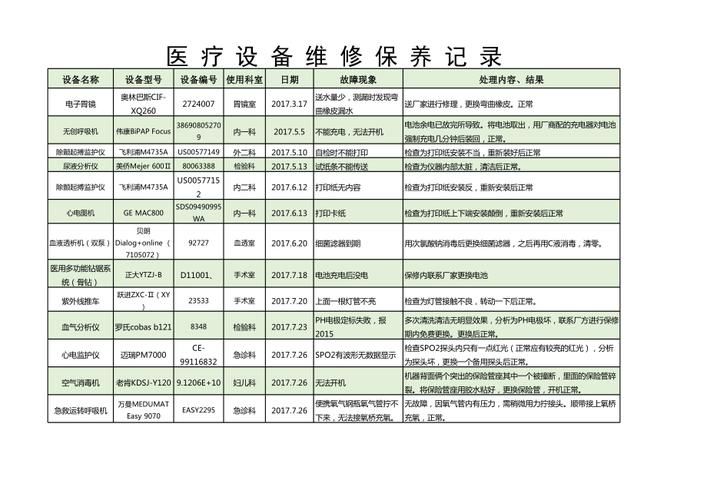
The use and maintenance of medical equipment as a central tool for clinical treatment is directly related to the quality of care and patient safety. The use and maintenance of log forms as a key vehicle for the full life cycle management of equipment is not only a mandatory requirement for regulatory compliance, but also a core tool for improving equipment reliability and reducing operational risks. This paper sets out the logical and applied methodology for the construction of the table, from value positioning, design elements, practical specifications to digitization optimization, and provides a ready management reference for medical institutions. I. Core value of record forms: the rigidity between compliance and risk control (i) regulatory compliance requires that the quality control of the use of medical devices explicitly require medical institutions to establish systems for recording the use, maintenance and maintenance of medical devices. The records form, as a statutory document, is the central basis for the regulatory authority to verify the compliance of equipment management, and the missing or irregular records face administrative penalties. (ii) full-cycle equipment management allows accurate assessment of equipment performance decay patterns by recording data on the length of use, frequency of failure, maintenance costs, advance development of preventive maintenance plans (e. G., high-value fuel replacement cycles, early warning of life of critical components), extension of the useful life of equipment and reduction of overall procurement costs. (iii) clinical risk retroactives and controls when equipment is subject to a bad event (e. G., failure of surgical devices leading to disruption of operations), maintenance records can quickly trace the causes of malfunctions (e. G., “the previous maintenance of unreplaced seals resulting in fluid infiltration”) to avoid repetition of similar malfunctions; the use of records can identify operational risks (e. G., “the failure to report errors in equipment as a result of failure of the protocol to pre-heat during the operation”) and provide a basis for optimizing training. Key elements of table design: modularization in conjunction with practicality (i) basic information module: basic information on equipment identification “id” equipment: name, model, unique numbering (contribution to desk accounts), placement, date of purchase/use (support for age assessment). Subject of responsibility: day-to-day operator (signature column), maintenance liability (associated maintenance team/outsourcing service provider). (ii) use of recording modules: a “trajectoral map” of dynamic behaviour using scenes: detailed into “surgery” “image screening” “rehabilitation therapy”, etc., to facilitate the measurement of equipment loads in different scenarios. Status records: in addition to “normal/facility”, add “early warning” (e. G. “power light flashing” “image resolution decline”) to capture potential malfunctions in advance. Length and personnel: recording of single usage times (auxiliary assessment equipment fatigue), operator (link training records, analysis of human error rate). (iii) maintenance log module: “casebook” failure description for failure recovery: pictification is required, e. G., “cyrocardial monitor rate displays drift, error > 5 times/minute” “pump flow deviation of 15%” to avoid ambiguity. Maintenance measures: distinguishing between “replacement parts” (e. G. “replacement headers”), “software upgrades” (e. G. “update system solids to v2. 3)” and “calibration calibration” (e. G. “ultrasound calibration error < 0. 1 mm”) and recording the branding, model of the materials/components (for retroactive cost accounting and quality). Validation and timeliness: the maintenance will be validated by, for example, the “air-borne test” “simulation clinical scene test”, recording the results of the test (e. G. < 2 per cent error in the flow rate of the fluid pump, which meets industry standards); maintenance time (e. G. “3 hours”) will be used to assess maintenance efficiency. (iv) maintenance plan module: next maintenance date for the precautionary management “navigator”: automatic generation of alarms (electronicized forms can set calendar alarms) in conjunction with the frequency of use of equipment and the plant's proposal (e. G. “clean optical lens every 200 hours”). Maintenance items: identify specific actions such as “clean” “lub” “calibration” to avoid a pattern of maintenance. (iii) manuals of exercise: time-bound: 24 hours after use of the “immediate record” principle, from filling in to managing landing details (i); maintenance records are updated immediately after completion of maintenance to ensure that data are alive. (ii) accuracy: “retroactive” principle failure descriptions need to include phenomena + data + error reporting codes (e. G., “ct scanner tier 3 detector error, code e12, image false area > 5 per cent”); maintenance components need to record batch numbers (e. G., “replaceable pressure sensor batch a ”) to facilitate retroactive supplier quality. (iii) closed chain of responsibility: the "signature + review" mechanism operator and the maintenance officer must have a hand-written signature (electronicized form may have an electronic signature), with clear responsibilities; maintenance records for critical equipment (e. G., respirators, defibrillators) must be reviewed by the head of section or the head of the equipment section to avoid omissions. (iv) unusual upgrades: “records + reports” when an emergency, such as “equipment alarms cannot be lifted” “sudden decline in performance”, is observed in the “remarks” column of the form (e. G., “#1 4. 30 for equipment section”) and interim disposal measures (e. G., “replacement of backup equipment, failure of equipment to be secured”). Iv. Digital optimization: from paper desk accounts to smart management (i) e-sheet efficiency upgrades using excel or specialized equipment management systems (e. G., integrated modules of the hospital his system), introduction of drop-down menus (e. G., equipment status, type of maintenance), data validation (e. G., date format, numerical range) to reduce manual errors; self-measurement of monthly failed top3 equipment “maintenance cost ratio” statements through the data lens table to support management decision-making. (ii) multi-dimensional data links maintenance records to equipment acquisition files (e. G., “three maintenances over two years for the equipment, with a cumulative cost exceeding 15 per cent”) and supplier evaluations (e. G., “a high rate of maintenance of a brand-name sensor, blacklisted”) to provide data support for equipment overlay and suppliers' selection. (iii) mobile and real-time development of mobile end-of-pipe programs to support medical personnel in wiring (equipment rfid or 2d tags), on-site uploading of fault photographs, test reports by maintenance personnel, and real-time control of the "use-maintenance-maintenance" process. Typical scenario applications: the record of the use of anaesthesia machines from problem resolution to the management of the upgrading of a three-accelerator hospital shows that within three months there was a “tide display deviation” in five devices and maintenance records were “calibration sensors”. An analysis of the records shows that the deviation values have been expanded with the increase in the number of times used and ultimately traced back to “the ageing of the sensor has not changed in time”. Hospitals thus optimize their maintenance programmes by reducing the sensor replacement cycle from “two years” to “1. 5 years”, and by requiring the recording of “sensor length of use” after each calibration and a 70 per cent reduction in similar failures after six months. In another case, the cost of maintenance of a blood dialysis machine showed that the annual cost of maintenance of a type of equipment exceeded $100,000. In combination with usage records (8 hours per day, 6 hours recommended by the factory), hospital shifts are adjusted to reduce the load of equipment to a reasonable range, and maintenance costs are reduced by 40 per cent the following year。concluding remarks: form for recording, use and maintenance of medical devices for medical quality "invisible guardian" is not a simple "deskbook tool" but a cross-cutting device