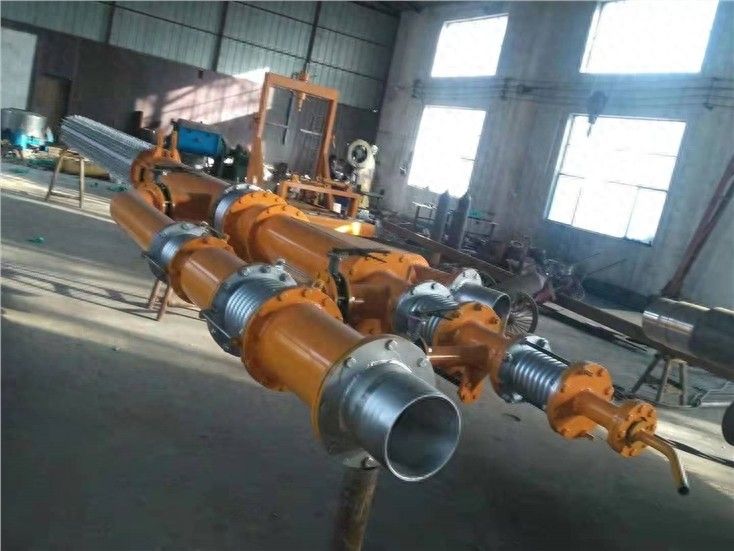
I. Classification of low nitrogen multi-channel kiln burners: the zhengzhou environmental protection corporation customises multiple types of fuel rotary kiln burners, with a wide range of areas of adaptation, which can be divided into gas rotary kiln burners, caustic gas rotary kiln burners, high furnace gas rotary kiln burners, light-hydrocarbon rotary kiln burners, ore kiln burners, rotor gas rotary kiln burners, yellow phosphorus tail rotary kiln burners, diesel rotary kiln burners, heavy fuel rotary kiln burners, coal powder burners, etc., with low maintenance rates, low energy consumption, and environmentally friendly advantages being used as ideal replacement products for retrofitting kiln equipment users。
Ii. Structure of the rotary kiln burner:
1. Low nitrogen rotary kiln burners consist mainly of tubeways, nozzles, metal bellows, butterfly valves, pressure gauges and protective layers。
Pipelines: axle currents, coals, cyclones, central windways and fuel pipelines, from external to internal. Since fuel pipelines are used only for ignition purposes, they are commonly referred to as four corridors。
Nozzles: processed with special materials, the jet-exceeding area of the rotor is adjustable, thus regulating the jet-out speed and the volume of wind, and the full nozzle is a key component for the flame shape。
Swift wind-corder: is the main component that connects the internal and external pipes of the cyclone, seals and regulates the shape of the flame。
Fluttershy valve: for wind regulation。
Pressure gauges: indirectly display the rate of venting in the burner。
Protective layer: the fire-resistant injection layer, where the user is on site。
2. Coal-powder working methods: coal-powder is carried by gas from the coal-winding pipe, which ejected outwards at a certain proliferation angle, from the adhesive wind of the outer neighbourhood to a fairly high kinetic and kinetic rectangular, and the internal whirlwind is mixed with the ejected coal-powler gas stream, which moves in high-speed spirals and meets the high-speed ejected axis. The insertion of axle current beams further enhances coal, wind mixing (including the surrounding secondary wind) and regulates the dispersion of the flame, allowing for the required length, fineness and shape of the flame. *the role of the wind is to stimulate small amounts of * partial coal powder and co burning, to make the combustion more adequate and to act as a steady flow. Because of the high speed of these combustion mechanisms and cyclones and axle winds, combustion is very rapid and complete。