If we don't talk about the high-end things that go on the computer and read the data stream, we'll talk about the most basic -- an ordinary four-cylinder engine, what's the most basic knowledge in maintenance? What do you want? What do you care
Don't underestimate that. I've seen a lot of apprentices come up and think, "build the bmw, and then even a four-cylinder machine in an old jedda has a problem." the foundations are not strong, the mountains are shaking。
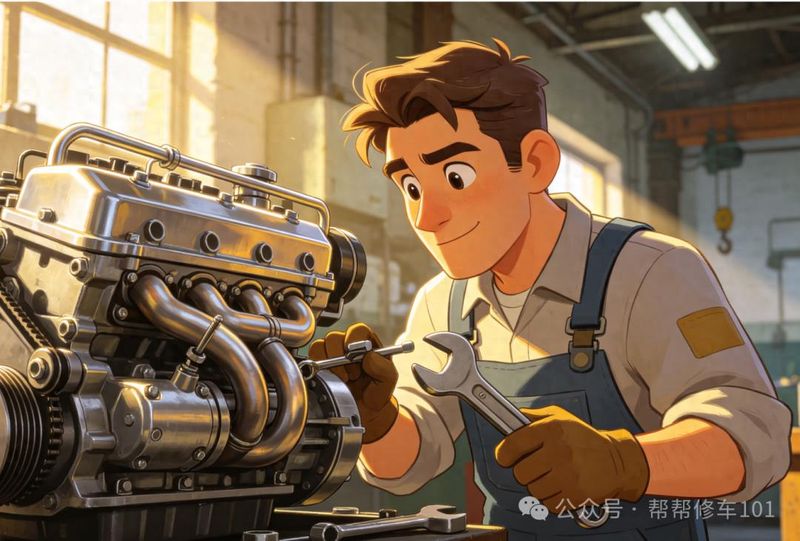
Basic knowledge: you need to know how to “breath” and “work”
The core principle is four words: in, in, in, in, out of, out of, out of, out of, out of, out of, out of。
You break down the development motive and see the four round holes, with four pistons in them. They are like four brothers, working in rotation, usually in a sequence of 1-3-4-2 or 1-2-4-3。
Can't remember the order of the ignition? Read the split line (old car) or check the maintenance manual. The wrong one. The engine's shaking like a sieve. Can you believe it
The relationship between the axis and the cam axis: two circles around the axis and one circle around the cam axis. The right time mark is wrong, the piston top door, and a few thousand dollars of tweak is gone。
One sentence: fix the 4-cylinder, first understand its “working beat”。
Ii. Practice of maintenance: no one learns, but “hands” are not everyone
A lot of friends think engine repair is a change of parts. Wrong! The key to repair is not "change" but "check" and "load"。
1. Dismantling: marking, sequencing
The length of the screws needs to be distinguished: the gas door covers, the screws of the waggle, for example, vary. You can't pay if you're in a hole and you've broken the tank
The spare parts are in order: the broken air doors are stubble, pistons, barboards, and must be in the original form. Don't mix it up, because every piece and piece of complication has been tweaked。
2. Inspection primer: speaking in data
Don't feel it! Take a percentage of the inside and wear the cylinder. Take a piston to measure the hole。
The gas tank is round, the cone is too big? If it's too big, you can't expect another ring to fix the engine oil。
Curvature axle azimuth: a percentage scale, a wide gap, and a hysteria, not dependent on the speedbox。
3. Argumentary command: the wrench is the one who saved lives
That's the top priority
(a) a cylindrical lid screw: 2-3 steps, in the order prescribed, with a twisting wrench to the ruler (e. G., first step 30 calf, second step 90 degrees)。
Lined tiles, main bearings: also needed to twist. You think it's "almost tight," and it's probably 18,000 miles away. It's too loose, it's too tight, it burns。
Don't tell me, "teacher has hands." i'm telling you, the best teacher has lost a good twister。
Iii. The most easily neglected concerns: details determine success or failure
Tell me a few of the pits i stepped on。
Clean! Clean or clean
Engine maintenance, worst fear of "dirty"。
Oil channels and waterways must be blown through by compressed air. A small piece of sealed tape blocks the engine and the new engine pulls the tank。
The joint must be shaved and the scraps of the old mat must be polished with sandpaper. Otherwise, new mats will leak。
The more seals, the better
A lot of students play glue like toothpaste, round and round。
Oil seals behind curved axes, gas door covers: too much glue, squeezed into the oil shell, plugged in the filter; squeezed into the real time chain, plugged in the compactor。
The right approach: a thin layer of balance, with more at the critical corner。
3. Pistol opening in the right direction
The piston ring is not just a set of pistons。
You have to stagger the openings 120 degrees. You can't go in the direction of the pistons。
Otherwise, the oil goes straight into the burner room from the opening, and you're not fixing the engine, you're building the four-scrambling diesel, you're not burning it, you're burning it。
4. Right on time. Two rounds of manual drive
Put on a belt or chain and don't start a fire. With the wrench two laps, it feels like there's no carton, dead。
Nothing? Checking right now is wrong。
If you hit the cab, "boom," the gas door, the piston — congratulations, for nothing。
Concluding remarks
The basics of repairing a base four-cylinder engine are three:
Knows how to work four cylinders。
Heavy data: disassembly with twists and test utensils。
Button details: cleaning in place, punctuality, piston rings are good。
Don't look down on the 4-cylinder, and fix it up to "a car, no shaking, no burning" and you're already over half of the country's repair workers。
There's no shortcut to technology. You fix the simplest four-cylinder machine to the extreme, complex v12, w16, in your eyes, the four-cylinder combination。