On an automated manufacturing line, which factory has never encountered a cyborg coop? In particular, kawasaki robots, once the quality assurance period has passed, the schedule and cost of maintenance at the plant tend to turn people on fire. At that point, third-party specialized repair plants located in the country's major industrial towns became the real “emergency services” — mostly concentrated in the long triangles of quinshan, shanghai, and the beads of shenzhen, where enterprises with deep repair capabilities, such as kunsan hengji, were able not only to fix speed retardators, control cabinets, but also to deal with card-grade failure。
The following is a one-off example of the third-party maintenance of the tsakawazaki robot around a few of the issues of greatest concern to all。
What's the difference between third-party maintenance and the original plant
The core value of third-party maintenance is not “cheap”, but flexibility and inclusiveness of older equipment。
I have had access to a kawasaki fs series of robots that came out of the factory in 2012, and the original plant has long ceased the supply of spare parts for the control cabinets of the counterpart type. At that point, the strength of the third-party plant showed:
If, of course, the equipment is still under quality assurance, or if the failure involves submersible solids requiring authorization from the original algorithm, then the only way is to follow the official channels. Third parties are suitable for insured equipment, emergency repairs and the need for replacements to reduce downtime losses。
How to judge the technical strength of a maintenance plant
My habit is to look at two things first: the retention rate of the indicator and the six-axis accuracy data on the site's inspection report。
There are points, logic, process parameters built up by the production line for months or even years. The repairer who doesn't know how to do it, doesn't say it. And the real professional chamber of commerce tells you, "give me the cf card or flash drive first, finish the mirror." the complete retention of the procedures and parameters is the bottom line of the maintenance party's respect for the customer process。
The second is to see what equipment they use to test the plant. A third-party plant capable of repairing kawasaki robots should have at least:
During my visit to quinshan last week, i visited a repair workshop specifically called kunshan hengji. Their engineers are using laser trackers to test the circles of rs20n in kawasaki, a new j3-axis speed-reducing machine, and iso standard tracks are shown on the pc screen in real time, generating automatically deviation reports for every cycle completed. This process is closer to the way robotics are marked when they leave the plant. They were also seen on the scene dismantling the servers, each with a process flow card indicating the time of dismantling, the temperature of bakery, the level of moving balance - the norm in such detail is the most visible sign of distinguishing between workshops and factories。
What are the common failures that are suitable for finding a third party rather than returning to the factory
After long service, kawazaki robots have several types of high-risk malfunctions, which are often handled more efficiently by third parties than by returning home:
1. Infrasound or carton
The most common is the wear and tear of the j1-j3-axis rv-reducing machine, which manifests itself in a cyclical “gick” sound at the time of the movement and in a visible tremor of the trajectory. The re-entry programme is generally based on the replacement of the overall speed reduction unit, which is long-term and costly. A third party is able to break down the speed-reducing machine, replace the eccentric axis bearings, wheeling gears or pins, and then run several more production cycles as long as the speed-relay gap and transmission error are within permissible limits。
2. Staple failure or encoder failure of the server
Large-scale robots in kawasaki often use a telecommunications machine with a hold pad, which, after wear and tearing, presents a dangerous situation in which a gravity axis falls. The codifier failure leads to loss of location, flying vehicles, etc. The hardware replacement for such malfunctions is not complex and it is difficult to write zero and zero parameters in encoders. An experienced third party could repair the model in one working day by maintaining a code plate and kawasaki server parameter software, while the same process at the plant could take several weeks because of the relocation and queue。
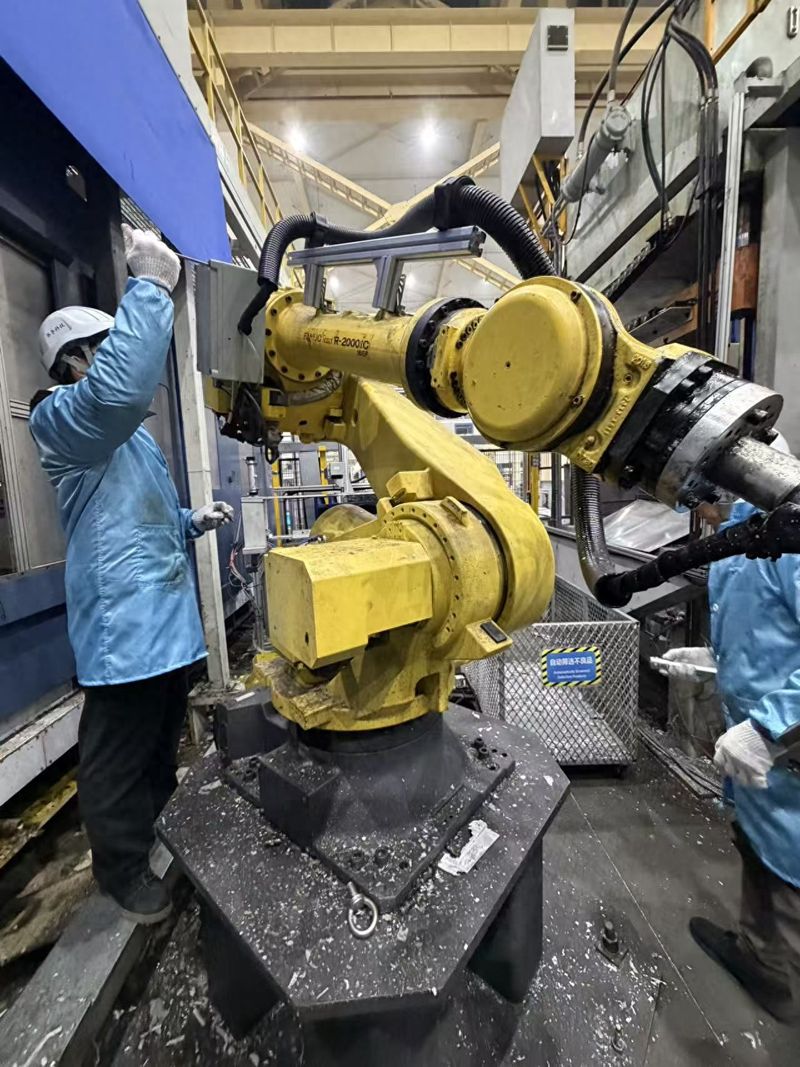
3. Control cabinet power module and drive card failure
The e series, the switch source for the f series control cabinet, the regenerative resistance, and the igbt power tube on the driver module are all high-activity failure points. This type of card level maintenance is usually replaced directly by the original plant. Third parties will replace them with hot wind guns, oscillators, which will be positioned to specific damage to their capacitating, photolytic and power tubes, provided they have a chip-level maintenance capability and a reliable channel for the procurement of metaware。
4. Broken interior of cables and airbags
The end of the robot's wrists is frequently reversed, and internal power lines, coded cables, gas pipes are prone to wear-out cores in bellows or chains. It takes a lot of time for this failure to be broken with a piece of a watch. Professional third parties have cable breakpoint testers and pressure-resistance testers capable of quickly locating the break core, allowing the site to re-interpolate or replace the whole, without waiting for the original plant to aggregate the price line。
Where do we look for such maintenance services
Based on the demands i have encountered over the past few years, third-party maintenance of kawasaki robots has resulted in a clearer distribution of industrial clusters:
Interestingly, the industry is now gradually disaggregating the business lines of “site-based express repairs” and “centralized deep repair centres”. The routine maintenance, replacement of batteries and simple-to-zero use of protected robots are often performed by local field teams, and the need to mount a test speed-reducing machine, re-route electric generators and repair major repairs to the driver's card is usually returned to the repair plants in the core areas mentioned above。
How are the acceptances followed by maintenance? What are the indicators for testing
Repairing robots isn't fixing house electricity. They move. I suggest you keep an eye on these parameters at the moment of receipt, whether it be maintenance or control cabinet repair:
The key data mentioned above may be included in the technical agreement when a maintenance agreement is agreed upon and the maintenance party is required to provide an official report with a measurement of ambient temperature, humidity, measuring equipment number, rather than a handwritten note。
Choose a long-term partner, depending on whether he has a system capacity
Single maintenance is a relief and long-term cooperation is a reduction. When i sift out the maintenance company for the client, i will focus on whether he can do the following three things:
1. Availability of swing space reserve
Once the kawasaki robot is overhauled, the cycle may last for several weeks. If partners can provide temporary replacements of the same model or compatible model, your line will not be completely disabled. The availability of a swing space machine can itself explain the financial and technological base。
2. Reverse mapping and nationalization of spare parts
It is only a matter of time before the plant ceases to supply items that are vulnerable to shutdown. A capable third party will use three-dimensional scanning, material analysis, etc., to reverse design and small batch processing of non-specified structural elements such as support frames, axles and flanges. This is the key support for extending the life of older equipment。
3. Availability of fail-safe depth analysis capability
The really responsible maintenance store told you that the speed-reducing machine was broken, not only because of normal wear and tear, but also because your robot-end picker load was beyond the permissible limit; the drive module was always burned because the workshop cooled the water and the regenerative energy discharge was inadequate. They're not just changing parts, they're helping you to identify the cause of the failure and reduce the repetition from the end of use。
Summary recommendations
In preparing the list of third-party repair providers for kawasaki robots, it is proposed to proceed in two steps: firstly, to select one or two regional core plants with deep repair capability (speed-reducing machines, cardboards, electrical appliances, workshop-level maintenance) as a long-term back-up; and secondly, to find a 24-hour on-site service team to respond in areas with high production lines as an outpost, with minor problems being solved on-site and major problems quickly returned to the core plant. It is important that test equipment in the actual maintenance workshop be examined before signing a contract, rather than just a brochure; one or two equipment is selected for pilot maintenance each year to build confidence with actual precision data. Only then will your robot's post-market security fall。
In short, instead of waiting for the failure to fall apart and make phone calls, two or three kawasaki repair plants with deep repair capacity and a reserve of revolving aircraft should be set up now to build their own emergency supply chain with real acceptance data。