The diagnosis of mechanical failure is an integrated marginal discipline that was created and developed in the 1960s and 1970s. On the one hand, as modern equipment becomes larger, more sophisticated, more automated and more continuous, the equipment, if broken, gives production and quality to people
Their life and property safety has an immeasurable impact, and the maintenance costs of keeping the equipment in working condition account for a significant portion of the operating costs of the enterprise. Therefore, in order to be more efficient and scientific in the maintenance of this vitally important equipment, it is necessary to have a proper understanding of the object of repair - the deterioration of the equipment, the malfunctioning state, the location of the failure and its causes. On the other hand, the development of relevant disciplines, such as information sensor technology, signal processing technology and modern testing technology, especially the rapid development of computer technology, has provided tremendous technical support for equipment failure diagnosis, making this possible. And it's in this context, inspired by some of the underlying logic of medical diagnostics, and extended to the field of engineering, that created a new discipline -- engineering diagnosis。
Content of the diagnostic study on mechanical failure
The diagnosis of mechanical malfunctions is the science of identifying the operational state of the machine or the crew, and it looks at changes in the operational state of the machine or crew that are reflected in the diagnostic information, which includes three aspects of the diagnosis of the operational state of the machine, the monitoring of its operation and the prediction of trends in its operation。
Principles underlying the diagnosis of mechanical failure
Mechanical failure diagnosis includes both theoretical and technical aspects of mechanical failure diagnosis。
2. 1 basic components of mechanical failure diagnosis
A complete diagnostic process typically consists of the following basic elements。
2. 1. 1 establishment of elements of operational monitoring
This includes, inter alia, the identification of monitoring parameters, monitoring locations and monitoring modalities, which depend primarily on the pattern of failure, taking into account factors such as the structure of the subject being monitored, the working environment and the conditions of existing testing equipment, which form the basis of the entire diagnostic exercise. The content of state surveillance is well established, not only to greatly improve diagnostic efficiency, but sometimes to determine the success or failure of diagnostics, which must be given due attention。
2. 1. 2 establishment of test systems
Select the sensor and its associated facilities, as required by step 1, to form a test system to collect the information required for failure diagnosis. In building the test system, not only should attention be paid to the acquisition of a useful signal (sensitivity and accuracy, etc.), but also to the environmental adaptability of the test system and how to reduce noise during the testing phase, etc., so as to simplify subsequent signal analysis processes. Acquiring the correct and effective signals is a prerequisite for the correct diagnosis, and, in departure from that premise, there is no way to talk about it。
2. 1. 3 testing, analysis and extraction of information
The main elements are the processing of signals obtained through the testing system, including filters, the removal of abnormal data and various analytical algorithms, the main purpose of which is to obtain as much useful information as possible from limited signals about the state of the subject being diagnosed, which is at the heart of a mechanical failure diagnosis。
2. 1. 4 status monitoring, judgement and forecasting
It's the last part of the diagnosis, the ultimate purpose of the mechanical failure diagnosis. This step involves the construction or selection of criteria to determine the equivalent of the respective parameters for the classification of the equipment, in order to determine the operational status of the subject and predict its future trends。
2. 2 fault feature parameters
For a particular type of failure, our concern is: 1 the physical parameters through which the failure is manifested; 2 the relationship with the physical parameters. In general, for the first question, as long as the mechanical system is active
When changes are made, they necessarily affect the dynamic physical parameters associated with them, which are more extensive; and the relationship between the type of failure and the physical parameters is our most interesting. Because only those physical parameters that are closely related to a certain type of failure and are reliable in their sensitivity are used for the diagnosis of failure. In the area of mechanical failure diagnostics, these are known as fault feature parameters, which are sensitive and stable physical parameters of failure。
The type of failure of a mechanical system is very different, and corresponding to each type of failure, the mechanical system must be shown by one or more physical parameters, and each type of failure must be caused by one or more causes. That means, so..
There is a correspondence between the performance of the barrier and its characteristic parameters and cause of failure as follows:
F=f (alpha1, alpha2, zirconium)
Where: f: some type of failure;
α1, α2, ⋯: characteristic parameters or cause of failure。
The failure diagnosis is to determine the correspondence f between f and α1, α2, thiram, to determine whether the failure type f has occurred by detecting α1, α2, thiram, or, if f is known, to identify the causes of α1, thiram, etc。
2. 3 general mental approach to mechanical failure diagnosis
The theory of fault identification is inextricably linked to the development of the science of thinking and technical means of fault diagnosis. The identification theory, which corresponds to traditional diagnostics, can only be based on simple reasoning based on form logic, while the modern diagnostic technique has multiple identification theories, such as fault tree analysis, model recognition and vague diagnosis. Two common ways of thinking are described below:
2. 3. 1 form logic
It can be assumed that the fault diagnostic process is an observation, hypothesis, validation, correction, re-validation, until the real cause of the failure is found, and that the failure diagnostic process can be divided into the following five steps: 1 study, resulting in the failure phenomenon; 2 false
Reasons; 3 the results to be derived from the assumptions; 4 a comparison of the inferences with the phenomena resulting from the study; 5 a conclusion as to whether the assumptions are valid or not and, if not, a different assumption。
3 and 4 above are presumptions of confirmation or rebuttal. In the analysis of malfunctions, some exploratory adjustments and dismantlings are often made to observe changes in the symptoms of failure, in order to locate or reverse the occurrence of the malfunction。
2. 3. 2 fault tree analysis
The so-called failure tree analysis is the selection of a system failure with the greatest impact as a top event, and the classification of the cause of the system failure as an intermediate event until the underlying event, which cannot or does not need to be broken down, is given a log map of the tree, called the failure tree. Figure 1 is a simple failure tree. This simple failure tree shows that the system failure as a top event was caused by the failure of component a or the failure of component b, while the failure of component a could be caused by component 1 or by component 2, while the failure of component b was caused by both components 3 and 4. In this way, the underlying causes of the system failure and the ways in which it affects them are clearly expressed。
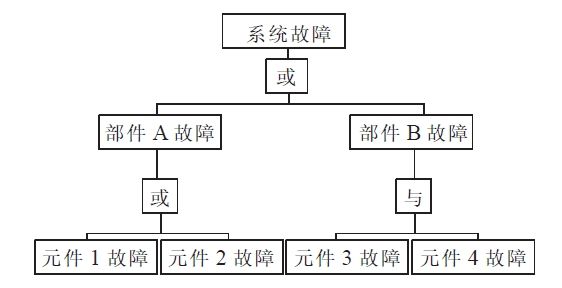
Figure 1 simple failure tree
2. 4 mechanical failure diagnosis techniques
With the combined efforts of national experts, academics and a wide range of engineers over the past 30 years, the diagnosis of mechanical malfunctions has evolved considerably, both in depth and breadth, and new diagnostic theories have emerged, and diagnostic techniques have been improved, and the diagnosis of mechanical malfunctions has become more scientific and operational. At present, a situation has largely developed in which vibrating diagnostics, oil pressure analysis, temperature detection and injury-free techniques are the main technical tools, with several characteristics。
2. 4. 1 vibration diagnostic techniques for mechanical failure
Vibration diagnostic techniques dominate the entire technical system of mechanical failure diagnosis in comparison with other methods because of their many advantages, such as their theoretical basis, the soundness of analytical testing equipment, the accuracy and reliability of diagnostic results, and the ease of real-time diagnosis. The weakness is that there is a high demand on equipment diagnostic technicians because of the impact of vibrating diagnostic techniques in areas such as information transfer, vibration testing and signal processing. In addition, another characteristic of vibrating diagnosis is the sensitivity of the parts。
2. 4. 2 hydrogen analysis techniques
Oil analysis techniques, represented by spectroscopy and iron spectroscopy analysis, have significant characteristics of high information integration. A high degree of information integration means that when a mechanical device carries out a failure diagnosis, the wear and tear of the fluid, as long as it passes through, can generally be diagnosed by sampling and analysis of the fluid at the site, which is its advantage; the deficiency is that the diagnosis is effective only for wear and tear and has a long diagnostic cycle, and generally only in a laboratory, the results of which are highly influenced by the operator. The fluid analysis technique is often used for failure diagnosis of hydraulic and lubricating systems。
2. 4. 3 temperature detection techniques
Just as human body temperature can be used for health tests, temperature parameters are often used for equipment failure diagnosis. Of these, exposure temperature measurements are used mostly in areas that require continuous or non-observable monitoring, such as the temperature monitoring of bearings; non-contact measurements are used mostly in hazardous or inaccessible locations, such as the temperature monitoring of high-pressure electrical points. The salient feature of temperature testing is that the diagnosis process is simple, the diagnosis is clear, and the presence of infrared cameras, in particular, makes the measurement of objects' temperature fields more visual。
2. 4. 4 non-destructive detection techniques
So-called non-destructive detection techniques or non-injury are the characteristics of the physical properties of the substance that have changed due to defects, which are tested without disrupting the subject in order to detect a comprehensive diagnosis of any defects
Break technology. Its salient feature is its non-destructive nature. No injuries were first developed in developed industrial countries in the 1950s and 1960s. Currently, it includes, inter alia, radial, ultrasound, magnetic and permeable injuries. The importance of injury-free techniques for improving product manufacturing processes, reducing manufacturing costs and improving the operational reliability of equipment is a promising discipline。