


Many parents have an error: isn't middle class playing games in kindergarten and learning to sing? The word-reading count can be scaled up and captured. In fact, middle school (4-5 years) is a critical transition to early childhood development, and the ministry of education's learning and development guide for children 3-6 years of age clearly states that at the age of 4 to 5 the child's brain, socialization and self-control are placed in a rapid development window, not in advance of learning, but in the building of a lower level of competence。
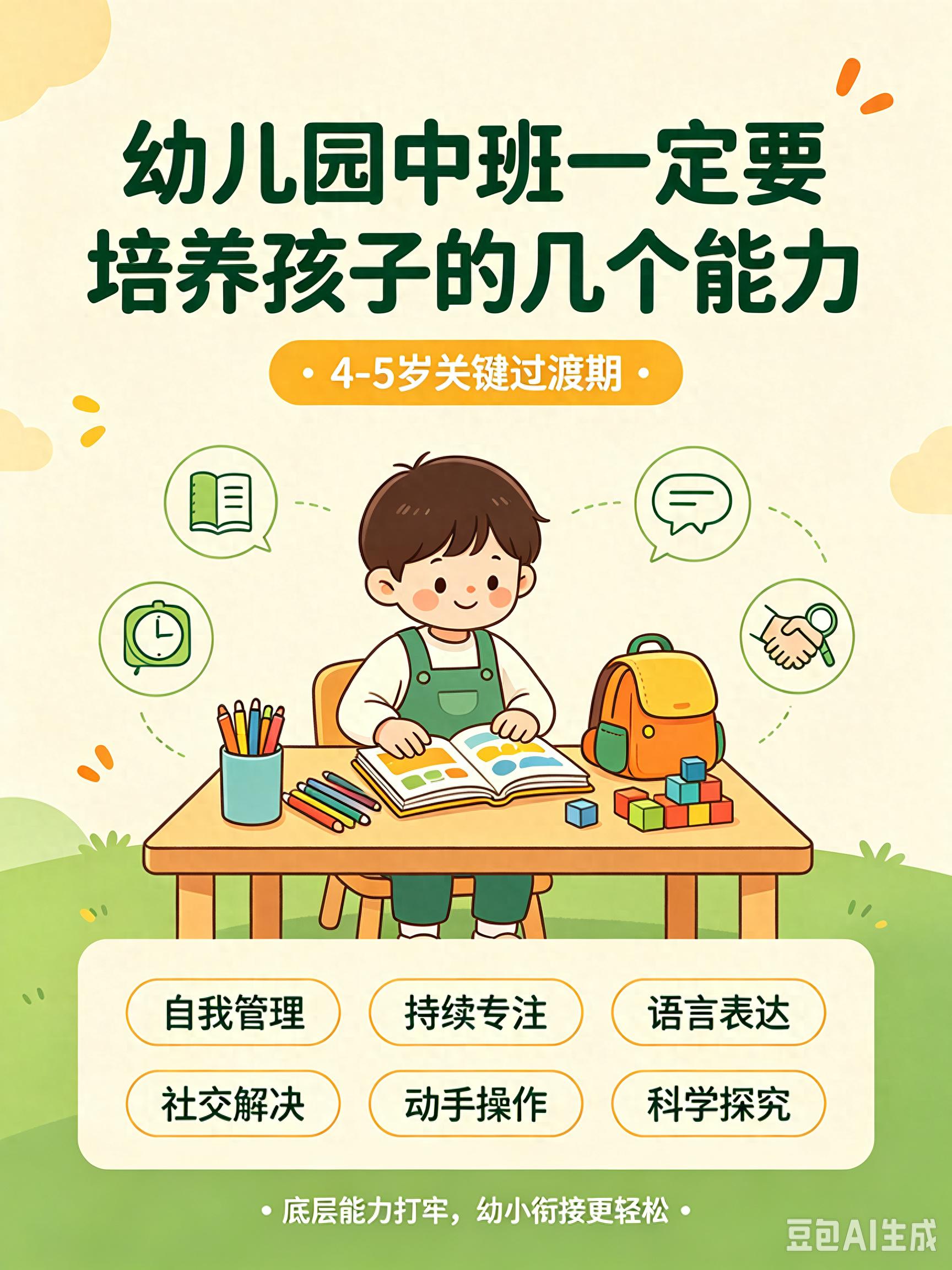
The biggest difference between middle and small classes is that small classes focus on adaptation to collective life, separation of anxiety and learning to take care of themselves; middle-school children have adapted to the kindergarten environment, their self-consciousness is rapidly rising and they start to think about themselves, while at the same time being aware of the rulesFocusAnd language understanding comes at an advanced stage. At this stage, the lower level of competence is being taken into account, and it is much less difficult for the younger generation to connect with each other; it is easier to focus on poetry, counting and learning。
Without talking about the concept of early learning today, and in keeping with the requirements of the guide to learning and development for children aged 3-6, it is clear to all of you that the middle class really has to focus on the core competencies of grinding, and each of them speaks clearly about the development of standards and daily landing practices, avoiding the pits that everyone can most easily step on。
I. OrderdSelf-managementCapability: not "do what you're told," but take care of yourself
Many parents understand themselves by eating and dressing themselves. It's just a small class target. Self-management in the middle stage is the orderly management of one's own goods, time, emotions and the most basic pre-positioning capability for young connections。
In line with the four-to-five-year-old development goals of the guidelines, young children in middle school need to be able to organize their own items by category, to follow a simple schedule with reminders, and to express themselves when emotional, not to keep crying or venting。
First, item management. Many middle-school children go to school, and there's a mess in their school bags, drawings, changing laundry, water cups and yelling for help if they can't find something. The essence is not that the child is lazy, but rather that there is no habit of establishing classification。
No complex training is required on a daily basis. At home, the bag is at the door, the drawings are on the shelf and the underwear socks are in their small drawers. Every time a good toy is played, it's not the parents' rush to collect it, it's the protocol: take only one toy at a time and take the next. The point is to show the kids where to take things and put them back. There is no one-time requirement to pack up a whole bunch of tasks for middle-class children, and to do one little thing at a time. Many parents are prone to mistakes: children are slow to pack, they are poorly packed, and parents work directly for them. Once, the child loses the opportunity to practice and never cleans up。
Then there's basic time perception. The children in the middle of the shift are not able to read the clock and do not need to learn the timewise. What is needed is a sense of sequence: to get up and wash breakfast, to go home after school, to wash your hands, to have a little dinner, to read and to sleep. Set the process, let the kid know what's over, what's next. A photo schedule can be applied to the wall to understand the order with the image, rather than the word “quick”. Children who have been pushed for long periods of time, without an inherent sense of time, are only passively awaiting instructions from adults, and it is difficult to accomplish their task independently in primary school。
Emotional self-management is a top priority. More than four-year-olds tend to lose their temper, fall and fight for toys. Many parents are at two extremes: either they can't stop crying, or they can't just compromise. The guide suggests that this stage leads children to recognize emotions and learn to express them. And when the kid gets angry, he says, "i'm angry because i don't want to share toys," not just do it. Emotions are allowed to exist, but the bottom line is defined: you can be angry, but you can't hit or throw things。
At the heart of this ability is not to let children never lose their temper, but to be able to recover slowly after having become emotional. It's crucial that parents demonstrate, and when things happen to us, they do. If parents yell at each other in a hurry, it's not effective to teach children how to control their emotions。
It is here to remind you that middle class self-management is an independent, not perfect, goal. It's normal to be dressed in reverse and not properly dressed, and we'll just warn and not make arrangements。
Ii. A continuing focus: not to sit still, but to be proactive
A lot of parents' first reaction is to be able to sit quietly for 30 minutes. This is a very common area of error。
According to ecd, the effective focus of 4 to 5-year-olds is about 10 to 15 minutes. This data is not a hard indicator. It refers to the child's active investment in an interesting matter and is not forced to sit still. The child sits still, his eyes are empty, it's not a focus, it's just “sitting”。
Secondary-level training, with a core objective: to be able to perform a simple task independently and without the constant involvement of adults, without easy interference from outside。
Many family practices are undermining focus. Children build blocks, read drawing books, and parents often interrupt: "drink water," "do you want to eat fruit" and "do you think this is wrong?" frequent breaks and the child's concentration chain breaks down at a time, making it very difficult for one thing to sink in for a long time。
Day-to-day exercise principles:
1. When the child is playing himself or reading a book, he or she does not disturb himself or herself as long as he or she is not in danger. Don't stop commenting and directing。
2. Mission difficulty matches the middle class level and cannot be too difficult or simple. Too hard for a child to give up; too easy for a child to be bored. The puzzle, the search for different building blocks can be difficult and gradual。
Reduce environmental disturbance. When kids do things, the tv, the short video, try to turn it off. Many families used to spend their time with their children on television, environmental noise continued to stimulate and it was difficult for children to build up a deep focus。
Many parents prefer to practice concentration with brushing and typing, which is not very effective. The focus of middle-class children is in games, exploration, hands-on exercises, not static brushes. Do not blindly seek to sit for long periods of time and give priority to protecting the child's willingness to invest in one thing。
There are two different situations: when a child is playing, he/she gets his/her head up, which is a normal phenomenon in this age group; if he/she does anything, he/she gives up for more than two or three minutes, it is difficult to insist, then he/she slowly increases the exercise of simple tasks。
Iii. Languages and responsibility of languages:
In the language area of the guide to learning and development for children aged 3-6, the goals for the ages of 4-5 are: to be able to tell what they see and experience in a largely complete manner; to be willing to talk to others and to talk about topics of interest to them; to understand continuous instructions。
Many middle-school parents focus only on whether the child will recite an ancient poem, how many words he/she will read and how many words he/she will ignore oral expressions. Oral expression is the foundation of future reading understanding and writing. A child can make one thing clear, and it will be easier in the future to understand topics and express ideas。
The middle class is not going to practice fancy words, but narrative logic: one thing, first of all, what happened, how in the middle and what the end result was。
The most convenient exercise is a short daily chat. On the way to school, let's not just ask, “was it a good day or a good day? What's so funny about this? To guide the child to speak from beginning to end。
In the beginning, the child may be intermittent, and he is encouraged to repeat, without interrupting the correction, to listen patiently and to help him to correct the sequence。
It also trains the ability to follow instructions. Secondary children need to understand two to three consecutive steps. For example, "put the drawings back on the shelf and bring a glass of water." it's hard for children to exercise their hearing memory for single-order families。
Note that the instructions are simple and do not take a long line of words at once. If the child fails to do so, do not direct criticism, make sure he hears and repeats the instructions。
To avoid a pit: do not force children to perform poetry in front of relatives. Such pressure scares children from speaking, but instead undermines the expression of will. At the heart of language skills development is the willingness of children to express themselves and dare to express themselves。
In addition, children are not allowed to watch short videos for long periods of time in order to talk more to them. Short video images are extremely fast to change and children are not required to think about the language of the organization, and long-term large-scale viewing can reduce their language organization。
Iv. Social communication and conflict resolution capacity: friendship, conflict management
The shift is during the outbreak. Most of the children in the small classes play in parallel games, and when they come to the middle classes, they start to like playing together with their partners, and there will be a marked increase in fighting and fighting. When many parents see a conflict between their children and others, the first reaction is to protect them and to intervene directly to help them resolve the conflict, in fact by missing opportunities for social practice。
In line with the guidance's objectives in the social area, young children aged between 4 and 5 years: like to play with children and have small partners who often play with them; can peacefully resolve conflicts with peers with the help of others; and do not bully the weak。
Social skills are not born, they are developed over and over again. Focusing on two points: mutual understanding, and basic conflict management。
Together, you can feel people's feelings. Regular chats can guide: is it sad that a child is pushed down? If you take someone's toys, they won't be happy. Secondary-school children are self-aware and are accustomed to self-centered, slowly leading to other people's feelings, not learning at once, and need long-term insulation。
Conflict management is the easiest place for parents to do wrong. There are two ways in which children rob their toys: firstly, they give their children back, which must be shared; and secondly, they immediately take care of the children and go to the parents。
In the middle stage, priority is given to encouraging children to try to communicate themselves. You can teach simple words: "i want to play this, can i have it when you're done?" "i don't want to give you toys."
Tell the children that sharing is voluntary, not forced. And let him know that someone else can turn him down. Parents intervene only when there is a risk of push or injury。
After the kid's fight, he goes home, without charge, and asks him: what just happened? Is there another way? Let him think about the results of different approaches。
Good social skills do not mean that children have to look outward and be loved. Introverted children also have good social skills, as long as they can play friendly with their regular partners, have respect for others and express their thoughts in the event of conflict. Don't force the children to come and socialize。
V. Hand-in-hand and fine-action capabilities: hands-on for brain development
A lot of people think it's a lot more extensive to take a brush. In the area of health, the guide to learning and development for children aged 3-6, the goals for the ages of 4-5 are: to be able to draw relatively simple graphics along the edges, to be able to fold them broadly; to eat with chopsticks; to be able to produce simple graphics consisting of straight lines along the contours。
Hand-to-hand movements, hand-to-hand nerves and brains are closely linked, hand-to-hand exercises directly contribute to brain development and are the basis for future writing, manual work and tools. Many of the children in the class are in incorrect pen positions and difficult to write, and many of the root causes are in the middle of the class's fine moves。
There is no need to buy expensive teaching aids on a daily basis, and many small things in the family can be practiced: using chopsticks, buttons, zippers, origamis, tearing paper, beads and beans。
Practice is gradual and safe. The use of scissors must be accompanied by adults, and children should not be allowed to use them alone。
Don't practice it too early. The small muscles of the middle class are not fully developed, and long-term pen-shocking can lead to wrong pen-shaping positions, fatigue of fingers and even resistance to writing. This stage of practice is dominated by graffiti, drawing simple graphics and manual exercises。
The big movement cannot be ignored. Secondary classes require continuous running, jumping, balancing and climbing. A major movement has been developed to help children coordinate their bodies, enhance their physical abilities, advance their physical development, and indirectly increase their concentration and emotional stability. Ensuring two hours of outdoor activity per day is the state's recommended standard for pre-school children. Outside is not just play, but training in physical abilities。
Scientific thinking and exploration: learning to ask questions and to think, not to back off
The scientific skills of the middle class are not in early mathematics or back science. Guided scientific areas 4-5 year-olds: capable of observing things or phenomena and finding the same and different; often brain-searching objects and materials and enjoying them; able to sense and distinguish between the number of things and understanding the simple concept of numbers。
A lot of middle-class families, crazy enough to teach their children to add up to 100 times, actually reverse the end. Secondary math core is a sense of numbers, understanding numbers, matching, comparing, not a hard back calculation. For example, when you divide fruit, you count a few, whichever is more; you sort the toys by color, shape. The amount of perception in the life scene is far more effective than the brush。
Explore ability and focus on protecting curiosity. The child will keep asking: why is it blue? Why leaves turn yellow in the fall. Parents should not be in trouble or throw a standard answer. It's a good question. Let's find out. Guide observation, encourage speculation。
Allowing children to try, to play with water, to play with sand and to observe insects of flowers and weeds is a search. The goal at this stage is to allow children to observe, to think, to question and to build interest in exploring the world。
It's time for the parents to remember
1. Do not advance the teaching of primary school subjects. In the middle class, priority is given to lower-level competencies and literacy algorithms can be minimally enlightened and cannot be considered a core task. Early high-intensity learning can reduce learning interest and lead to anaemic learning。
2. No horizontal comparison of children with others. The pace of development is different for each child, and the guide is a development reference, not a test. There can be no problem with continued progress as long as it is on an interregional basis。
3. Do not seize many capabilities at once. Over time, emphasis has been placed on one or two items, such as the preparation of items and the presentation of language during the month, which is moving slowly and without fatigue on the part of parents and children。
4. Capacity development is integrated into everyday life and should not be used as a lesson. The best training is the small things in life, which do not need to be set aside for long hours to practice in eating, walking and packing toys。
5. Less material incentives and more positive processes. “you just insisted on having your book packed, not just saying, “you're so smart”. For a long period of time, it was only clever, and children feared failure and were afraid to challenge difficult tasks。
The year of the middle class is a very crucial one. Small classes are adapted to life, middle classes build lower-level capacity, and large classes are connected to young children. Competencies are progressive, with middle-schools taking self-management, focus, expression, socialization, hands-on, and investigative skills firmly in place, and children attending classes and primary schools are well adapted. Education is not a short-term sprint, and middle-school classes are not used to steal knowledge, but to develop habits, exercise abilities and protect children's curiosity about life and learning。
Interactive topics
Which of your family's abilities is it? Is there a low level of focus, or is it often a conflict with a small partner? You're welcome to talk about your real experience in the comment section。
Disclaimer: this document refers to the guide to learning and development for children aged 3-6 years, which is shared only as a family education experience, with individual differences in the pace of growth of each child, and the method used in the text is for reference purposes only and does not constitute a therapeutic and compulsory training programme for children. The child-rearing process is flexible, taking into account the child's own state, and if there are obvious anomalies in the child's development, counselling is recommended for child health professionals in regular maternal and child health homes。









