There are no more people like meProperty costsIt's a few years. But to be honest, most owners have no idea what the property services contract looks like or what it says。
The vast majority of properties do not actively publicize information to owners. For a long time, we all agree that we don't have to look, we don't have to ask, we don't have to pay, we don't have to pay。
This corrects a large number of people's mistakes: many think that the property's internal information, the billboards, and ordinary owners are not entitled to access it. Not at all. In accordance with the relevant property legislation in force, it is the legitimate right of every owner to be informed of the information published in the small areas. It is not necessary to wait for the commission to be available to individual owners。
Long-term failure to reconcile these key information can easily result in shrinking services, higher feesPublic revenueTo go to unknown problems. Today it is clear, once and for all, that the property documents to be checked by the five categories of owners, as well as the way in which the property is handled, are correct。
I. Property service contracts, find out what the real estate needs
Property service contracts are the central basis for all services throughout the sub-district and are the least visible documents for owners。
Each owner has the right to have access to the complete original version, whether at the time of delivery of the building, the prior property service contract entered into by the developers, or the formal contract after selection by the later owner's congress。
The contract clearly states the scope of the property's services, the standard of services, the pricing of fees, the service cycle and the liability of both the property and the owner。
Many times we feel that property is inactivity and poor service, that we want to be theoretical, that we want to defend our rights, and that we can't justify it, because we have never seen the terms of a contract and are naturally passive。
It is recalled that when looking at it, it is important not only to look at a simple fee page but also at the complete contract text. By contrast, the current rates are consistent with the contract, the services specified in the contract, and the property has not been lazy。
Ii. The bill on public revenue in the district. See where the billing money went
Sector elevator ads, building ads, express containers entry fees, parking fees for public spaces, rental costs for temporary stalls... All these revenues are owned by all owners。
But in reality, 90 percent of the owners had no idea they still had the money。
The property is required to establish a complete public revenue desk account, with detailed and documented records of each revenue, expenditure and surplus. Owners have the right to check at any time the income and expenditure statements, as well as the contract documents for advertising cooperation and rental of premises。
The normal rule is that public revenues, after deduction of minor management costs for property, are either allocated to the small areaMaintenance fundEither by means of a vote of the general assembly of owners, they are used for public improvements and maintenance of facilities in the subdistricts。
If you do not have a clear and complete account of your property, it is a violation。
Iii. Detailed use of funds for specialized residential maintenance
When we buy a house, we pay for a special home maintenance fund, which is what you call a maintenance fund。
The sum is not small and belongs to all owners. However, the vast majority of the population has never asked again when the money was used, where it was spent and why it was used in an unreasonable manner。
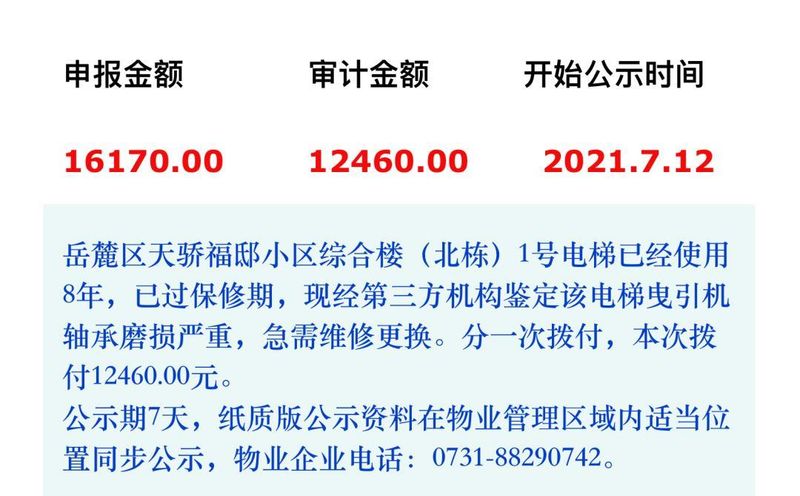
The maintenance fund is dedicated to the maintenance of large public facilities in small areas, such as elevator maintenance, renovation of exterior walls and repair of firefighting equipment. In each case, there are approval records, project details and the amount spent。
Owners have full access to the full flow of water to verify the authenticity of the funds used and to avoid unreasonable expenses and misappropriation of maintenance funds. Many of the districts suffered as a result of the persistent failure of owners to check accounts and the consequent loss of large sums of money. The day-to-day attention is devoted to keeping everyone's public property safe。
Iv. Information on the disposition of the parking garage
Almost all owners are concerned about parking spaces, but the vast majority are unclear as to which spaces are available for sale, which are rented and which are already shared by owners。
In fact, we can apply directly to the property for access to parking spaces and garage rights。
It is clear from the data that the total number of parking spaces in the sub-districts, the number of ownership spaces available for sale and the division of public rental spaces. In practice, many properties profit from the private rental and sale of public spaces owned by owners。
Once the data on ownership are clear, it is possible to avoid all kinds of pits that are rented and purchased。
V. Secretariat administration statute, minutes of relevant meetings of the conference of owners
Each sub-district has its own administrative statute, which corresponds to the “rule of self-government” of the sub-district。
It sets out in detail the rules of behaviour of owners, the requirements for renovations, the rules for the use of public areas, the system of district management, etc。
In addition to this, voting resolutions and minutes of meetings of owners ' assemblies are also publicly available to owners。
Significant decision-making and institutional changes are recorded in many sub-districts. By looking at it more, we will not be unaware of the events of the region, and we will have a clear idea of the origins of the regulatory requirements of the region。
Practical methods for owners to apply for access to information
Many owners have defended their rights and failed to check their data because they only ask questions orally。
Asking whether the property industry can see that most of the people simply gave up “no information, no information,” the other side said。
The oral consultations were not documented and were easily perfunctory. The most conservative way is to apply in writing:
A simple request for access, indicating the building number, the list of access information, personal contact information, is submitted to the property. After submission, photographs, screenshots and retention certificates must be taken for subsequent use。
Property is required to cooperate with access within a reasonable period of time。
If the property finds reasons to dismiss it and refuses to access it, for example by claiming that “in-house information is open only to the commission”, it does not argue or dispute。
Directly carry vouchers and provide feedback to the community house councils, street offices and the property section of the local housing agency. Many cases of non-cooperation also have access to justice. The law supports 100 per cent of the legal claims of owners。
A few small reminders to keep an eye on
First, the owner has the right to access, extract and copy publicly available information, but may not claim all commercial secrets of the property, in-house private files, and access to them is subject to the law. The content relating to the privacy of other owners is provided after the property has become unsensitized。
Second, the information should not wait until a contradiction has broken out. When things are normal, checks can be checked in advance, rules can be checked in advance and temporary remedies can be avoided。
Third, there were problems with accounts and information, and it was suggested that a number of employers should provide consolidated feedback to the authorities. It was important not to fight by withholding property fees, which not only did not solve problems but also caused disputes and losses。
The neighborhood is where we live for a long time, and the property money is what we pay. Active monitoring and verification will allow each penny to be spent transparently and effectively。
Interactive questions
Have you seen the entire property service contract in the district
2. Will your neighborhood regularly publicize public revenues such as elevator advertising
3. If the property refuses to provide relevant information, what way would you choose to deal with it