Definition of mobile internet operation industry
Mobile internet operations are an integrated management activity focused on improving the performance of the product or service market in a mobile network environment. It involves planning, organizing, implementing and controlling the entire life cycle of mobile applications, websites or services through effective strategies to attract users, increase user adhesion and promote user activity, and ultimately achieve business objectives. The core objectives of mobile internet operations are usually outlined as “upscaling, retaining, promoting”, i. E. Attracting new users (upscaling), keeping users alive (retention) and stimulating users to use products more frequently (promoting)。
Classification of mobile internet operators
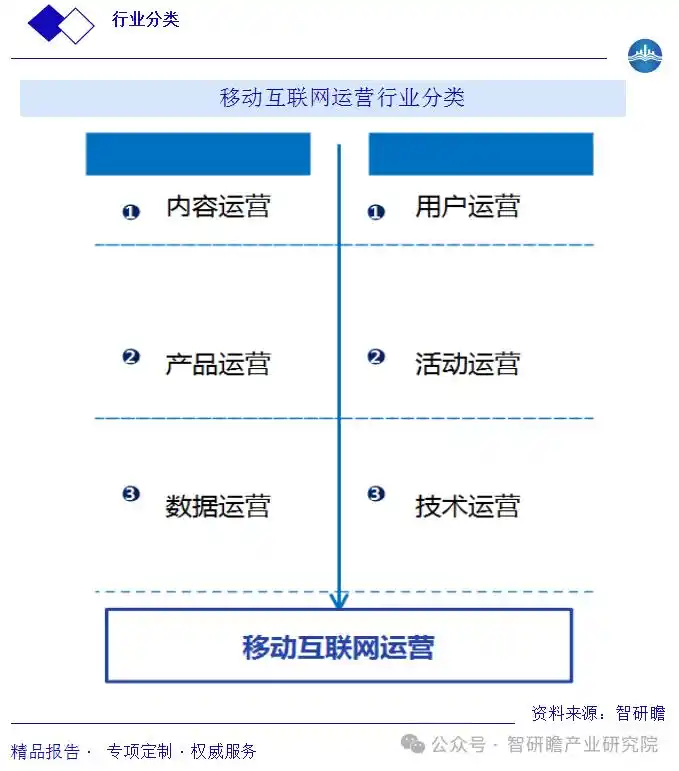
Depending on their core functions and clients, mobile internet operators can be broadly classified into six main categories: content operations, user operations, product operations, activity operations, data operations and technology operations. Content operations focus on creating, editing, publishing and managing a wide range of text, image, video, etc. To attract user attention, enhance user activity and loyalty. User operations, in turn, focus on understanding user needs, enhancing user experience and promoting user growth and retention through user stratification, community operations, customer services, etc. The product operates around the product itself and is responsible for product strategy planning, functional iterative optimization, user feedback collection and product life cycle management to ensure product market competitiveness. Activity operations engage users by designing and implementing offline activities, such as promotions, competitions, user interactions, etc., to achieve branding or marketing conversion goals. Data operations are based on data analysis to provide quantitative support for operational decisions, including user behaviour analysis, market trend forecasting, a/b testing, etc., to maximize the accuracy and effectiveness of operations. Technology operations focus on the stability, efficiency and security of the technology platform and support the technical needs of other operational activities, such as server deployment, system optimization, sdk integration, etc。
Development of the mobile internet industry
The development of the mobile internet business industry dates back to the beginning of the twenty-first century and has begun to emerge with the spread of smartphones and mobile network technologies. Between 2000 and 2010, mobile internet became visible with the expansion of the 3g network and the spread of smartphones. Major operators have started to introduce home-based mobile data services, while mobile internet operations have started to appear in the form of simple sms and wap websites. In the period 2010-2015, the construction of the 4g network and the emergence of mobile applications (apps) ushered in rapid growth in the mobile internet industry. During this period, mobile applications became the main vehicle for the mobile internet, and the mode of operation was more diversified, encompassing various forms of socialization, games, electronics, etc. At the same time, mobile internet advertising is becoming an important tool for business marketing. From 2016 to date, the development and deployment of the 5g network, as well as the application of technologies such as artificial intelligence, big data, have entered a new phase of innovation upgrading in the mobile internet industry. Operators provide more personalized and accurate services to users, not only through connectivity but also through data analysis and user imagery. At the same time, privacy protection and data security have become important issues for industry development. In general, the mobile internet business industry has undergone a process ranging from embryonic to rapid development and to innovation upgrading, constantly adapting to and leading changes in mobile internet technology and applications。
Midstream/downstream in mobile internet operations
In the upstream area, mobile internet operations rely mainly on strong hardware and software support. This includes internet hardware support, such as the continuous optimization of basic resources and the access environment, such as the synergistic development of ipv6 and ipv4, as well as the development of hardware facilities for the development of the internet industry and the development of internet industry software applications. Representative enterprises in the upstream industry, such as the three major telecommunications operators, neptunium software, waves, etc., provide solid network infrastructure and technical support for mobile internet。
In downstream applications, mobile internet operations are more diversified and extensive. First, the mobile shopping industry, one of the typical applications, has over 700 million users, bringing a rich flow of traffic and differentiated ecology to electric power platforms. In addition, mobile internet applications cover a number of areas such as government, transport logistics, police, tobacco, health, education and sports. These industries use mobile internet technology to achieve information services and to improve operational efficiency and productivity. For example, in the retail sector, the mobile internet industry, through the saas model and cloud computing techniques, provides businesses with a powerful platform for solutions to help them manage successful end sales。
Our mobile internet industryMarket sizeAnd growth rates
By march 2024, the number of active users of the mobile internet in china had climbed to 1,232 million, a significant increase from the same period the previous year to more than 20 million users. This data provides insight into the broad and continuing dynamics of the mobile internet user base and validates the dynamism of the industry. Data from china's 2023 annual report on key internet trends show that, as early as 2023, china's mobile internet monthly active users had reached a level of 1,224 million, highlighting a steady trend towards a steady expansion of user size in recent years。
In terms of traffic consumption, in the first two months of 2024, our cumulative flow of mobile internet has increased by 16. 6 per cent, a data that not only highlights the rapid growth in the use of mobile internet traffic, but also reflects the growing demand for mobile services by users, reflecting the in-depth penetration of mobile connectivity in daily life. Of particular concern is the development of the mobile ott sector in the sub-market of the mobile internet. By the end of 2020, the size of the mobile ott market in china had been recorded as 14,84. 4 billion yuan yuan, with an annual growth rate of 18. 29 per cent, clearly depicting a strong growth pattern even in the specific branch of the mobile internet, which augurs well for the diversification and specialization of the internal structure of the industry。
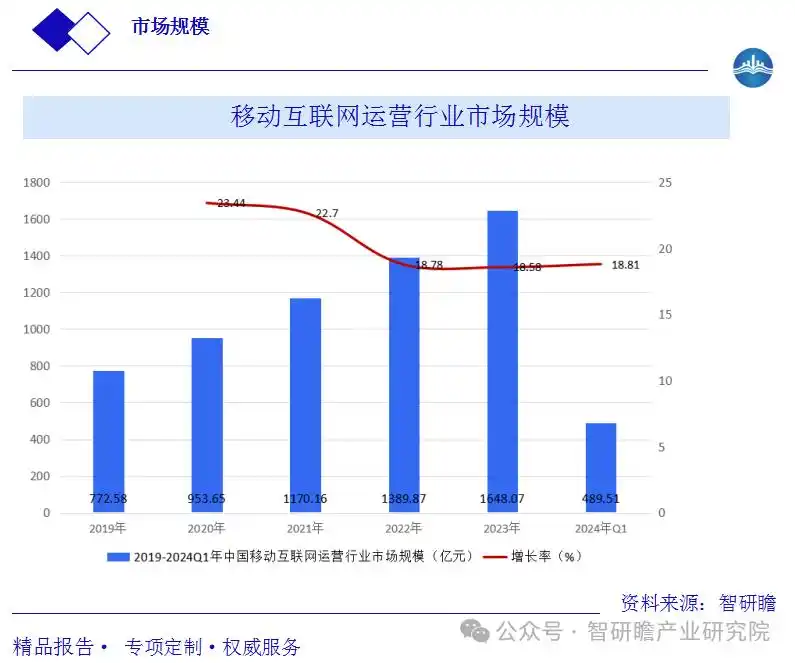
According to isp statistics, the market for mobile internet operators in china was 7,7258 million yuan in 2019 and in q1 in 2024, 48,951 million yuan, an increase of 18,81 per cent over the same period. The market size of china's mobile internet operation sector in 2019-2024q1 was as follows:
Mobile internet operations industry policy
With regard to the protection of personal information, the policy requires enterprises to comply with relevant laws and regulations, such as the law of the people's republic of china on the protection of personal information, and to ensure the lawful, legitimate, necessary and transparent use of user information. Enterprises need to establish robust personal information protection mechanisms to store and transmit user information in encryption and to safeguard the right of users to know, choose and control their personal information. In terms of compliance with mobile internet applications, the policy requires enterprises to comply with relevant requirements, such as the mobile internet applications information services management (imips) requirement, to ensure compliance with applications. Enterprises need to put in place a robust application compliance management system that provides rigorous clearance and oversight of applications to prevent them from disseminating information on violations or harming user interests。
Problems in the mobile internet industry
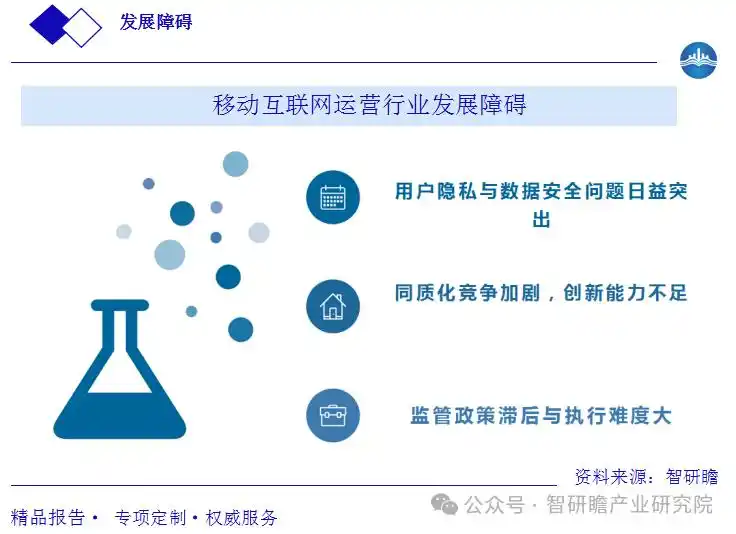
First, user privacy and data security are becoming increasingly prominent. With the widespread application of big data technologies, user personal information becomes a core resource in mobile internet operations. However, excessive data collection, misuse and leakage are frequent, seriously threatening the privacy interests of users. In pursuing the maximization of commercial benefits, some operators ignore the legitimate use of user data for compliance, leading to a decline in public confidence in mobile applications and affecting the healthy development of the industry。
Second, there is increased homogenization competition and insufficient innovation capacity. There are a large number of mobile applications in the market, but fewer products with truly unique values and innovative models. A large number of applications have similar functions and content, making user selection difficult, and operators have to invest more resources in marketing rather than product innovation, creating a vicious circle. In addition, following the prevalence of imitations, original content and models are not effectively protected, discouraging innovation。
Finally, regulatory policy lags behind and is difficult to implement. The rapid growth of the mobile internet business industry often exceeds the expectations of existing laws and regulations, making policy formulation difficult to keep pace with changes in the industry in a timely manner, especially in emerging areas such as short video, live broadcasting, social utility providers, etc. At the same time, due to the geographical nature of the internet, the differences in laws and regulations between countries and regions pose a major challenge to regulation. Effective enforcement of regulatory policies in the context of globalization, protection of the rights of users and combating violations are among the issues that need to be addressed。
Prospects for the development of the mobile internet industry
Prospects for the development of the mobile internet business sector are generally well received and the industry is expected to continue to grow strongly as technology progresses and user demand diversifys. The extension of the 5g network and the development of technology for physical networking will open up new market space by introducing new applications and business models for mobile internet operations. At the same time, the integration of cutting-edge technologies, such as big data analysis, artificial intelligence, enhancement of reality and virtual reality, will further enhance user experience and stimulate industry innovation. As the digital transition deepens, the penetration of mobile internet operations in traditional sectors such as education, health care and finance will become even deeper, leading to more efficient and accessible service models for these industries. In the context of globalization, the internationalization of mobile internet operations will also accelerate, and enterprises will have greater access to overseas markets and wider business opportunities. In general, the future of the mobile internet industry is bright, but it also requires constant innovation and adaptation to achieve sustainable and healthy development。
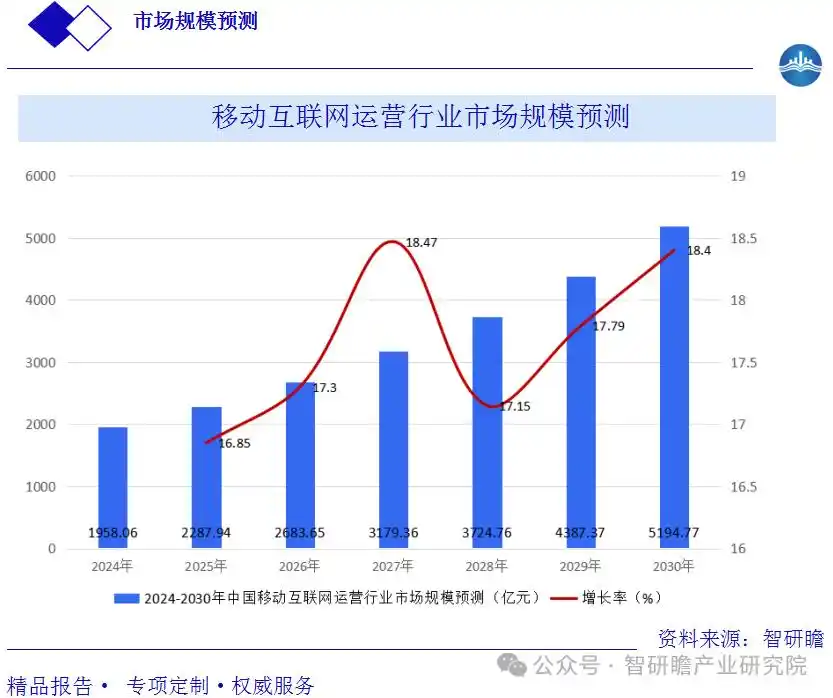
According to isp projections, the market size of china's mobile internet operation industry grew between 16 and 19 per cent in 2024 and 2030, while that of china's mobile internet operation was 519,477 million yuan in 2030, an increase of 18. 4 per cent over the same period. The market size of china's mobile internet operation sector is projected as follows: