


Knowledge managementThe process of transforming data/information dynamics into knowledge/intellectuals helps us better to make decisions and solve problems to achieve sustained growth. The authors of this paper will analyse how knowledge management can be done from five links and learn from it。

What was said in the previous section about knowledge management, and why it should be done, is that we have a bottom-up model that is familiar with how information can best guide our decision-making and behaviour if it is translated into knowledge。
Know what it is and why. Let's talk about knowledge management
We have to have a goal for everything. With the goal, we know where to focus our attention and do not stray。
Remember the definition of km? "translating data/information dynamics into knowledge/intellectual processes will help us better to make decisions and solve problems for sustained growth."
The ultimate goal of km is not to manage knowledge, but to change itself, solve its problems and grow itself. Next, i have five links to knowledge management, taking into account my past experience。
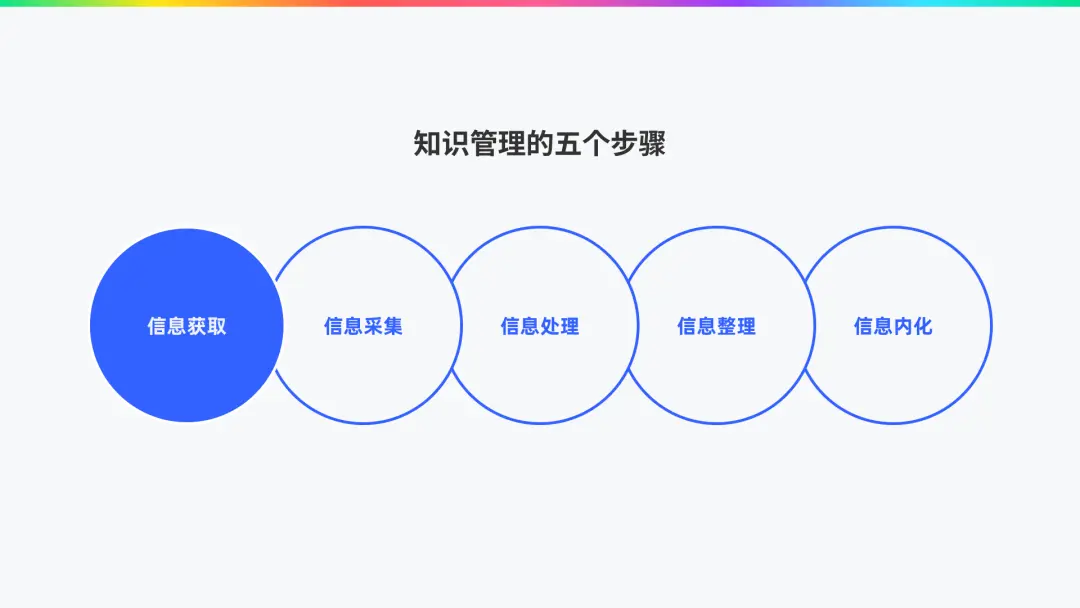
Access to information
The first step sounds simple, but it is a direct source of information. There are three hidden faults in this chain: passive reading, innate scenes and endless vortex。
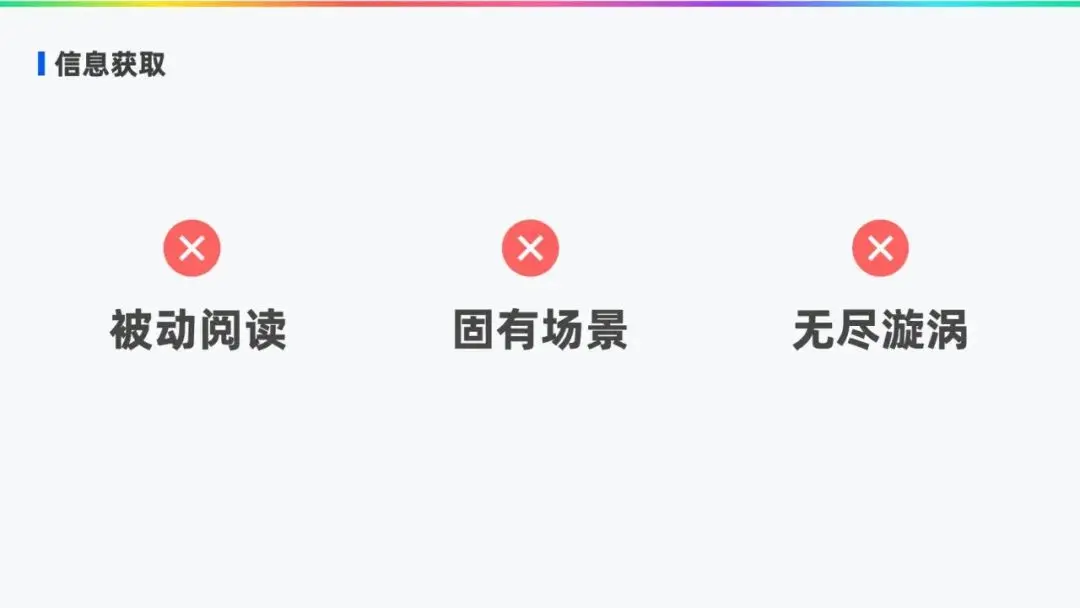
1. Passive reading
One of the elites, louiscard, once said:
We don't have time to read. We don't have time to read. On the subject of information, many people do not know that they are passive. As we mentioned earlier, what is most important in this era is content, and much of it is fed to your mouth by the platform in a pushover。
If not restricted, the vast majority of access to information may be dominated by a variety of push-overs: short, popular videos sent by the shivering; news of the downsizing of the various large plants of the microblogging community; a big melon of a star in weibo; updated tips from the b station master, etc。
And so, in this state of unconscious access to information, your attention, your time, is constantly being taken. But what's really worth it to you? The solution to this problem is simple and straightforward: taking out push (or implicit push) and taking back the lead in reading. Then we'll have enough attention to choose the better information。
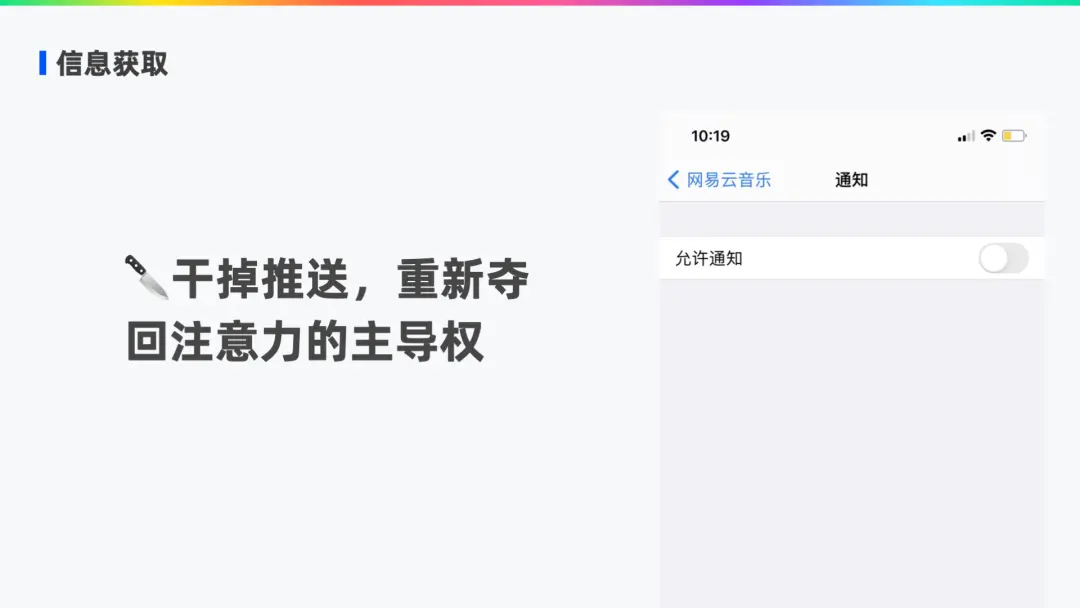
2. The problem of inherent scenes
A lotDesignerFriends, including myself, are conscious of the fact that valuable information exists only in high-quality articles, books, teaching programmes, so that all other ways of obtaining information are blocked。
But that is not the case. In the dikw model described in the previous article, we interpret the information as "data that are subjectively interpreted and given meaning" that removes uncertainty and answers simple questions. But there are no media restrictions. That is to say, apart from the graphics produced by creators and writers, every scene of our daily lives can be a source of information。
For example, in my work a few years ago, the inspiration for the lower left came from a model room that i saw on a tour of ikea, which was a message for me; the work on the right came from the iron king scene of the amelioration。
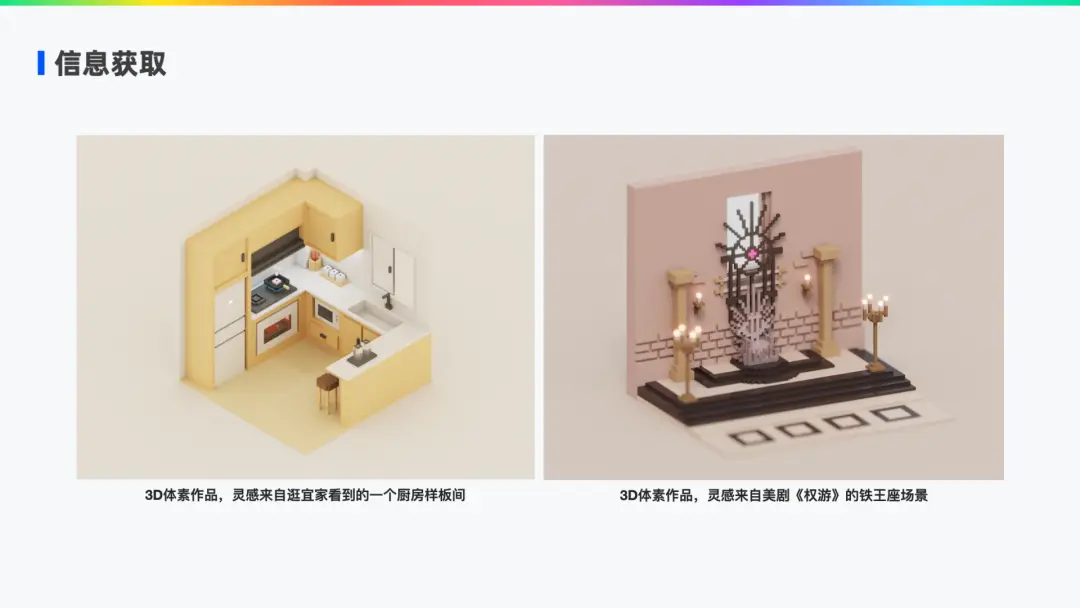
So, at all times, you can look to capture information that is not normally noticed but valuable。
The flomo tool, which is recommended here, is very well suited to temporarily capture the dynamic, uncapturing information, a point of view spoken by friends around them, the idea of being on the subway, etc., can be quickly recorded in this application。
3. The endless vortex problem
But, with no control, you can easily be caught in an endless information vortex and consumed by it. That is the third endless vortex. Identification and filtering of information sources of insufficient quality is the only way. For example, there are no sick moaning, no nutritious subscriptions, low-quality, uninterested news, and microbusiness friend circles that promote more than 10 messages a day。
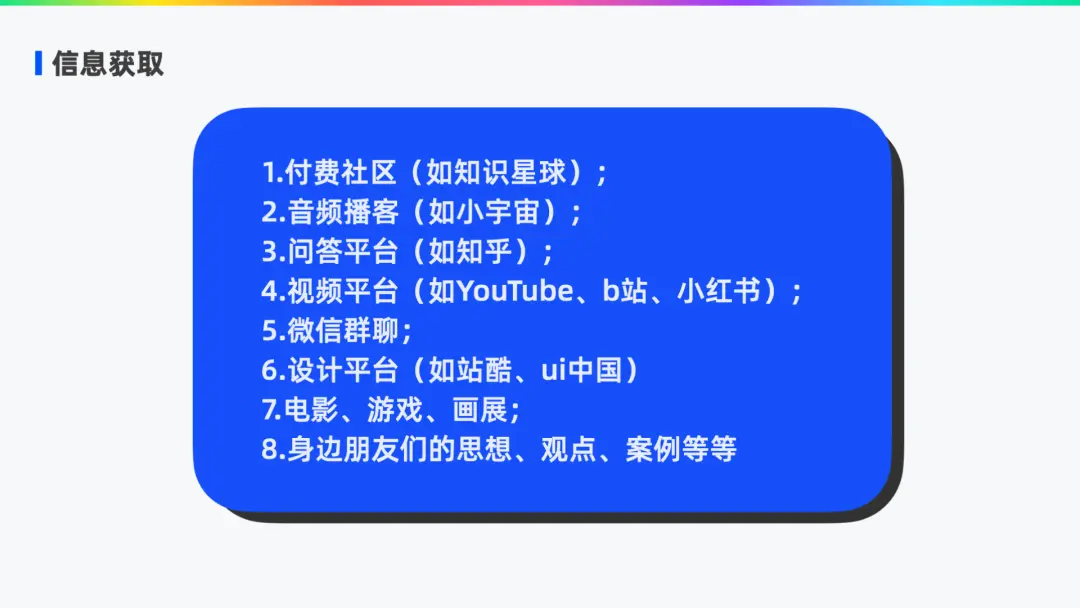
And finally, i'd like to recommend some of the high-quality public information sources that i think are designed for--
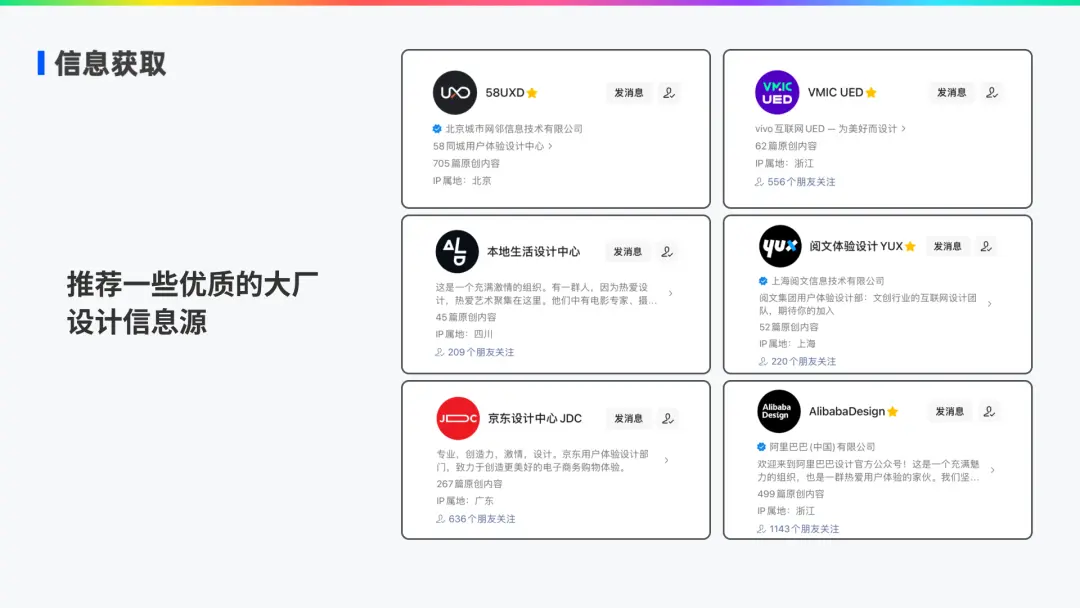
Ii. Information gathering
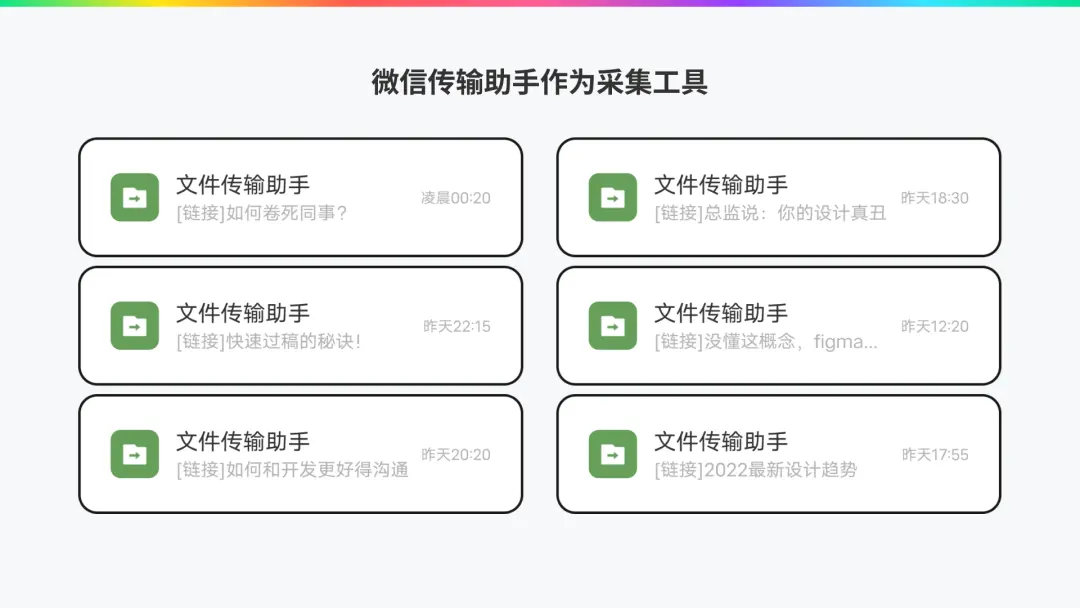
This step sounds simple and easy to lay down. The first scenario was to use a micro-mail transmission assistant as an information-gathering tool, and to throw at the transmission assistant every time you see something that feels good, but in fact, the original purpose of the micro-trust function was to synchronize documents between multiple devices, not information collections, and thus inevitably to make subsequent information difficult to locate and manage。
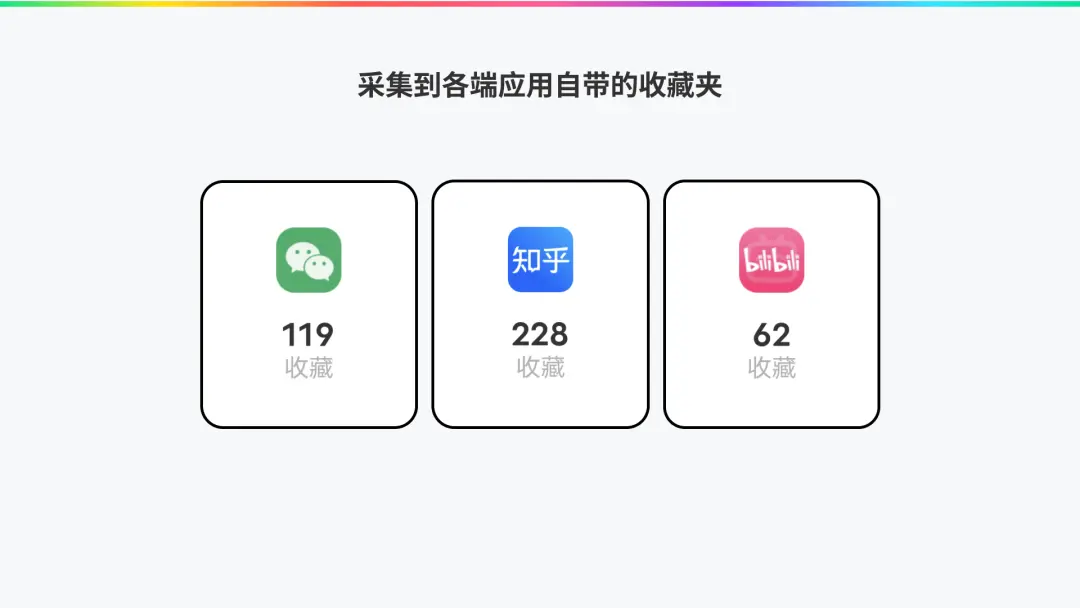
The second scenario is to collect the preferred information from each application into their own collections. Information is completely fragmented and cannot be brought together in one place, which directly results in a lack of uniformity in its management and accessibility。
In addition to the above questions, more friends will choose to collect information into the notebook tool. I've been collecting information with notes for a long time, such as impression notes, canary, and so on, but eventually it's getting thicker and messy. Notes are a better tool than the first two, but not the best。
In our conventional perception, a container is consolidated in a web-wide fragmentation, resource-based discs, content notes. But back to the tools themselves, the notes were originally meant for personal creation. Once there is a mix of handling (i. E., information gathering) and creation in the notes system, confusion and collapse are only a matter of time。
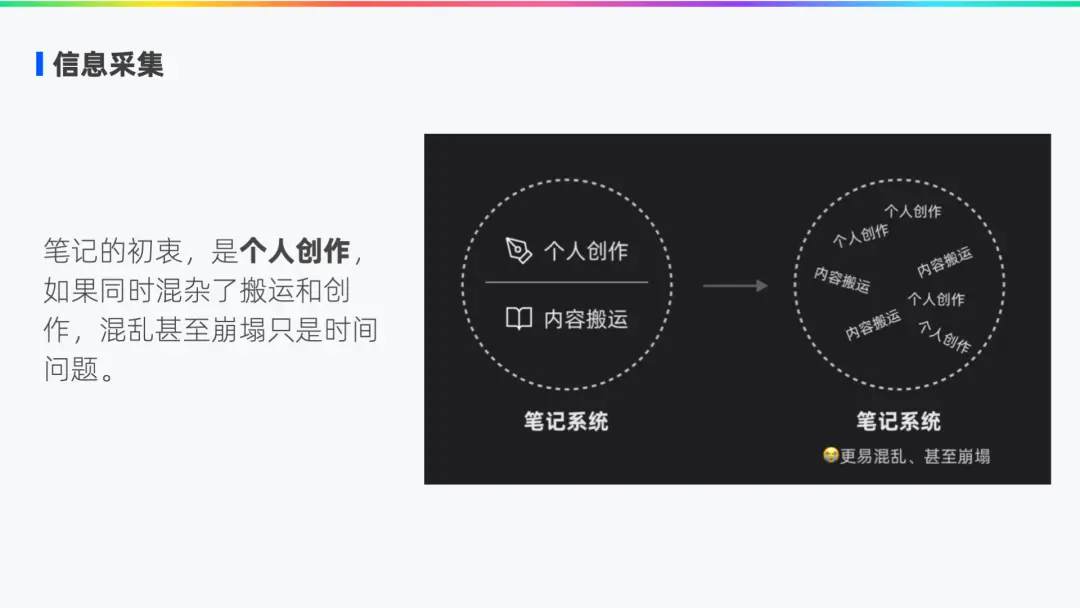
The notebook system was created for creation and the main target group remains creators. It also means that its services are more for creators than consumers。
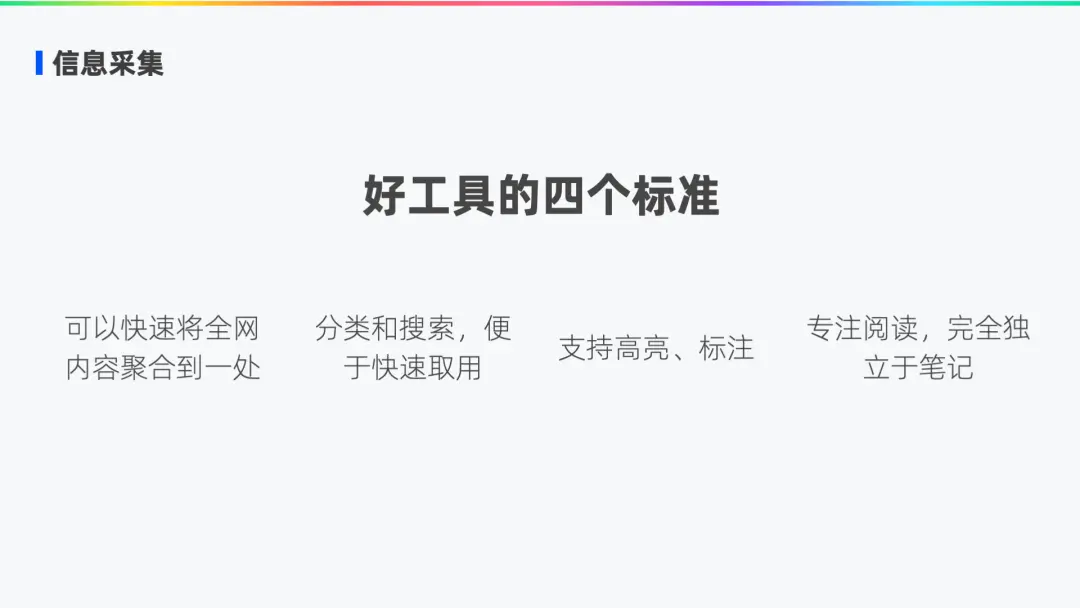
It is difficult, for example, for existing notes to provide functions such as reading progress, labelling, review, custom layout, which in turn play a crucial role in information processing. So it is not that the notes are not good, but they are not suitable for gathering information. It's like you're shaving with a knife, doing things that it's not good at. In my view, a good collection tool needs to meet at least the following four criteria。
The whole web content can be quickly consolidated in one place, and the whole system exists; it can be classified and searched to facilitate quick access; it can support high-profile, labeled and capture key words and related thinking; it can be read with a strong focus, completely independent of notes and in line with consumer demands
At a later stage, the reading tool basically meets these four criteria。
Reading later is not a new concept and was introduced as early as 10 years ago, resulting in a series of classic products such as pocket, instapar, readablity, etc。
In short, reading later is that when you see good things on any platform, you can gather them in one place and then read them again。

Its greatest effect is to separate reading from in-depth reading. For example, much of the information is simply a glance and does not require secondary processing (e. G. News, title parties, low-value information), so it is directly filtered
And that really valuable information can be transferred to a later reader for further reading. I used the five readers, pocket, instapar, again, twilar and cubox, in depth, and finally identified cubox as my master tool。
A simple demonstration of the collection function。
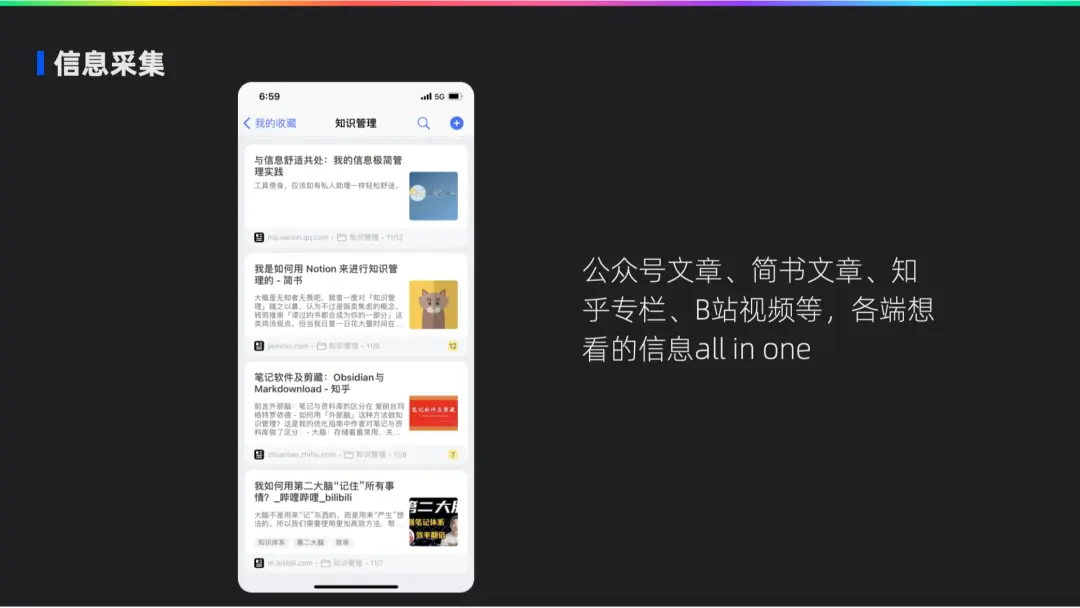
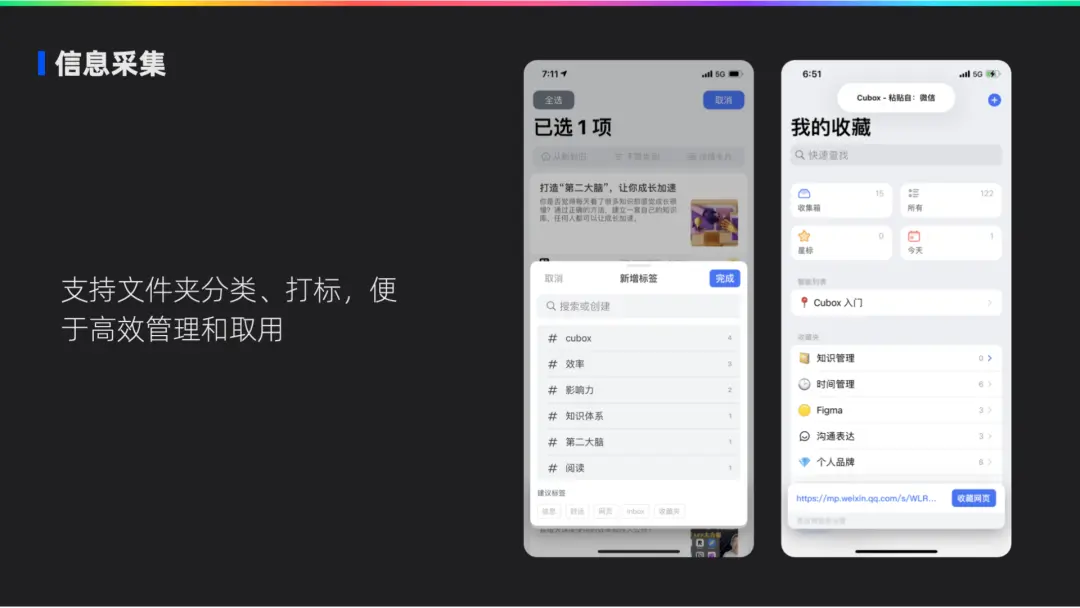
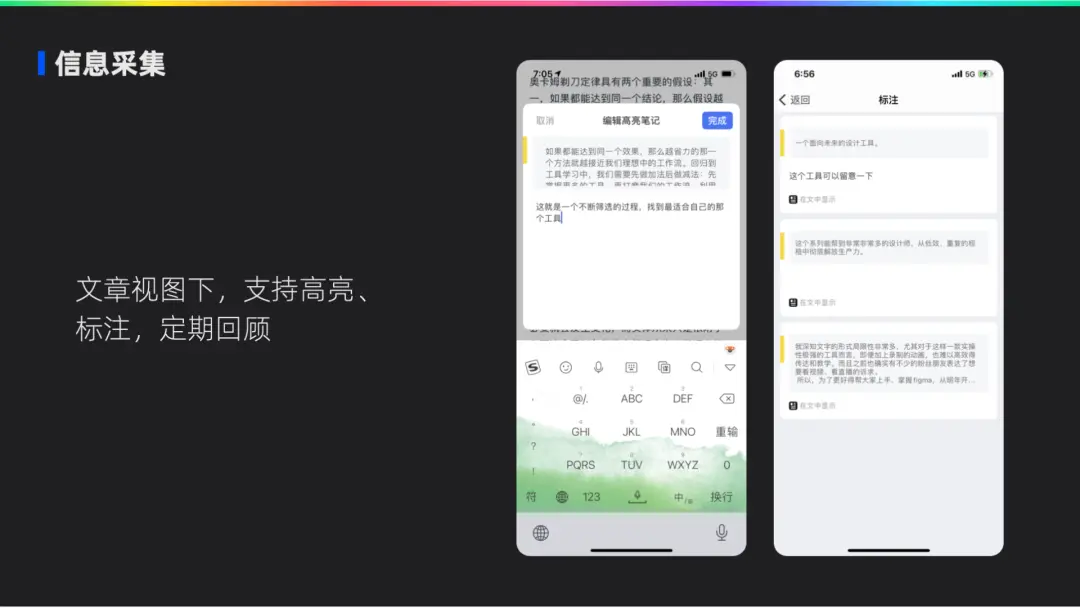
Of course, cubox also has disadvantages, such as supporting only web-based collections and only collections without entry thresholds (the courses that are paid for require log-in and therefore cannot be collected)。
Iii. Information processing
This is what is often said about reading, and it is the easiest to lie in the pit. But this is the key step in transforming information into knowledge. Remember the ultimate goal of knowledge management? – to solve the problem of "yourself" and to keep "yourself" growing, and here i place special emphasis on "yourself," and i explain it from three angles。
1. Systems 1 and 2
In " think fast and slow " , kaniman referred to the concepts of systems 1 and 2。
The brain is more accustomed to self-reaction without conceiving, so the brain is used to understand new concepts by using old concepts that are already available to it to reduce its energy consumption. Otherwise, each one of these messages will feel like a new knowledge, and it will take time to learn. Here's the old concept, be yourself。
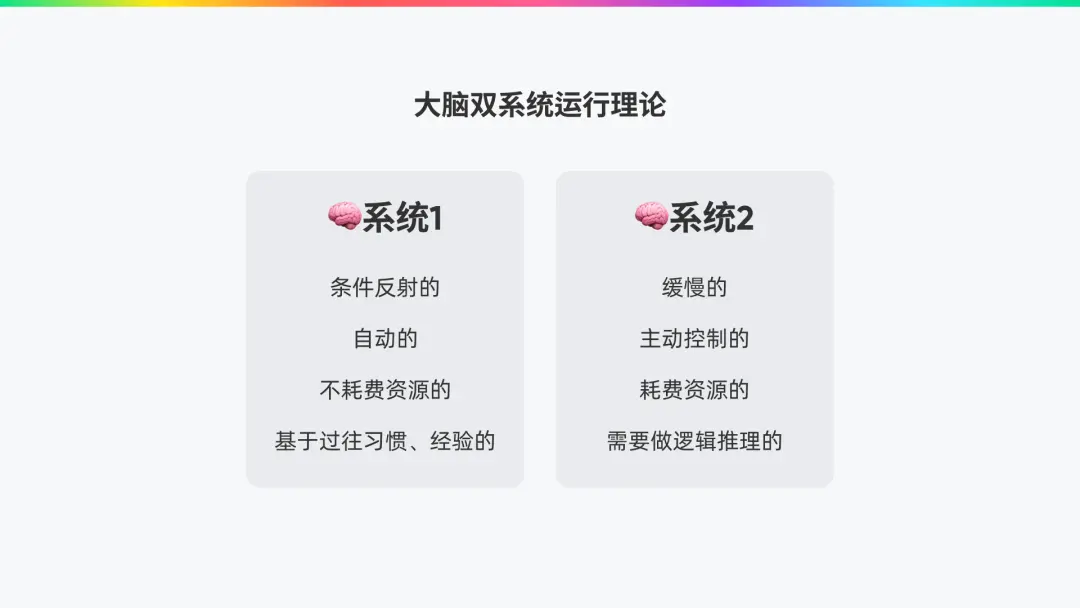
Thus, the knowledge that connects with one's own past is cognitive, consistent with the system of the brain, and enables the flow and flow of knowledge not only to deepen understanding, but also to further validate and refine the knowledge systems of the past。
2. Ebinhos experiment
Bringing up the oblivion curve, you should think of einhos. He had two sets of memory experiments over a year, during which an interesting phenomenon had been discovered. The first thing the students forget is essentially insignificant, meaningless, uninterested and unfamiliar。
So how quickly can one thing become important and meaningful? Humanly, everyone's greatest concern is himself. So when information is linked to itself, it becomes related to its work and life, it becomes important and meaningful, thereby reducing the forgotten priorities。
3. Definition of knowledge
We return to the definition of knowledge — knowledge can only be counted as information that can be applied to working life and that guides behaviour. Who lives here, who guides? Likewise, it is itself. In conclusion, the key to information processing is to input and add a thought action, the key to thinking is to connect to yourself。

This type of reading that connects itself can also be called utilitarian reading, with the ultimate orientation of "solve problems" in order to reap quickly what really works for us, and then to guide subsequent behaviour by using behavioural guidance。
Sounds a little abstract, for example。
For example, if we look at the big factory article and see a competitive analysis, you can choose if you're as shocked as you always are, then it's gone. But you can also choose to relate to your own thinking:
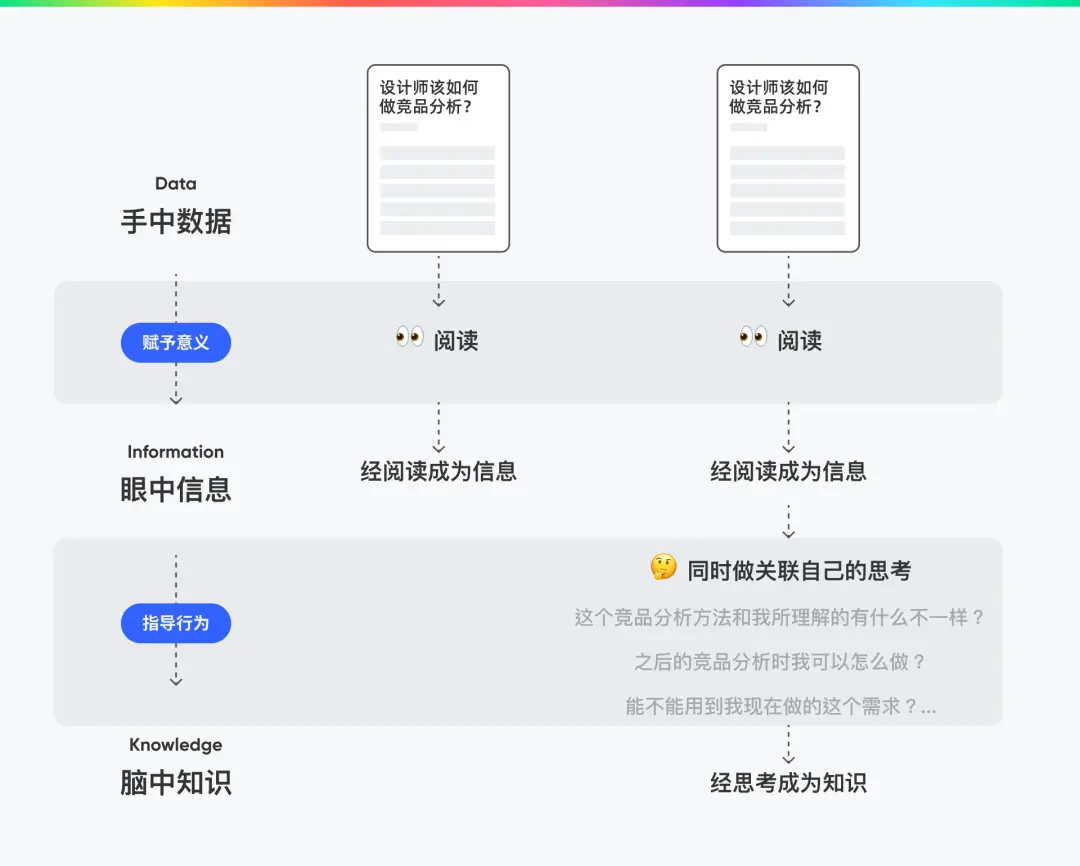
The transformation of information into knowledge has been achieved by taking this simple step of thinking. As a result, you can move quickly to the problem-solving level and continue to evolve on the basis of subsequent feedback。
This is how you deal with your own information. And the next stage is our top priority。
Iv. Documentation
The purpose of this step is to integrate into a system the information that we have at the processing stage. So how do we integrate? Is there an existing methodology? Let's see what the bosses say first。
We should look at knowledge as a tree, and only with an understanding of the most basic principles, namely, the trunks and branches, can we study the details in depth and without the trunks, the leaves can be attached nowhere. — elon mask
If you just remember things in isolation and try to pull them together, then you can't really understand anything and you have to rely on the framework of models to organize your experience. Charlie manger, the poor charlie book
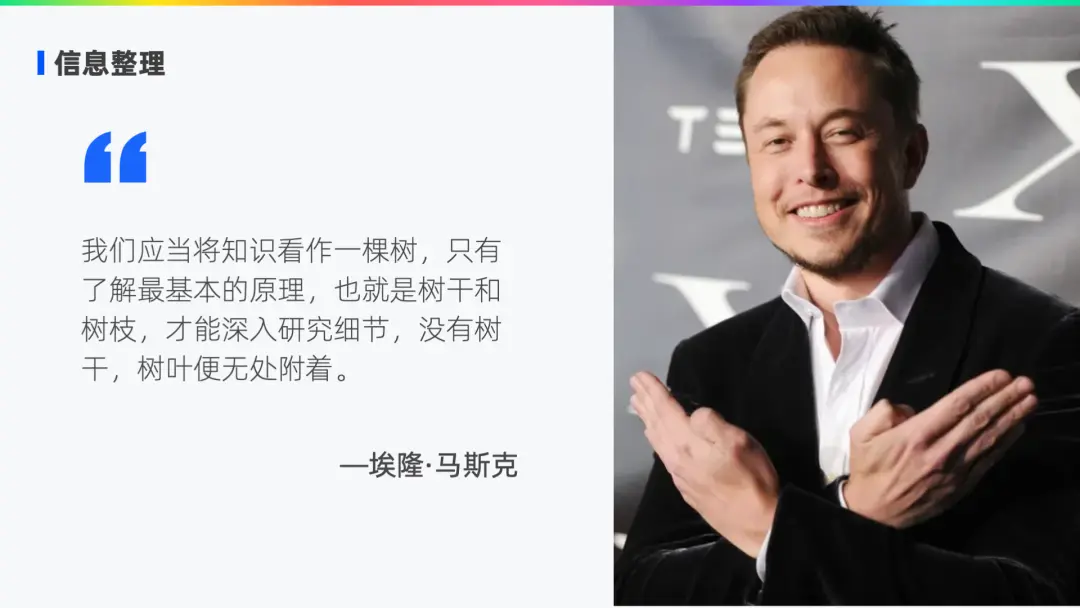
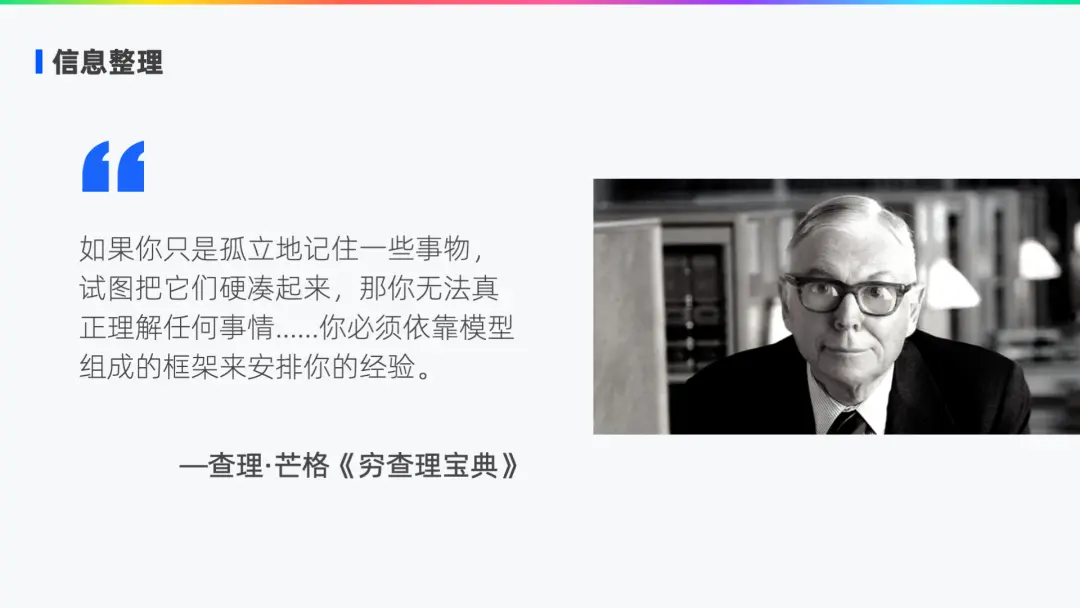
So we can see that there's something in common: in order to be better understood, a structured framework must be arranged as a vehicle。
So the main way to integrate information is to create a knowledge tree. You can also be called the knowledge base, the knowledge system, and so on
1. What is a knowledge tree
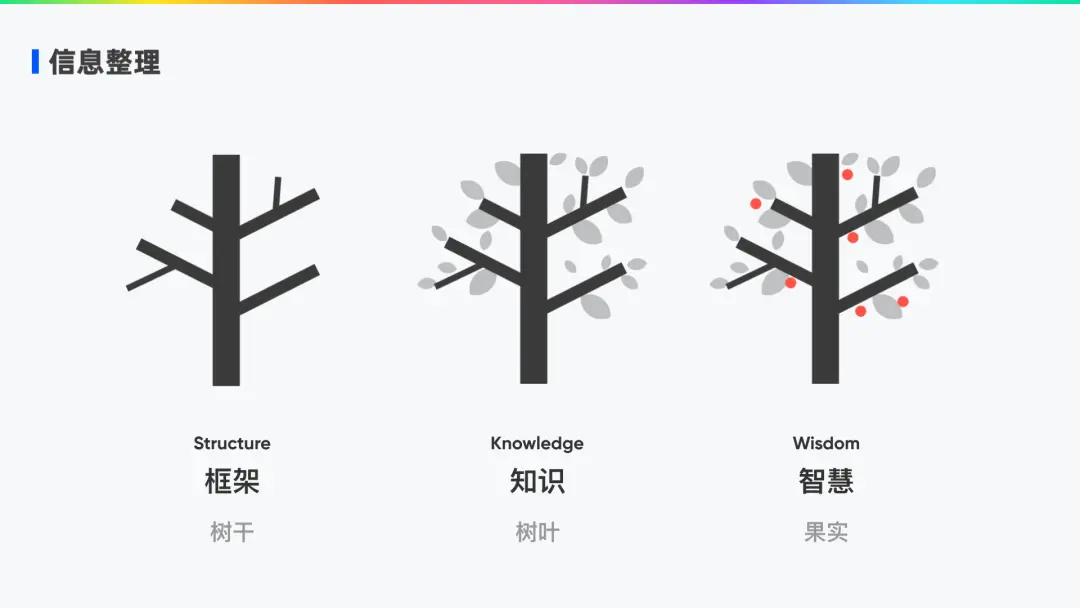
In short, the knowledge tree is a pyramid-structured knowledge system. The trunks correspond to the frame, the leaves to the knowledge, and the fruits to the wisdom of learning many times so that they can sink later. The knowledge and experience correspond to the k and w of the dikw model。
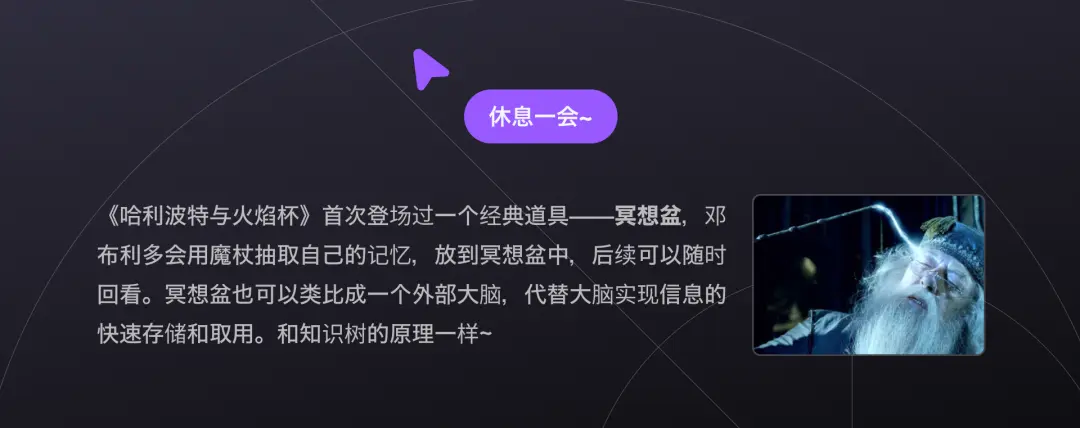
2. Why use the knowledge tree as an external brain for the permanent rapid storage of knowledge and access to the pyramid structure, so that knowledge becomes a system that counteracts debrisation through repeated storage to accelerate the pace of long-term memory formation and to remember to be stronger
Thirdly, with a simple explanation, we say remember one thing, and we say long-term memories。
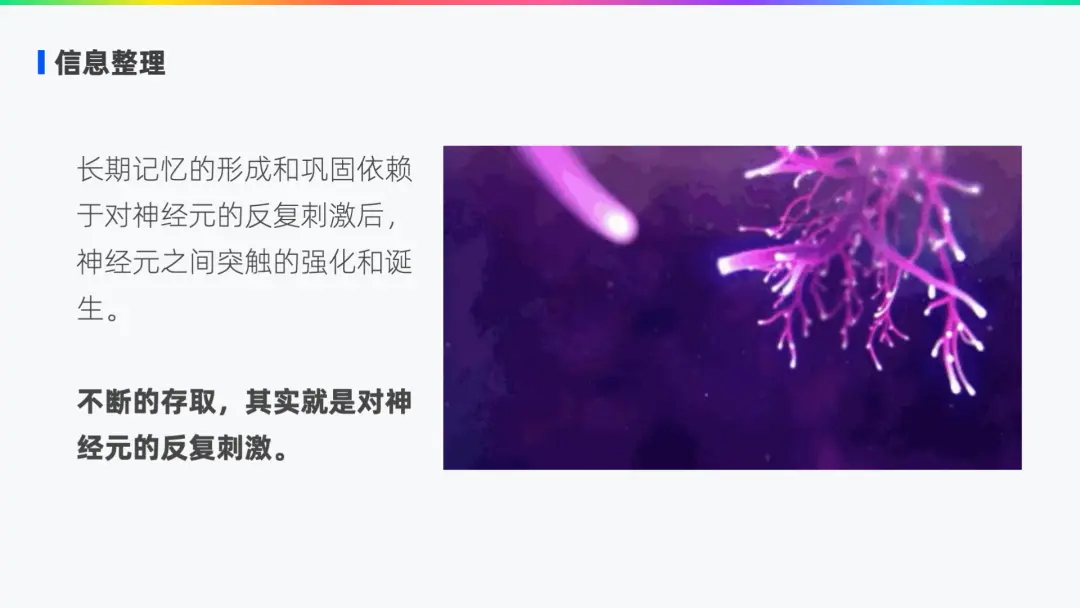
Biologically, the formation and consolidation of long-term memory depends on the intensification and birth of synapses between neurons after repeated stimulation of neurons. And the constant process of access, in fact, is a constant stimulation of neurons, which makes us even stronger。
How to build a knowledge base
We can imagine the growth of a tree, first a branch, then a leaf. So the first step is to build a framework, and this step is three things:
Because of the use of the notebook system as an external brain, it is necessary to follow the mece principle on the note: to be independent and completely exhaustive in order: to use the coding system (e. G. The dewey decimal code) to assist us with fast browsing and searching
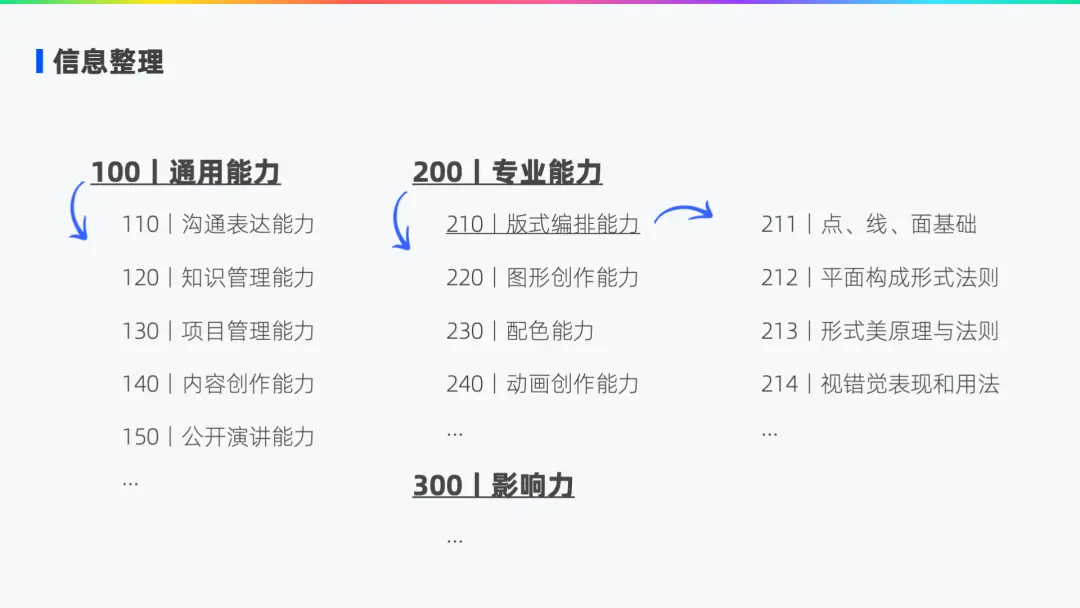
With regard to coding systems, for example, it is assumed that we will build a knowledge tree framework for personal abilities, as was the case with the dewey decimal code:
The top layer is sequenced in hundreds of numbers, such as 100,200 300 serial numbers for generic, professional and influence... The lower layer is sequenced in ten digits, such as 210, 220, 230 sub-numbers for professional competence..
The tail layer is sequenced in single digits, e. G., the sub-level numbers of layout capability are 211, 212, 213. Through these three-tiered encodings, it is possible to establish cataloguing order and enhance ease of use simply and efficiently。
The second step is knowledge filling. The guiding principle of this step is to keep only what is useful to you, and to abandon everything else。
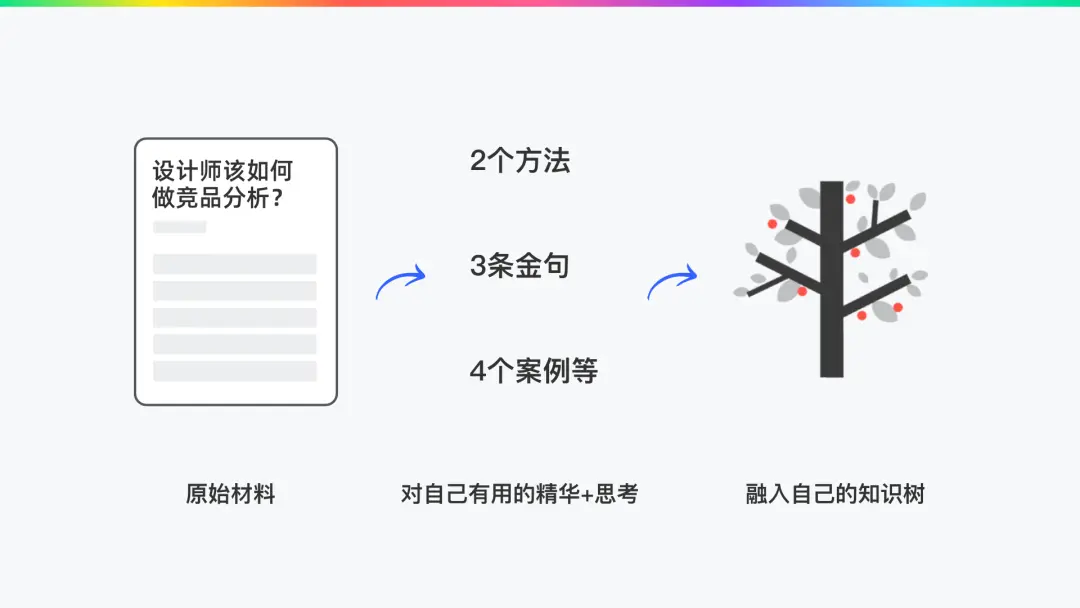
Thus, the articles at this time are no longer an undivided whole but a collection of titles, factual cases, gold sentences, views, stories, ways of thinking, etc. And then, based on what's said in the processing of information, we're going to decipher everything that works for me。
For example, in an article on how designers do competitive analysis, i think two methods, three gold sentences and four cases are useful to me, so i can break it alone. The aim is to reap quickly the information that is useful to us and to preserve it in my knowledge base for my own benefit。
Four points are noted in this step:
Enclosed with our own thoughts and insights, how much we relate to ourselves! This is the key to the transformation of information into knowledge; to attach the original source, the link, which can be understood by dating back to the original language when we cannot understand it from the removed notes; and to use the note link function to create access to information. (for example, a notion tool can create a database, make the extracted information a single card, synced block double-link, and connect the pages referenced to the card. The type of knowledge is inadequate or problematic and the framework can be iterative. Knowledge management is a dynamic and ongoing process, each of which is a sorting and upgrading of thinking。
Here we go, finally。
Information internalization
The purpose of internalizing information is to integrate it into our bodies and to transform it into something of our own. Speaking of which, i have to mention a master, richard feynman. He once said that if a scientific concept cannot be understood by a new university student, you do not really understand。
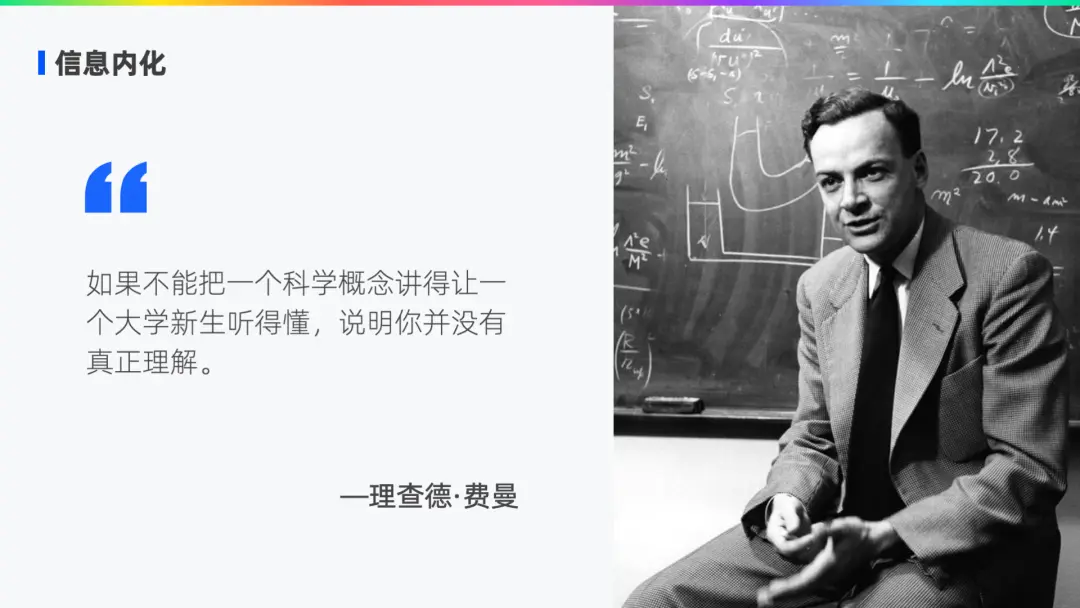
What feynman means is that we need to fill our gaps by teaching, by facing our knowledge blind areas. Specific steps are:
Select a concept that you're going to internalize and pretend to tell outsiders that there's a shell, that the place where the card is, is exactly where you're blind, needs to return to the original material and learn to keep it simple until it can be expressed
Of course, speaking to amateurs is only one way of teaching, as long as it is exported. For example:WritingIn the past few years, i have been able to share it with myself, share it online, produce short videos and even simply repeat it to myself. Of course, writing remains my most recommended mode of external output。
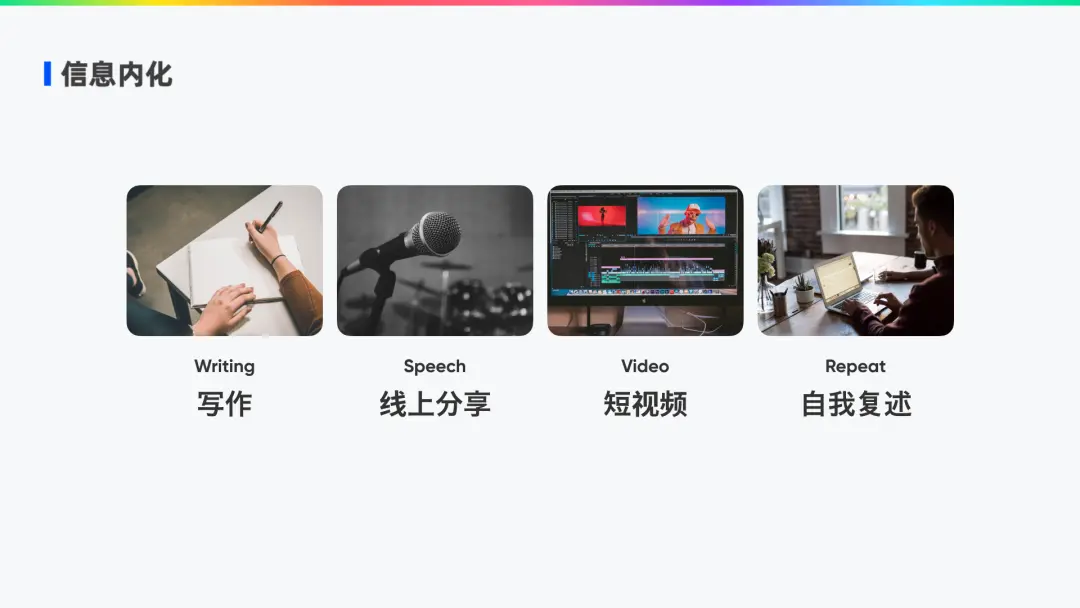
1. Why do i recommend writing
The benefits of writing are simple in terms of intergenerational learning, input costs, capacity-building and impact。
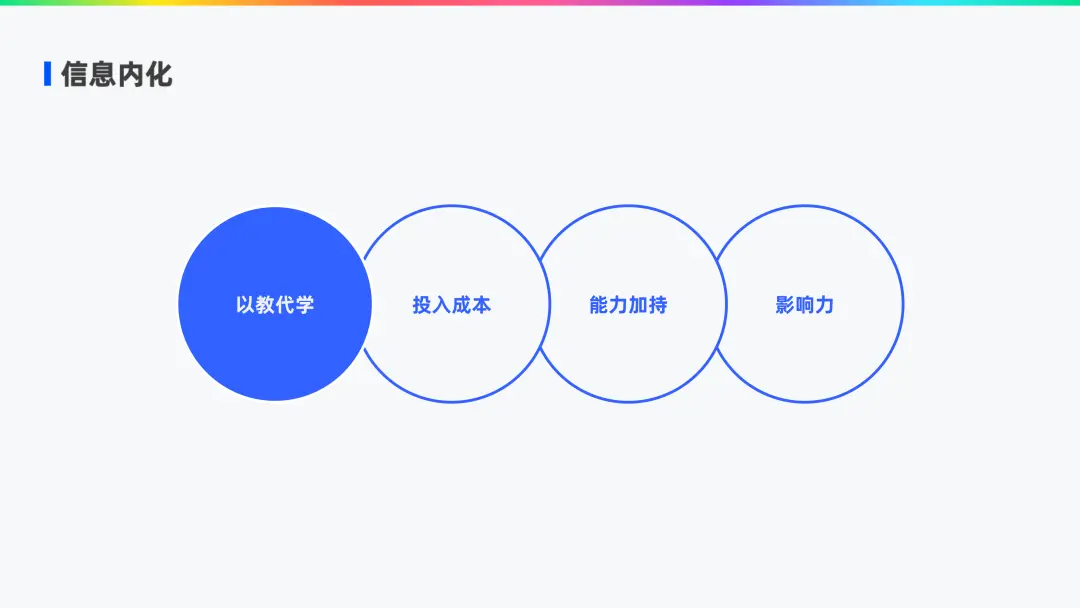
As the last link in knowledge management, writing can be well taught, and in turn compels you to fill gaps and depths in knowledge points, to internalize what you learn more effectively and to contribute to growth; to produce the lowest cost of input compared to short video and live output, which does not require steps such as scripts, clippings, phonography, etc.; to write is clearly associated with other related abilities: logic, public speaking, reporting, etc., is accompanied by increased ability and value; to write in public means continuous exposure, which means increased impact. When designers build up some influence in the industry, it means that more opportunities and resources are coming to you. Title, lecture, realization, etc。
In addition, many large plant designers have a competency model and promotion mechanism that, in addition to being too hard in terms of professional competence, will require industry influence. Thus, long-term writing has a positive impact on job search and promotion。
In addition, i myself have insisted on writing, and for two and a half years to date, including this article, has produced 100 original articles in my own public domain。
The changes that writing has brought to me can be said to have been dramatic, and i have become a columnist; i have been invited to teach underline for university students; i have been invited to do online sharing by 58uxd; more and more friends are actively linked to new partners, dignitaries and even partners; and i have attracted more business lists, liquidity, etc. Writing may not help you make money, but it will make you more valuable。
2. Simple sharing of some writing experiences
1) problem of being afraid to write
A lot of classmates, like me, may have been suspicious at first, afraid to write them up. This is quite normal, especially since many designers are low profile and do not want to be exposed. As a first step, the mind was always the first step, and my first article was a month long before i could make it public. But everybody's busy, and nobody's gonna make fun of you。
One way to use the book " disgusting courage " is to share it with you, and how others see evaluation as someone else. What we can choose to do is to completely separate the two subjects from each other, without interfering, so that the mentality is much better。
The problem of unwritten
In fact, seeing this, you should know that writing is not isolated, but the last link in knowledge management. The front line is a prelude to writing, and it's perfectly normal for a woman to be a riceless woman, not to enter, not to think. So the writing process is also a process of introspection and reflection. It is possible to try to make input and think a habit, to insist on a certain amount of input and to think every day, and even without writing, a month of awareness can be synthesized. Besides, i'm holding on to it every day. Not only does this seemingly ignominious habit get you used to texting, keeping your hands warm, but it also makes you realize what you do right every day, what you do wrong, what you see in your eyes, how you grow。
3) problem of non-resistence
Robert theodori referred to the principle of “commitment and consistency” in the book “impact”, and once a person has made a commitment, he is more inclined to complete it. In particular, in the public domain, dadline promised to "face" after all. So, based on this psychological effect, it is possible to use the same open challenge approach as i did. Two years ago, for example, i publicly committed myself, both in the public and in the friends community, to "finishing 30 original articles by the end of the year" and to divide 5 k of all the amazing friends if the challenge fails. And i'll write about every one of them, and how many of them remain。
The final effect is clear, especially for a serious delay like mine. My 100-day design challenge and my 40 original article challenges were thus completed. If you want to keep writing, you can try。
How did i prepare for this sharing
And finally, the preparation for this live sharing --
1) establishing the theme of knowledge management, all of which will need to focus on this theme。
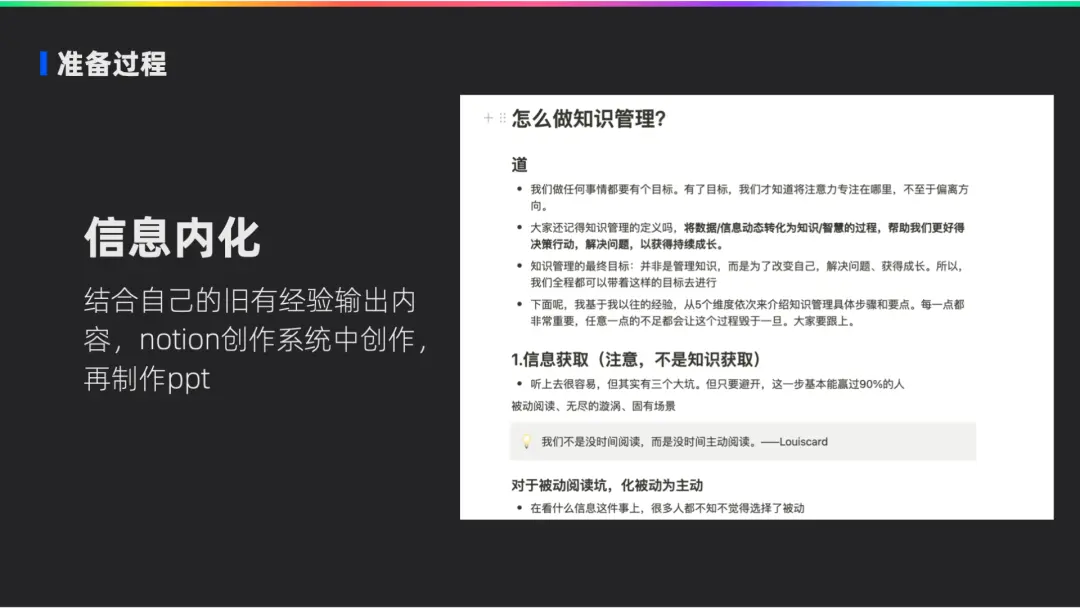
2) the information-access phase, during which i began to gather a large amount of information on the internet。

3) during the information gathering phase, all quality information is aggregated in one place using cubox。
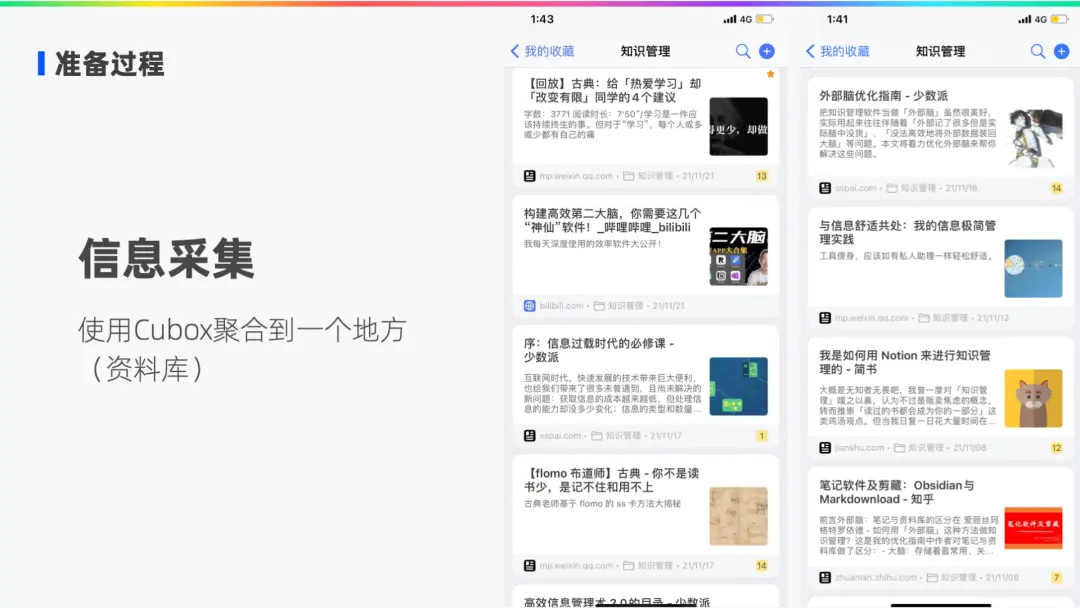
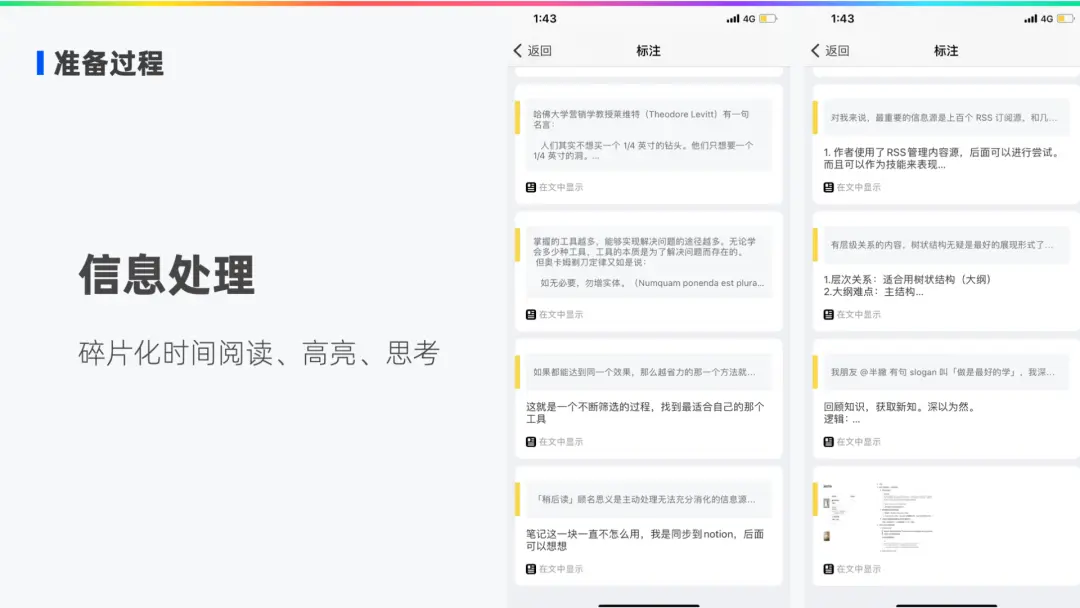
4) during the information processing phase, i use fragmentation time for in-depth reading, reflection and high-profile and labeling。
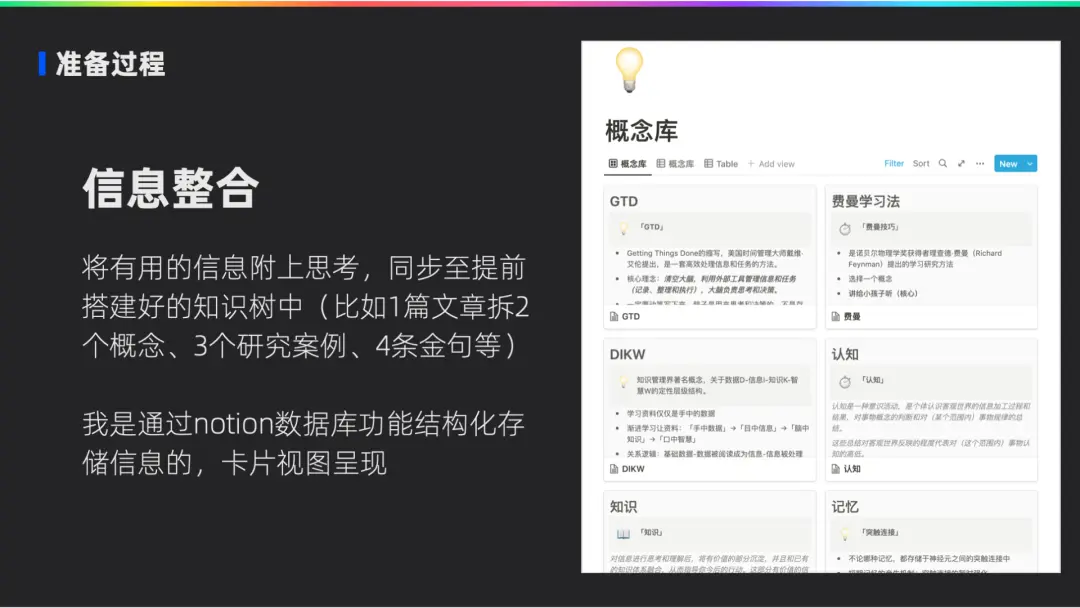
5) information integration phase, early creation of knowledge trees using notion and synchronization of the previous phase to the knowledge tree (e. G., 1 article with 2 concepts, 3 gold sentences, 4 cases, etc.)
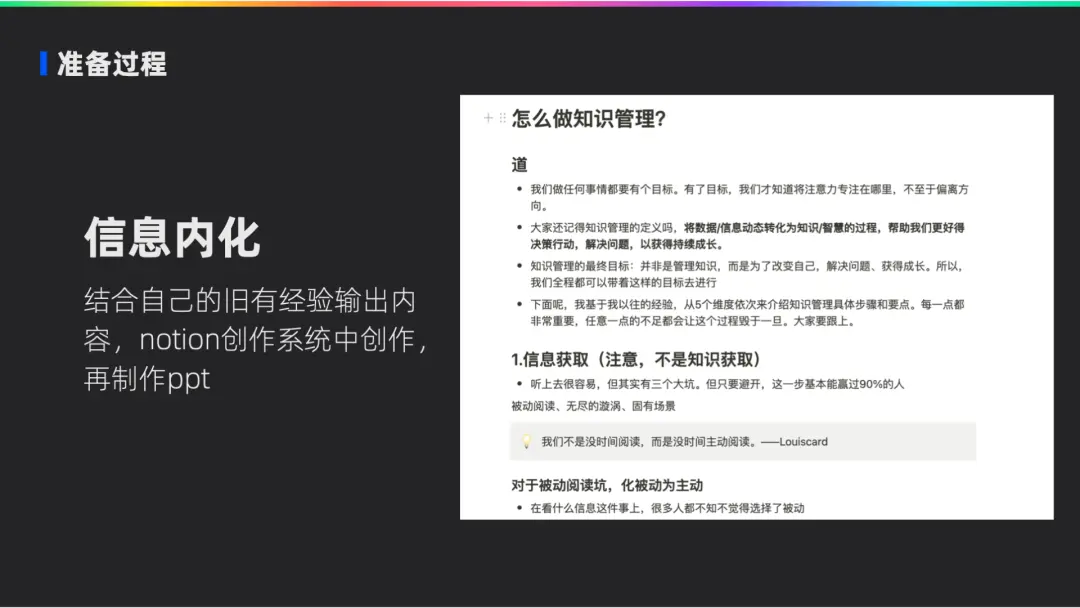
6) information internalization, content creation in the context of their old experience, and finally content-based completion
Vii. Final
And then just take a little bit of knowledge with you。
The original 13000+ product is closed here, but for reasons of space, many places are not actually spoken. We'll share more with you if we get a chance。
Finally, thank you for your patient reading. I hope this one's a good one。
I'm andrew the designer. I'll see you next time。
Columnist
Andrewchen; wireless public: design notes for transvestites, everyone being a columnist for product managers. M. A. Is self-directed in secondary schools and is good at helping young designers to grow and become effective through words. Delayed satisfaction, protractedism。









