


This is in the magazine piano art
No. 9 of 2022
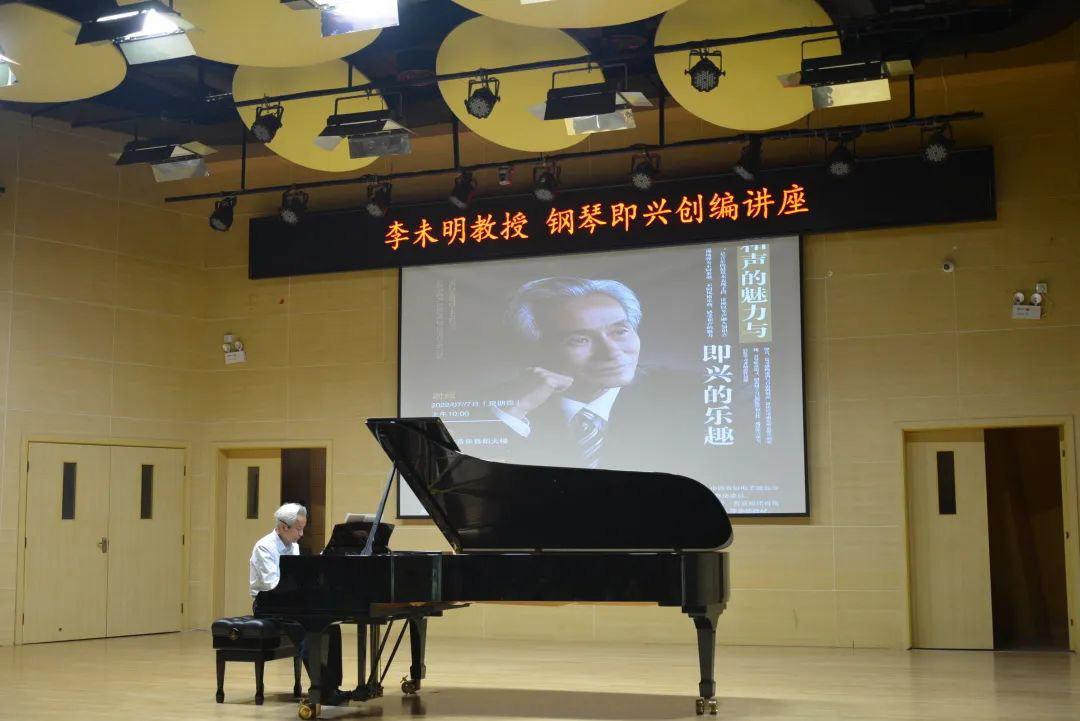
On july 7th, 2022, the organizing committee for the theme week of the faculty of music and dance of the chinese overseas university was honoured to invite professor lee wiming to the university of xiamen to perform a project for students called "the charms of peace and voice and the fun of improvisation"Academic lecturesI don't know. The author was involved in the entire course of the lectures and was impressed by the high level of enthusiasm and was able to make a contribution to the proceedings。
Of course
As shown in the title of the lecture, professor lee began this academic journey from the technical element of “peace and voice” by systematically exploring the meaning of the essence of the voice and how to learn, learn and think better and understand its unique charms。
(i) related “summary”
At the outset of the lecture, professor lee suggested that “`keypads and sound' is one of the most valuable courses; the special value of keyboards and sound lessons is to maximize the opportunity for hearing practice. In this course, theoretical concepts can be demonstrated, evaluated, judged and compared directly by sound. It enables us to compare music from sound to sound; that is to say, keyboards and sound reflect the colour, strength, emotion, style and image of the chorus. It should be said that the course is one of listening, exploration and application.” in order to more fully interpret the “keyboards and sound” course, professor lee has focused on the following six areas。
First, develop internal hearing. “the heart must move before the sound”, before the piano is played, the player must first establish the effect and colour of the sound and the sound to be played and match it with the actual sound and sound of the play, and find a difference and thus enhance his/her hearing. Professor lee quotes the famous poet goethe, “you will not pursue it if you do not know it exists”, to prove the significance of the inner hearing in the process of peaceful learning. Music is the art of the heart, the art of emotion, and when you feel it with your heart, our inner world becomes richer. Through the irish folk song danny boy, professor lee guides students to the piano to feel and sound changes, and the effect of such changes on their inner hearing。
Second, develop a sharp hearing. Through sound hearing training, students are equipped with a strong psychological memory capable of developing a sensitive emotional response to sound, sound, chord structure; once they feel specific and sound, they are able to express it more naturally on the piano. There are a number of methods of training in audio and sound hearing, such as audio, chord-resolution exercises; they can also be based on a given sound or chord, etc. Professor lee believes that from the moment of contact with music, students should learn how to listen to sound, feel and sound, thereby enhancing their ability to listen; just as children learn to speak, they can speak directly when they do not understand grammar. Professor lee cited little thompson's piano teaching material as an example. The first sound in the first edition of the course is central c. How can you play the first sound? In addition to the correct palm and fingering, there is a component to make peace to influence the child, which requires the teacher to play alongside the student. As for the first volume of thompson jr., "play it up." as soon as the first sound came out, the children heard the third, seventh, seventh and third chords (which were played by piano teachers); so many different structures and chords, so rich and so loud could have a profound impact on the children. After that, professor lee, citing the example of " creamberry flowers " , further emphasized the need for teachers to take the initiative in guiding students to feel the effect of the chords and the color of the sound。
Thirdly, the aesthetic ability to enhance harmony. The most important thing is how to choose the sound and voice that best represents music. In response to this problem, prof. Li chose the chinese national song " rivers and waters " , which was equipped with many different and audio versions, encouraging students to participate in the discussion of these different and audio versions. In order to explain more effectively the importance of acclaiming the importance of the development of aesthetic skills, professor li also chose the chapeau of beethoven's eighth piano concert, " every time i walk through a teacher's window " the moon represents my heart " , songs such as shawbang's " down e night " " , " e-precise " and " yesenia " , to further justify the need to improve the ability to acquit and acclaim the world's famous songs and to draw nutrients from them, thereby constantly improving the development of his own art。
Fourth, developing multisound thinking. Professor lee believes that the horizontal link of harmony is often more important than vertical chord structures. In the case of xinjiang kazakh folk song, “gahlette”, professor lee has shown two different ways on the piano to drive the rhythm and multisound lines together; and to discuss with students which way to push the orgasm more significantly? It is clear that horizontal multisound line movements are more likely to produce stronger and more vocal tension. Professor lee then cited beethoven's first musical instrument, the french television show mariana, and tchaikovski's first musical chapter, which focused on the form and strength of multisound thinking in music。
Fifth, it fosters a sense of innovation and a rich and vocal imagination. Learning keyboards and sound should first follow the training requirements of scientific norms; and secondly, it cannot be seen as rigid rules, which need to be constantly explored and created in order to be able to expand and act further. Innovation and voice thinking must be rich and vocal in imagination, and voice imagination is a sine qua non for building and vocal awareness of innovation. Professor lee cited einstein's famous phrase, “the imagination is more important than knowledge”, to illustrate the importance of increasing and vocal imagination. Later, professor lee cited music such as " gentlemen " , " guerrilla songs " , " let's swing two oars " , " the night on the side of moscow " , " beautiful dream god " , in order to focus on the important relevance of imagination in the actual music process。
Sixth, emphasis on practice. Keyboard and sound is a theoretical application course that translates theory and sound into sound, where sound is used to express and appeal. Therefore, sound is the key to learning, how it is made, how it is made and how it is linked. It is only through practice that we can understand, understand and grasp the logic of sound and the music style of sound. How can practice be better? Professor lee has proposed nine "to" from classical functions and voice hands to capture the positions of various kinds of chords, and then gradually to develop a fixed handframe that matches the chords; two to perform 24-size end-to-point and voice connections; three to practice multiple kinds of chords and chords, including different styles and acoustics; four to explore a variety of different and acoustic configurations of the same subject and to find the most suitable theme; five to create melody and acoustic synchronization; six to seek to engrave and sound in the brain, with a sense of "heart" and not just a hint of spectral and acousal marking; seven to do as much as possible to read, play, listen and want to synchronize; eight to move in step, with shallow depth; and nine to focus on the application of the fabric. From the above account, professor lee's love for peace is more clearly understood; in addition to his interpretation of sound-related theories, he has tried to break through the rationality of the theory by playing a large number of classics of different styles and familiar with each other on the spot, trying to be emotional, in an intuitive form of art, so that students truly understand how the emotional dimensions of rational peacekeeping practice of theory can be integrated in a particular space。
It is important that professor lee never forgets the second part, the "fun of improvisation" part, when he talks about the charisma part of the charisma, when he talks about the charisma theory and practice, and when he talks about the charlatan theory and practice, the key word of this lecture is "improvement". Thus, at the official start of the second part, students are able to easily and naturally enter improvisation. From the structure of this lecture, professor lee believes that peace and sound are the basis for achieving improvisation, or "immediate"。
(ii) related to “improvement”
The improvisation is “cotted dance” and is inspired by rational control. After mastering the dimensions of reason, students confront three questions: how to build emotional courage; how to build sensory pathways; and how to build emotional personality (or creativity). The first issue is most critical, where students have some rational knowledge but are unconscious, unwilling or even afraid to improvise. In order to effectively address this problem, professor lee asked a student to perform improvisation on the piano on the basis of a pre-set and audio sequence. While student performance can be traced, there is still considerable room for improvement, mainly because of lack of improvisation. To that end, professor li hopes that the students will be happy, driven by their hearts; that they will not be bound by established attitudes, that they will practice with courage, that they will press for love and poetry on the piano, and that they will maximize the sound of what they want。
How to improvise yourself and create a unique “me” through improvisation is the real point of improvisation. In response, prof. Lee asked each of the four students present to make a different sound and form an "f-a-d-c" quartet, and then prof. Lee demonstrated on the piano how to improvise on this established quartet. Professor lee improvises several different pieces of music, which reflect a few of his concerns about the improvisation of the piano, which can be summed up as "one holding on "two preset."。
"one stands." it is valuable that the awareness of the “preservation” of thematic material preserves the specificity of the art of time. “standing” thematic material is one of the most easily ignored or even ignored by beginners in the process of improvisation, without which improvisation cannot be called improvisation. For improvizers, in the process of improvisation, because of the instantaneous changes in the subject matter, it is possible to "defunct" in the subject matter material for a short time, but it must be returned to the subject matter material in time. This requires that improvizers strengthen the management of “thematic materials” awareness。
"two presets". First, improvisation is premised on specific and vocal contexts. It can be found in the actual music spectrum, or in a sequence of acoustic memories in the mind of the creator, or even in the schematic spectroscopy of the famous piece, etc. Second, improvisation is pre-positioned on specific and face-oriented woven sound. With its rich piano performances and the analytical work of the piano, the creators can begin with a rapid, woven sound generation exercise in the brain based on subject matter material, which can then be expressed naturally and spontaneously on the piano; and have a richer expression rather than just a bunch of meaningless, specific, organic adhesives。
Three concerns. In the case of professor lee's live piano improvisation work, first of all, special attention is paid to the transitional link between different themes. These varied and transient components of the transition link, which, on the one hand, have "temporaryly" escaped the theme melody from its own “emotional sphere” to become a contrasting part; thus, both boosting the spread of music and giving a lot of colorful and radiant hearing; the sound of the whole music is the "interlocking" between the more simple subject matter material and the more glamorous transition material. Second, special attention has been paid to the psychological change of “immediately”, thus further embodying the character of improvisation as a unique “free spiritual production”. In order to reflect instantaneous psychological changes, professor lee often undergoes mutations of instantaneous force from three technical parameters, mutations of fabrics, mutations of chords (especially sudden applications of seven chords down), plus a fast-flowing pitch (including semisonic steps). Finally, special attention is paid to multi-style free-mixing, a single mobile biblical, or a single decomposition, semi-franchise, etc., which tends to give rise to conservatism and stylistic impressions (although a single voice can also better express some established emotions), for which professor lee often uses a multi-style free-mixing approach, such as the free-mixing of classical-era fabrics (or even barlock-era fabrics), romantic fabrics, and the free-mixing of impression-based fabrics, resulting in many novel sound feelings. How can the potential exclusionary response of such a mix be avoided? Prof. Lee has incorporated subject matter material into the fabric concept, to organize different styles of fabric sound and to make it relatively uniform。
In addition to the technical aspects of the improvisation of the piano by professor li, it is possible to look at the richness of improvisation。
First of all, improvising power is the image of a living creator. This image of the creator is both the essence of music and the essence of music education. Using this common, intuitive approach, professor lee has enabled students to feel the pleasure of improvisation and has brought students into creative dimensions, giving the whole lecture the meaning of "the meaning of the world outside the world" of wittgenstein。
Secondly, improvisation highlights intuitive thinking. Improvisation is a "heart"-based campaign that integrates complex realities, impressions, into an organic whole of mind; in the process of its creation, individuals are embedding their own unique life course and awareness into such an intuitive activity by improvising themselves. Again, the improvisation emphasizes experience. Improvising is an improvisation of the initiative, and outside it is a human aesthetic experience, which is closely linked to human daily experience. The daily life experience of the students is a direct source of improvisation, and the resulting aesthetic experience is a meaningful form and a meaningful expression through conscious refining, deepening and upgrading。
Finally, improvisation does not emphasize perfection, and indeed improvisation does not. Professor lee has repeatedly emphasized that each improvisation is a “different fireworks” and that it is a different emotional expression in different contexts. To that end, students should create such concepts or consciousness that improvisation does not care whether you are fully and adequately expressed, but rather “you are expressing”, emphasizing the improvisation process and reflecting the heidegger “presence” (not the “presence”). As hoffmannstar said, "aesthetics are never independent and passive. It means judgement and action, and improvise to “judgment and action”, so that “improvement” becomes “improvement”。
To the point
(i) knowledge expression on theory
On the floor of the lecture, professor lee, while using live examples, played more than 30 musical songs, each of which, after each theoretical point, must be matched by several corresponding examples, combining theoretical expressions and practical performances in a simple, intuitive and highly effective way, making the entire lecture a concert that allowed students to “take care of” and “gods”. On the other hand, during the course of the lectures, professor li emphasized that theoretical knowledge is only an interpretation of the present situation, an understanding, not an ultimate interpretation, an understanding, and cannot be absolute. Emphasis was placed on the dynamic nature of theoretical knowledge, which could not be confined to a narrow mindset that would make it "dead knowledge", but rather a very clear concept of theoretical knowledge. If students are to question the certainty and objectivity of theoretical knowledge, try to circumvent the dogmaticization of theoretical knowledge and deepen their understanding of theoretical knowledge, the ultimate goal is to move theoretical knowledge to a specific context and to be applied flexibly, so that the rich and varied expression of “piano improvisation” will naturally give rise to the essence of “the expression of theoretical knowledge”。
(ii) expression of style on practice
Prof. Lee has chosen many different styles and different historical periods in which to play, thereby making the practice colorful and emotional. The interpretation of the same theoretical issue is supported by the fact that professor lee will also select the work of the national style, western classical style, western modern jazz style and even popular music style. For example, professor lee, in his discussion of how to “enhanced the aesthetic aesthetic abilities of harmony”, listed seven different styles of the "d-tone" "the water of the river" "when i walk through a teacher's window" "the moon represents my heart" "e-poncho" and "me and my fatherland", with piano songs, folk songs, popular songs, pop songs, etc。
(iii) interactive expression on the ground
Prof. Lee used various ways and means to make the lectures happen naturally in happy and happy situations, with the invisible realization of the concept of “situation” in cognitive learning theory. Prof. Lee gives students questions and answers on the spot; guides students on the spot on “promulgation”, and guides them on the spot, which is a high-quality interaction between teachers and students, giving students a deep sense of the joy of learning and the importance of participating in learning together。
In conclusion, professor lee's unique “concert-type” model of lectures, with a large number of practical cases, live practice and theoretical analysis, will give students some visual experience and may affect their future learning behaviour. In the course of their studies, especially in the study of some of the more complex and profound ambivalences, and in the study of the theory of place, the action is much more important than “spoken”, and can be felt by listening, analysing and practicing. Professor lee suggested that students learn the glamour of theoretical knowledge, and then, in improvising "like game" practice, visualize how theoretical knowledge can be glorified and become "pretty"。
In discussing the function and significance of improvisation, professor lee, in addition to obtaining better pedagogical results through the interaction of teaching, gave theoretical knowledge "live" and "recreated" to gain a unique sense of theoretical knowledge, which is the application of theoretical knowledge and which is a good part of the lecture。
Beyond meaning
The lecture, which was based on the theme of “choose and voice”, was an improvisational one, which, in addition to the sound of the musical body and the technical expression, gave rise to a great deal of real thinking about the improvisation of the piano and gave rise to more ideas than others。
First, in the current construction of the music profession in general higher education institutions and related disciplines, one of the obvious "problems" of improvisation is that the boundaries of improvisation cannot be clearly defined, making improvisation and related teaching impossible to objectively quantify and evaluate. However, precisely because of uncertainty, improvising education is the future of certainty, while the science of so-called definitive upbringing is more problematic than ever. Thus, teaching related to improvisation can be a useful complement to the current music profession (and, of course, to other non-musical disciplines) and can compensate for some of the obvious disadvantages of the current science disciplines. At the institute of professional music, professor sun weiqi of the shanghai academy of music has been the first to recognize the significance of improvisation and has offered courses in this field. In response, professor li has also been the first to experiment with improvisation for more than a decade at ordinary higher schools, and the results can be seen as significant. This is what improvisation means in practical terms。
Second, in the long career of professional music, the main reason for improvisation is the “crushing” of the aesthetics of scientology on the human aesthetics and the compromise and convergence between them. In essence, improvisation tends to be a model of thinking of agricultural civilization, which is inevitable in the era of industrial and post-industrial civilization. But in the modern aesthetic development process, retrospectivity, weakening reason, has become a trend of time. The improvisation of music creation and the inherent desire for “unrational” and self-expression naturally coincide with this “unrational” mentality and thus become an integral part of the aesthetics of humanism. From this perspective, the improvisation of the piano highlights irrational thinking and emphasizes intuitiveness, which makes it possible to open another door to art education, which is what the improvisation means at the aesthetic level。
Finally, marx considers that the essence of artistic production as distinct from other production is that it is “free spiritual production” “in the strict sense of the term “artistic production” only if it transcends the natural necessity of human existence, does not pursue any direct practical purpose, expresses the freedom of human beings, and displays the intrinsic force of human beings”. As a result, the orientation of artistic production can be seen as an improvisation of the piano, which can in fact be seen as a spiritual production of the main “expression of individual freedom” and “expression of the essence of the individual”. From the point of view of improvising artistic creation, which is the creation of a self-spirited mind, the improvisation of the piano is a "free spiritual production" that meets the spiritual demands of the self and gradually becomes a free and fully developed person. This is also the ultimate claim of marx's scientific socialism for human development. This is what the piano improvisation means at the philosophical level。
In retrospect of professor li wei ming's efforts over the years, it will be found that the subject of his lectures at universities is almost identical and that even the title of the lectures is unified as “the charm of peace and sound and the pleasure of improvisation”, which is his “suspension”. In the current situation of piano education, where improvisation lectures are not the mainstream (or may even be completely missing), professor li has insisted on conveying his understanding of improvisation, turning the podium into a stage, turning it into a stage, presenting his academic and performance vision for decades. Emphasis is placed on the practice of the piano, on artistic creation, on building on the current state of education to complement current music education; on mental health and enrichment; and on free, complete and comprehensive human development. This is the essence of professor li wei ming's insistence。
Lee wiming
Li wei ming, born in 1947, was born “excellent”. Born on the island of music — fujian zhumen — from being immersed in a strong artistic atmosphere, a strong and sensitive artistic intuitive feeling has developed; born in a musical family (mother is a famous singer in china), in the typical sense of the term “star-two”, “student-two”, and in a well-developed family, with a strong moral training that values “moral kindness” and a rigorous and systematic artistic education, has formed a strong foundation for their subsequent studies and careers. Subsequently, he became a music educator, a second-level professor at the faculty of arts of the university of xiamen, a member of the social music council of the chinese association of musicians and a vice-president of the chinese society of electronic keyboards; a former vice-president of the faculty of arts of the university of xiamen, a former vice-president of the faculty of music of the university of fujian; a member of the tenth and eleventh national political consultative union; a teacher of the national higher teacher college of the national university of taiwan; a teacher of the national academy of arts of the national university of hong kong; a teacher of the national college of higher education of the province of fujian; an award for “good educators”; a number of awards for outstanding teaching results of higher education at the university of fujian province of fujian; a number of educational materials such as the pian concerta of the national culture ministry of education, the bi-piano contest of the chinese association of musical sciences, the digital piano collective of the chinese society, and the stanway youth international piano competition of the university of china (apec), as well as well as a member of the it's a wonderful life









