


The prison guard is complete
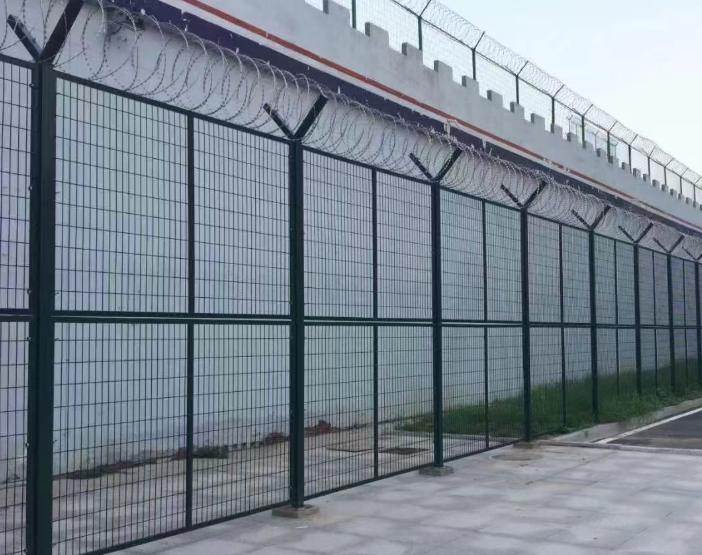
Prison guards, often referred to in the industry as fences for the supervision of steel fences, isolation fences for detention wards, perimeter fences for the perimeters of the wards, are special high-security, high-level quarantine protection products, distinguishing between general municipal guards, factory fences and courtyard fences. It is used mainly in prisons, detention centres, compulsory drug treatment centres, juvenile correctional facilities, military police barracks and war reserves. Its core design objectives are to prevent overturn, climb, damage, cut, and impact. It is the first core line of physical containment within the security system around the premises。
The security level, structural strength, duration of damage resistance, flight protection and acceptance norms of the place of custody are strict and rigid and are not substitutes for conventional fence products. The general fence serves only as a simple zoning, warning separation, while the prison guard, as a physical perimeter barrier, needs to be linked to security alarm systems such as blades of bayonet, pulses of electronic fences, video surveillance, infrared pairing, etc., to form an integrated perimeter security programme for physical blockage + detection warning + video review, which is also the core design logic of the prison guard。
I. Principles and industry norms for the design of prisons
The perimeter protection of the place of custody has clear security design requirements, and the development, production and installation of the guard post is subject to the relevant regulations of the security works at the place of custody, all of which are designed around the time of the delay in the invasion. The security industry has a core indicator: the duration of damage resistance, i. E. The time taken by the invader to cut, pry and climb across the fence using ordinary tools, which directly determines the level of security on the fence。
The perimeter fence in the conventional factory area has a very short resistance period, with the use of wire pliers and crowbars for a short period of time, and it must significantly increase the difficulty of the damage, prolong the invasion and allow for response time for security personnel on duty and for carabineros disposal。
The overall design follows five principles:
(a) priority against climbing: eliminating all available points of embarkation, grasping and borrowing, and eliminating climbing points
(a) strong shear resistance: wires are thick, welded solid, with high hard pipes and common manual tools are difficult to cut quickly
(a) structural resistance to shocks: pillars, tubes, pre-assemblies are of sufficient strength to withstand human impact, crash damage and are not prone to fallback
(a) dismantling design: the use of a security bolt, which cannot be removed from the outside without hand, screw protection against loss, sled
Resilient and stable: open-air use over the years, anti-acid rain, salt fog, aging ultraviolet light, not prone to rusty collapse, and reduced pressure on later protection in the regulatory area。
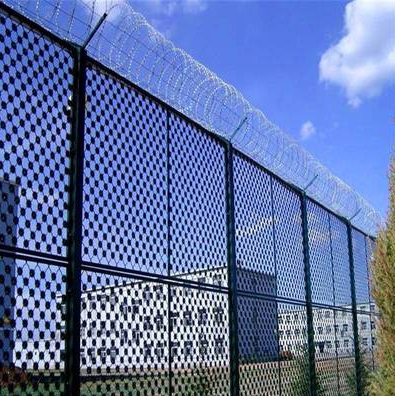
"prison fence-type web-structured details of gill holes, threads, welding nodes."
Ii. Distribution of main structure and technical parameters in prisons
The prison fences that are most frequently used in the country's prisons are divided into two main categories: the y-barrelled gill fence (y-barrel) and the frame steel fence (prison framework fence), which are not applicable in the same places as the main perimeters of many large prison projects, with the y-wire gill fences being used in the interior of the wards, the isolation wards, and the functional subdivisions。
1, y-coated gill net prison guard (first option for the main perimeter)
The y-column pillar, with a y font structure with two forks at the top of the pillar, is used to build a bladed bayonet (stabbing net) that is the most common formula for the perimeter of the first perimeter of the perimeter of the prison and detention centre。
Cylinder material: q235 low-carbon steel tubes/cylinders, standard specifications 8080 mm, 100100 mm, wall thickness 2. 5 - 3. 0 mm
(a) nets: usually using bilateral wire protection nets or welded grids of 5. 0 mm ≥, 75150 mm or 50100 mm
(b) top security configuration: a v-type support frame with a spiral blade (bto-22 standard blade gill net), tightly organized and sharply secured, which significantly increases the risk of overturn
(b) fixed fittings: all of which are anti-fouling bolts, anti-spring nuts, which cannot be removed directly by the ordinary wrench
Altitude: the general overall conventional height of the main outer perimeter is 2. 5 m, 3. 0 m, 3. 5 m, depending on the level of security and safety
Preservative process: thermal zinc plating + electrostatic spray double layer preservative, zinc layer thickness, plastic layer thickness up to the level of the foreign minister's efficacy standard。
Advantages of the y-column: the high deterrence of the top blades, the greater the difficulty of turning them over, the overall penetration, the absence of the surveillance camera view, the monitoring of the blind zone, and the soundness of the continuous laying of the outer perimeter. The disadvantage is that it is more expensive than the normal frame fence and suitable for the level-i perimeter。
2. Framework prison steel fences (part of the ward is isolated)
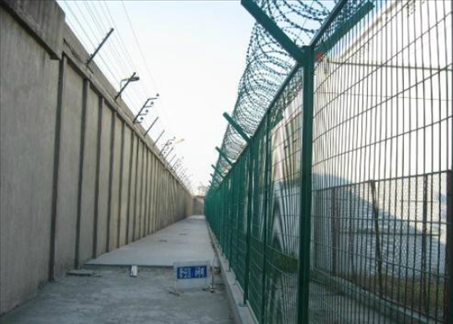
The frame guard is welded from the outer frame tube + the internal welding chip as a whole. It is more holistic, more rigid and not easily deformed. Most are used for the separation of cells, the separation of passages, the separation of vents, and the internal partition, which generally allows for the choice of bladed or unstabbing rope at the top, adjusted to the level of internal security。
Outer frame: 3050 mm, 4060 mm rectangular tube, wall thickness above 2. 0 mm
Intranet: 5mm-6mm coiled net, nethole encrypted to prevent finger reach to grab and leverage
Welding techniques: full welding, solid welding of welding points, and welding followed by welding to sharpen the thorns so as to avoid management problems caused by sharp thorns
Form of installation: pre-burial fixed or flannel swelling bolt fixed, ground-scrutinized cement base construction
The frame fence is comprehensive, structurally thick, highly impact-resistant, zonally organized, well-dressed, suitable for finely isolated, close-range area of activity。
Supplement: a small number of high-level control projects are selected using steel-net prison fences, hedge-card fence walls, which are more impact-resistant and are used in hazardous storage areas and in priority closed areas。
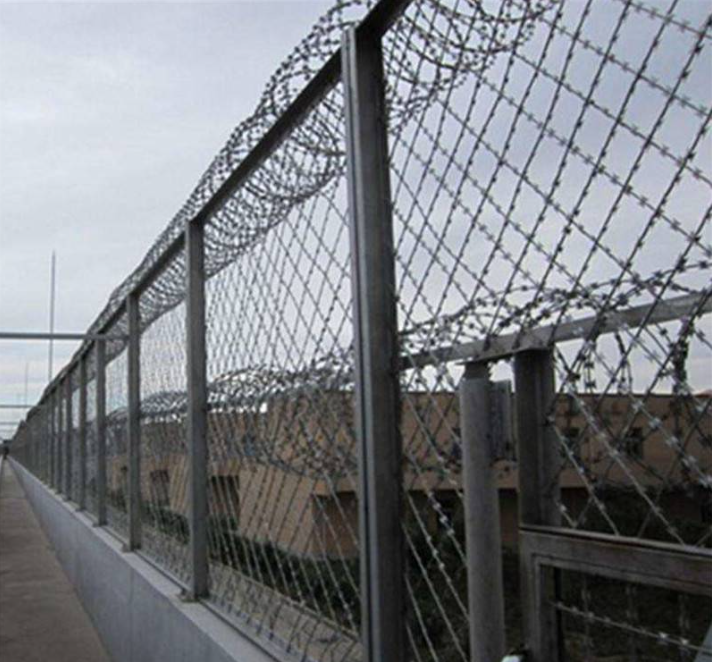
"details of the installation of bladed bayonets on top of the y-column guard."
Iii. Elaborating the corruption-proof process and why regulatory scenes have to be double-layered corruption
Prison guards are always open, many of them are wet, along the river and coastal areas, the air is very wet and salty, and if the preservation process fails to meet standards, rust, welding, rusty and thin pipes will occur in just two to three years, and the security of the system will be directly compromised, causing significant security risks for the prison system, which will be difficult to replace at a later stage and complicated in order to prevent corruption as a rigid indicator of the prison guard。
Standard prison guard corruption prevention process:
(a) step 1: scrutinization of base acids and removal of stain and oil from the surfaces of pipes
Step 2: high temperature thermal impregnated zinc, forming a layer of zinc alloy protection that isolates steel from air vapour
Step 3: surface electrostatic powder spray (spray), external resistant polyester powder, common grass green, ink green, grey and evenly coloured
Double-layer process superimposes, with normal outdoor life of up to 15-20 years, and maintenance work is extremely low in non-coastal inland areas。
Low-cost, low-cost products are only made of simple paints or monolithic sprays, with no heat-plating bottoms, with short-term beauty, with extensive rusting for 1-2 years, and the use of such simple preservation bars is strictly prohibited in regulatory projects。
Iv. Accompanying and connecting programmes for security and safety (professional focus)
The prison guard is not a physical fence that is used in isolation, a mature system of perimeter control, which is a carrier and which needs to be combined with other security equipment:
Blades: bto-22 is the common model of the place of custody, divided into spiral crosses, tablets, blades of sharp blades forming barriers, which are core parts for protection against overturn
(b) anti-fisting solids: plum-proof bolts, pentagon-resistant bolts, which require special tools to remove them, and the removal of fences within the regulatory area
(b) perimeter alarm equipment: pulse electronic fence detectors, tension nets, vibrating fibres, installed on the fence net or on a support frame, triggers an alarm signal as soon as a person climbs, squeezes or cuts, a sound light alert in the duty room, and a synchronous joint camera automatically captures the video
(a) in situ mine-protective accessories: the perimeter fence is a continuous metal conductor and the long-range fence must be made mine-protected to avoid damage to back-end warning equipment
Security alert signs: security alert signs, alert signs, which are placed at standard intervals and serve as a warning deterrent。
It's an isolated section of the frame prison
V. Basic installation construction programme, basic and fixed modalities
The basis for the installation of the prison guard also affects the overall security effects, mainly in two fixed ways:
Pre-laying: digging the base pit and laying the bottom of the pillar inside the concrete. This method, which is the most resilient and impact-resistant, is the preferred option for the main outer perimeter, suitable for new sites with strong foundations and difficult to push over
The flannel swelling bolts are fixed: the ground is hardened to the concrete floor, the base of the pole is welded to the flannel, and the ground is fixed with a high-intensity swelling screw. Advantages are being built quickly and are suitable for the rehabilitation projects that have been completed, which are mostly used on the ground in the cell area。
The construction priority control requirements are: strict control of vertical deviations of the poles and maintenance of a straight line of the whole line fence; containment of the mesh collage in a very small range, without leaving a large gap, to prevent the movement of people's hands and feet; complete coverage of all welding points, cutting of the cut-off positions, and the presence of the cut-off positions, so as to prevent rust from starting from the cut-off position; and the tightness of the blades, which cannot break down and the smoothing of the barlines is reduced to a high degree。
Upon completion of the project, the construction party will be required to perform damage tests, pull tests, external inspection and acceptance in conjunction with the a, supervisory, security and receiving unit, to provide material test reports, zinc plating measurements and complete security clearance and inspection。
Vi. Central difference between prison and communities (selection to buy pits)
Many clients can easily confuse prison guards, factory guards, airport guards, but there is a huge gap in security levels:
The design objectives are different: the general fences are used to divide areas; the prison guard core targets are delayed to enter and escape
(b) higher thickness of the wiring pipe: thicker walls, thicker wires and greater welding
(b) dismantling structures: all of the flask-proof screws, with more common bolts in the general fence, can be removed at will
Top configuration: most of the guard fences are accompanied by bladed gilllines, and the general fence is generally free of gill nets
(a) strict acceptance standards: the supervision of the project is a special security project, with the process of receiving and inspection and the information requirements being much higher than the normal municipal and factory fence
There should be no too many pedestals: there are many general fences, which are easy to climb and the prison guard structure minimizes horizontal pedals。
Scope of application
The prison guard is a special high-security fence and applies in prisons, prisons, detention centres, compulsory isolation treatment centres, juvenile correctional centres, military police barracks, armoury stores, important secret areas and border checkpoints。
The level of security varies from one region to another: the first perimeter perimeter has the highest level of perimeter security, with the choice of a high y column + encrypted blade for the barline; the cachots are placed in the windyard, the internal corridor is isolated, and a framework secure steel net fence is used, where appropriate, to simplify the configuration of the cords, taking into account the security and management observations。
Description of plant support services
Unlike ordinary retail orders, prison guard projects mostly involve tendering for security works, with complete requirements for qualifications, samples, testing reports, site surveys, deepening drawings, production schedules, site installation and after-sale quality assurance. Formal producers may deepen their programmes on the basis of drawings or site surveys from the supervising unit, adjust the height, hole, gill line layouts, provide samples, test certificates, qualification documents in conjunction with bids, and have a specialized security and construction team, familiarize themselves with the construction management requirements of the supervising premises, comply with the requirements for site access management, and complete the completion of security and safety checks and inspections and provide long-term quality assurance services。
Ix. Summary
The prison guard is an essential physical barrier to the security of the perimeter of the place of custody and relies on high-strength steel structures, double layers of long-acting preservation against corruption, anti-climbing structures, with bladed bayonets and perimeter alarm systems, to form multi-layered defensive lines, to prevent overturning and escape at the physical level and to gain valuable response time for safe disposal。
In selecting projects, price must not be limited. Priority must be given to checking filament lines, wall thickness, corruption-proofing processes, anti-piracy fittings, anti-destruct indicators, the appropriate selection of the y-column or frame-column programme in conjunction with the project's level of protection, and the construction and inspection of the project in strict compliance with security norms, in order to stabilize the long-term, high-level security needs of key places of detention, such as prisons and detention centres。










