This is about the modules of business excellence managementQuality managementThe tenth tweet, total 1884 words, takes about two minutes, i hope you like it
Before reading this paper, please consider what is the most vulnerable part of your company's product? How do you manage it? You can also discuss it in the comment section。
If you have experience, you will all know that, if you are able to operate strictly under sop, it would normally not be too bad, especially in large quantities. However, adverse products are often most likely to occur when production processes change. So the point of change is the key node in which poor quality occurs, which is, unfortunately, ignored by many companies。
It is therefore important not only to manage normal situations, but also to focus on managing each change node, the so-called change point management。
What are the changes in the production process? This includes the replacement of materials, the replacement of knives, the switching of products, the replacement of personnel, the maintenance of equipment, the replacement of equipment, changes in processing parameters, changes in processes, etc。
So change point management has to do the following:
First step, detailed listing of relevant changes affecting product quality points
The most common change points are: changes in personnel, maintenance of equipment, replacement of equipment, replacement of aircraft, exchange of tools, changes in raw materials, changes in parameters, changes in standards, etc., which can be identified on the basis of the actual status of each company。
It is important to note here that identification must be comprehensive and complete and should not be left out。
Too often, the mistake is that, because of experience, one tends to pre-empt changes that one sees as having no impact. For example, when i carried out project advancements in a company, i found that the company often suffered from strange malfeasances, presumably caused by a lack of familiarity with operating standards and methods. In response to a query about the management of changes in posts, managers all said that there was a complete management approach, which, when actually looking at the personnel management situation in the workshops, revealed significant differences in management across departments and that there was no uniform personnel change management approach. This is why, as a result of your experience, some managerial details are often overlooked, leading to anomalies. These anomalies have naturally been improved by the development of detailed personnel change management methods。
Step two, for each change point, assess its impact content and level of impact
If the accuracy of the equipment is subject to deviation after maintenance, then it is natural to confirm the accuracy of the equipment, e. G. Cp values are required to confirm the accuracy of the equipment。
If the production process parameters change, the quality of the product, etc., needs to be verified。
The actual situation needs to be assessed in detail on the basis of specific elements。
Phase iii. Development of a response to the impact of change pointsManagement processAnd management systems and education of employees to implement them accordingly。
After the first two steps, the impact of the changes and the points of change on the quality status is also clear, and detailed management methods and processes for each change point need to be developed to control each change point。
The following table shows the case in which the production sector of a company has developed, for the information of the public, regulations for all changes in the production process and the corresponding management processes。
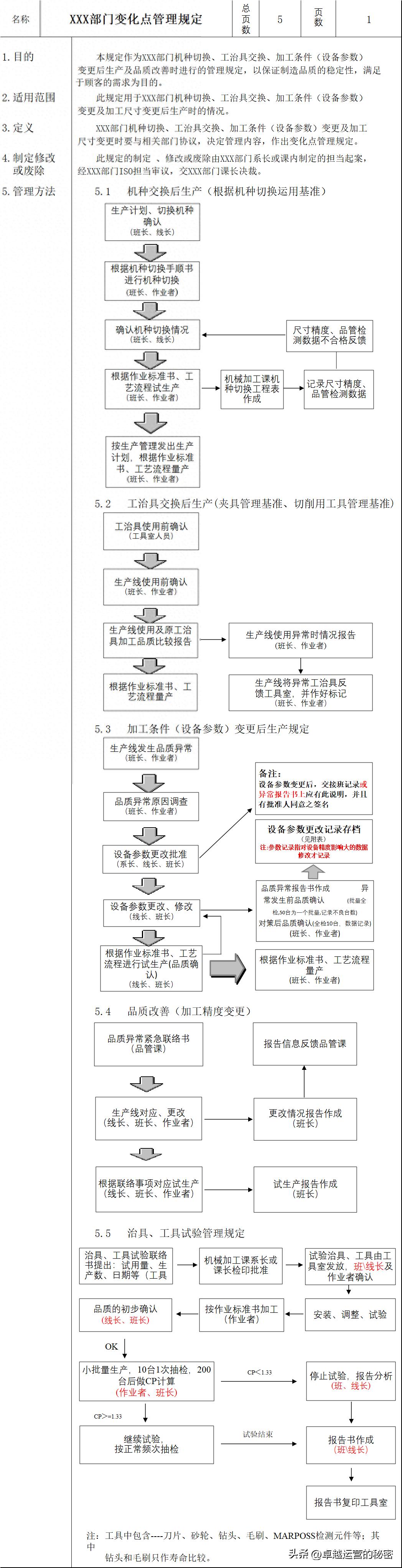
Managing change in content would naturally solve major quality problems。
Please take note of this next issue, which will provide you with an ongoing discussion on quality assurance