


Reporter
Why is it possible for ai to avoid barriers when a car drives automatically? This possibility of “prejudicing the future” is a key shift that ai is going through: it is no longer just reading, answering, but beginning to understand the laws of physics, predicting the evolution of things, and thus helping humans make rational decisions. It is called “physical ai” and “world model”。
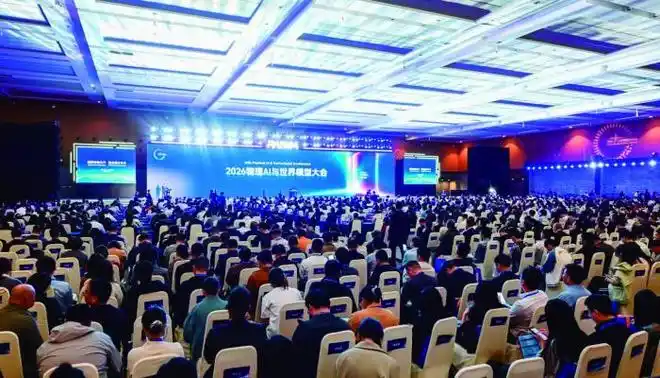
On 20 october, the 2026 physical ai and world model congress opened in nanjing. This is the country's first high-profile and comprehensive industry congress in the field of focused physics ai and world models, under the theme “model physics world, a better future for intellectual enlightenment”, bringing together a large number of turing award winners, two faculty members and industry leaders to share cutting-edge insights. The assembly also issued a series of landmark results and held major project contracts covering the areas of computing and digital infrastructure, the construction of high-quality data sets, joint research on smart key technologies and demonstration of industry applications。
The key leap: from playing chess to folding clothes
What is a physical ai with a world model? At the conference, a number of large firms shared cutting-edge insights around the world model's technological roots and trends。
In his keynote address to haibin, a member of the chinese engineering academy and director of the institute of industrial artificial intelligence of the chinese academy of sciences said that, in the field of control, the world model could be considered a dynamic model (dynamics model) with forward prediction capabilities, describing how a dynamic system was transferred by controlling input, also known as a state transfer function. In his view, the world model should have three basic capabilities: first, “simulate” before acting, without really “falling the head”; second, to complete “unvisible information”, without superficial confusion; and third, to predict “what happens in the future” and to make decisions ahead of time。
“the industry usually divides world models into generic world models and specialized world models, which are not a substitute, but which can be converted into one another.” according to haibin, the universal world model is a long-term ideal that promises to move from local modelling to a uniform representation and prediction of the physical world; and the dedicated world model will not be quickly replaced, and the two are developed in parallel and in synergy over time。
The world model is understood, but its development and use is not easy. Just as it is relatively easy for a computer to play chess as an adult, it is difficult for it to feel and act on the skills of a one-year-old child, and it is only a particular dress that can fold. This difficulty has been summed up by industry as the “molavic paradox”。
“let the machine truly understand the world in which it lives, to sense, to observe and to act.” according to haibin, physical ai research has become a critical leap from artificial intelligence to the real physical world. Large-language models allow machines to understand and generate language, images, but always “stuck in the light screen”; and world models attempt to build a “physical simulation” inside ai to understand gravity, inertia, friction and objects, pre-playing the results in the “think” before the operation. It can be said that physics ai is a closed circle of perception, decision-making and action in the real world。
In addition, ai drives polyphysical simulations into new times, such as multidisciplinary physical simulations, polykinetic simulations, robotic physics simulations. Of these, welding process controls based on a dynamic calibration function, real time based on 3d temperature field modelling, are highly promising for engineering applications。
Core foundation: building a common physical ai base
“the real physical world, full of real needs, and the core infrastructure for the next phase of ai's integration with the real economy, is in the hands of those who possess a verifiable, actionable, deployable physical ai base.” the founder and chief research and development officer of counter-max technology and head of the world modeling innovation centre at the beijing institute of intellectually-intellectual research。
"the world model is experiencing a critical leap from "virtual intelligence" to "physical intelligence." in the keynote speech, chen ji-kwan shared that current ai technology has developed a large-language model, a multi-modular model, and a smart body application, leading to a world model and a future generic physical intelligence model. What he and the team are doing is to connect “to plan missions around targets, to call tools and to adjust to implementation feedback” to the world of physical space, thus building “world models + modelling physics”, predictable world change and operational consequences, with the future becoming a common ground for smartness, intelligent manufacturing, autopiloting and simulation industries。
In the field of physical ai applications, autopilot, human robotics, industrial simulations, are the highest current orientations of land landing heat. “however, physics ai is currently in the start-up phase of 100 km of marathons, and today many models are ready to move in a well-defined laboratory environment, but this is far from entering the real industry scene.” chen bo-yu explained that the ideal state of intelligence in general physics is that physical ai can re-utilise existing knowledge when entering strange scenes, facing new objects and missions, and can accomplish its mission only with a small amount of suitability or even without additional training. The real world, on the other hand, is constantly bringing new combinations: “the marginality is not long, it is normal, objects, environment and mission requirements can change, and it is difficult to capture training coverage on a case-by-case basis. When physical ai is given thousands of tasks, the probability that these tasks will appear in the data is essentially zero”。
According to chen, this will require more scientific institutions and enterprises working to create a common physical ai base, to develop rules that can be generalized rather than fixed, to increase technological experiments, to reduce high-cost trials, to reduce the cost of real experiments, and to accelerate physical ai's access to the screen and to a wide range of professions。
On that day, the national data marker was first tested with the sioux city alliance (the long triangle data marking joint innovation centre), which will integrate data element resources from both locations and create a long triangle to map industrial synergies and innovation highlands; jiangsu also released the action plan for the construction of high-quality data sets for physical ai and world models, which simultaneously showcases some of the typical results and scenarios of the jiangsu physical ai and world models and provides practical reference for national industry development。
At the physical ai application end, li yu-ping, senior vice-president of achu technology, described the company's landing of state-of-the-art ai technology in industrial manufacturing, particularly in the areas of semiconductor chips and light module equipment. Company-related technologies and products now serve smart manufacturing plants such as meso-creative, micro- and micro-electricity, and lg new energy. Ali baba group asked the vice president of the ministry of the environment, song kong, to say that the hardware that ai wears is gradually entering people's lives, that it can assist the ai model to better reach the physical world, and that ali is further developing new products to help the physical ai and the world model move into production and integration。
Industrial empowerment: from scene advantage to industrial closure
Physical ai is different from a simple text large model and requires greater synergy between real physical scene data, physical hardware and production studies. It was described that in recent years jiangsu had taken the lead and won the initiative on the new physical ai and world model。
Jiangsu's absorptive capacity is reflected in several hard indicators: in the first half of 2026, the province-wide earnings from the ai industry amounted to $24,313 billion, an increase of 17. 32 per cent over the same period; by the end of june, the total capacity of 308 cacs had increased by 49 per cent over the end of 2025, with a cumulative total of 92 large models completed; more than 1,500 ais-related enterprises were assembled throughout the province, of which 600 were high-technology enterprises and 139 were state-owned specialized “small giants”。
More crucial is the size of the scenery. The jiangsu manufacturing industry is well organized, and real environments such as smart plant clusters, medical operating rooms, auto-driving roads and so forth continue to produce physical scene data, precisely as “materials” to train the world's most scarce models. The closed circle of “data supply-model training-situation validation-scaling” has been largely shaped in jiangsu。
The deeper point is that the physical ai landing threshold is being systematically lowered. The maturity of such tool chains means that the cost curve between small and medium-sized manufacturing firms and medical institutions will shift significantly downwards in their ability to access the world model。
As more and more world models continue to run in jiangsu, the empowerment of physical ai to the local economy is no longer confined to single-point projects, but is embedded in the day-to-day operation of manufacturing upgrades, health services and urban space governance. In workshops, world models can simulate the operation of production lines, pre-judgmentation equipment failure; in medical settings, multi-modular world models support the identification and progression of disease stoves; and in auto-driving and robotic operations sites, world models assume sensory presension and operational planning, which translates the site advantage into industrial advantage。
At the conference, two rounds of major industrial cooperation projects were contracted centrally on-site, totalling more than $6 billion, covering priority tracks such as smart integrators and core parts, world models and robotic brains, and physical ai chips, and the first national physical ai and world model investment fund strategy to build an industrial ecological support system for technology development plus capital empowerment。
It is true that the industrialization of physics ai will not take place overnight, but jiangsu is providing this track with a testable and replicable set of realistic samples with a view to planting and expecting results for another innovation in the future。









