A lotElectric operatorsThe newbies, who do a lot of shops, are always bogged down: constantly optimising the master map, making price adjustments, promoting it, working too long without traffic, without orders, with low or high prices. In fact, it was not that complex to have multiple shop busts, and all the charges were based on two core operating logics。
A lot of businesses can't do it, and the central reason is that two sets of tactics are mixed, the tracks are wrong, the blind and the inside. Today's detailed dismantling involves two major explosive strategies, fine-tuning the details of the landing and the method of breaking down, and newers can quickly break out of the shop without searching for their own products。

I. Low pricesFlow breakerStrategy: a start-up, no-budget business
This is a multi-centre, core-based start-up approach and a fundamental strategy for the operation of start-up electricists, with free natural flow driven by price-driven platforms, and zero promotion costs。
Applied scenes: new stores, small items for daily use, a lot of sales items, no cost promotion budget, and shops that urgently need zero weight。
It is common for newcomers to be wrong: many of them mistakenly assume that low prices are brainless losses, either too low direct losses, or lower prices without basic optimization, and still do not capture flows. A simple low price, which meets the price test of the platform, is the key to failure。
Details of the fallout: for the main sale price for the same equivalent, the product is priced at an industry average rate of about 90 per cent and the platform price strength label is accurate. Priority is given to the registration of low-cost activities, the accumulation of base sales and good ratings, and the refinement of buyer shows and detailed pages. It is not necessary to open up the entire site blindly, and the natural flow of the platform will help to stabilize access to visitors, sustain movement and quickly break the new shop traffic impasse。

Ii. High-profit anti-value-break strategy: avoiding low-priced domestic rolls and making steady gains
The low-priced track is extremely heavy, with little profit, and the problem of selling it can easily be lost. In order to make a long-term profit, it is necessary to master this high-profit-price-proof strategy, which is the core profit-making game operated by mature electricians, and to move away from low-cost and vicious competition。
Applied scenarios: businesses with product differentiation, subcategories, functional products, single-volume profits, and no lower prices。
It is common for newcomers to be wrong: many beginners make high-priced items, carry directly low-priced master charts, titles, detailed pages, produce without any differentiation, and are trapped in competitive paths, with customers opting directly for low-priced items, leading to zero transformation of high-priced products。
The downside details: the core is to cut prices and strengthen differences. First, it optimizes the master map and detailed pages, highlighting product upgrades, proprietary functions, post-sales safeguards and a clear distinction between low-priced and low-quality competitions; second, it uses shop coupons, new discounts, hidden price adjustments for exclusive activities and avoids open lower prices at the front desk. Finally, micro-investments are targeted at high-intensity populations, which do not buy traffic at low prices and sell on product value to achieve high profit stability。

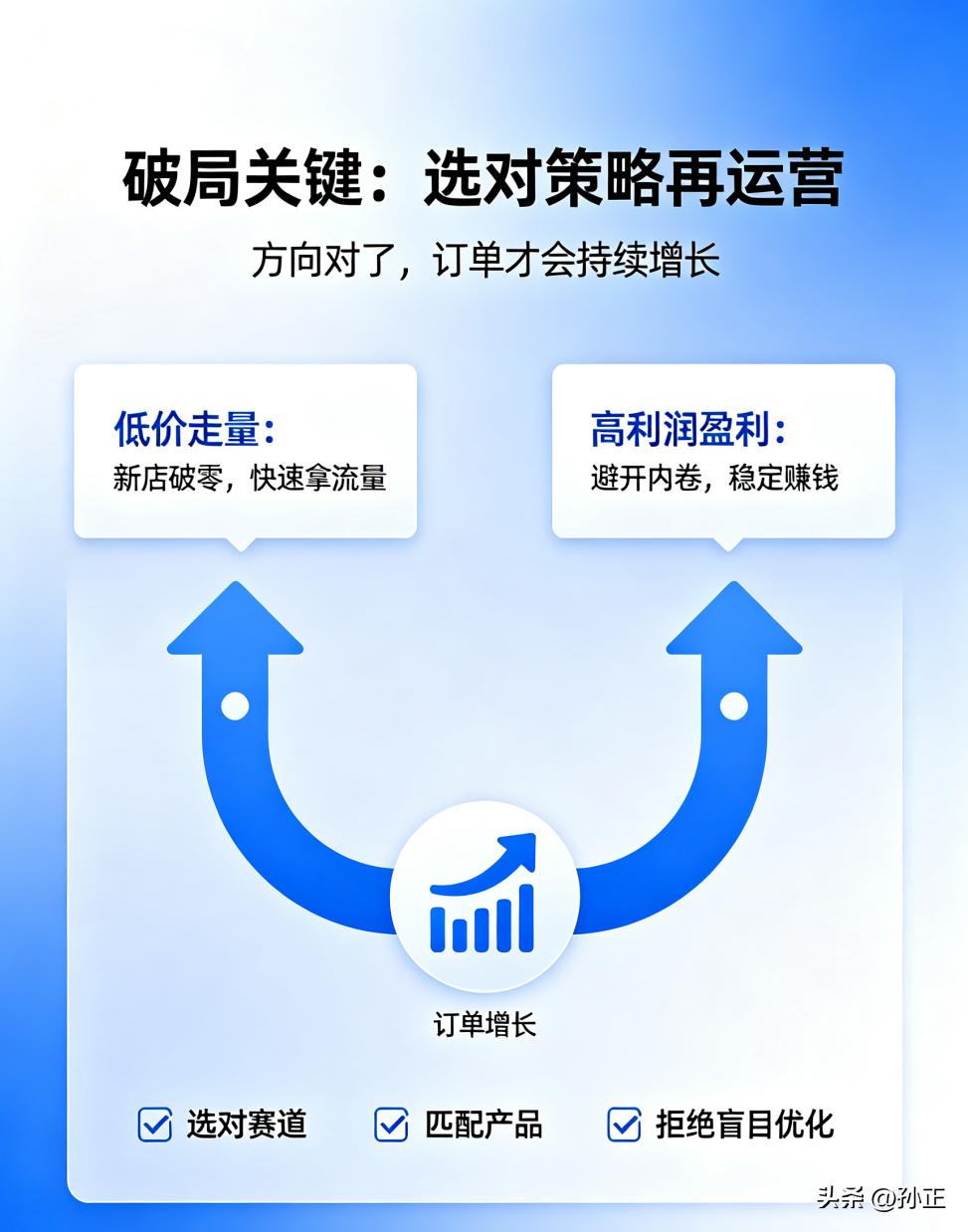
Core battery keys: selecting the right strategy, leaving the blind operation
New players do many of the biggest operational loopholes, and they don't know how to do it. The amount of money that had just been taken was not required to be higher-priced profits, resulting in the non-transformation of the flow; the difference between the profit money and the lower-priced paper, the loss of profit。
Professional electricians operate with precision matching strategies: a new start-up low-price-flow strategy, fast-breaking zero-weighted; and a long-term stable profit-fixing strategy. Selecting the right direction is far more important than blind optimization。
Summary
In the final analysis, there are only two core operating models. Low-cost strategies break the flow gridlock, high-profit strategies break through the month, and through these two sets of games, we will be able to get out of the trap of new businesses and old ones。