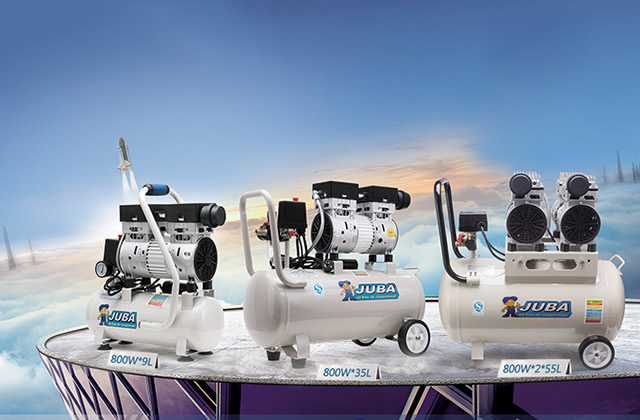
Common malfunction analysis of compressorsAir compressorMaintenance methods
We're running out of air
The shortage of vents is one of the most frequent failures of compressors, the emergence of which is caused mainly by:
1. Faults of the ingestion filters: a reduction in the volume of exhausts due to the jamming of mud; too long and too small the length of the pipe, which affects the amount of gas due to increased resistance to inhaling, and regular cleaning of the filters。
2. Reduced exhausts due to reduced condensation speed: air compressors are not used properly, as the exhausts of air compressors are designed at a certain altitude, gas temperature and humidity, and when they are used on a plateau above the above standards, the inhaling pressure is reduced。
3. Gas cylinders, pistons, pistons, severe wear, excessive wear, increased gap and leaks, affecting exhausts. In the case of normal wear and tear, vulnerable items, such as pistons, need to be replaced in a timely manner. In the case of an incorrect installation, the gap is inappropriate and should be corrected on the basis of drawings, such as, in the absence of drawings, the desired empirical information, for the gap between the piston and the cylinder along the circle, such as the casting iron piston, the gap is 0. 06/100 ~ 0. 09/100 in the diameter of the cylinder; in the case of aluminum alloy pistons, the gap is 0. 12/100 ~ 0. 18/100 in the diameter of the gas diameter; and for a steel piston the lesser value of aluminum alloy pistol。
4. The filling letter is weak, resulting in a leak that reduces the gas volume. The first reason is that the filling letter itself was not adequate at the time of manufacture; the second reason may be that, at the time of installation, the piston poles and the filling centre were poor, causing leakages such as wear, tear, and so forth; and generally, lubricating oil is added to the filling letter, which acts as lubrication, sealing and cooling。
Impact of failure of compressor inhaling, exhaust valves on exhaust volume. The valves fall between the valves and the valves into metal fragments or other impurities, resulting in severe closures and leaks. This affects not only emissions, but also changes in inter-stage pressure and temperature; such problems may arise because of quality problems in the manufacture of, for example, valves, and also because of leaks due to severe wear of valves and valves。
6. Poor match between the spring strength of the valve and the gas power. Excessive resilience slows the opening of the valves and delays in the closure of the valves, which affect not only the volume but also the increase in power, as well as the lifetime of the valves and springs. At the same time, changes in gas pressure and temperature can be affected。
7. The pressure of the pressure valve is inappropriate. If the pressure is small, the leak, of course, is too tight to allow the valve mask to be deformed and damaged. The normal pressure is calculated in the following way: p=kπ/4 d2p2, d is the valve diameter, p2 is the maximum gas pressure, k is the value greater than 1, typically 1. 5 - 2. 5, k = 1. 5 ~ 2. 0 at low pressure, k = 1. 5 ~ 2. 5 at high pressure, and k = 2. 5 ~ 2. 5. The valves fail and the caps are bound to heat, while the pressure is abnormal。
The temperature is abnormal
An abnormal vent temperature means that it is above the design value. Theoretically, the factors that influence the increase in the temperature of vents are: the temperature of intake, pressure ratio and compression index (for air compression index k = 1. 4). De facto factors that affect high inhaling temperatures, such as low cooling efficiency in the middle, or the fact that the condensation of water in the middle chiller affects the exchange of heat, are bound to be higher in the back stage and higher in the exhaust temperature. In addition, leaks in valves and pistons not only affect higher vent temperatures, but also cause changes in inter-stage pressure, as long as the pressure is higher than normal. In addition, water-cooled machines, water shortages or water shortages increase the temperature of exhausts。
The stress is abnormal
If the emissions of compressors do not meet the flow requirements of the users under rated pressure, the exhaust pressure must be reduced. At this point, it is necessary to replace a machine with the same exhaust pressure, which is large. The main reason for the abnormality of the pressure between stages is the leakage of the gas valve or piston ring after wear and tear, so that the reasons and measures should be found。
An abnormal sound
When certain components fail, the compressor makes an abnormal sound, which is generally distinguishable by the operator. Pistols have too small a gap between the lid of the tank and have a direct impact; piston poles are connected to the piston with the screws loosely or unbuttoned; the piston ends with a barbed wire and the piston moves up to the concussion tank cap; metal fragments fall into the cylinders and the build-up of water in the cylinders can sound banging inside the cylinders. An impact sound may be made in a warp case, such as a curvature bolt, a screwdriver, a bolt, a cricket bolt loose, a button, a break, etc., and a severe gap between the axle grinding and the liner of the crossing. Fracking of exhaust valves, soft or damaged springs of valves, inappropriately adjusted load adjusters, etc., can cause a bang in the valve cavity. This leads to failures and measures。
Overheated failure
At friction points such as warp axes and bearings, crosses and skateboards, fillings and piston poles, temperature exceeding specified values is referred to as overheat. The consequences of overheating: one is the acceleration of wear and tear of frictions, and the other is a major mechanical accident caused by the continuous accumulation of overheat heat and the burning of friction surfaces. The main reasons for the overheating of the bearings were: uneven alignment of the bearings with the necks of the axes or the smallness of the areas of contact; dichotomy of the bearings, too small viscosity of the lubricating axes, congestion of oil roads, failure of the pumps resulting in oil outbursts, etc.; failure to even out the installation, failure to find gaps, failure to find the main axis and the electrical axis, and tilting of the two axes。
The bearings are worn
Compressor grinding is a widespread problem, including bearings, bearings, bearings, axes, troughs and threads, with traditional methods based on welding and coating spraying, but both of which have certain disadvantages: the heat stress generated by welding high temperatures cannot be completely eliminated, is prone to material damage and leads to bending or breakage of components, while electro-painting is limited by the thickness of the coating, can be easily stripped, and both methods are metal repair, cannot alter the “hard-to-hard” co-operation, and, with the combined effect of each force, can result in further wear and tear. In modern western countries, where high-molecular composite materials are used more often than not for compressors, the most sophisticated applications are the american mercantile technology system, which has a combination of super-strength, excellent stress resistance, etc., that avoids disassembly machine processing, with no welding stress effect and no thickness limit. At the same time, the material is not metal-enabled, absorbing the shock vibrations of the equipment and avoiding the possibility of further wear。
Corrosion erosion species
The form of compressor corrosion can be divided into two categories: total (equilibrium) corrosion, which is more evenly present on the whole surface of the compressor, and local, which is only local, such as corrosion, crack corrosion, crystal corrosion, stress corrosion, etc. The application of surface organic coating to compressors using high molecular composites is one of the effective corrosive measures, with good chemical resistance and excellent mechanical and adhesive performances, and features that are simple, low-cost and well-recovered compared to traditional pressure vessel welding。
Shell cracks
Compressors often cause cracks or cracks in components due to casting, processing defects, internal stress and overloading. The normal method of repair is welding, but some of the components are cast iron, aluminium alloy, titanium alloy, which makes welding difficult. There are also dangerous blast-prone situations where weld restoration is less likely. The new “cold welding” technology avoids thermal stress deformation, while a combination of well-equipped and pressure-resistant, corrosive, etc. Allows maximum compliance with compressor usage requirements, thereby effectively ensuring operation with minimal cost inputs。