


Thinking about everyday life
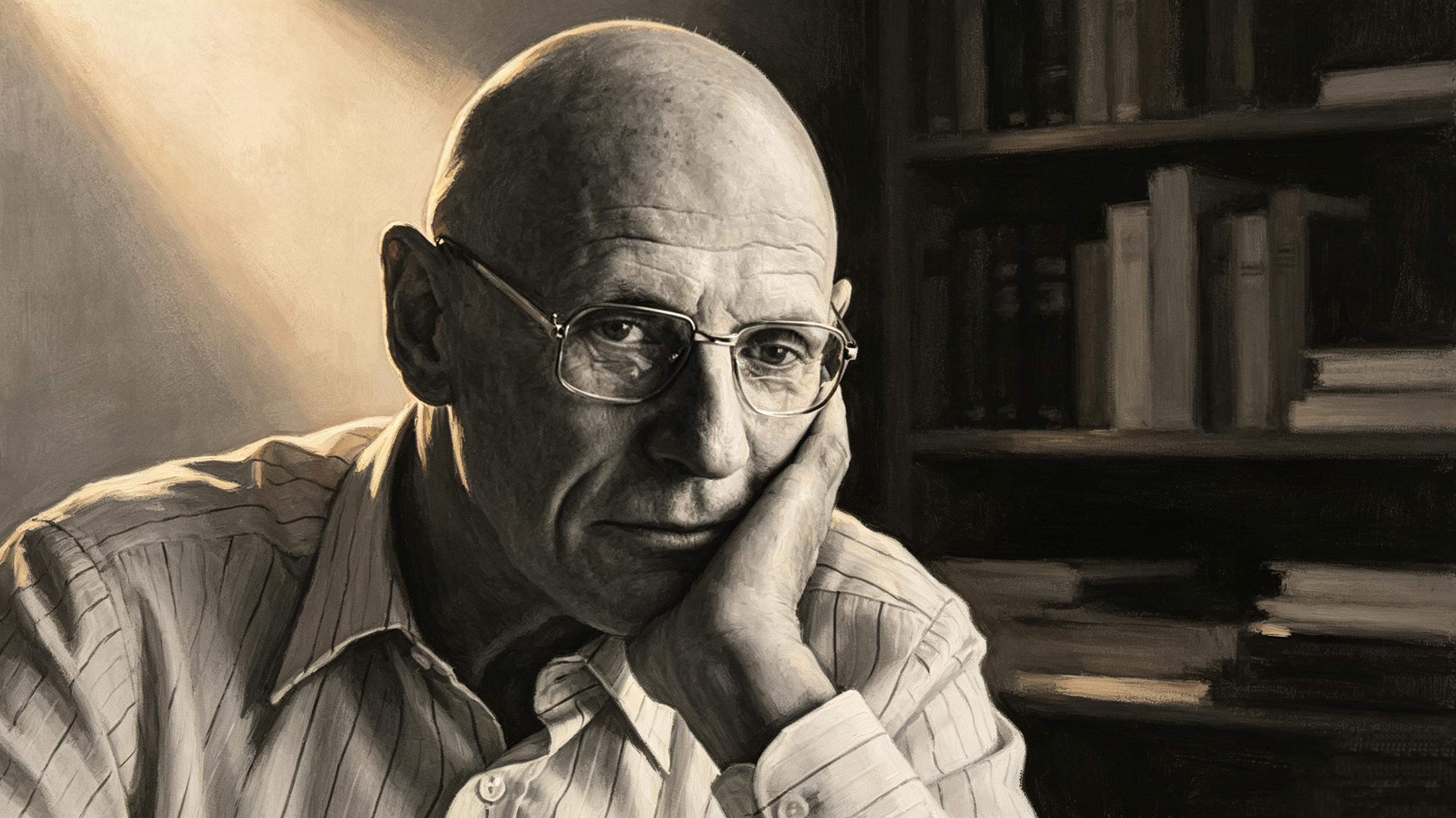
Michelle focker (1926-1984), french philosopher, social thinker, the most subversive power theorist of the twentieth century
Have you ever had that experience--
You walked into an office, and you accidentally put your voice down. You walked into a fancy restaurant and you were unconsciously straight back. You saw the camera, you sorted your hair unconsciously. You changed the language three times before you sent the circle of friends。
Nobody ordered you to do that. No one pointed a gun at you. But you're an automatic adjustment。
You feel free. You think you can do whatever you want。
But there was one person who saw the illusion of your “freedom”. He said, "you think you're acting free." in fact, every step of the way, you're in the "teaching" trek. Power is not in you, power is in you.”
This man, his name is foco。
A man who has turned power upside down
Fukuo was born in 1926 in pwaje, france. His whole life, he's had trouble with the word "normal." he's had severe depression, tried suicide, drunks, drugs. He declared his gay identity, which in those years required great courage. He wrote a doctoral thesis on “a history of madness” — studying how society defines people as “crazy” and then locking them up。
He later taught at the french academy. His class was extremely hot and the classroom was flooded. He doesn't have to deliver a speech. He talks very fast, like a storm。
In 1984 he died of aids and was only 57 years old. By the time he died, his book had been translated, discussed and debated throughout the world. He was considered “one of the most important thinkers of the twentieth century”。
But he's not the kind of philosopher who built the system. He doesn't give you answers. He gave you tools. A tool to dismantle “power”。
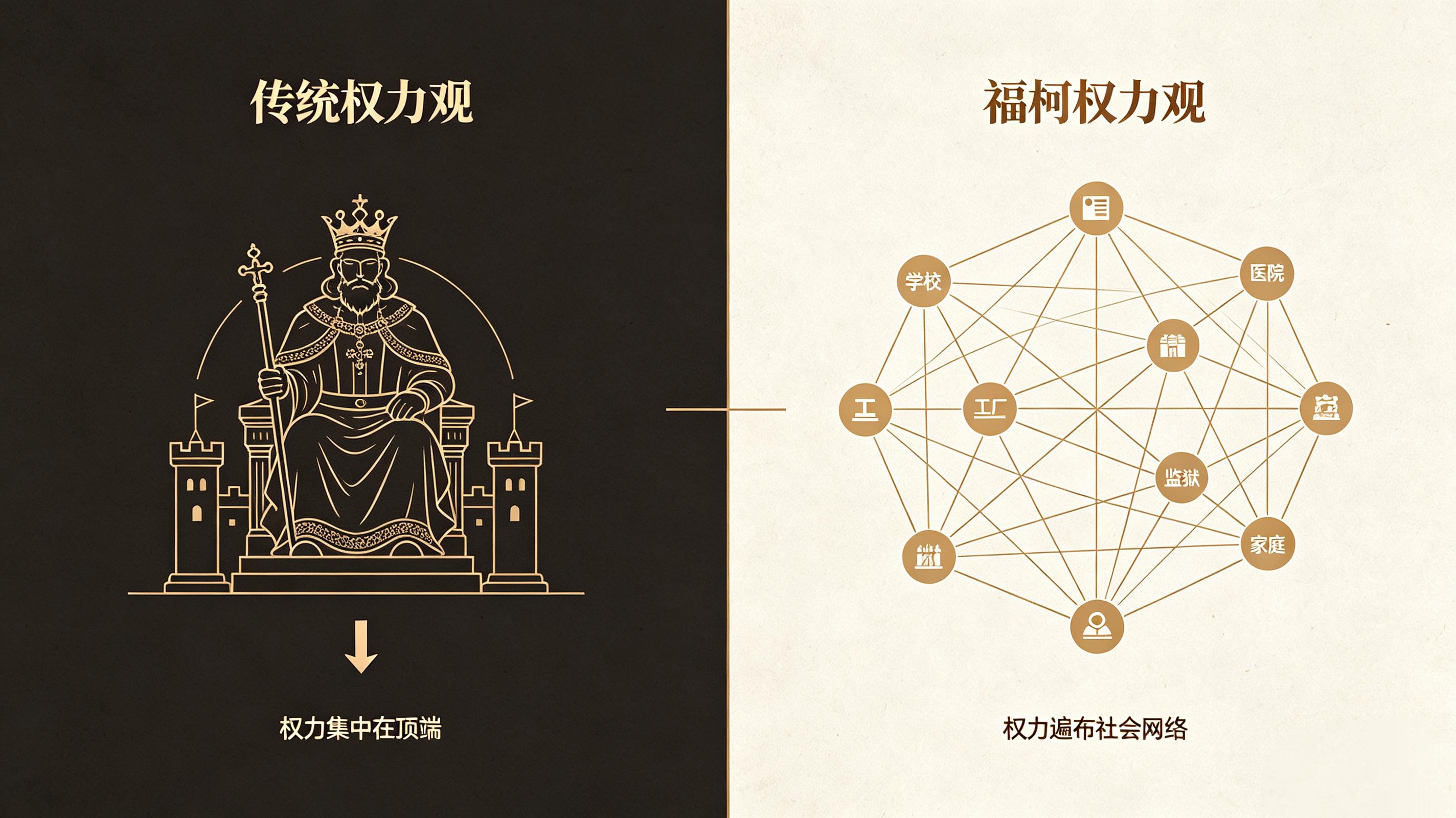
Fukuo said power is not something “who owns”. Power is a net. You're on this net. You're on this net
Power is not something. It's a relationship
How do we usually understand power
Power is something that is owned by a “person” or “an institution”. The king has power. The government has powers. The boss has power. The police have powers。
Power is “top down”. You obey because you're "feared."。
Fukuo said, "no。
Power is not “something”. Power is “relationship”。
Power is not “who has”. Power is “between whom and whom, what happens”。
Power is not “up to down”. Power is everywhere. Between you and your boss, between you and your partner, between you and your children, between you and yourself。
You are not a “victim of power”. You are also a “participator of power”。
You're exercising power when you reprimand the child. When you evaluate your colleagues, you exercise authority. You exercise power when you say "no" or "no"。
Power is not “bad”. Power is “productive”. It produces knowledge, produces words, produces “normal” and produces “irregular”。
Rules: you've been trained to be a normal person
Fukuo's most famous concept is discipline。
The discipline is not “pression”. Training is “training”。
Think about it. How did you learn to sit
When i was a kid, the teacher told you to put your hands on the table, keep your back straight and don't talk. You did it, teacher praised you. You didn't do it, the teacher criticized you。
You're trained. You're being disciplined。
You learned to sit. You learned to line up. You learned to "pay on time." you learned not to shout. You learned not to interrupt。
You've been taught to be a normal person。
Fukuo said that modern society was a huge “teaching ground”. Schools, hospitals, prisons, armies, factories — their “logical” is the same. They're all training people. They're all making normal people。
You're not born normal. You were trained to be normal。
“normal” is not “natural”. “normal” is a “product”。
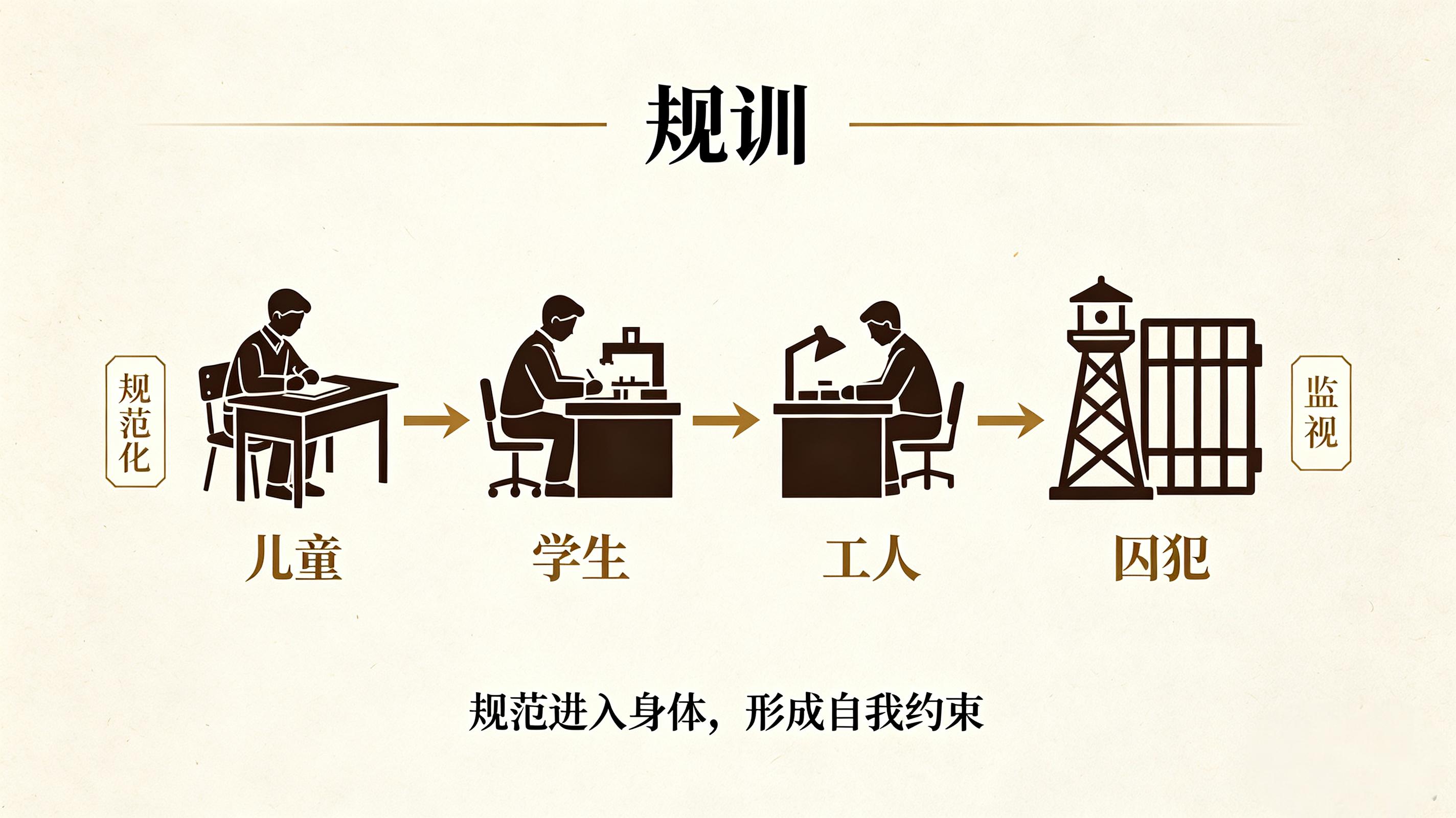
Foco says you're not born normal. You're being trained by schools, hospitals, companies, society
Panorama: you're watching, but you don't know who's watching
One of fukuo's favorite metaphors is "the panoramic spectrum."。
It's a round prison. In the middle is a watch tower. There was a cell around the corner. There were windows in the cell, facing the tower. However, there were blinds in the cell, and no one in the cell could see them。
You don't know if there's anyone in the tower. You only know "may be someone."。
So you're always in a "seen" state. You don't dare to do anything that's illegal. You can't cross the border. You can't relax。
You've taught yourself a lesson. You've become your guardian。
Fukuo said that modern society was a huge “wide view prison”。
You walk down the street, you have cameras. You work, you have kpi. You send a circle of friends, and you say, "be nice." you speak “politically correct”. Everything you do, you can be seen。
You don't know who's looking at you. But you feel like you're being watched。
So you automatically adjust your behavior. You automatically suppress your impulses. You become a normal person。
You don't need a guard. You're a guard。
Word: who's talking, who's defining
Foco also has a core concept: words。
Words are not “languages”. The words are “a set of words”. It determines “what can be said” and “what can be said” and “what is right” and “what is wrong”。
Think about it. Who defined the word "mental health"? It's psychology. Psychology tells you what is “normal”, what is “depressive” and what is “anxiety”。
You accepted the phrase. You began to use the phrase to understand yourself. You think, "i'm anxious." you think, "i'm depressed." you think, "i'm not normal."。
You're not finding yourself. You're using the word "others" to define yourself。
Foco says words are power. Who has “the power to define” and who has “the power”。
You said "inline paper" today. The word did not exist 10 years ago. It is “invented”, then “dispatch”, then “accepted”. You started to explain your pain with an "inner scroll." you think, "i can't roll anymore." you think, "i don't want to roll."。
But the volume itself is “defined”。
Living translation: you live in an invisible cage
Fukuo's philosophy, translated into the language of life, is one thing:
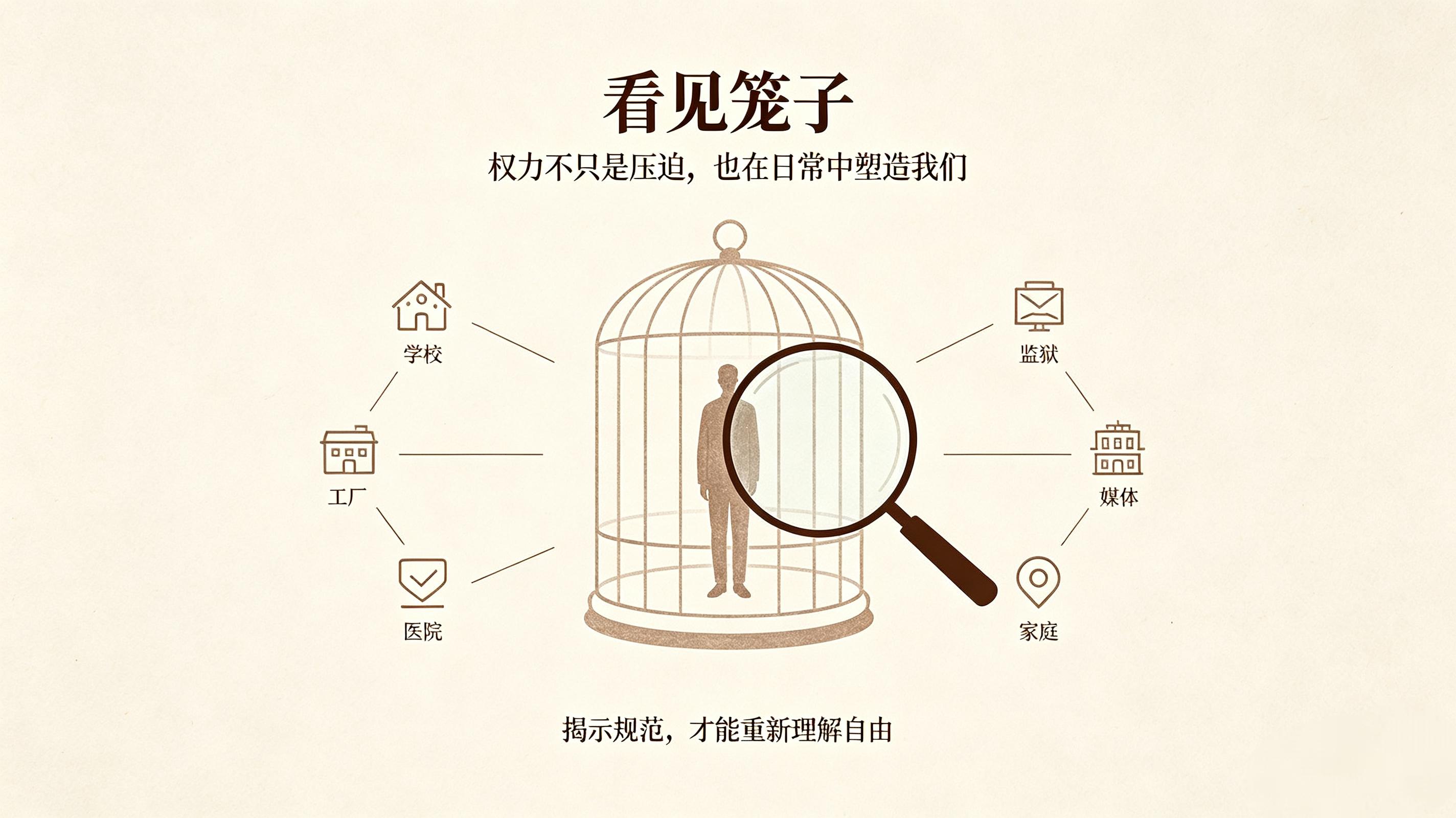
You live in an invisible cage。
The cage is not an "iron rail". The cage is "you should." the cage is “everyone does”. The cage is “an abnormal person will be ridiculed”. The cage is “you must succeed”. The cage is "you can't stop."。
You dare not “cross the border”. Not because someone stopped you, but because you stopped yourself。
You don't dare not get married. Not because “the law does not permit”. It's because "others will say you." you're afraid to quit. Not because you can't get a job. It's because, "you're afraid people think you're unstable." you don't dare to be yourself. Not "you don't have yourself." "you don't know if you're normal."。
You're so well trained. You've forgotten the cage。
Way out: not "run out" but "see the cage"
Foco didn't ask you to get out. He wants you to see the cage。
“seeing” is not “resisting”. "see" is "aware"。
You realize that you're being watched. You realize that you're “teached”. You realize, you're defining yourself in the words of others。
After seeing, you have a choice。
You can choose to continue. You can also choose not to continue。
You don't need to break a cage. You need to know where the cage is。
“power is everywhere. But resistance is everywhere."
The moment you saw the cage, you were already resisting。
The questions he left you
You changed yourself again today。
You walk into the office and you lower your voice. You saw the camera, sorted out your hair. You changed the language repeatedly before you sent the circle of friends。
Foco will ask you, "why are you adjusting?"
Is it because you want to? Or because you think you should
You don't need to fight everything. You need to know what you're doing。
You're not "free." but you can "see" your "not free."。
Seeing is the beginning of freedom。
Next period, we will move from “power” to “ meaning”. When foco said “power everywhere”, derida said, “the meaning is not `fixed'. Meaning is "delayed." you think you're talking. You're actually breaking up." the deconstruction centre — the world has no one truth。
Next issue: derida, the deconstruction center, the world has no single truth in western philosophy. 85
Interaction: have you ever had a time to "align yourself"? Walking into one of these places, you don't know what you're doing? Where are you, not yourself









