


Let's start with a fact that's not common。
In 2025, the national customs authorities seized 4205 shipments suspected of violating the law in cargo channels. Of these, 4084 shipments - 97. 12 per cent, or 99. 83 per cent of the quantity of goods seized - were detected and initiated by customs。
In other words, almost all of the counterfeits stopped at the border came from the customs authorities ' own eyes, not from the rights-holders ' reports。
And if customs eyes can see your brand, it depends on an almost zero-cost thing: if you're in the system and you're right to hang。
This is itIntellectual property rightsCustoms protection records. Free, all-way network, 10 minutes to go. But we've seen too many businesses, brands registered, platforms filed, customs filed, like a ship-by-ship out — because it's just those things that put their names on the list, that really determine the interception rate, and so on。
This one takes the whole thing apart: how are the two kinds of protections chosen, how the filing works, why the patents are basically "unuseful" in customs, and how many more sets will have to be prepared after going out to sea
Part 1: customs "involved" and "you asked for it" are two completely different mechanisms
The regulation on customs protection of intellectual property rights gives two paths, with similar names and a difference of weight。
Article 1: protection ex officio, also known as "active protection"。
This is provided that the filing is completed in the general customs administration. Customs, in its supervision, discovers that imported and exported goods may infringe on registered intellectual property rights, suspends customs clearances on their own initiative and gives notice in writing to the right-holder. The right holder is required to reply within three working days from the date of receipt of the notice as to whether there has been a violation; if the violation has been confirmed, an application for detention and guarantees have been submitted and the customs authorities have seized the goods。
Following this seizure, the customs department makes its own inquiries, determines itself within 30 working days to determine whether or not the violation was committed; if the violation is found, the goods are confiscated, fined and the suspected offence is handed over to the public security authorities。
The guarantee has a number of details that are not known to many: under ex officio protection, the guarantee is related to the value of the case, but not more than rmb 100,000 per case; and a general guarantee for the protection of intellectual property by customs may be applied for and granted without having to pay each case. In 2025, the national customs authorities approved 162 applications for general guarantees, an increase of 14. 89 per cent - this is a very small figure, which means that most enterprises are not aware of this。
Article 2: the application for protection is also called "passive protection"。
No record required. If you find that a shipment of illicit goods is about to be imported or exported, you can apply to the customs service in transit for detention。
The price is: the guarantee is equal to the goods (no ceiling of 100,000); the customs authorities do not investigate the facts of the violation; after the seizure, you have to go to court to sue or apply for preservation, and after the delay, the goods are released。
A comparison:
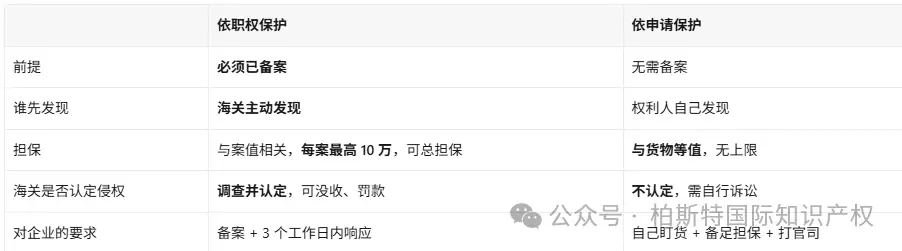
Here, 97. 12 per cent of the previous one explains: the 97 per cent that customs has taken the initiative, all of which are subject to filing. If you don't, you're willing to give up the most effective line of border protection, leaving a high-cost path of "self-discovery, self-privileged security, self-promoting."。
And the filing itself is free。
Part 22025 border fact: what can be stopped by filing
Look at the sum first. In 2025, the national customs administration implemented intellectual property protection measures in 5. 34 million cases, seizing 38. 7 million shipments of goods suspected of import or export infringement and 86. 42 million items. In total, 57 countries and territories have rights holders protected in chinese customs - this detail is worth noting: not just chinese companies in china, but rights across the globe are using the system。
By type of right, the structure is very clear:
Trademark rights3. 84 million batches, 80. 32 million pieces, absolute power
Copyright: 710 batches, 630. 02 million batches, 61. 36 per cent growth over the same period — the fastest growing piece
Patent rights: 15 batches, 1163 million。
In terms of channels, cross-border electric operators seized 246,000, still the largest number of batches; market procurement exports seized 37,888. 89 million, an increase of 48. 4 per cent over the same period. The export chain seizures of 383,000, 8581. 93 million - the main battlefield of border protection is being exported and not imported, which is particularly critical for foreign trade and cross-border: you're not just trying to keep people from selling fake goods in the country, you're going to sell them abroad against your brand。
The size of the file is also rising rapidly. In 2025, 35220 applications were processed by the customs authorities, which for the first time exceeded 30,000; and 27553 were approved, of which the rights holder in the country was 19930, an increase of 24. 38 per cent. In the “1455” five-year period, the national customs administration has nurtured 211,000 new filing rights and 1,072 million filing rights, an increase of 77 per cent and 84 per cent, respectively, over the “1355”。
A specific case illustrates how the system is running: in 2025, customs launched a special operation targeting the tide-playing industry, seizing thousands of batches and millions of abusive goods, represented by bubble-mart, throughout the year, to save businesses from economic losses. This type of case is characterized by the dispersion of production and distribution sites, which are almost impossible to report by the enterprise itself at a single port; it is possible to do so through a national customs network。
Part 3 must make one thing clear: patents are in customs, almost "no need."
This is the one that needs to be kept in mind most of all, and the biggest misunderstanding of many enterprises。
In 2025, the number of patent infringement goods seized by customs was 15. The trademarks for the same period were 38. 4 million. 2500 times。
It is not that customs do not value patents, but that the system is naturally restricted on patents for three reasons:
First, judgement costs are too high. Trademarks are false and can be characterized by identification, authorization and packaging; patent infringement is subject to a cross-section of claims, determination of whether or not they fall under protection, treatment of the principle of equivalence, existing technical defences — inspection of sites is not possible and customs does not have this function。
Second, counter-guarantees could be released. In the case of goods suspected of violating a patent right, the consignee or consignor may request a counter-guarantee release after providing security equivalent to the goods. In other words, even if the patent case is seized, the other party can hand over the goods first. Trademarks and copyrights do not have this route。
Thirdly, the patent itself is highly uncertain. A patent may be being declared invalid and the boundary itself of a possible claim is disputed. As an administrative law enforcement agency, customs is reluctant to make final judgements in this area。
So the right expectation is that trademarks and copyrights, customs are the main battlefield; patents, customs are only auxiliary, and real battlefields are in fto screening, platform complaints and courts。
The united states is the same logic. The e-recordation system of the cbp accepts only trademarks and copyright filings, and patents cannot be filed. The united states patent borders are protected by an investigation of 337 by the itc, which is executed by cbp after the exclusion order has been obtained. The threshold and cost of this route is one order of magnitude higher than for filing。
If your brand is built mainly on appearance, practical and new forms of construction, then the focus is on the fto screen and platform complaints in front of the top shelf, and don't count on customs to block it。
Part 4 how do we do it
China's customs record-keeping process is itself light: registration of rights-holders' accounts on the customs administration service platform – recording of filing application data – is submitted for review. The general customs administration takes a decision on approval or rejection within 30 working days; the rejection may be resubmitted mutatis mutandis. All-way network, no charge。
The filing shall take effect on the date of approval and shall be valid for 10 years; if the remainder of the intellectual property is valid for less than 10 years, the validity of the intellectual property shall prevail. An application for renewal may be made within six months of the expiry of the period of 10 years at a time。
Come here and just "scramble." what really pulled the intercept rate is three things。
Number one: fill in the key。
In 2025, customs came on line with a module called "standing focus on commodity points". The rights-holders are free to submit their own identification points for their own products and take photographs in the system. This means that the identification officer opened the box at the port with the identification criteria you wrote。
The value of this module is equivalent to what you have in mind as a guide to the work of more than 800 sites and 5,000 clearance agents across the country. However, very few businesses are actually filled in。
How does it work? The core is observationable, photoable, comparable:
Don't write a subjective description of "working rough" and "poor material" -- the customs officers can't judge it. You're going to write, "the original here has 0. 8 mm dents, imitations are flat."。
Number two: leave someone who can really find you。
The contact in the file is the only route that customs can reach you when it finds a suspected violation. This position is the most vulnerable: the employees who left office three years ago, the public mailbox, which is unobserved, and the number that has been shut down。
In the absence of a response within three working days after the issuance of the customs notice, the application for detention is legally considered to have been waived - the goods are released directly, and an opportunity to intercept is exhausted. The official guidelines of the cbp make this point even more straightforward: the most important point in the file is the contact person (poc), which must be updated regularly。
Third: consider filing alive, not one time。
Company name change, trademark transfer, change in licence relationship, additional legal user - all filed for change or cancellation within 30 working days. The consequence of this failure is not merely that the information is out of date: if the legal import, export or customs control of another person is seriously affected, the general customs administration may cancel the filing and, if the application is withdrawn within one year, the customs authorities may dismiss it。
Part 5 is another system, mostly year after year
It's the most easily missed link。
China customs records only china's borders. The chinese customs can stop the counterfeit from going out of china; however, it enters the country in los angeles, rotterdam, london, and is beyond the control of chinese customs — the customs authorities there identify only their own records。
So branding must be done on a separate level overseas。
United states: cbp e-recordation
Submitted online on the iprr system(). If the trademarks must be registered in the uspto main book - the trademarks registered in the secondary book cannot be filed - this is the hard threshold。
Cost: mark $190/international, renewed $80/class; copyright $190/part, valid for 20 years. The validity period of the trademark filing is synchronized with the base registration - the registration lapses and the filing lapses。
Three of the official best practices of the cbp are worthy of direct follow-up: submission of product identification guidelines (produd id guide, detailing how to identify authenticity); creation of poc as a person who understands the product and can see how it can be judged; and response within 24 hours of the cbp asking。
Eu: afa
Under eu regulation no. 608/2013, the right holder is entitled to act in his/her place by submitting an "application for action" to the customs authorities of the member states. An application may be made for an afa from a single member state or for a multi-country union afa - in one member state and in other countries listed in the application after approval。
Application is free of charge and submitted electronically via ip enforcement portal (ipep) of eupo. But there is a key limitation: it is valid for only one year and needs to be renewed annually。
A lot of people are caught up in this thing every year. The day the afa expires, your protection at the eu border is zero and there will be no warning。
It is also important to bear in mind that when goods are withheld by the eu customs, the declaring person or the holder of the goods must make a statement within 10 working days of receiving notice (3 working days for perishable goods); neither nod nor object, and be considered as consent to destruction. If you don't answer, it's probably gone。
The uk is also an afa mechanism with a duration of one year。
The value of the eu is not worth doing, looking at a set of items: in 2025, the eu seized more than 196 million counterfeit commodities at the border and internal markets, valued at about euro6. 3 billion, an increase of 67 per cent over 2024. The seizure rate is rising, meaning that law enforcement is tightening; it also means that the probability of being wrongfully withheld is increasing - this is another reminder for law-abiding exporters that the chain of filing and authorization is affordable。
Part 6 five step list
Step one, inventory。
Not all intellectual property is worth filing. Three categories are given priority: core brands (main category), trademarks and copyrights corresponding to the most imitated product lines, and registration rights in priority export markets. Copyright filed at the fastest rate in the last two years (3415 approved in 2025, an increase of 28. 7 per cent over the same period), and in the case of creation, fashion, home drawing, software interface, remember this。
The second step is to take china's customs record。
Free, online, 30 working days. This is the highest level of input output — in particular, the export chain, on which the vast majority of the 38. 3 million seizures made in 2025 were based。
Step three, fill in the key。
Write the difference between the real and the fake into something that the customs officers can match with. This step determines whether your file is "a name" or "an enforceable identification manual"。
Step four, go to sea。
United states e-recordation ($190/category), eu afa (free of charge, year after year), uk afa. It's your actual country of sale and the main port of entry - the market with the largest volume。
Step five, establish a response mechanism。
Those responsible for the three time-frames will be responsible: three working days after china customs notification, 10 working days after eu customs withholding, and 24 hours after cbp inquiries. These three numbers, any of them, are broken and all the files in front are made in vain。
Part 7 at the end
Customs isn't your law department. It's a law enforcement force that happens to be standing at the door of the state, holding the right to inspect, detain, punish, but it doesn't know your product, nor what your logo looks like。
You tell it what to see, it sees。
The filing is not a formality. It's a warrant you sent to customs. The more specific it is, the more accurate it is。









