


Concept of knowledge
Knowledge is also the product of human understanding of an objective world in practice, including human beings themselves, which includes facts, descriptions of information or skills acquired in education and practice. It could be about theory or practice. Research on knowledge is called the acquisition of knowledge involves many complex processes: perception, communication, and access to knowledge. Knowledge can also be seen as the most fundamental form of human wisdom, with consistency, fairness and the judgement of truth based on logic rather than position. The definition of knowledge is still an issue of contention, and robert grant points out that although the question “what is knowledge” has inspired many great thinkers in the world, there is still no uniform and clear definition. A classic definition comes from the fact that a statement can claim that knowledge must meet three conditions, that it must have been proven, correct and believed, and that this is the criterion for distinguishing between science and non-science。
In terms of type, knowledge can be divided into simple and complex knowledge, unique knowledge, specific knowledge and abstract knowledge, and so on. In the 1950s, the world-renowned master of science, michael polani, discovered the hidden dimensions of knowledge and thought that it was the most important discovery in his life。
The concept of knowledge is one of the most important areas of philosophy。
Chinese word source
The word “knows” for “knowledge” is both a word and a word. “target” means “shooting arrow” and “mouth” means “talking”. Together with the mouth, the word “speaks like an arrow, says dialogue like a target in an arrow”. Beneath: that's right. The term “unknown” or “unknown” refers to a lack of precision, as if the arrow had not hit the target. Whether or not the arrow is fired can be verified by the target; if so, it can be tested by the public. Example: the 18th century british astronomer harley claimed that he knew the pattern of behaviour and predicted that the comet would re-emerge in 1759. Then, on 21 january 1759, people saw the comet again. Harley's right. That's "know."。
“knowledge” is the word “know-it” written from words to words. The word “single” has been replaced by the word “single” and the word “single” has been interrupted by the master's commitment, which we can understand today. The word “single” was drawn from the sound of the song and was meant to refer to the square exercise of the ancient army. The words of the “sound” instructor (including the drums of the marching army and the killing of soldiers) and “go” refer to the weapons of participating in the conduct of the military. Following the instruction of the instructors, there will be an integrated movement of the military formations, either as a whole or as a retreat, a left or a right move, a line of rows, one to the left, one to the right, and one to the right. It will be as if we were watching the group exercises on the stage at the stadium, and we would see all the graphics that emerge from the integrated actions of the participants. Thus, the word "polytic" is used to refer to "the rule graphics and their transformation". This is the case with all the words from the word “tits”. An example of “weave” is the incorporation of a pattern into the fabric during its manufacture. For example, “thing” is the incorporation of a national pattern as a national symbol in the production of the flag, such as the five-star pattern of the chinese flag, the star strip pattern of the united states flag and the rice font pattern of the british flag. Moreover, “posts” are group players and the task is to take instructions and then make the required moves. As a result of this, the actors changed their graphics. In the light of the above, we are here to give the proper meaning and rationale for “knowledge”. Beneath: describe the shape and details of the pattern in language. Introduction: distinction, distinction. For example, “literacy” is “literacy according to the shape, structure, writing”. At the same time, learning has the speed and means to learn quickly or to know quickly that knowledge is in need of ways and means, e. G. Through web channels, through books, etc。
In-depth study
Educational psychology
Information acquired by individuals through interaction with the environment is referred to above as knowledge。
Knowledge is understood by modern cognitive psychology as being broadly and narrowly differentiated. Broad knowledge can be divided into two categories: narrative knowledge, and procedural knowledge。
1. Narrative knowledge: narrative knowledge is knowledge describing the characteristics and relationships of objective things, also known as descriptive knowledge. Narrative knowledge consists mainly of three different levels: symbols, concepts, propositions。
Symbolic manifestations are the simplest descriptive knowledge. A symbol is a symbol of something. For example, the verbs of english words studied by students, numbers in mathematics, symbols in them, symbols of chemical elements, etc. Are symbolic signs。
The concept is a reflection of the essential characteristics of a group of things and a more complex narrative knowledge。
The proposition is a statement of the relationship between things and a complex narrative knowledge. The propositions can be divided into two categories: one is a non-general question of life and only indicates the relationship between more than two particular things. Another type of proposition is the relationship between a number of things, called general, such as “the circle is twice the diameter of its radius”, where the multiple relationship is universal。
2. Procedural knowledge: procedural knowledge is a body of knowledge about the course of business, also known as operational knowledge. Such knowledge is used primarily to address the issues of “doing what” and “doing what” for operational and practical purposes。
Strategic knowledge is a more specific procedural knowledge. It is knowledge of methods and techniques of awareness activities. Such as how to remember effectively, and how to chart the way to solve problems。
Unlike philosophy, cognitive psychology studies knowledge from the point of view of its origin, the process of generation of individual knowledge and the forms of expression. For example, according to piajay, experience is derived from the interaction between individuals and the environment, and can be divided into two categories: physical experience, which comes from the outside world, which is the object of the individual's work on objective things and their knowledge; and logical -- mathematical experience, which comes from the action of the subject, which is the result of the individual understanding of the coordination between action and action. For example, when children gain experience with quantitative persistence by playing with objects, students gain knowledge of mathematical principles. Piajer's definition of knowledge is expressed in the process of generation of individual knowledge. In the classification of educational targets, blum considers knowledge to be “reminiscent of specific things and universal principles, reminiscent of methods and processes, or of a model, structure or framework”, in terms of what is contained in knowledge and as a phenomenon。
We believe that, in understanding the meaning of knowledge, it is necessary to distinguish between knowledge as a common asset of human society and knowledge in individual minds. The knowledge of human society exists objectively, but the knowledge in the individual's mind is not an objective reality per se, but a subjective manifestation of the individual's body of knowledge, i. E., the structure of the human brain, which encompasses feelings, perceptions, images, etc., as well as concepts, propositions, diagrams, which represent, respectively, the breadth and depth of the individual's reaction to objective things, which is shaped by individual cognitive activity. Generally, individual knowledge is stored in the brain in the form of a hierarchy of networks, from specific to abstract. Philosophy focuses on the nature of common knowledge in human society, while psychology focuses on the nature of individual knowledge。
Let's start with a stratification of knowledge:
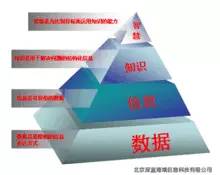
Progressive map of the intellectual class
Here we can see that the five evolutionary levels of knowledge can evolve in both directions. Distinguishing data from noise into information, upgrading to knowledge, improving wisdom. Such a process is the process of information management and classification, which allows information to flow from large amounts of disorder to orderly classification and needs. This is a knowledge management process and a process to enhance the value of information。
In turn, with the enormous wealth of means of information production, when the amount of information comes up, we find noise, and the process of information production is also a process of constant decline, from intelligence to knowledge, from knowledge to information to data that are recorded, to data that have lost its usefulness, and only the value of records, from data decline to noise, is simply nothing。
So we can extrapolate the following detailed processes:
After analysing the evolution of this knowledge, we can already see that the definition of knowledge requires several key points:
It needs to be used to guide practice and action. Whether or not it is good or not is right depends to a certain extent on the person who uses it。
Expressions must be expressionable, manifest and inherited. Expressions can take a variety of forms, but they must be understandable to the recipients, and the process of expression can lead to some loss of information。
We can therefore conclude that knowledge is a summary of all human beings and that it is true and can guide ideas, experiences, procedures, etc. That address practical problems。
Knowledge, as a special message, has more additional features, that is, the more information one adds to the branding of such characteristics, the closer it is to knowledge。
Invisible features
Note: knowledge is more hidden and needs to be summarized, summarized and refined。
Operational orientation characteristics
Note: knowledge can contribute directly to human decision-making and behaviour and accelerate the process of action。
Dynamic features
Note: knowledge is continuously updated and revised。
Subjective characteristics
Note: every person's understanding of knowledge is based on his or her subjective will。
Replicable/transferable
Note: knowledge can be replicated and transferred and reused。
Extend growth feature
Note: knowledge is constantly enriched and expanded in its application and exchange。
Capital characteristics
Note: knowledge is money。
Multiplication feature
Note: knowledge is disseminated without diminishing, but with multiplier effects. One knowledge is shared by two, at least two。
Proficiency characteristics
Note: the more knowledge is used, the more effective it is。
Situational characteristics
Note: knowledge has to work in the prescribed scenario, and human choice of knowledge is generally contextualized。
Mental acceptance
Note: knowledge must be internalized and understood in order to be applied accurately。
Result-oriented characteristics
Note: knowledge not only accelerates the process but also leads to a predictable outcome。
Identity of power
Note: people with knowledge have some hidden powers, even if they do not hold high positions。
Life characteristics
Note: knowledge is a process of production and effectiveness, life span, not permanent。
Human beings enter the age of the knowledge economy: the knowledge economy is an economy that is directly dependent on the production, dissemination and use of knowledge and information for economic growth, with the primary industrial pillar, with intellectual resources as its primary pillar, and sustainable development. According to the world, the knowledge economy is one centred on modern science and technology and based on the production, storage, use and consumption of knowledge and information。
(nonaka) believes that knowledge is recognized as the creation, organization and transmission of knowledge through the patterns and constraints of belief of the holders and recipients of knowledge, as well as the transmission of a cultural system. Knowledge changes, rebuilds and creates from irrelevant or related information, and has a broader, deeper and richer content than data and information. This perspective emphasizes knowledge and context, as well as the relationship between knowledge and information. He distinguished between two forms of knowledge: tacit knowledge and express knowledge. According to this classification, the first two types of knowledge are prominent and can be accessed by enterprises through reading materials or teaching materials, meetings and reference databases, and this type of knowledge can be computerized; and the latter two types of knowledge areInvisible knowledgeIt is more implicit knowledge, which is difficult to quantify and inform and to transfer through formal information channels. It's characterised
(a) it is a procedural knowledge, closely related to action;
(b) in everyday life, hidden knowledge is useful and a tool for people to achieve values. The higher the value of the goal, the more direct this knowledge supports the goal, the more useful it is;
(c) access to tacit knowledge, which does not receive direct help from others, is often acquired on its own, and is not a knowledge that can be heard. Invisibility is the process of knowledge-sharing。
Seci model
Yujiro nobuaga and takenoi hiromi (1991) also presented a complete model - seci model
Distinctions and linkages between data, information and knowledge (michael earl)
Data information knowledge
Contents events trends
Form, communication mode, learning
Information task description operation encoding
Access to observation, judgment, experience
Automation of organizational intent
Oecd classification
In its 1996 annual report, the knowledge-based economy, the world economic cooperation organization (oecd) divided knowledge into four main areas. Category
(a) know what knowledge (know - what) is, mainly knowledge of the facts
(b) knowledge of why (know-why), mainly knowledge of natural principles and patterns
(c) knowledge of how to do it (know - how), primarily in terms of skills and competencies for certain things
(d) knowledge of who knows (know-who) about who knows and who knows how to do something。
Davenport & prusak combines elements such as the form, composition, primary role and storage of knowledge, describing the definition of knowledge from the following:
(i) the form of knowledge: knowledge is a mobile, dynamic mixture that changes and updates as incentives and learning become available
(2) composition elements: including experience, values, scenario information and professional insight
(3) main function: it provides a reference structure to assess and integrate information and experience generated by the new stimulus, to develop new structures and to guide decision-making and behaviour
(4) storage subjects: the creation and use of knowers, knowledge in the organization not only exists in the document and knowledge base, but also in routine work, processes, practices and culture。
Knowledge
From wikipedia, the free encyclopedia
Known as a family, or undermining of someone or something, such as, or, or, or, or, or, or...
It can be effective (as with the physical killer or external) or exclusive (as with the local expertship of a project); it can be more or less for the sake of the system.
Knowledge is also said to be relevant of archowldgmentin human beings.
-situated knowledge
It is a person who is aware of the situation, and who is responsible for that situation, and who is responsible for that situation, and who is responsible for that situationI'm sorry, i'm sorry, but i'm sorry
Haraway's arms are drawn from the lives of the human, as well as the overemphasis of the inThis is the "gazes that mythically involved players all the marked boddies, that makes the unmarked city clean to see and not be seen, to present while being engaged."In order to intervene this, "haraway personnels a trial of which offenses the i"movation of the interms of both ordinary and political ability.".
Some methods of general knowledge, such as, or learning fromOne of the main targets of the oceans is much less situatioNo, no, no, no, noThis integration of scienceNo, no, no, no, no, no
In this case, that is known as "a prince", meaning that one takes for grantedThis knowledge is not knowing that one can "forget", even though someone is working from amnesia outside the world in 3d.
Even though haraway's armed are barely bOn, as well as the stage of scientific knowledge is present in the main arms of the system.









