Summer inflammation, "the divine"Air conditioningThe competition in the air-conditioning market has also entered the hottest phase of its home。
Over the past two years, in addition to price competition, brands have been showing off on post-sale maintenance services the "killer": loose, gold-to-supplied compressor extension service, and long rainbows have been selling for 10 yearsPauseAnd the brands of gly, walling, tcl, among others, emphasize “conservation warranty”。
How does “quality assurance” “package” “conservation” services differ? How can consumers pick out their brands in this “sales battle”
5 air conditioner brands, “full charter for 10 years”
As early as 2005, several air conditioner brands, such as the gry, the beauty, the long-wind, and so on, started a major battle for the upgrading of charter services. At the time, the home air conditionerAfter-sale servicesUpgraded to a “six-year package” and rolled out to industry benchmarks, and some brands have continued to date。
According to incomplete data from consumer report, out of 17 heat-sale air conditioner brands, national product plates generally implement a “six-year package” after-sale policy, while foreign brands such as gold, mitsubishi power and mitsubishi heavy work remain at the level of “three-year overhaul”. In terms of statistics, the length of the package for national product plates is longer than for foreign brands。
It is worth noting that most brands are cautious about oversold promises. At present, only five brands are committed to a 10-year “whole charter”, namely gly, casady, rainbow, tcl (for small blue-wing series only), and matsune (part of model)。
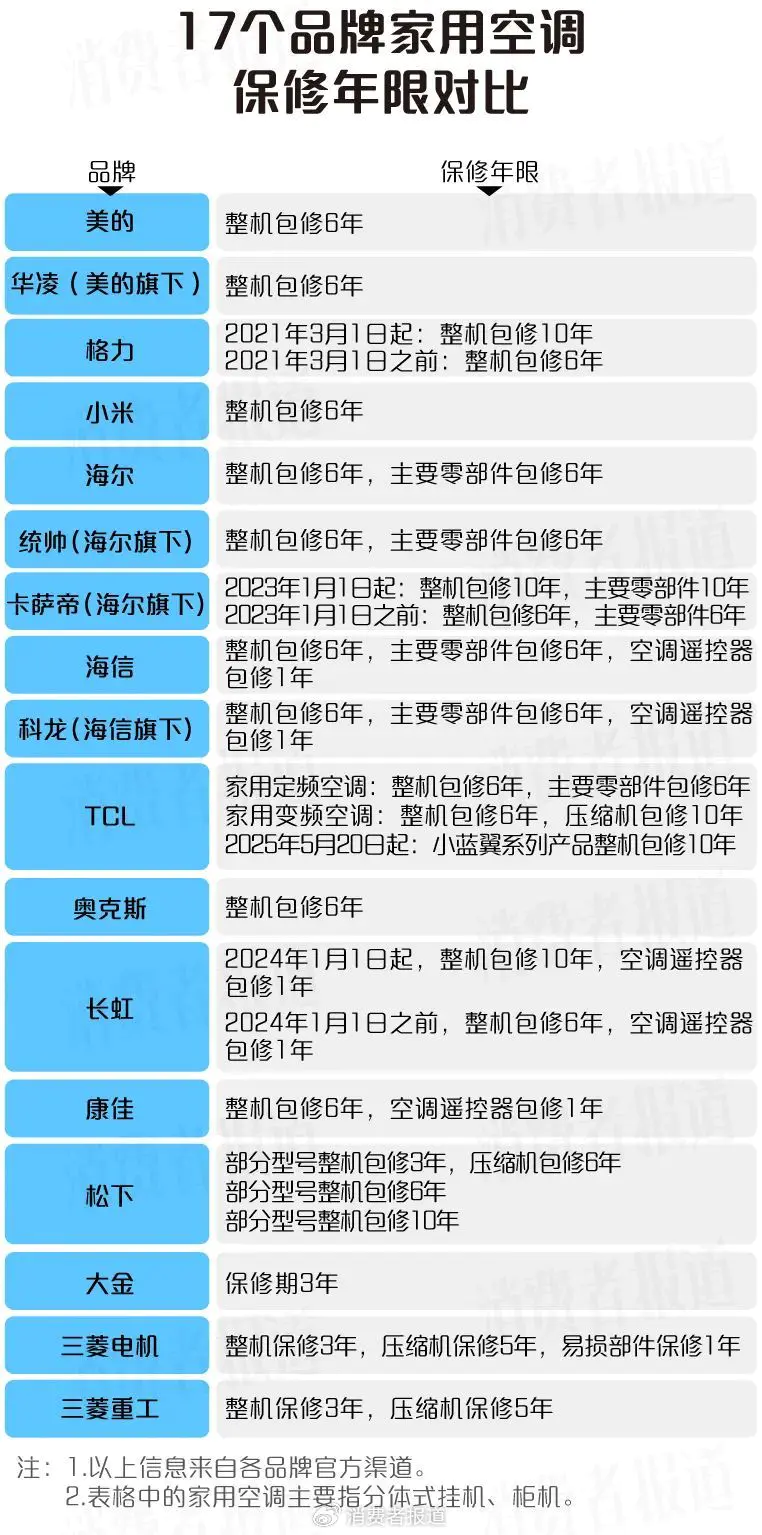
Consumers are reassured that the state's “three-pack” policy of retrofitting air conditioners brands, which are marketed for heat, is strict. The three packages of domestic air conditioners are valid for one full year and the main component for three years, in accordance with the regulation on liability for the repossession of partial commodity repairs. The main components include compressors, fans, thermostats, evaporaters, electromagnetic valves, filters, condensers and catheters。
In an interview with the consumer report, lawyer yang changshan, the law firm of sin yio-chang, stated that different products required a different “three-pack” period and that the producer had to meet the “three-pack” period prescribed by law. But if they make longer-term commitments, then the “three-pack” obligation must be met within the longer-term commitments。
In chronological order, gwig was the first brand to claim “a 10-year overhaul of the package”, followed by casady, rainbow and tcl。
In a sense, the promise of a 10-year package is the brand's self-confidence in the quality of the product and after-sale services. On the one hand, this requires enterprises to exercise strict control over the quality of products at the research and development, production and manufacturing stages and to ensure the reliability and durability of products from the source. On the other hand, this requires enterprises to build a well-established system of after-sales services that will ensure timely and effective responses to consumer maintenance needs for up to 10 years。
In his new year of the economy and finance speech at 2024, the chairman of the gwig electric board, dong myung joo, stated: “`ten years of free packing' is a challenge to us, and if you are of poor quality, you are afraid to give this promise because the amount of after-sale services increases the costs to businesses.” for its part, rainbow indicated to consumer report that the 10-year package of the aircraft achieved a leap from “capable for 10 years” to “failure for 10 years”. The tcl, for its part, believes that this will move the air conditioning industry towards higher standards of after-sales services。
For the extension of some air conditioner brands from 6 to 10 years of “package” services, major general ding, an electrician, saw this as an expression of the leap from price to value fighting in the air conditioning sector. He said to consumer report: “this would benefit the air-conditioning industry from a better post-sales service experience for consumers.”
According to the safe years of use of domestic electrical, published by the china national electronics association, the safe life of air conditioners is 10 years (from the date of production). This means that the after-sale policy of air conditioners “for 10 years” essentially covers the safe life cycle of air conditioners. According to industry sources, 10 years of work are essentially equivalent to “lifetime” work。
Isn't this a warranty
“although the air conditioner is still on warranty, there is no difference between having to pay for the spare parts when they are broken and having to find a master to fix them, even if i have to find a teacher, the spare parts are cheaper.” ms. Huang, who lives in guangzhou, expressed dissatisfaction with consumer reporters。
In reality, many consumers have similar maintenance experiences: even though air conditioning is still under warranty, it is being maintained with spare parts, high-altitude operating fees, etc。
Consumer reporter noted that a number of air conditioner brands emphasize the concept of “conservation and repair” in post-sale policies. Specifically, “chartering” refers to products that need to be repaired during the warranty period, and the manufacturer provides completely free maintenance services covering labour, door-to-door fees, testing fees and spare parts. “pension” services, on the other hand, means that during the warranty period, if the product requires maintenance, the manufacturer is exempt only from labour costs, but is required to collect spare parts。
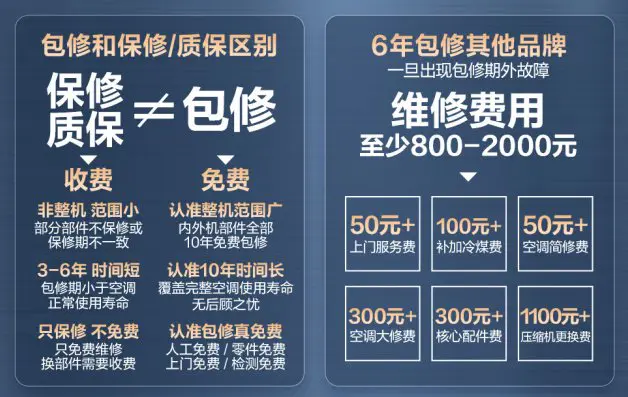
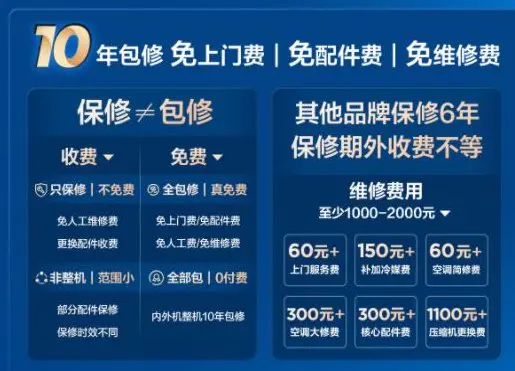
Some air conditioner brands promoting “package”
With respect to the distinction between “conservation” and “compensation”, mr. Ouyang ipeng, a beijing-based law firm, pointed out to the reporter consumer report that the differentiated promotion of services such as “conservation” “conservation” by merchants, which appeared to be an upgrading of services, might hide the intention of circumventing responsibility, which is a typical area of legal ambiguity in the current advertising of after-sale services in the domestic electricity industry。
According to counselConsumer rightsArticle 24 of the law on protection, “fortification” is the core component of the “three packages” (fortification, change, withdrawal) service. The current law, however, does not clearly define “guarantee”, the meaning of which depends on the commitment of the merchant; “maintenance” is an agreed liability and may be subject to fee maintenance. Under article 26 of the product quality act, “quality assurance” is a guarantee of product quality and is not directly equivalent to maintenance services. From the legal point of view, the safeguards for “compensation” are significantly stronger than those for “maintenance”, which is the statutory duty of complete and free maintenance, and for “conservation”, which is either free of charge or dependent on contractual agreement。
Package period from completion of air conditioner installation fine
It is a matter of caution that individual enterprises may lower service standards by distorting the definition of "package" and shortening the computational cycle. Consumer report recommends that users not only focus on the length of the package, but also on the details of the post-sale clause。
Recently, the market supervision authority of the white cloud area of guangzhou city received a complaint from the consumer, mr. Zhao, that he had used air conditioners for almost six years for cooling failures and that the vendor had refused to provide free maintenance during the “purchase date” start-up period。
According to the purchase certificate presented by mr. Zhao, the date of purchase of the air conditioner was 22 april 2019, the date of delivery was 26 april 2019, the date of installation was 28 april 2019 and the date of renovation was 24 april 2025. With the intervention of the supervisory authority, it was finally confirmed that the lump-sum period would be based on the date of completion of installation。
Article 18 of the regulations of the people's republic of china on the implementation of the consumer protection act provides that the operator's agreement with the consumer to assume the obligation to return goods, replace them, repair them, etc. Shall not be less valid than the requirements of the relevant provisions of the state. The period of validity is calculated from the date when the operator delivers the goods to the consumer or provides the services, and the period of validity is calculated from the date when the installation of the goods is completed. Since air conditioners need to be installed for normal use, the three-pack period shall be counted from the date the installation is completed。
At present, consumers are paying more attention to the fact that some businesses in the market do not use the invoice date, purchase date or shipping date as the starting date for the “three-pack” period, as required by the relevant state regulations. In addition, purchase invoices, warranties, installation records, etc. Are important grounds for consumer access to warranty services and should be kept in their proper custody。
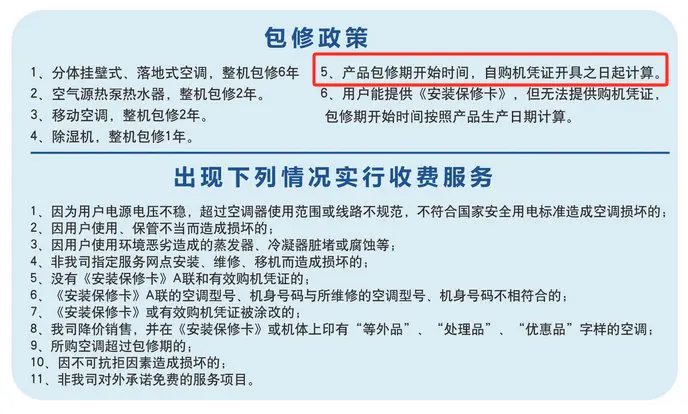

The “three-pack” period for some air conditioners was calculated from the date of the purchase of the documents or from the date of the invoice, and did not comply with the relevant provisions。
— concluding remarks
As consumer rights awareness continues to grow, after-sales services are becoming a new track for competing for air conditioning brand differentiation. In the future, brands capable of providing longer-term, better quality packaged services will be well placed in market competition. This is both an opportunity and a challenge for brands。