


On 5 september, the round table on innovative urban development in the city of chongqing of 2023, one of the major events of expo 2023, was inaugurated。
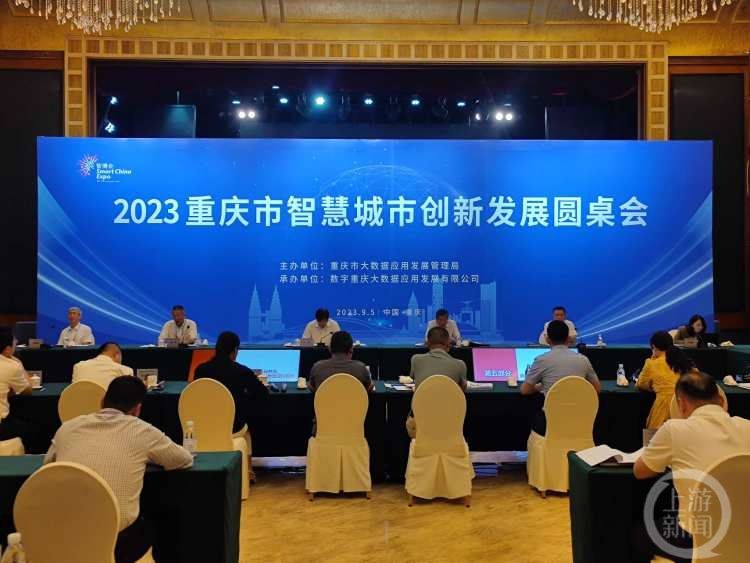
The relevant officials from beijing, shanghai, shandong and chengdu provinces and municipalities in the area of data development and government services meet with the relevant officials of the big data development department of the chongqing regions. Focusing on areas such as smart city-building, urban operations and governance, and grass-roots intellectual justice, people share typical local practices and experiences and explore pathways and approaches to improving urban governance capacity and governance。
“the 20-year report of the party emphasizes the need to strengthen urban infrastructure by creating liveable, resilient and intelligent cities.” inspector liu qiang, at the level of the beijing municipal service authority, presented experiences and methods of intelligent city construction in five ways. Liu qiang indicated that in order to contribute to high-quality development in beijing, the beijing municipal service has been exploring ways to build a consistent system of reform promotion, creating a closed-ring mechanism for “cycle management”, deepening data to improve governance effectiveness and innovatively implementing mega-cities governance models。
In sharing practical experiences at the round table, liu xiang, deputy director of the shanghai city data centre, stated that the digital transformation in shanghai, within the framework of the policy of “1+1+3+3”, had created an overall framework for the governance and application of public data, promoted the integration of external government networks, upgraded the e-government cloud service level, achieved a web-based, integrated management, and provided solid support for the digital transformation of cities and economic and social development in shanghai。
At the meeting, a member of the party group of the department of data applications development of shandong province and deputy director-general of the department of economic and social affairs, ren kai, presented a report entitled “strategic classification to advance new smart city building and to improve the digitalization of urban governance globally”. He indicated that shandong province had developed the new smart city building indicators in the construction of smart cities, classifying cities into different cities, setting up 45 indicators around 27 subdivisions of government services, educational services, health services, social security services, etc., and constructing a new smart urban model of “twilight cities”。
“sung-ju has been actively exploring the governance model of mega-cities, especially the advent of the digital age, which poses enormous challenges to their governance.” in sharing their experiences, the secretary-general and director, feng su-fook, of the network, has made it clear that exploring the practice of mega-cities requires an “embroidery” effort, both to use modern technology to achieve intellectualization and to improve the brand quality of cities through “embroidery”-like care, patience and care. “sung will promote the upgrading of one network of governance, one network of access, one network, one key of response and the continuous improvement of the effectiveness of urban governance.”
At this meeting, vice-president li bin, member of the chongqing metropolitan data applications development authority, shared his experience on digital change for digital chongqing. At the meeting, li bin indicated that chongqing would further learn from the concept of smart city-building in developed provinces and cities, advance work in various fields in line with the overall framework of the digital chongqing “1361”, promote the deployment of the fastest systems, minimum input costs, best operational effects, maximum data-sharing, vertical connectivity, horizontal connectivity and multiple synergies, create new engines for high-quality development, new models of high-quality living, new paradigms of efficient governance, and a model of a new era of digital civilization in the market area, contributing to the building of digital china。
Song kaye, senior engineer, china institute for policy and economic research, china institute for information and communication, presented the “chongqing program” for the development of digital china with unique advantage. Song kai-chul noted that the “1361” digital construction system is a further refinement of digital china's planning in chongqing, promoting the restructuring of work systems in various fields, re-engineering business processes and reshaping institutional mechanisms, leading to the creation of a new state of modern chongqing with digital celebratory construction。
At the end of the round table, there was also an exploratory exchange of participants and business leaders。









