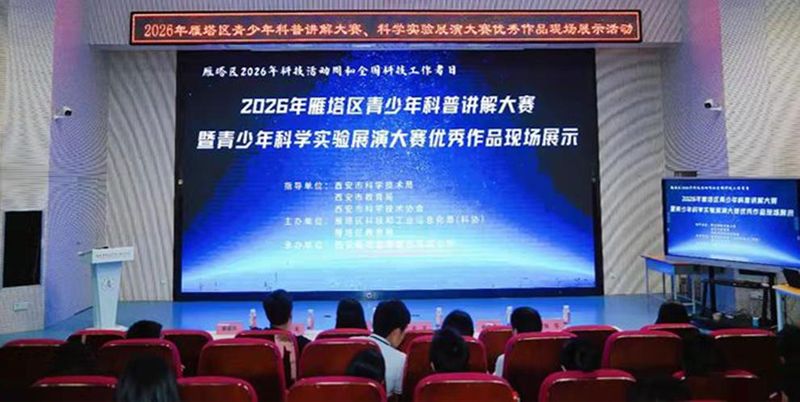
This paper is taken from dr. Zengin interconnected ceo bauter, and gave a presentation on the theme of "infomatics and knowledge management" in shanghai on 11 july 2017。
Introduction to events:
The shanghai information markets expert committee was established in 1999 as a high-level expert body to promote the implementation of the shanghai information technology development strategy, which provides intellectual support to improve the quality and level of information development in shanghai and improve the integrated competitiveness of cities in shanghai, through various studies and consultations. In order to actively expand new ways of developing think tanks, conai has strengthened its in-depth cooperation with the shanghai institute, co-organizing the committee's sharon series of events, bringing together experts ' wisdom and sharing trends. The current session of the committee of experts on informatics, sharon, will focus on the areas of artificial intelligence and knowledge management, inviting experts from business, research institutions and government departments to discuss it。
Botter: hi, i'm talking about more specific things today. The previous expert teacher introduced some of the taller things, and i've been looking for land for years。
Today i am talking mainly about financial applications. For many years before that, i also worked in schools, one canopy after another, jumping a lot of holes. Our theme today is knowledge management, and from 2005 to 2012, i myself wrote a number of knowledge management systems, including in 2008, to the rpi (note: rensler institute of technology, united states) — the best school in this field, where i wrote a knowledge management system, but the entire laboratory was not used。
I was thinking painfully that we were the best people in the world to do knowledge management, that we were confident and well-informed about it, and why are we not doing anything ourselves? There must be something wrong. My system could then be described as failing, and then the lab went back to work, and it took two more years to figure out how much it cost to re-establish a knowledge management system based on the rdf, which ended up failing。
Projects that fail are good examples, especially in well-known institutions. Most ai projects end up failing. One thing is, if you go to the sausage factory, you don't want any more sausages. If you've done an ai project, you might not want to do ai anymore. Most ai projects are like retards. It may also be that this area is still at an early stage of development, that many of the criteria do not exist, that many roads still need to be travelled, that they have not yet arrived, and that each road requires the bodies of numerous projects to be laid in front of it. The whole area of knowledge management, from its birth 40 years ago to the present, is one that can be said to be very difficult. It was only in 2012 that there was a real prospect of a relatively clear, large-scale application, which had been painfully sought in the dark for more than 30 years。
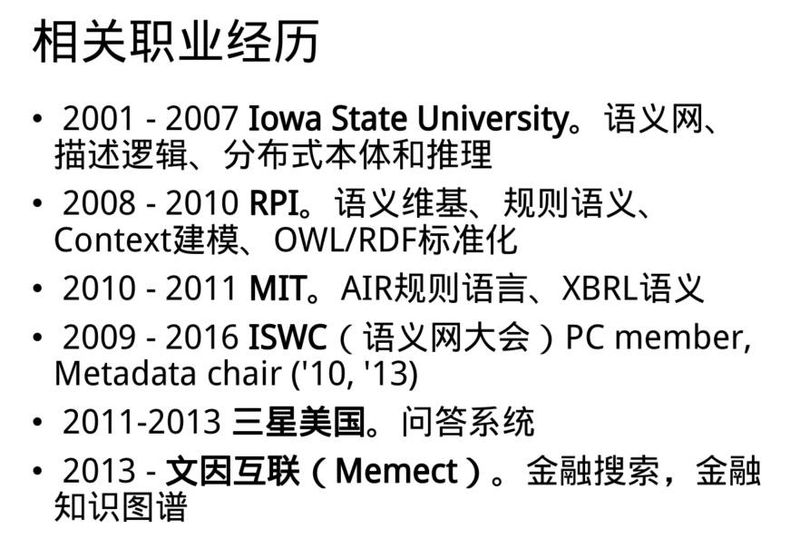
What i am talking about today is mainly some of the paths we take in the financial field, some of which are curved. My personal academic experience has been essentially in the area of semantic networking and knowledge management, prior to which i have also done some neuro-network and machine learning, mainly in connection with today's work, one of which was the semanticization of xbrl at the time of mit, and the other in recent years, in which financial search and financial knowledge mapping have been done to automate questions and answers, and to connect the company vinyl。
Briefly, we are a small company in beijing whose name is “cultural gene interconnection”, in english called memect, the first four letters, “meme” is a word in english that has been translated into a meme, and i have translated it into a cultural gene, short of “vine”。
What can knowledge maps do for finance
What can knowledge maps do for finance? Simply put, it would be to replace the simple duplication of work that is now being done in the financial sector. One would ask whether financial knowledge mapping could make better investment decisions than people. This is one of the most important concerns, and i say no, at least in the short term. Sometimes, some friends in financial institutions ask, can this not increase the return on investment? I said no, no, no, no, no. What did he say you could do? I said it would be more efficient. He would ask, "what's the use of efficiency?"
It's a very classic misunderstanding. When it comes to artificial intelligence, especially seeing artificial intelligence so hot in the media, the first idea is that human beings are being destroyed by artificial intelligence. It doesn't actually feel good. Because there have been two such feelings in history, each of which ended not with the destruction of humanity, but with the destruction of us (artificial intelligence practitioners). Because you think we're liars, every time you feel that way, i'm scared. I'll be honest with him that we can't really do anything big right now, and we can at best replace some of the primary jobs, even though the population is already large。
Where we are now able to land with technology, we assume that, in the area of finance alone, we can really affect the work of millions of people, not by letting them lose their jobs, but by allowing them to work more efficiently. There are now a large number of interns and junior analysts in every financial institution in china, and it is a great waste of manpower to do work that should never be carried out by human beings。
Many of the master's degree students in well-known universities have been doing secretarial work for the first two years, working on extracting data from PDF documents, or writing reports that they themselves vomit. Like the first reports from the coupons, there is no insight, because it is basically a set of templates, and even worse, it is written by no one and by no one. The entire financial nervous system is not yet in place, so it is a great waste of at least 1 million people to do a great deal of what should have been done by machines. Eight million people in china are in the financial sector, not only in securities, but also in insurance, banks and so on。
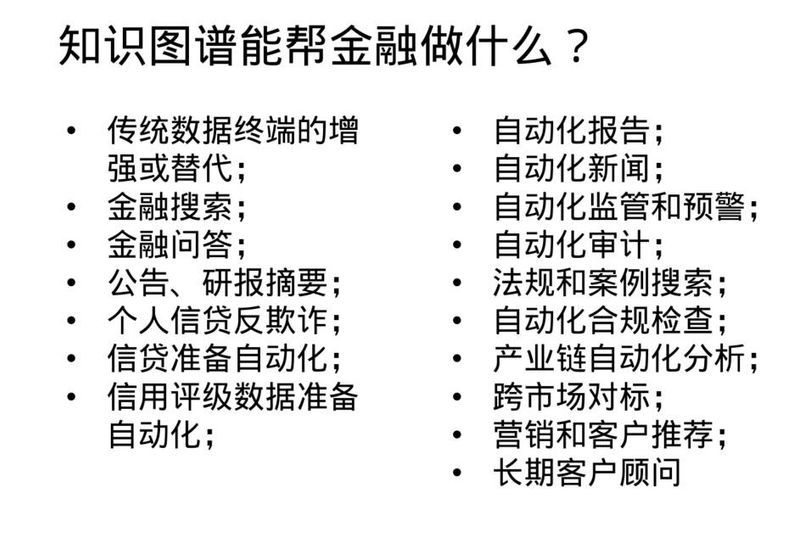
It contains about a dozen practices. This was what i thought of when we opened the hangzhou financial knowledge mapping forum last march. In march 2016, when we opened the first financial knowledge salon, there were only five, six, one year, and we found so many new applications, none of which were hypothetical, each of which was real and corporate. We have started our own financial search, followed by automated reporting, and are now exploring a number of deeper applications, including some automated regulation, and financial questions and answers。
Two ways to achieve financial knowledge mapping
In fact, financial literacy is not a whole new thing. Twenty-three decades ago, the use of structured data in finance existed, but not by that name. In 1998, the xbrl language was invented, the english language of extensible business reporting language, which is an extended commercial reporting language。
When this thing was invented in 1998, xml was an emerging technology, and xbrl was based on xml. The basic idea is to design from top to bottom, and it's a group of experts who are talking about the format that we have, and all the people involved are doing it. Xbrl has a committee, which is discussed mainly by persons with an accounting and financial background, and the glossary of xbrl is also discussed, and each country itself. In the united states, for example, there are gaaps, there are cass in china, europe has its own set of standards, and japan has its own standards, all of which are home-to-peer designs. In china, i know of at least four xbrl standards, so far they have not been unified, and so far the top-down design has not been unified。
It is also only at the highest level, where it is extremely difficult for us to pursue such a top-down design with the major issuers and the listed companies. Listed companies are required to publish data in a format such as xbrl, but their secretaries and proxies often do not understand structured data, and it is difficult to understand the significance of using machines to process data, which is redundant and difficult for them. It would be better for the main listed companies, and it would be more painful for the new board companies now. As a result, more than 10,000 new companies on board now do not enforce disclosure of xbrl, which is difficult to enforce because of high costs。
How? In recent years, you have been wondering if we could not make such high demands when information is released. We already have some published data, such as the annual reports of companies, the quarterly reports and the stock transfer, many of which are recurrent and can be extracted from the existing data, the structured part of which is a way of summing up, which is now the method of mapping our knowledge that has emerged in recent years。
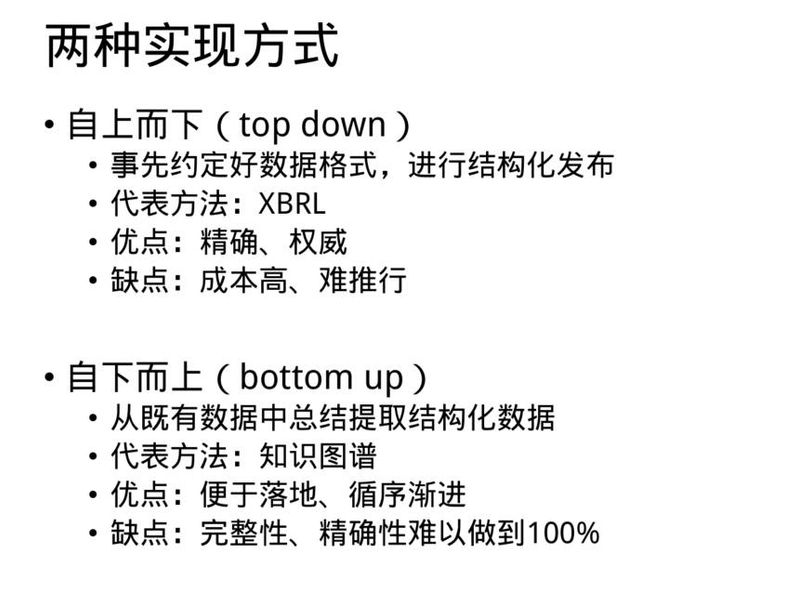
So the knowledge map and the traditional semantic network are both an inheritance and an abandonment, because the traditional semantic network, the top-down method, is to think of a schema and then fill in the data on schema. So, starting in 2006, from lAnd the branch that started, and we found that it would be better to sum up this structured data than to design structured data, although the quality of this data is bound to decline because the data in reality are very dirty, but at least we get something。
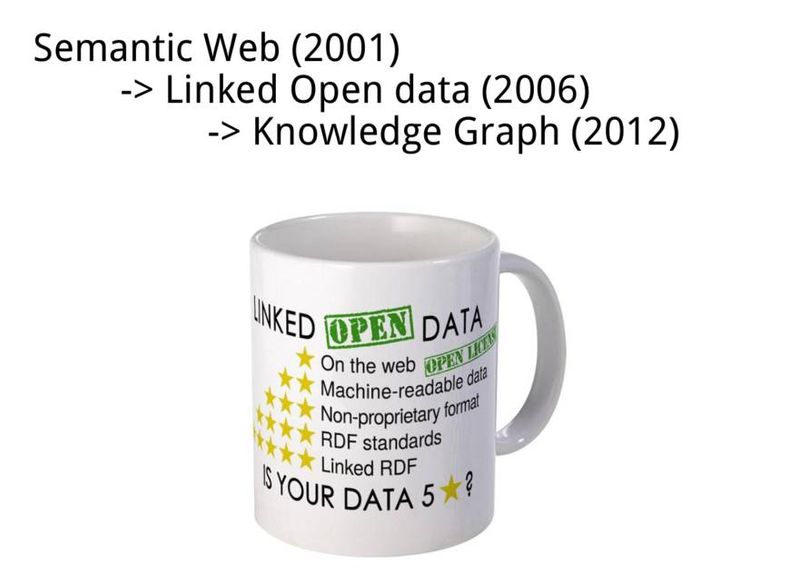
So in 2006, tim berners-lee, my mentor in mit, proposed lThe concept of an open data. It's a cup, and he's got a rating of five stars:
The first star is to publish the data, on the web. Now, for example, we're doing finance, and there's all the companies' public disclosures on the big tide。
The second step is machine-readable, called machine readability. For example, in early 2013, many of the new three-board open materials were scanned and the machine could not handle them. Most of the documents involved, for example, are still scanned when we produce debt rating reports, which do not meet the machine-readable standards. Fortunately, the vast majority of companies now have text-readable feasibility reports by the time the disclosure material is released, all meeting at least two stars, namely, machine-readable。
The third star, that is, it would be best if it were in an open format, not in proprietary format. For example, PDF is not an open format, as PDF is an adobe company-owned format. For example, in china, where the paper database used to have a cis format, that data did not meet the requirements for open data because it was a company that decided how the format was to be published。
The fourth star and the fifth star are talking about how data can be interconnected, using the w3c semantic web standard, the rdf standard, not to mention here, because going back is a costly way。
Open data is the high iron of the new age
Back to finance, say more. Why are we doing this? Why open the data? On the financial front, i will give more examples as to why open data is an essential element in overall industrial development. Open data is the high iron of the information world。
High iron connects the whole of china, and if we have open data in all fields, the economic value that we create is, i believe, no less than high iron, a very important competitive advantage. That is why, in 2009, in the first month of obama’s inauguration, he issued an executive decree requiring all federal government departments to open their data, which is then followed by state governments. The british government has followed suit, and hundreds of thousands of data sets have now been opened, and this is a very far-sighted thing for european and american governments。
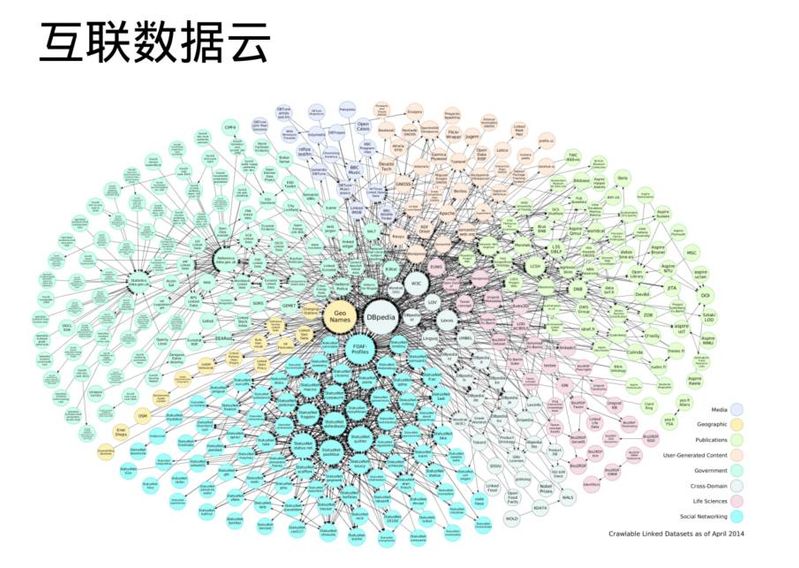
It's called the interconnected data cloud, or a screenshot i made years agoThe organization, inked open data, is in europe and the united states, and they open up a part of the data here. In fact, we now have the goal of open kg, as mr. Chen said, to make a chinese version of the open data cloud. This is still a three-year-old version, and it would have been impossible to draw it now, and it might have been impossible to paint the whole wall, because there are hundreds of thousands of data sets now。
But there's not much in finance, which, we see, is mostly encyclopedia, media, biology, where only a fraction of the financial data is in government open data. The main government open data is in the us government, the data. Gov website, which has about 100 financial-related data sets, most notably from the us sec. These include bulletin data, investment companies, mutual funds, xbrl, insurance, sec regulations, etc。
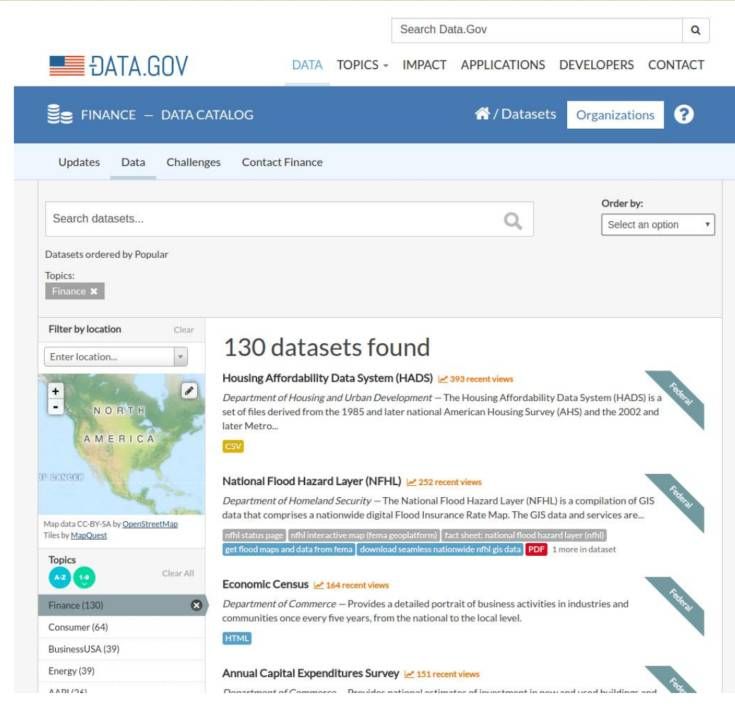
In fact, more than 100 data sets are relatively small. Because there are thousands of data in other areas, such as environmental protection, finance is relatively backward. Most of these data, it's still a star, it's just there, and many of them are excel's forms, just like the law, so they're not very well handled. However, the ussrc listed company announced this section, which did better, with its data, first publicly available, second machine-readable and third without proprietary formats. These annual reporting data for all united states companies are available directly from the sec website and can be downloaded. This data openness is very good, and china has not been able to do so yet, and i believe it will not be possible to do so in the next few years, which is where the united states is ahead of china。
What can open data bring
What can such data openness bring? A long time ago in the united states, a number of small market-monitored companies existed. As soon as sec publishes the data, robots will monitor and analyse the data, decipher the structured picture of knowledge, judge on the basis of pre-investment decisions, whether there is a special opportunity, or a special risk, and send the information to the investors who subscribe to the rule within two seconds。
China has not yet done so, as basic data are not yet available. One can say that the preparation of basic data is what we and other similar companies are doing. We're chasing the united states, although they're years behind, but i'm sure it won't take us seven or eight years to catch them, because, after all, the technology has improved。
In addition to this, china now has a project to open government data, and i think shanghai is doing very well, and some other local governments have published data, but they have to apply and then register and submit id numbers. I've applied for a city before, but it's never been approved. Economic development is not the same, and the better it is, the more open it is。
Currently, china, the united states of america can be said to have disclosed information using xbrl in most of the blue countries on the map. In the united states, xbrl is mandatory, but in china it is not mandatory yet。
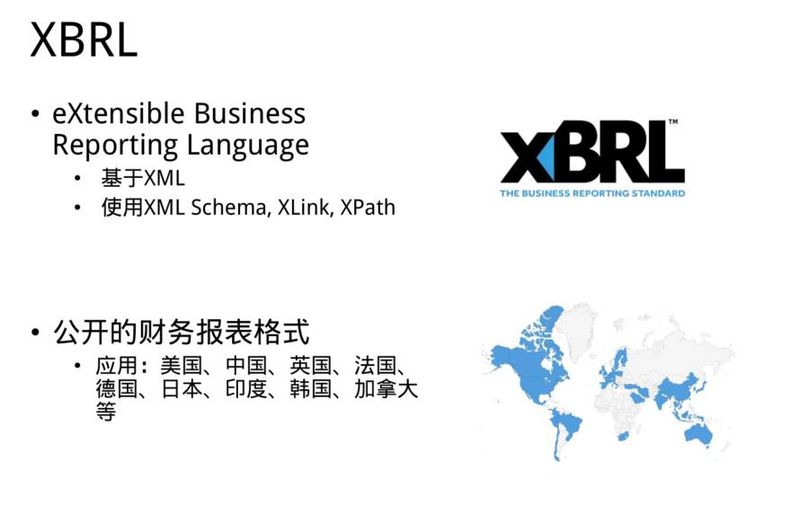
Introduction to xbrl
What the specific xbrl says is that i will not go into depth here, basically in a machine-readable format that talks about financial statements, profit statements, cash flow statements, accounting figures for different statements。
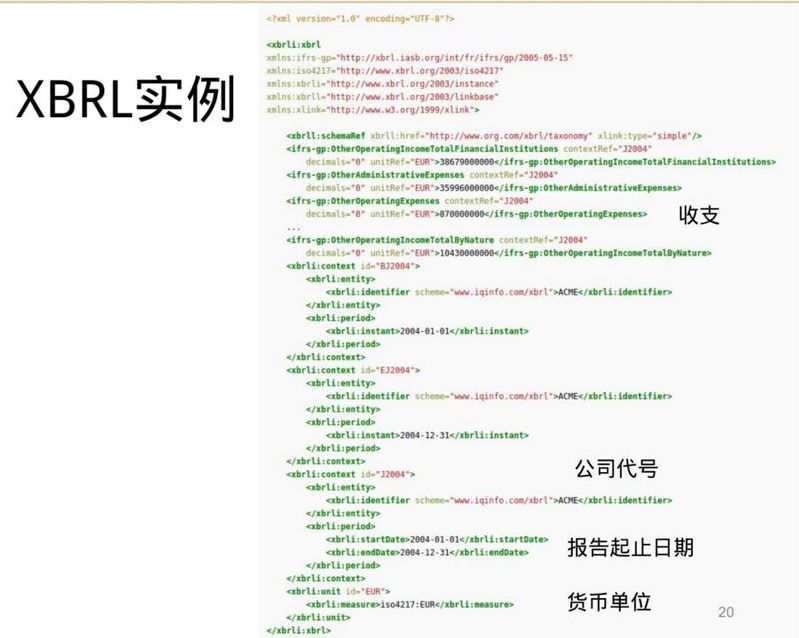
This is a specific example of xbrl, which represents the revenue and expenditure of a company, the date of commencement of this report, the currency unit, etc., and it can be seen that the very large number of characters on this entire page does not say anything, so it speaks of a few simple numbers. It has so much supporting information here for these numbers. Xbrl is essentially a very noisy language. Why? Because it's actually a structural description。
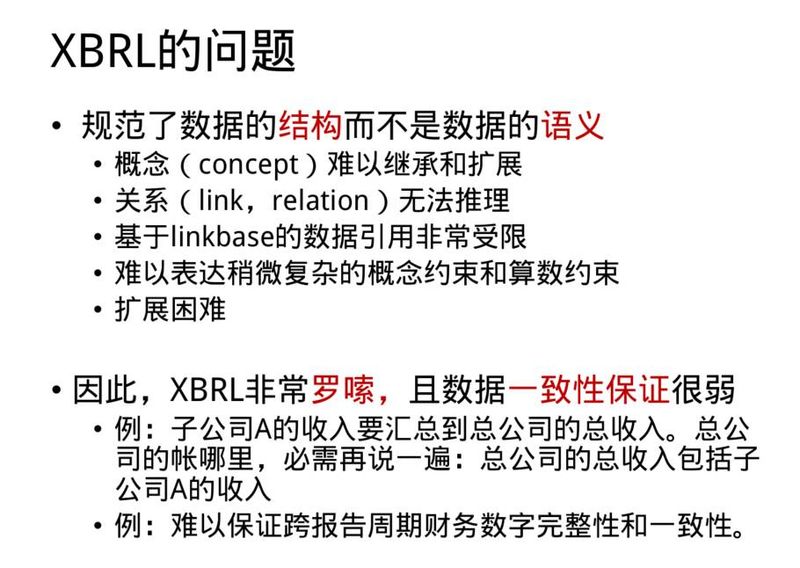
We all use excel as a traditional accountant, but excel is not easy to automate, e. G. What the header means, what the relationship between columns and columns is, and it is not written, but xbrl can do it. We write about the relationship between these initial structures, but it's still just a structure, not a semantic, so it's very annoying. For example, if a subsidiary's income is to be pooled in the head office, then the head office should be mentioned again. It has no reasoning, nor can it say that my subsidiaries are here, and there is no such logical relationship。
For example, consistency checks, the integrity and consistency of financial data across the reporting cycle, which cannot be checked internally, allow programmers to write a rule outside to do the check. In the mit, we used to semanticize the xbrl, to describe the xbrl in a logical language, and then to express the rules in a language like sparql. The details will not be repeated, because they're more technical, and i'll send this to you later, interested in contacting me。
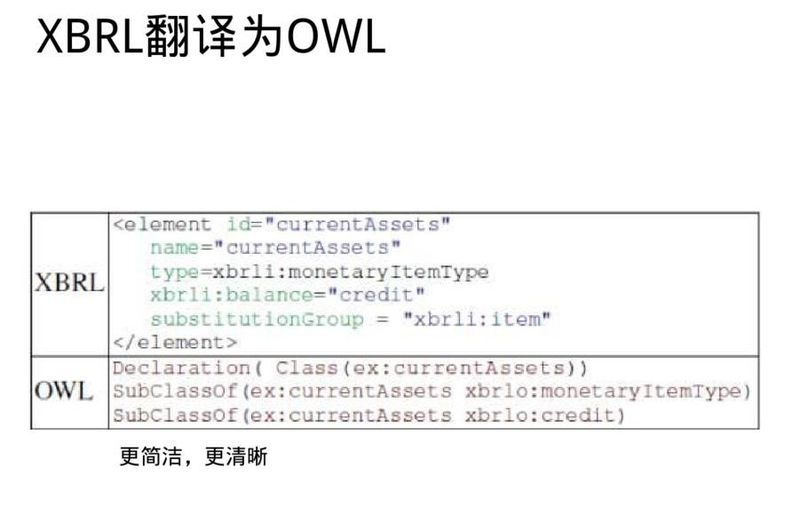
Here's a concrete example, which is a description of the xbrl, which is a structured description and which comes back here with semantics. The semantic relationship of the notional hierarchy, for example, is implicit in the sense that we have become clearer with the logical description, especially when relationships like owl can be intellectually deduced. On that basis, it is possible to model rules. If we conduct a publicly announced compliance check, for example, by requiring disclosure of a major contract within two days, and if disclosure of a major contract is also described by xbrl, the inspection can be conducted. Because disclosure rules themselves can be written into a computer-enforceable rule. In a series of inspections, we can judge whether the disclosure is in compliance by the date。
What we're talking about is that we have structured data. But we do not have such structured data, and it would be very costly for all listed companies to provide such structured data from the source. In recent years, in w3c, the world wide web alliance has a dedicated working group to improve these, one of which is known as fibo, one of the core tasks of which is to expand the collection of words across the financial subsectors. They continued to seek experts, bank experts and securities experts to meet in the working group, which was held for seven or eight years and has not yet been completed。
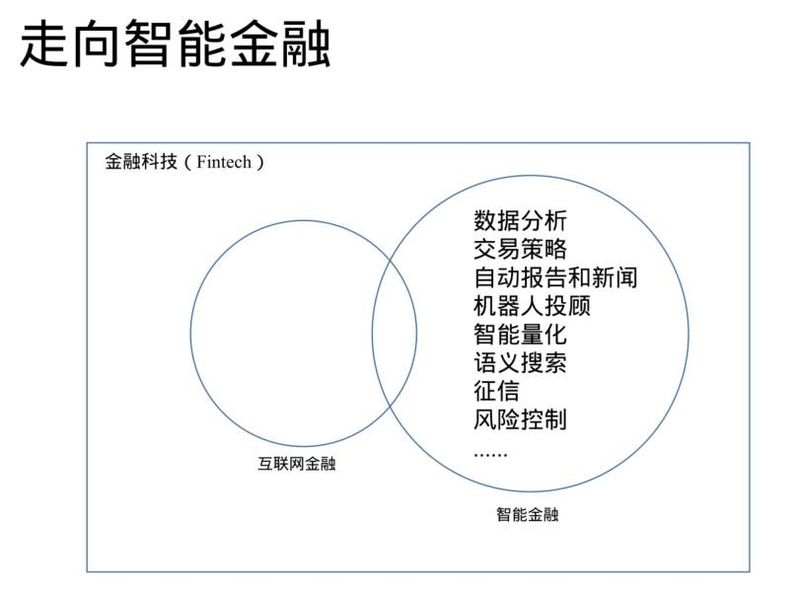
So the top-down design, we can see, is very inefficient and difficult to land. But some of them, related to individual consumers, are now on the internet. Some concepts related to personal credit, for example, personal consumption, and credit cards. Google's been used in its schema. Org vocabulary, which is a little bit of a landing for years. The central question in recent years is whether we can not ask you not to publish these structured data, but rather to publish the existing data, and then we can structure what can be structured in this data, which becomes the domain of smart finance。
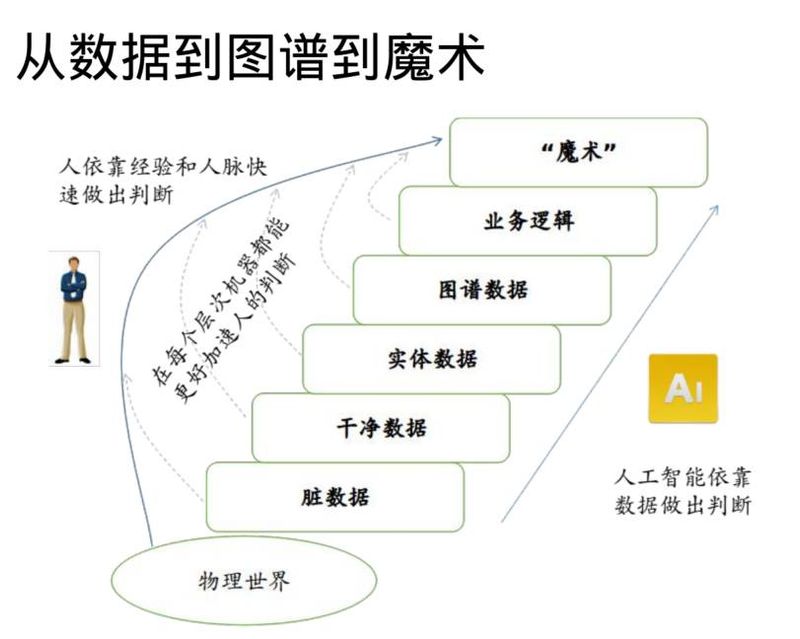
There are a number of specific technologies, the core of which is that we are gradually improving the quality of data in the process of applying them. I've been sorted around here, starting with dirty data, for example, some scans are dirty data, at least some text data are clean, like text, paragraphs are divided, sentences are divided, tables are extracted, and this becomes a very clean data. It's been a very difficult step, and we'll probably have to write more than 100,000 lines of code to make these PDFs cleaner。
It is even more difficult to extract the entity, the company, the name of the person, some product, industry, the relationship between the product and the product. Going down, these are maps, such as the global industrial chain, the match between united states and chinese companies, the possibility of investment targets for the new three-board company, and so on, which together form a picture of the so-called relationship between entities。
And then there is business logic, for example, industry logic, for each industry, where we look at different indicators, different growth rates, and business logic, for example, indicators of m & as and shell shopping, for example, regulatory logic, which is one layer at a time, and each layer is more difficult than the other. That doesn't mean we have to do everything before we can turn into financial magic. Because basically every level can accelerate the human and machine collaboration of our people, we can do things faster, and that is what we are doing now with some operational partners。
Machines are not substitutes, but reinforcements。
The financial knowledge profiles that we can now see on the market, with first- and second-tier markets, market-creating data, bulletind data, researched data, data from businesses, and so on, vary from company to company. We have concentrated mainly on the basic data of listed companies, as well as on the extracts of bulletins and research。
In march of this year, we held a forum in hangzhou on financial knowledge mapping, attended by about 200 people. In march 2016, we had a meeting, about 30 or 40 people, one year, and that was just the beginning of the field. We will open it again in shanghai in september this year, and i am sure it will be full of friends and welcome to participate。
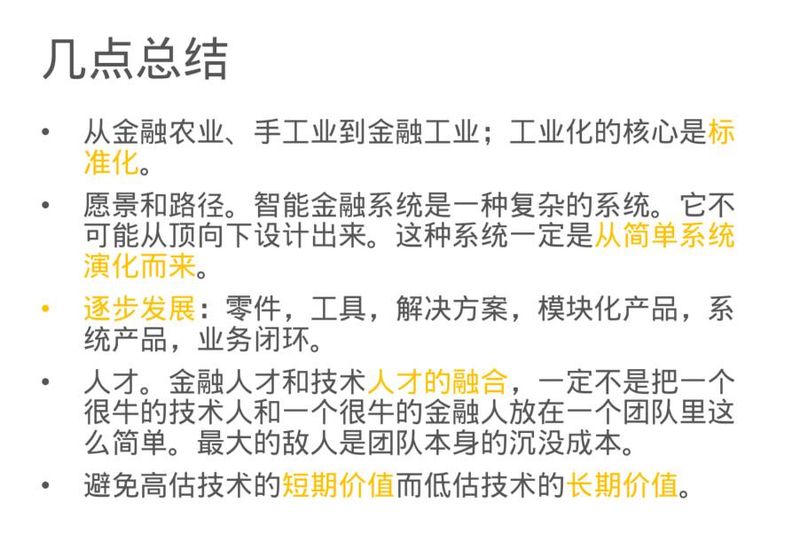
To conclude with a few more words, and a few words of response, many of the things that i mentioned at the outset are “difficult”. Artificial intelligence was good at first sight when it landed, but it was extremely painful every time it landed. The good things are all summed up, and very few of them can go down from above, and you have designed them, usually a pit, another pit, another pit, from the pit. It turns out that it takes a simple system to evolve a complex system. The complex systems that were designed at first are often impractical, as is the intelligent financial system. The king's cto just mentioned watson, who was not very comfortable when he landed in some areas, because the system that was designed to land in a specific business was very difficult to imagine, but it was something that was not so big at first, something that started with a very small detail, and could finally be implemented。
Finally, one word from others. Often, the short-term value of technology is overestimated, while the long-term value of technology is underestimated. Now that artificial intelligence technology has returned to this point once again, it has been overestimated its short-term value, and it has always been felt that human beings are being destroyed by machines, or that jobs are being replaced, and that there is a great desire for artificial intelligence to show a higher intelligence than humans, but this is really “no concubine”。
But the long-term value of this technology, such as one that can improve human efficiency, is also being underestimated. You can't feel it when it makes you two or three times more efficient, but when it boils frogs, when it increases your efficiency tenfold, what happens when you suddenly find the whole field? It is possible that, in about 10 years, a new thing has emerged that has turned upside down。
Our company is right next to the trade, and i often stand in the window and say to our colleagues, "look at the warlords in the writing building who will be killed by the red army armed with ai." but when it comes to real concrete steps, it is very painful, starting with very small things, starting with ground-building。
Qgyx123, with names, affiliations, departments, and positions, will be invited to join the group。