


Served in a three-academic hospital, master of engineering, senior engineer, ethics commissioner, nearly 10 years of medical computerization, work and research directions: major medical data and pharmaceutical computerization; published 9 papers, sci 2, statistical sources 7。
I. Issues and background
1. Typical performance and operational costs of data islands
In the case of the hospital where the author is located, the system is more than 130 in size and is evaluated by means of interconnection with level 5b and level 5 of the electronic medical record. But the more systems are in place, the more data are “separated” — a common situation for the vast majority of health-care institutions in the country。

Figure 1
At the hospital level, “there are big data, why they are still invisible and unmanageable when making major decisions”; functional departments are required to “run their legs off” when they make statements; data are always “failed”; clinical sections are fragmented and unable to access the full patient's face on a one-stop basis, and seeking to do scientific research is blocked outside the door by the application process and technical barriers; the information sections have access to data, but often become “back-man” because of quality problems。
1. 1 clinical perspectives: broken information, missing landscape
Patient information is spread over dozens of systems such as his, lis, pacs, emr. Doctors need multiple systems to switch back and forth, and there is a lack of panoramic support for decision-making; the same pneumonia can be written as “pulmonary infection” with “bronchopneumonia”, “grave pneumonia”, which is coded differently and directly contaminates individual disease quality control data。
1. 2 management perspective: caliber fighting, uncounted
Data from different sectors on “fights”, incoherence, disease costs; manual integration is error-prone to support precision management - the root cause is the fact that the same business concept speaks in different systems and in different statements。
1. 3 scientific perspectives: data are difficult to use and costly
Mass cases are deposited in unstructured text, queues rely on manual screening, incorporate absence of traces, data preparation cycles in real-world studies are counted over a month, and studies are less reusable。
In the final analysis, the essence of the island is not “more systems”, but three questions remain: what are the data, what quality, what is the value of the hospital, who is in charge, who explains it? — lack of standards, lack of accountability, lack of mechanisms. As the classic metaphor in the big data field says: “the true value of data is like an iceberg, and what can be seen is only one corner, most of it hidden under water”。
Background to the rise of the data base to strategic engineering
2. 1 policy drivers: superseding resonance from data elements to `advisory +'
In december 2022, the central committee of the communist republic of china, the state council's opinion on the construction of a data base system to better perform its role as a data element (article 20 of the “data”) established the data base system, and in 2023 the national data agency was established and the data became the fifth largest production factor. August 2025-june 2026 state council opinion on the further implementation of artificial intelligence plus action (2025) no. 11, state council, august 2025; implementation programme for action to promote the construction of quality data sets in industry (2026) (c) policy initiatives 25, june 2026, national data agency, implementation opinion on the promotion and regulation of the development of the application of artificial intelligence + health care (november 2025, five sectors such as the national commission on health and health) and 2026, “model resonance” (april 2026, ministry of industry and information technology, national data agency) have been introduced in an intensive manner, ranging from top-level design to industry landings, to the formation of closed loops, along the same lines: the development of a data governance model to map the use of intelligence。
2. 2 assessment driven: a complete shift from evaluation criteria to “data speaking”
Level reviews emphasize automatic data collection rates and completeness, interconnectivity assessments are premised on standardization, electronic patient history ratings include data quality as a core test, and national examination indicators rely heavily on data quality. The 2025 version of the evaluation criteria for level iii hospitals eliminates on-site inspections and turns to “day-to-day behaviour, objective indicators, quantitative evaluation”, a 10 per cent, one-vote rejection of error data exceeding the verification clause — data governance has changed from a “subsection” to a “survival item”。
2. 3 technically driven: data and ai move from “floating” to “cracking”
Medical ai moves from “dazzling” to “fall-down”, and data and ai move from loose to tight: data provide fuel for intelligence and become the winner of a leap in intelligence. Without a data base, ai can only stay at the demonstration stage。
Ii. General structure of the data base: a land-bound governance framework
1. Content and boundary of the data base
1. 1 reference to dama and dcmm, not to “self-contained systems”
The dama wheel chart defines 11 management functions, such as data architecture, data modelling, data security, master data, metadata, data quality, and central data governance; dcmm conducts a hierarchical evaluation of nine large capacity domains, including data strategies, data governance, data standards, 33 capacity items, and 576 capacity indicators. In generic terms, data governance is the development of a uniform “rules manual” for disorderly raw data, moving data from a “dispersional resource” to a trusted and efficient core asset; the data base is the engineering landscape of the system in hospitals。
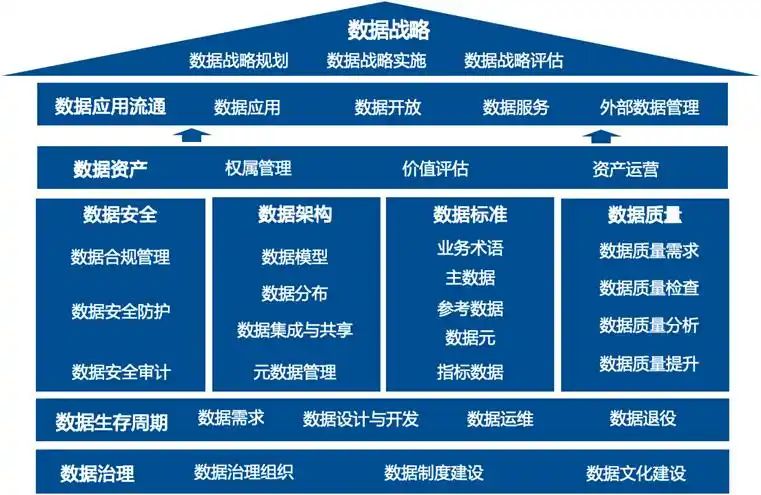
Figure 2
1. 2 “resource-assets-element” three-tiered leap
The release of data values follows a three-stage pattern: the resource phase, where the data are deposited in the operating system; the asset phase, which is managed, measurable, manageable and applicable; and the factor phase, where the data drive business innovation and growth. The essence of building the base is to drive hospital data to complete the “resource asset factor”。
A two-wheel-drive architecture for `modulation + intelligence'
In the overall architecture, the hospital uses a two-wheel-drive “mixed + digital” model to integrate data governance and artificial intelligence into the same framework。
2. 1 bottom layer: "digital" to make the data credible, usable, reliable and manageable
The bottom layer covers six capacities: master data standardization, harmonized data standards, five-dimensional quality control, life-cycle security governance, harmonized indicator systems and data asset management. Infrastructure adheres to the “five ones”: a cloud, a network, a data centre, a system, a set of standards to eliminate data barriers at root and allow multi-hospital, multi-business data “asymmetrical, car-like”。
2. 2 engine layer: “technology” to translate data into operational capability
At the engine level, the four core domains of clinical treatment, patient services, operations management, medical research are addressed not by large models, natural language processing, computer visualization and intelligent body technology, but by “the availability of data” and “the ability of data to be translated into value”。
2. 3 synergy: organizational, institutional and evaluation closed loop
The team is led by a secretary-general, the president, with special classes on data governance, smart hospitals, big data and artificial intelligence, and a weekly, monthly briefing and quarterly review mechanism. The two-round logic of evolution is to “do things first, do things first, do things smart, do things smartly” — to provide the fuel and the rules in quantitative terms, which in turn push governance deeper。
Key practical pathways for building the data base
Main data governance: first, people, money, things speak the same language
1. 1 panorama planning: integrating core master data into a unified governance vision
Hospitals integrate key clients such as clinic information, clinics, personnel, beds, districts, medical advice projects, billing projects, testing indicators, diagnostics, medicines, equipment, etc. Into a unified governance vision, which is coordinated by the data governance subdivisions, with personnel, medical services, pharmacology, equipment, finance, etc. Taking responsibility for “who produces and who is responsible” and setting up a primary data framework covering the main operators of the institution。
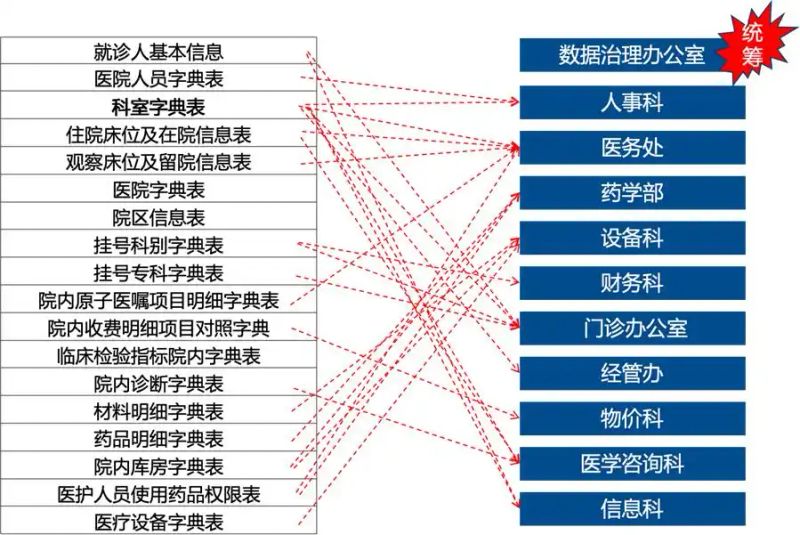
Figure 3 master data panorama planning: a system of core master data dictionaries
1. 2 one-size-fits-all: division of labour between source and mapping governance
The dictionaries have a heavy history of using “mapping governance”: more than 1900 standardized maps have been completed, nearly 1,200 have been standardized, more than 300 long unused sections have been cleared and room management has shifted from “temporary clean-up” to “continuous governance”. The dictionary uses “source governance” to directly manage information on the personnel system, with functional titles and academic qualifications, for example gb/t 8561, gb/t 4658 and standardization at source. The principle is that what can be solved at the source will never be filled downstream, and that the source will never change the map to the bottom — “one by one”。
System of data standards and indicators: unified calibre, elimination of “talking”
2. 1 standardized path for "countermark + map "
In the absence of uniform standards, data may still be “not one thing” after the system has been completed. In practice, a standard system of operational terms, data metadata, classification codes and indicator calibres has been established to bind the new system to the “reference continuum” and the “magnify continuum” to cover the inventory system, taking into account both the practical complexity and the gradual convergence into uniform semantics。
2. 2 harmonized indicator bank: condensed calibre of more than 4800 indicators
Hospitals are guided by a level-iii hospital review, which systematically consolidates policy sources such as provincial evaluation criteria, quality control indicators, statistical annual reports, national performance monitoring, price cost monitoring, high-quality development evaluation, and then develops a uniform indicator warehouse for more than 4,800 indicators, a platform for the management of accompanying indicators and a unified definition, processing and export. The full-scale monitoring indicator covers thousands of data items and is scattered across dozens of departmental sections — non-standardized, non-routine — and reviews are “movement fires”。
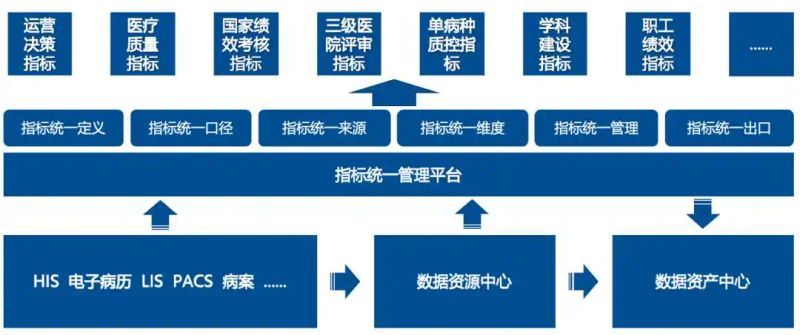
Figure 4 harmonized indicator system: compilation of indicators from multiple policy sources and composition of the indicator warehouse
Quality management for life-cycle data: making data “credible”
3. 1 five-dimensional quality rules and line-by-line approaches
The quality rules system is built around uniqueness, integrity, compliance, homogeneity, timeliness. For example, an electronic medical history rating is provided, as shown in table 1。
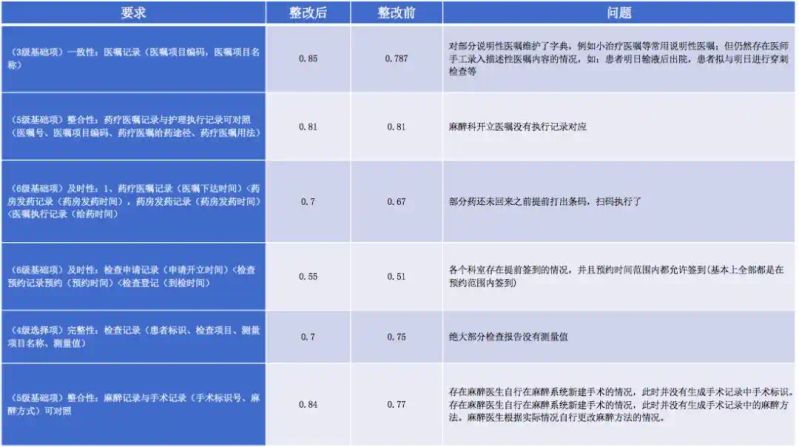
Table 1 examples of data quality refinements (e. G., e-calculation)
3. 2 from “ex post facto” to “closure”
The key to quality management is not checking but changing. In practice, a closed loop path of “problem collection-cause analysis-programming-change implementation-impact assessment-continuing operations” has been developed, which is handled by the “quadrift modification” classification. On the assessment quality chain road, the data capture logic is first confirmed with the responsibilities section road show, the production of primary data in the large data centre, the processing and production of secondary data in the section and the implementation of primary quality control, the functional units perform secondary quality control — the producer, the user, the manager's duties are divided and the quality responsibilities are truly on the ground。
4. Data security and compliance governance: holding the bottom line to release value
Implementation of classification, encrypted transmission, desensitization, minimalization and audit trails around the collection, transmission, storage, processing, sharing and destruction of data throughout the life cycle; introduction at the institutional level of a system-level data management approach, which is based on “who produces, who owns, who manages and who is responsible for whom”; clarification of data exit boundaries, ethical review and de-marking requirements for new scenarios such as ai training, so that the data is “open and managed”。
From base to value: typical data-driven scenes and closed loops
Specialized high-quality data sets: from “specialized databases” to “research-level data assets”
High-quality data sets are the most direct value exports of the data base. For example, a two-tier data model is used: the general database covers hospital-wide clinical data, and the specialized database targets diseases such as hypertension, diabetes, slow lung resistance and pulmonary knots. On the data chain route, source database original migration into certified copies, dissensitized, cleansed, structured, standardized and omop (observatio)The generic data model map forms standard research data to underpin real-world research such as the queue study; an integrated chinese medical terminology system is built at the core of the terminology hierarchy。
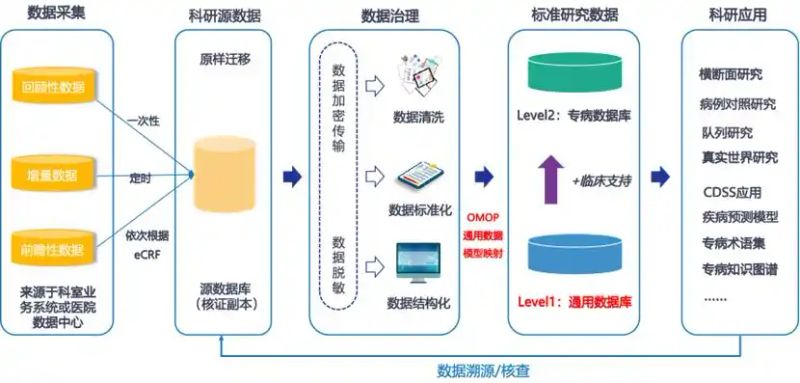
Figure 5 paths to treatment of specialized databases
Destructured data are the hardest and most valuable. An in-depth network-based chart-text extraction model allows for an accurate understanding of the syntax of the medical history, along with a framework for configurable rules extraction, automatically structured elements such as past medical history, history of tobacco and alcohol, family history, principal case symptoms, and over 95 per cent accuracy and recall; definition of variables and multi-wheel evaluation of clinical units - - dataset quality is endorsed by clinical experts and data teams。
2. Medical ai landing: high-quality data is the strength of the model hands
The development of ultrasound models is the best illustration of “data decision intelligence caps”: four highly qualified doctors have been able to complete systematic labelling of 14 dirty instruments, 110 diseases, 46,000 cases, 440,000 ultrasound images (more than 90,000 fine-lined drawings) over a six-month period, and have been trained on this base to produce 8. 77 billion multimodular models of parameters with image purification, screening, multi-modular reasoning and structured reporting. Another “business definition ai” path is a self-studyed image intelligence reporting system by ultrasound physicians, which produces reports that are reduced to seconds, where key messages are missing and where any steps can be taken manually. The conclusion is that the essence of the ai project is data engineering, and the organizational ability to label data of high quality is more likely to determine success or failure than the algorithm selection。
Continued operation of data values: from “projectization” to “normalization”
There are no endpoints for the construction of the data base. The governance drive follows a three-year three-step approach: phase i, “platform building, priority twinning”, building a platform for data assets, integrating master data standards and an integrated system of indicators; phase ii, “data empowerment, system closure”; and phase iii, “normal management, value leaps”. Institutionally, more than 50 declarations and 12 proposals have been submitted to the entire institution through the "stand out" initiative to actively involve the operations section in the construction of high-quality data sets while hugging ai; and to provide for specialized personnel, regular training, scientific clinics and daily use, making the data service “persons, doors and accounts”。
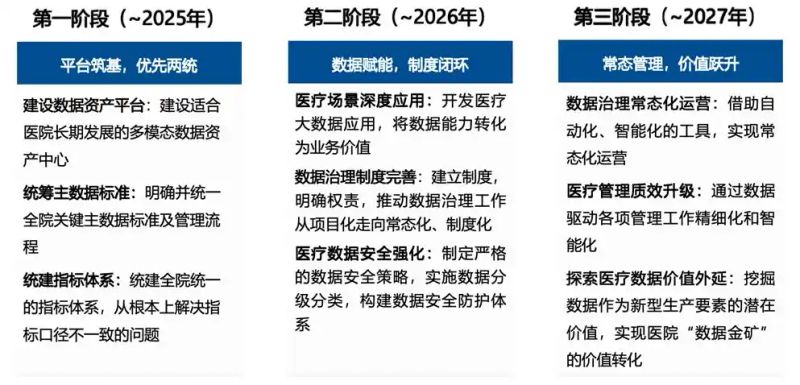
Figure 6 three-year plan for data governance
V. Implementation experience and sectoral thinking
Key success factors
1. 1 the governance of the first-hand engineering and specialized facility data is a whole-of-house rather than a sector project. The establishment of leadership groups led by the party's main political leaders, the establishment of multi-disciplinary classes and the establishment of a quarterly check-in mechanism for weekly movement control reports will allow for a breakthrough in the classic dilemma of the information section's operational sections。
1. 2 urgent ahead, quick impact
“it is easy for the world to suffer, and it is easy for the world to do great things.” from the most painful and specific questions, such as the desk dictionary, the indicator calibre, three months of success and a better consensus than a perfect three-year plan。
1. 3 standards first, corporate planning, step-by-step implementation
Pre-established rules and systems are being built to avoid “side-by-side disruptions”; the top-level design of the three-to-five-year evolutionary route, planning, platforms, data assets, application scenes, training multi-line and step-by-step delivery。
2. Key challenges and responses
The first is the long and costly historical data governance cycle, with a prioritization of target groups, and a combination of source and mapping governance; the second is the shortage of complex talent, which makes operational experts allies in governance through training of data managers, cross-laborator laboratories and the “business definition ai” model; and the third is that the boundaries of security, ethics and responsibility are yet to be clarified, with systems ahead, hierarchical classifications, full-scale audits, more slowly than “naked”。
3. Some signs for industry
First, data are assets, not by-products — each day-to-day data is a valuable asset for the hospital, not “by-census” but to operate with care. Secondly, data governance is a management issue, not a technical one, and ultimately “who, how and to what extent”. Thirdly, it is now never too late: it has already been done since the harmonization of the names of the sections and the identification of two key indicators。
From “data isolation” to “data base”, what changes is not just the technology warehouse, but the way hospitals produce. The future of inter-hospital competition is essentially a competition for data governance — the day when the base is firmly in place — when the true scale of intelligence is flourishing。









