


Single selection issues (10 sub-issues, 3 minutes each, 30 minutes)
1. Kindergarten teachers analyse the psychological characteristics of young children by documenting their performance in their daily lives and activities. This research method ( )
A. Observation law
B. Interview method
C. Test methods
D. Experimental methods
2. The following types of accidents are not handled correctly: ( )
A. A little fly bug enters the eyes of a young child and rubs it with a sponge
B. Minor scratches after a young child falls, cleaning and decontaminating the wound and wearing disinfectant medication
C. Small beads, bean pellets, and other things like twirling
D. Weakly alkaline liquids, such as bee water or soap water, when young children are injured by bees
3. In order to ensure the healthy physical development of young children, teachers require that young children have the right standing and sitting position because of the young child( )
A. Skeletal elasticity, plasticity and deformity
B. Skeletal elasticity, plasticity, deformed
C. Skeletal elasticity, plasticity and deformity
D. Small skeletal elasticity, plasticity and deformity
"i'm not afraid i won't cry!" it shows he's preliminarily available
A. Emotional understanding
B. Emotional expression
C. Emotional recognition
D. Emotional self-regulation
The number of health check-ups per year for children aged 1-3 years is specified in the health care work in kindergartens
A. One
B. 2 occasions
C. 3 occasions
D. 4 times
The typical characteristics of autism children do not include ( )
A. Slow development of speech
Lack of interest in people
C. Fear of life
D. Repetitive stereotypes
7. The 10-month-old beibei saw her mother stuffing toys in boxes. He'll open the box and find the toys. This means beibei's conscious
Persistence
Indirect
C. Reversibility
D. Object permanence
The baby says, "mother hugs" and "milk" and "plays outside" etc., commonly referred to ()
A. Words
B. Double words
C. Simple sentence
D. Composite sentence
9. The framework for guidance in kindergarten education (preliminary) proposes that the evaluation of kindergarten education should be ()
A. Early childhood assessment
B. Parental evaluation
C. Teacher self-assessment
D. Expert evaluations
The theoretical basis of zhang xuemen's “behaviour course” is (...)
A. Dewey utilitarian philosophy
B. Constructive psychology
C. Humanist psychology
D. Behavioural psychology
Ii. Brief answers (2 sub-questions, 15 minutes each, 30 minutes)
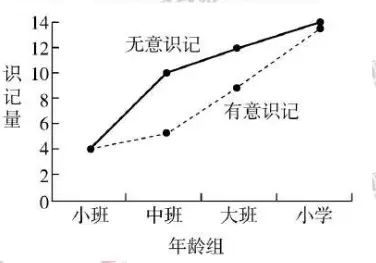
11. The development of young children's memory is illustrated in the figure below。
Briefly describe what is meant by “child-centred” teachers。
Iii. Topics for discussion (1 sub-theme, 20 minutes)
13. Five broad areas had been identified in the development framework, and it had been said that five university departments were the subject of university studies。
Iv. Maintenance analysis of major questions 2 minutes, 20 minutes, 40 minutes
Material: when mr. Lee played the role, he found out that beans were often hanging with little dolls, saying, "you're not good, i'll hit you!"
(1) analysis of the causes of this phenomenon. (8 minutes)
(2) what should be done after mr. Li? (12 minutes)
15. Materials
Ming was over four years old, and his mother found out that he did not accept criticism, and as soon as his mother criticized him, he said, "the teacher says i love helping people, i paint well, i'm a good one."
According to this material, the characteristics of young children's self-awareness development are described。
V. Activity designing questions (1 sub-theme, 30 minutes)
16. Secondary science education activities: let young children sense and discover plant growth processes and basic conditions。
Design educational activities to address this problem. The design thinking, the name of the activity, the objective of the activity, the preparation of the activity and the process of the activity are required。
References
I. Single selection issues (10 in total, 3 in total, 30 in total)
1. A
Analysis: the method of observation is a method of purposeful and systematic observation of the performance of pre-school children in everyday life, play, learning and work, including their language, expression and behaviour, and of analysing the patterns and characteristics of their psychological development on the basis of the results of the observation。
2. C
Analysis: this question examines how common accidents are handled. Item c describes a young child's nose that is stuffed with small beads, bean grains and other things, which should be dealt with in a way that immediately instructs the young child to hold his hands to his or her nostrils, slit his or her nose and excrete the alien. Don't use a sling to trap a round alien, because it is very difficult to pick up a round alien with a sting, which makes it deeper. Alien matter such as bean grains rises in the nasal cavity and is not easily removed. They should be taken to hospital when they are not easily available. The topic had been chosen in an incorrect manner and item c was therefore in line with the title。
3. A
(b) diagnosis: there are more organic matter and less inorganic salt in the child's bones, so that the bones are soft, flexible, small in severity and not susceptible to fracture, but susceptible to deformation and plasticization。
4. D
Diagnosis: self-incentive is the ability to regulate emotions。
5. B
A health check-up is conducted twice a year for children aged 1 to 3 at intervals of six months. Health check-ups take place once a year for children over 3 years of age。
6. C
Diagnosis: autism is a mental condition of a child's self-conscious development disorder and a type of widespread sexual development disorder, which occurs in early childhood and manifests itself in varying degrees of speech, interpersonal impairment, narrow interests and behavioural stereotypes. C timid fear of birth is a typical expression of a child with a silent disease。
7. D
Analysis: the subject examines the mental characteristics of young children — the permanent nature of the object. The object of division d is considered permanent when the object disappears from the horizon or is undetectable through other sensors. It is still possible for young children to find permanent manifestations of the object in front of them to disappear from the sphere that was inserted into the box。
8. B
Analysis: the subject examines the basic grammar structure of pre-school children. The two-word line in b, an incomplete sentence consisting of two words and sometimes three words, generally appears between the ages of one and a half and two and a half. The language of a dry baby appears in two words, such as “mother hugs” “milk” “plays outside”, which is a typical double-word message, so that item b fits the title。
9. C
Analysis: this subject is examined in the framework for guidance in kindergarten education (preliminary). According to part iv of the outline, article 4 of the education evaluation refers to a system of evaluation of the work of kindergarten education that is based on the self-evaluation of teachers, involving the head of the garden and the relevant managers, other teachers and parents。
10. A
Analysis: this is a test of zhang xuemen's pre-school philosophy. At the beginning of the twentieth century, the utilitarian idea of education, represented by dewey, was introduced into china, with wide-ranging implications for chinese educational theory and practice. The idea of “doing secondary school” education as life”, “education as growth”, “education as transformation of experience”, has greatly influenced china's then child education reform. The philosophy of the behaviour curriculum created by zhang xuemen is largely influenced by dewey's educational philosophy, which emphasizes behaviour, life and teaching together, all of which reflect the transmission of dewey's ideas and their indigenousization. Zhang xiemen considers the pre-school curriculum to be the experience of young children. “life is education, and the practice of children of five or six years of age living in a kindergarten is a behavioural course.”
Ii. Brief answers (total of 2 sub-questions, 15 minutes per sub-question, 30 minutes)
11. The development of the memory of young children: (1) the retention of memory is gradually extended. (2) ignorance is dominant and conscious memory is progressive. (3) increased use of mechanical memory, which begins to develop. (4) image memory is dominant and linguistic memory is evolving。
12. A central component of young children is respect for their rights and interests, with young children as their focus, and the full mobilization and empowerment of young children. In keeping with the characteristics of young children's physical and mental development and the pattern of health-care activities, appropriate education is provided to ensure that young children grow up happy and healthy. “this” could be interpreted as: foundation, subject, foundation, original, essence, point of departure, purpose, etc. The term “childhood at its root”, or “childhood at its core”, is a concrete expression of a “people-centred” approach to science development in early childhood education, an essential component of the very essence of early childhood education and a central concept for kindergarten teachers. Valuing the lives of young children, respecting their values, meeting their needs, upholding their rights and promoting the comprehensive development of each and every child is a central element of “early childhood at its heart”. Advocating for “childhood as its own” but not isolated。
Iii. Topics for discussion (sub-theme 1, 20 minutes)
13. Different types. The five main areas are a diverse curriculum: language, society, art, health, mathematics. The disciplines are classified as those with a certain degree of relevance and are designed to meet the needs of the development of the disciplines and the development of human resources, taking into account the practices of the statistical classification of education. The two types differ。
Iv. Maintenance analysis of major questions
14. (1) the behaviour of soybeans in materials is an act of aggressive behaviour. Possible causes of aggressive behaviour include:
1 parental punishment. Punishment can discourage attacks on non-offensive children, but may increase attacks on offensive children. The role game is a re-emergence of the reality of life around us, and the bean-beans often play dolls and say, "you're not good, i'll beat you! You cry, i'll beat you," and it's likely that they've been verbally abused and threatened by their parents and that they've been transferred to the role game。
2 example. Attacks on television role models can increase attacks on children, and parents and peers are seen to have an impact on young children. Doudous as a small class has its own imitation characteristics, which can be seen on television, in real life or in games, as aggressive behaviour of others, leading to imitation。
3 enhanced. In the case of aggressive behaviour by a young child, the parent's failure to stop or to listen reinforces the child's aggression; it is also possible to learn offensive behaviour among peers, and if a child successfully invokes offensive tactics to control his/her peers, it can reinforce and increase the aggressiveness that follows. The aggressive behaviour of beans may be the result of intensification。
4 setbacks. Direct causes of offensive behaviour are mainly setbacks. Frustration is the emotional state in which a person encounters obstacles in the course of his or her activities or interferes with his or her achievement of objectives and needs, and a child who is frustrated is likely to be more aggressive than a child who is satisfied. Beans may have encountered difficulties in the course of the game, such as unfair treatment, which may lead to aggressive behaviour。
(2) ms. Li can begin by reducing offensive behaviour by soybeans as follows: teachers need to communicate with their parents in order to induce them to adopt a positive educational approach, reduce penalties and give positive guidance to young children, as well as positive feedback to young children in kindergartens. Article 11 of the law of the people's republic of china on the protection of minors states: “any organization or individual who discovers a situation which is detrimental to the physical or mental health of a minor or which infringes the lawful rights and interests of a minor shall have the right to discourage, prevent or lodge a complaint or complaint with the relevant public security, civil affairs, education, etc.”. Therefore, if mr. Li finds that a young child has been subjected to or is suspected of being subjected to domestic violence, he should, in accordance with the law, promptly report it to the public security authorities。
2 young children should be given a space to avoid conflict as much as possible. Teacher li can create a harmonious environment of tolerance in kindergartens and reduce conflicts among young children's peers. At home, they lead parents to create a good family environment, reduce quarrels and promote harmony in the overall family environment。
3. Fostering the will of young children and allowing them to express themselves reasonably. There is a need to improve the self-control and resistance of beans, and when difficulties and setbacks are encountered, not by harming others or others, and to guide young children to a rational discharge of emotional problems。
4. Strengthening pro-social behaviour among young children. In daily life and games, young children can be empowered to migrate, and soybeans can think about what happens if they are dolls: thus increasing pro-social behaviour and reducing aggressive behaviour。
Building social skills and social awareness among young children. Through teaching activities, teachers can make young children aware of the negative consequences of aggressive behaviour, enhance their ability to socialize and learn to cooperate and share good behaviour in play。
15. The development of young children's self-awareness is reflected in the performance of small and medium-minority materials, including:
(1) development of self-evaluation
Self-evaluation is a central element of self-awareness and one person evaluates himself/herself on the basis of his/her own knowledge. Xiaoming is in a period of rapid self-evaluation, as shown by:
1 ming's assessment of himself is based on dependent evaluation, i. E. Young children tend to rely on adult evaluation in self-evaluation. The material says, "senior zhang praised me yesterday!" saying i love helping people! Having a little red flower on duty is a reflection of ming's reliance on teachers to judge himself。
2 ming assessed himself as his external behaviour and individual aspects, and ecd self-evaluation focused more on external behaviour than on inner quality. The material says, "i also got the red flower yesterday on duty! Draws are also particularly well painted” are external acts and the evaluation aspect is relatively uniform。
3 the self-evaluation of xiaoming has a strong emotional tone and lacks a rational assessment based on the rules of conduct. Ming prefers to receive a commendation, also because a good evaluation can give a happy mood to young children。
(2) development of self-perception
Self-perception is the emotional experience that comes with self-evaluation, as demonstrated by: in the material, xiaoming believed that he was the best little friend in the class and based his confidence on the suggestion of the teacher。
2 ming showed a stronger inner experience, in which she found that ming was increasingly reluctant to accept criticism from others, reflecting a growing sense of self-esteem with age。
Combining the above self-conscious development features, ming should be guided in his self-evaluation by the use of independent evaluation, assessment of inner qualities and intellectual evaluation. At the same time, teachers provide some insinuation and encouragement in order to induce ming to develop a good emotional experience based on self-evaluation in order to improve the ability to regulate, control and develop self-control。
V. Activity designing question
16. Young children are curious, well asked, happy to try and like to explore the mystery of nature. But now that children are better off materially, virtual worlds such as the internet and television increasingly deprive them of the opportunity to be close to nature. In life, many young children eat with mouths and clothes and rarely work on their own. This activity enables young children to learn how to observe and document their cultivation through hands-on planting, through observation, hands-on operations and sharing, and through scientific observation and documentation, both to satisfy young children's desire to explore and to inspire their sense of responsibility and to enable young children to experience the joy of labour。
The objective of the event is to: (1) visit the plantations of kindergartens to find out the names and characteristics of some plants。
(2) understanding the process of planting and the basic requirements for seed growth。
(3) try to participate in planting and experience the pleasure of planting。
(4) to care for plants and respect the fruits of labour。
(5) the interest of young children in exploring natural phenomena。
Activity readiness:
(1) vegetables on kindergarten plantations: radish, lettuce, onions, oatmeal, and trees in kindergarten-growing areas - mountain trees。
(2) a video of seed sprouts is prepared for the event。
(3) prior to the event, parents are invited to direct young children to the methods of planting。
Activity:
(1) young children are invited to view the seed sprouts to stimulate their interest。
Question: how did the seed grow up? Do you think it's amazing? Would you like to visit the plants of our plantations and see if they grow up? (teachers actively encourage young children to respond and commend them in a timely manner) led young children to the plantation of the kindergarten and asked: what was it like the other day? What's changed now
(2) visiting all types of plant in kindergartens is for young children to observe and understand their names and characteristics. Do you know the names of these plants? B. Teachers introduce young children to the names and characteristics of various plants。
(3) panel discussion: understanding the basic requirements for seed germishment. The teacher asked: "where is the seed most conducive to its growth? Why? Teachers conclude that the basic conditions for seed growth are sunlight, water, soil, air
(4) mobilize existing experiences of young children and discuss planting methods with young children. Lead young children to discuss with each other about the process of planting seeds. Teachers asked: "who knows how to plant seeds in the soil? What needs to be done when seeds are planted
(5) teachers and young children share experiences and identify planting methods. Cultivation process: the seeds are spread evenly on the soil surface (the seeds cannot be put too much), then the seeds are fully covered with fine soil, and the seeds are eventually given the appropriate amount of water (the water is to be fully purged from the soil inside the container)。
(6) small groups of young children are involved in planting activities in bathrooms or suitable places, with teachers providing focused guidance. (1) teachers guide young children to grow according to the right steps. 2) teachers guide young children in the process of planting to think: what is the best place for seeds to grow in the soil? Why? Seeds can't be too deep, they can't germinate; they can't be too shallow, too shallow to dry
(7) sharing exchanges. Kiss our plantation baby. Teachers organize young children to share their experiences after visits。
(8) young children are taught to care for their plants, to know that they are hard-earned and to respect the work of others. Summary of activities: teachers summarize the performance of young children today and commend and encourage positive young children in their activities. The pleasure of scientific exploration is felt by young children as they grow. At the same time, teachers take care of young children who are quieter in their activities so that they can also enjoy themselves at the end of their activities。









