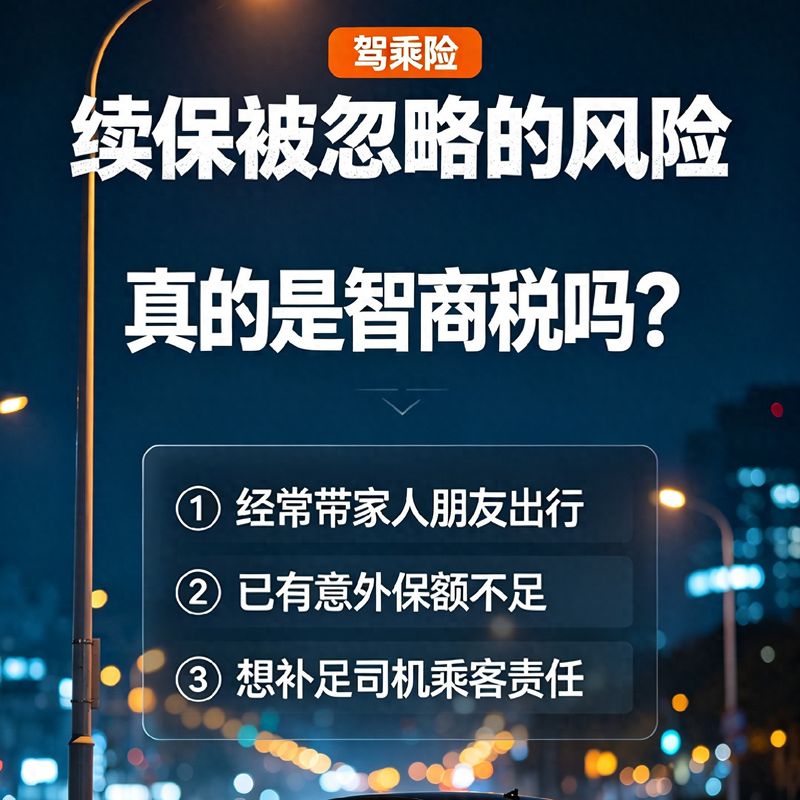
Every year, when the insurance policy is renewed, many of the drivers get their quotations and see a driving risk. A number of practitioners will strongly recommend it, and there are voices on the internet saying that driving risk is purely an iq tax and that there is no need to buy it. You're on bail
Shouldn't we get rid of the crash? Today, in big words, let's get this straight: without exaggerating, without creating anxiety, ordinary car owners can make decisions。
Many of the drivers have one of the greatest faults: the use of driving risk as their own. It's not, as we used to call it, insurance, insurance, insurance against injury and loss, and liability insurance for people on board, which is commonly known as seat insurance, which is the kind of risk involved in formal commercial insurance. Driving risk, known as accident insurance for the driver, is essentially personal accident insurance, an independent insurance product, and vehicle insurance is not a system, but many insurance companies send it to the owner along with the car insurance page, so the vast majority of people mistakenly think it is an option。
This difference in identity is a direct consequence of the difference between driving risk and seating risk resolution, which is at the heart of the whole problem. Many suffer from a lack of clarity about seating and driving risk, thinking that they are the same thing。
First, seat insurance, it is the liability of the owner. Translation: only if we are responsible for this traffic accident will the insurance company pay the driver and passenger injured in the car. It's a common example of life when you're driving for a red light, when the rear car comes straight up and the traffic cop holds the other side responsible. At this point, the family of your car was injured and hospitalized, causing tens of thousands of dollars in medical expenses. In such a case, your seat would not be paid a penny and the entire loss would only be claimed by the wrong-doer and his insurance company。
In reality, it's a very difficult situation, if the driver buys a strong risk, the three have low insurance coverage, even if the vehicle is uninsured, uninsured, and the other has no financial means to pay for it, the medical expenses of the vehicle’s personnel will be borne by our own families, and it will take a lot of time and effort to defend their rights. And once a seat insurance claim is made, accounting for an accident record, your overall insurance premium increases in the next year. Most of the ordinary seat insurance coverage is in the range of $150,000 per seat, with a premium of over $200, but the ceiling is very low, which, in the event of a more serious accident, is far from covering the cost of treatment for serious illness。
It protects people, not vehicles. Regardless of whose fault this accident is, whether we are responsible or irresponsible, compensation is paid under the insurance contract in the event of a traffic accident resulting in injury, injury or disability, as long as the vehicle is legally driven. And the example above of being followed by the other party is that if we buy a ride risk, the medical expenses of the vehicle’s personnel can be settled directly by applying to their own insurance companies, without waiting for the other party to pay, while we still retain the right to pursue claims against the perpetrator, amounting to an additional layer of protection。
Another practical point is that driving risk falls within the category of accident risk, which makes up the amount claimed and does not account for the number of accidents. Even if you had paid for the accident in the course of that year, the next year's premium discounts on insurance, insurance, and vehicle losses would have been completely unaffected, which is a clear advantage for long-suffering owners。
Here is a special reminder of the fact that the risk of driving is linked to the plates and the humans, and that many of the drivers are unwieldyly buying the wrong versions and paying the premiums does not achieve the desired safeguards。
With the plates, secure this car. Whoever comes to drive the car, and whoever sits in it, as long as there is an accident in the insured vehicle, everyone is guaranteed it. The vast majority of families that are suitable for ordinary family cars, where many people rotate their cars, often carrying elderly people, children, relatives and friends, are recommended by the bullet window to drive with their plates。
It's personal. It's guaranteed to bind the insured person himself. You're the only one who's gonna pay for an accident. But there's something wrong with someone taking your car, and the insurance doesn't pay anyone. It is appropriate to drive company vehicles on a regular basis, to rent them regularly, to carry very few others, and almost all of them own cars。
After understanding the underlying concept, we return to the subject of our most important concern: is the iq tax or not
Objectively speaking, it is not a panacea, but it is not a purely iq tax. It's all about your car scenes, your policy terms, and the insurance that your family had. Neither of the extremes on the internet can be believed, either advocating that all carowners must have a single one, or that it would be risky to buy one; or the total rejection, which says that buying is completely useless and that it is simply a harvester, is both one-sided。
First, in what cases, consideration could be given to removing the risk of driving without purchasing。
First, you're almost the only one who uses the car for short-distance transportation, and usually doesn't pick up family, friends, colleagues, and there's very few people around the world. At the same time, you yourself have fully integrated personal accident insurance. The individual comprehensive accident insurance itself contains the accident guarantee of daily driving and safeguarding yourself. Since there are few other crews, there is no need to pay extra for a ride-by-the-carriage risk, so that the renewal of the guarantee can directly eliminate the risk and save the premium. It is important not to confuse that personal accident insurance is guaranteed only to the insured person, and that your lovers and children are injured in the car and that your personal accident insurance does not compensate them。
Second, the budget was very limited, and priority had been given to combining risk insurance for high-risk, high-risk and out-of-pocket medical treatment, and there was no surplus budget. The logic of the allocation of insurance always gives priority to the protection of large external risks, with the three risks being the top priority, first ensuring sufficient capacity to pay after collisions, and then taking into account the safety of personnel on board. This situation can give up the risk of being driven, but the risk is clear in mind。
Third, some of the owners are already equipped with a high seating risk of more than 100,000 per seat, with a simple view of the parking space, with few irresponsible accidents requiring their own bottom-up or without double-hatting。
However, in the following categories of owners, it is highly useful not to recommend the direct deletion of driving risk。
The first category is a standard home-based scooter, which often travels with families, often with older persons and children, and sometimes with relatives and friends. This is a scenario that most needs to be driven. In the event of an accident for which the other party is fully responsible, many of the family members of the vehicle are injured and do not have to rely entirely on the party responsible for the damage, the risk of driving can be shared with medical stress, and economic disputes can be avoided because of compensation issues and the family and friends on board。
The second category is frequent high-speed, long-distance and frequent self-travel. In the event of an accident on the high-speed, the injuries tend to be heavy, the cost of treatment is high, and in the event of a lack of insurance coverage, it can place a heavy financial burden on families, with an additional layer of security and a higher level of security. Some of the products also support a doubling of statutory holiday coverage and greater holiday travel security。
Category iii, new drivers, with a relatively higher probability of accidents; occasional windmills, often accompanied by different passengers. Attention is drawn to the fact that general domestic insurance does not support the operation of internet-based vehicles, and if a full-time network-based vehicle requires the purchase of specialized operating-type insurance, it will be denied。
The fourth category, which had been without risk for many years, valued the discount on vehicle risk and did not intend to cause the next year's premium increase as a result of the seat insurance claim. In such cases, it would be more appropriate to supplement the safety of the vehicle by driving risk, which would not affect the discount。
It is also a source of iq tax that many people feel after talking about the people who are applying it and talking about the real pits on the market. Rather than being a bad species per se, many have bought products with poor terms。
The first pit was confused by a million-dollar bond. Some products have a total premium of 1 million, and many car owners consider each to be worth 1 million. It was only when the provision was opened that 1 million people were disabled, but only 30,000 to 50,000 were treated for accidents. Most of the traffic accidents in reality do not necessarily result in direct disability, more in fractures, surgeries, high costs of medical care, low levels of medical care, which are simply inadequate when they occur. In the selection process, the coverage should not be limited to physical care, but should focus on the level of medical care for accidents。
In the second pit, medical treatment is reimbursed only for the medication used in the medical insurance catalogue. Many of the low-cost jobs are not reimbursed for uninsured medicines, imported steel plates and special consumables. In the case of injuries caused by traffic accidents, a large amount of osteoporosis is used for self-suspension and reimbursement is significantly reduced if out-of-pocket medical responsibilities are not included. Priority is given to products that support out-of-insured medical claims, without which the value of the product would be significantly reduced。
The third pit thought it would cost us anything. No, drunk driving, poison driving, unlicensed driving, and vehicles are converted into operating orders, in which case the risk of driving is also directly denied, and any insurance is subject to an exemption clause, a simple review of the focus and not just an oral presentation of the sale。
The fourth pit, confusing the payment logic. The medical costs of driving the risk will not be duplicated if the third party liable has paid the full amount of the medical costs. However, the fact that death, disability compensation and hospitalization benefits are supercompensable should be distinguished from the fact that it is not possible to expect two medical claims at the expense of one medicine。
Fifth pit, tied for sale. Some of the renewal offers are silently defaulted on the selection of driving risk, and many of the drivers do not look closely, submit the renewals directly, and pay for them if they are confused. It is important that the list of quotations be checked on an article-by-article basis and that no manual cancellation of the ticking be required. In accordance with regulatory requirements, driving risk cannot be sold by binding vehicle risk insurance, and the owner has the right to buy it or not。
Many car owners will also have a problem: seat and motor safety, both of them? Or two or two
In the case of ordinary families with a regular budget, preference is given to one without both. Often travels with family members, preference is given to good driving risk with the car; driving is almost alone, priority is given to human driving risk or combined personal accident risk。
So what's the match? If you are often carrying outsiders, you occasionally run a windmill, with sufficient budget, you can have a small seating risk and a driver's risk. A little knowledge is added here: seat insurance can cover the costs of work-related accidents, nursing, etc., while many driving products do not include work-related costs. When we're all responsible for the accident, the passengers ask us for the cost of the work, and the seat insurance works, which is a short board for driving。
A simple set of configurations that can be consulted directly, taking into account the actual situation of ordinary families。
The average five-cars, often driven by many people in the home, often travel long distances: the guarantee is not to be removed directly from the driving risk, priority is given to the car layout, medical accident is to be given as high as possible, priority is given to the responsibility for out-of-pocket medicine, and the guarantee is to be recommended for 300 to 500,000 blocks each, with a premium of between 1,200 and 300 per year, equivalent to the cost of one or two meals. Seating risk does not have to be high, and budget constraints can even directly cancel the seating risk。
The day is just a day to go to work on its own, with very few people on board: a renewal of the policy simply removes the risk of driving with the car. It is sufficient to provide for an individual comprehensive accident risk, without spending any extra money。
The budget is tight: priority is given to full liability for risk insurance, insurance for more than 3 million persons, medical insurance, insurance for vehicle losses, based on the residual value of the vehicle, and the driving risk can be directly avoided, knowing that the person on board does not have such a cover guarantee。
All owners are also reminded that insurance will never be a risk transfer tool and that better driving risks will not replace safe driving. Compliance with the rules of engagement and careful driving are the best safeguards in the absence of accidents. Don't think you can relax by buying insurance。
Many of the drivers struggled with the essence of being afraid to step on the pit and to pay their premiums for nothing. In conclusion, driving risk is not a car risk or an iq tax. Matching the scene, choosing the clause, is a very practical cover guarantee; it's not a match, buys a bad article product, and that's really nothing. When the guarantee is renewed, do not listen blindly to the sales of the operator, or read a paragraph on the internet and delete it all, and then make a decision about how you normally use the car。
Declaration of exemption:
This paper is intended for the general public and does not constitute any recommendation for insurance coverage. The terms of the formal insurance contract and the official explanation of the insurance company shall govern the driving risk, the physical security of the seat insurance, the terms of settlement and the scope of the exemption. The cases in the text are referred to in the risk section only, and there are differences in geographic claims. If you want to buy a car, you can consult the formal insurance agency and make a choice。