


In 2023, the fujii courts were profoundly seized of the “political, professional, innovative and international” character of intellectual property trials, deepening conceptual change, institutional innovation and upgrading of competence, putting into practice the theme of “fair and efficient” work, promoting a rigorous and fair administration of justice, increasing the protection of key core technologies, priority areas and emerging industries, bolstering the rule of law and innovation in services technology, industry and institutions, and further enhancing the judicial protection of the rights of the fujii courts。
Basic information on intellectual property cases in provincial courts
In 2023, the fujian court fully assumed its role as a guarantor of intellectual property rights
(i) overall caseload
In 2023, the provincial courts handled 24,245 civil and criminal cases of intellectual property, the same level as the same. Of these, 2,360 were newly received, an increase of 6. 22 per cent; 2155 were disposed of; and 2,290 were outstanding. 23622 civil cases handled: 21836 at first instance; 1649 at second instance; 120 at second instance; 17 at second instance. The number of criminal cases dealt with was 623, which is the same. Of these: 432 at first instance; 86 at second instance; 105 others. In addition, 34 administrative cases were handled and 25 were disposed of。
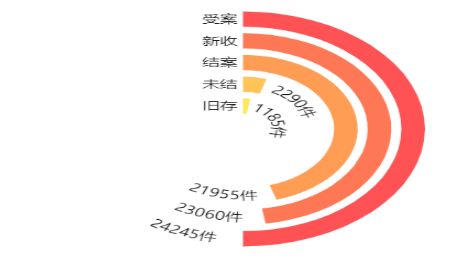
Figure 1 overview of intellectual property cases in provincial courts 2023 figure
(ii) first instance cases of intellectual property infringement
In 2023, 20,616 new cases, or 7. 53 per cent more, were received in the first instance in cases of infringement of intellectual property rights in provincial courts; 19484 cases were completed. The average trial time was 48. 53 days。
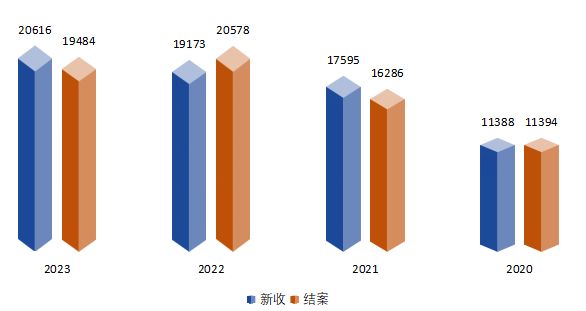
Figure 2
1. Distribution of cases. 865, or 44. 44 per cent, of trademark rights disputes, 362, or 1. 86 per cent, of trademark rights and tort disputes, and a total of 9020, or 46. 29 per cent, of trademarks disputes; 3831, or 19. 66 per cent, of copyright disputes, of copyright disputes and tort disputes, of 2975, or 15. 27 per cent, of copyright disputes and of copyright disputes, or 34. 93 per cent, of copyright disputes; 1954, or 10. 03 per cent, of patent rights disputes over visual design; 333, or 1. 71 per cent, of functional new patent disputes; and 1371, or 7. 04 per cent, of other disputes。
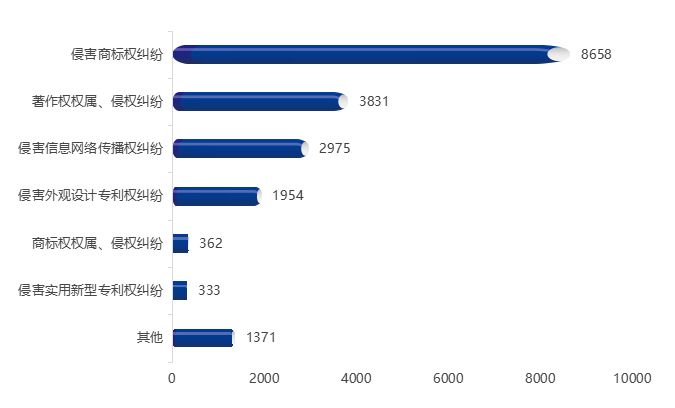
Figure 3 distribution of first-instance cases of intellectual property violations by provincial courts in 2023
2. Geographical situation. The top five new and closed cases were in quantuan, fukuda, tsubata, xiamen and dragonstone; the increase was significant: 41. 29 per cent in quantai, 26. 1 per cent in fukuda and 14. 81 per cent in quantuan; the increase was significant: 16. 22 per cent in quantai and 13. 71 per cent in fuku。
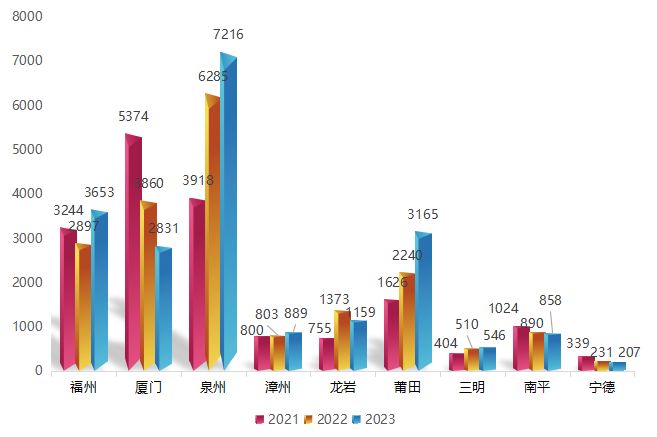
Figure 4 geographical breakdown of new intakes of first-instance intellectual property abuse cases by provincial courts, 2021-2023
3. Amount of compensation awarded. The average award was $62,000. Of these, 1,038, or 53. 31 per cent, were under $10,000, 8063, or 41. 38 per cent, were under $100,000, 890, or 4. 57 per cent, were under $100,000, and 15, or 0. 08 per cent, were above $10 million。
(iii) civil second instance intellectual property cases
In 2023, 1481 new cases of civil second instance of intellectual property rights were received, 1508 were disposed of and 141 were pending. The top five cases were: 729 trademark rights disputes, or 48. 34 per cent; copyright disputes, or 25. 20 per cent; patent disputes on appearance design, or 13. 66 per cent; improper competition disputes, or 5. 44 per cent; and concession contracts, or 4. 31 per cent. The proportion of first and second instance disputes is positive。
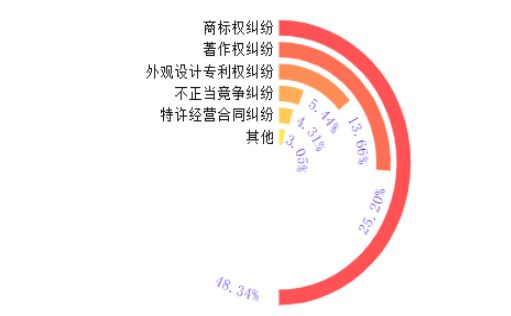
Figure 5 distribution of civil second instance cases of intellectual property by province courts, 2023
(iv) basic features of the case
1. The type of case disputes is relatively concentrated. Civil disputes are mainly concentrated in disputes over trademark rights, copyright rights and patent rights against appearance; criminal cases are dealt with mainly by the courts of quanzhou and yanda, which account for more than two thirds of the total number of intellectual property cases in provincial courts. The economic activity of the quantuan and yanda regional platforms has increased the awareness of rights-holders, and the number of disputes against trademark rights, copyright rights and patent rights to visual design has increased. The number of new cases in the courts at the quantuan and kanda levels has increased every year。
The closing points in patent disputes have been highlighted. The administrative standards of patent authorization are more difficult to harmonize with those of the judiciary, and the issues of revolving litigation, procedural emptiness are more prominent. The fact that some patent avoidance proceedings go hand-in-hand with civil proceedings, whether they result in a “long lead” in suspension of proceedings, or the “basket” in the “basket in the first instance” in the first instance in the first instance in the first instance in the first instance in the first instance in which a certain number of cases have been declared null and void during the second instance and have been set aside by the supreme court in the first instance in the case of patent disputes, is increasingly extensive and complex in technical programmes, such as technical information in the context of algorithms, product manufacturing methods and the qualification of technical features in the field of electrochemical chemistry through the definition of parameters。
The criteria for determining damages are more difficult to harmonize. The overall size of intellectual property cases, a reasonable balance between the market value of rights and the public interest, and a reasonable determination of the amount of damages for tort under the law remains a challenge that needs to be further addressed. Some rights holders do not focus on gathering evidence of the results of the damage caused by the violation, nor do they provide sufficient justification for compensation, which makes it difficult to ascertain the amount of the damage caused by the violation and the amount of the benefit of the violation, while the use of statutory compensation to determine the loss is subject to a subjective element and the criteria are not uniform。
4. There is a certain tendency to defend rights for profit. On the one hand, there is a certain imbalance between the tendency of rights-holders to defend their rights and the incentive for innovation to create entrepreneurship, with enterprises bringing hundreds of cases of “rights defence” or even “two cases” of “distribution” in the same period, while “harvesting” in the context of “fishing” and litigation of “rights defence” benefits even more than normal business. On the other hand, a large number of small businesses lack the basic capacity and means to judge the violation, which prevents them from actively, adequately and completely identifying the potential for abuse of goods in circulation in their commercial activities, as well as the irregularities in the management of small businesses and the incomplete preservation of evidence, which makes it difficult to establish their legitimate sources of defence at the time of the complaint. These conditions have to some extent disrupted the normal course of business in the market and have been detrimental to the growth of small commodity economies。
Deepening the concept of strict protection, enabling justice and harmonizing the legal protection of intellectual property with a view to “more quality efficiency” and building the foundations of “the development of new quality productivity”
The stakes, the sense of “as i am” are used to bring about real efficiency gains in the context of ensuring justice, better and more quickly to identify disputes, resolve conflicts, realize interests and stop disputes。
(i) strictly increase compensation in accordance with the market value of rights. The correct application of the appropriate determination of the amount of damages for tort under the law ensures that the penalty is proportionate. In the case of trademark torts between a company such as fiji and caygau, the amount of compensation was adjusted from rmb 1 million to rmb 3. 5 million in the second instance, taking into account the subjective malice of the tort, the apparent intent of the tort and the wide geographical scope of the tort. (b) to increase the amount of damages for the violation in accordance with the law, taking reasonable account of the punitive factors such as the clear and serious nature of the violation committed by the perpetrator. In the case of the “nine oren” trademark tort, a punitive factor was applied to determine the amount of 2 million yuan; and in the case of disputes over the right to trademarks and unfair competition, such as the case of the versailles corporation (verción watch) and an electronic commerce company in the drum building, a punitive factor was considered to determine the amount of 230,000 yuan. Punitive damages are actively applied to elements of punitive reparation that are compatible with such elements as tort, repeat violations, malicious violations and massive violations. In 2023, in five cases, punitive damages were awarded totalling $7,120,350,000。
(ii) active sources of resolution of disputes and good faith in judicial advice. Taking stock of the governance initiatives in each case, type of case, to promote “substantive resolution” of disputes “one-time resolution” “source resolution”. Fukuya central house successfully defused the first case of a monopolistic dispute over market dominance between chinese and indonesian “twice parks” enterprises across the province, and managed to properly resolve possible bulk chain disputes. The jianda district court, in conjunction with the relevant authorities, has facilitated the settlement of disputes with 91 large- and medium-sized karaoke operators throughout the city and has concluded an agreement on copyright licensing. To emphasize the important role of judicial advice in front-end governance, “retroactive” responses from case processing, case-based analysis, and to “big story” of “small-cut” participation in social governance with a view to achieving good results. Judicial recommendations to market regulators on the registration of cluster enterprises were issued by xiamen, nanping central court; judicial recommendations on the protection of intellectual property rights were issued by the quanzhou court of quan quan, “triple bill”, which regulated the abuse of trademarks; and judicial recommendations were issued by the quan dynasty and quijiang courts to the people's government of yonghua township, quan dynasty, and the quiang city management committee on the geographical concentration of intellectual property rights violations, respectively. The dragonlion city court, “the triple protection of intellectual property was innovatively driven by development”, was awarded the best case of a new national era, the maple bridge experience。
(iii) the ability to use sufficient evidentiary rules in an effort to resolve evidentiary difficulties. The effectiveness of the system for the preservation of conduct, the preservation of property, the preservation of evidence, the system for the presentation of evidence, proof of obstruction, etc., as provided for by law, judicial interpretation, the timely fixing and refinement of evidence, the reasonable allocation of the burden of proof and the reduction of the burden of proof on the rights holder are fully realized. The supreme court has affirmed the difficulty of allocating the burden of proof to resolve the source secret points of the software, compared with disputes over copyright and business secrets against computer software, such as the case of a technology company in shenzhen, where evidence was preserved and evidence was obtained. In the case of a dispute over the invention of the “public pig odour agent” method, the results of the examination in the field of specialization in which the “uniform system of registration of experts and expert bodies” is not in place are reviewed and accepted in accordance with the law, which guarantees the legal rights and interests of the right-holder. In the case of a dispute over trademark rights by a hannsian company, a settlement was reached between the parties through protective measures to resolve as a package all the trademark disputes between them in mainland china。
(iv) deepening the technical survey system to efficiently identify technical facts. The three intellectual property courts of fukuzhou, xiamen and quanzhou dealt with 2031 civil cases (473 in fukuzhou, 358 in quanzhou and 1,200 in quanzhou), concluding 1840 cases (451 in fouzhou, 306 in quanzhou and 1083 in quanzhou). A total of 103 cases from the three intellectual property courts were assigned to technical investigators. The professional and scientific nature of intellectual property trials is further enhanced by the efficient identification of “technical facts” in technical-type cases through the use of the technical investigators' in-depth participation in the investigation of forensics, surveying, preservation, hearings, identification and collegiate proceedings. The supreme court has upheld the methodology and the technical facts established in the case of a patent violation against inventions such as that of an pv company such as sun and a pv company in fukuzhou, where the technical investigator conducted a survey, demonstration and technical comparison of the product and produced a technical analysis, thus omitting the task of commissioning the identification。
(v) integrated and coordinated equal protection and active integration into international governance. Active participation in global intellectual property governance within the framework of the world intellectual property organization (wipo), contributing to the creation of international rules on intellectual property that are open, inclusive, equitable and just, acting creatively and in a leading role in the administration of justice, enhancing the leadership of international rules of governance, helping to integrate innovative subjects into international competition and creating a favourable international environment for the development of new quality productivity. A letter of appreciation was sent by a company from felix for the equal protection of foreign interests under the law in the case of a dispute over a “felony” trademark, which led to a settlement of the relevant trademark dispute as a whole and to the effective suppression of trademark attacks and chain violations. The second provincial court of the world intellectual property organization (wipo), following shanghai high court, has worked with china to provide a new path to exploring diversity in the settlement of foreign intellectual property disputes, creating more favourable conditions for a market-based, rule-of-law, internationalized and first-class business environment, and making it more attractive to global factors. Currently, a total of 16 mediation cases have been commissioned to the world intellectual property organization's centre for mediation, with 8 successful mediation cases. The public prosecutor's office has appointed the world intellectual property organization centre to successfully mediate the first three cases of foreign intellectual property, the first court in the country to have been entrusted with mediation through the centre。
Strengthening of high-technology, priority areas and specialty industry protection for “more focused” intellectual property rights (ipr) justice protection to foster “the development of new quality productivity” voto
Strengthening the rules for the protection of innovation and its value orientations, helping to promote innovation, in particular sti, in the construction of modern industrial systems, with intellectual property rights (ipr) judicial protection of the empowerment and integration of other factors of production, generating multipliers and multiplier effects, and providing services to safeguard innovative provinces of the new era。
(i) strengthening the protection of technological innovation and enabling science and technology to become self-reliant. Using the advantages of centralized jurisdiction in technology-based cases, increasing the protection of original innovation, key core technologies, strategic and emerging industries, agricultural science and technology outcomes and priority areas, “real innovation” is “real protection”, “quality” is “strictly protected”, strengthening the judicial protection of researchers, science and innovation, helping to foster the emergence of niche new “small giants” with innovative advantages and promoting the development of innovation in the economy. (b) to strengthen the judicial protection of intellectual property rights in the new energy industry by maintaining the issue and objective orientation, by providing a comprehensive overview of the handling of disputes in the new energy sector in the provincial courts, and by forming the report on judicial protection of intellectual property rights in the new energy sector in the fujian courts. Cases of disputes over technical contracts are dealt with in accordance with the law, the legitimate rights and interests of the compliance parties are protected, and the distribution of benefits and responsibilities for the development, transfer, licensing, pledge, consultation and so on are reasonably determined. In the case concerning a contract for the commissioning of a technology development contract between an east and a two motors company, the defaulting party's liability was determined taking into account the inherent commercial risks of a technical type contract, the degree of fault of the defaulting party, the contractual liability for default and the reasonable expectations of both parties to the market, the scientific determination of the liability of the defaulting party and a reasonable balance between technological development and liability。
(ii) strengthening data dispute research to help build a digital economy. Strengthening the consideration of cases involving open sources of data, data validation, data transactions, data services, data cloud storage, upgrading of the digital transformation for fujian, doing well in a large digital economy and providing strong judicial service guarantees. A proper consideration of cases involving violations of data from web platforms such as little red or little ali or ba, and the effective balancing of the boundaries of the use of big data in development processes such as ai industry in the digital economy, have led to the development of new business models for new industries. In the case of a company vs. The firm's improper competition, the “document md5 value manager” embedded in the “consolidation of a video software” was deliberately designed to help others circumvent the md5 value detection mechanism, which objectively made it possible to violate the copyright rights of others by replicating, modifying, etc., and found that the act constituted an undue competition, which was assessed as “50 typical ipr cases in 2023 in chinese courts”。
(iii) promotion of crop-based innovation protection and firm agricultural safety lines. “smalling, though small, is about the “big man” and the well-being of people. To strengthen the protection of the right to new varieties of plants, to prevent the unauthorized production, reproduction, sale or reuse of reproductive materials and to combat the production, reproduction or mixing of authorized varieties of plants in commercial plants or breeding. In a dispute between a chinese company and a company like fujian on the violation of the right to new varieties of plants, a paternity test for dna molecules was initiated, using the ny/t1432-2014 technical procedures for the identification of corn varieties ssr marking act as a technical comparison to effectively address technical factual determination difficulties. A dispute between an orange company in sichuan and an agricultural company over the use of the temporary protection fee for new plant varieties, a dispute over the infringement of the right to new plant varieties, the refinement of the reference factor for the use fee for the temporary protection period for new plant varieties, and the precise determination of the use fee for the interim protection period. The protection of the legitimate rights and interests of creative subjects is constantly being strengthened, and illegal acts involving seeds, such as forgery and placard abuse, are being severely combated by law. In the case concerning the production and sale of fraudulent products, the accused, in the absence of evidence from the seed quality testing agency, in connection with the field assessment conducted by the agricultural and rural directorate in a field sample of experts with high professional titles and relevant professional experience, statements of farm victims and statements of the accused, found the products to be false and sentenced to punishment in accordance with the law。
(iv) focus on the protection of niche industries and build on traditional innovations. Judicial protection of the ceramics industry has been strengthened, with 158 cases of intellectual property rights relating to ceramics being heard by the quanzhou courts, 144 cases having been concluded, the subject of proceedings amounting to $12. 656 million and the conciliation withdrawal rate of 67. 18 per cent. In february 2023 and march 2024, the judicial innovation mechanism for the intellectual property rights of ceramics was evaluated for two consecutive years as the “most accessible” initiative to optimize the business environment in spring 2022 and spring 2023. Explore the establishment of a “one month” mechanism for summary proceedings, with an average completion time of 38. 64 days. In the case of the dispute over the violation of the rights of authors of the mountain water cans, the protection of the rights of authors of the traditional elements should be strengthened, the boundaries of the rights of authors of the traditional cultures should be properly defined, the means of protection should be developed and the rule of law should prevail. Strengthening the judicial protection of the tea industry, establishing the “three tea rule of law station” “three tea” judges' workshop at the nanping centre, introducing the “ten tea integration development initiative” to assist in the construction of the tea industry's brands, providing legal support, leading the parties involved in the tea market to compete for prominent trademarks, registering geographical labels, severely punishing abuses of tea trademarks and unfair competitions, promoting the protection of geographical signs and the development of specialty industries, revitalizing rural communities in organically, and making every effort to play a “specialty card”; concluding 27 first instance cases involving intellectual property rights over tea, severely combating the criminal offence of impersonating the “trea” valley, with a maximum fine of over 900,000 yuan, properly concluding the infringement of the right to write on certain works of non-genetic persons, and protecting the development of traditional handicrafts。
(v) a fair balance between private rights and public goods and a fair competition order. The emphasis on strict protection must be accompanied by caution against the improper exercise of rights, accurate control of private rights and public goods protection, promotion of innovation and fair competition, and greater mobility of factors of production. In the fukuo trademark tort dispute, it was held that trademark rights holders were not entitled to prohibit others from using the fukuo, which is a common name for special snacks, as a legitimate “fukuo” close to the non-remnant list of quanzhou, in order to strike a reasonable balance between the protection of registered trademark rights with respect to public attributes in relation to intangible cultural heritage and the preservation of the public interest. Accurate application of the “general provisions” of anti-impropriation competition law, equalization of technological innovation and preservation of the competition order, combined application of the “proportionality principle” to determine whether competition conduct is justified. A company-in-competence dispute against a company in china was found to constitute an undue competition for the registration and submission to customs of trademarks, theft of works of others that had been previously used and had some influence. Strengthening the judicial protection of commercial secrets, the provincial courts, together with the provincial market supervisory authority, the provincial public prosecutor's office, the provincial public security office and the provincial judicial office, have jointly launched the fukuya province cooperative mechanism for the protection of business secrets, which works to curb the abuse of business secrets. A dispute between an internet company and a company such as shenzhen yun, against the copyright of computer software and against commercial secrecy, concluded that the computer software source programme did not lose confidentiality as a result of software registration and the issuance of software products, and that the software source programme, which remained confidential, constituted a commercial secret。
Increased capacity-building, innovation reform and research and advocacy to “higher levels” of intellectual property rights justice protection and to revitalize the “development of new quality productivity” dynamic
Continuing to advance the “formalization, specialization, professionalization, internationalization” of the intellectual property justice teams to reform innovative thinking and solutions to new emerging problems; focusing on special efforts and areas of focus, deepening research, strengthening judicial protection advocacy, unleashing positive energy and in-depth activation of the “development of new qualitative productivity” element。
(i) strong political character and professionalism. The understanding of “two to establish” is decisive, enhancing “four consciousness”, firmly “four self-confidence” and “two to maintain”. Provincial courts conduct training in the operation of the courts throughout the province, strengthen analysis, prepare key decisions, send personnel to the supreme court to exercise their duties, and fully use platforms such as the “full-in-law” platform “the people's court” to enhance the professional capacity of the judiciary. The fuzhou central college, in collaboration with fujian teachers university, organized the first session of the forum, which focused on hot spots and difficult issues for in-depth study; and xiamen central college, which hosted a parallel forum on intellectual property rights for the hayes central law district forum, which conducted in-depth discussions on the full chain of intellectual property protection, providing strong support to further strengthen intellectual property protection, promote innovation-driven development and promote the construction of heath central law district. The third division of the provincial court was rated by the state secretariat, the supreme court, the supreme court, the ministry of public security and others as “a group with outstanding performance in the protection of intellectual property”, by the third division of the provincial court, the intellectual property division of the central district of quan and the third division of the supreme court of the people's court as “an advanced collective in the adjudication of intellectual property rights by the people's court”。
(ii) in-depth promotion of synergistic protection and integration to enhance hard synergies. In collaboration with the provincial intellectual property authority (pra), efforts have been made to upgrade the “know china” online platform, which continues to facilitate the substantive functioning of the three provincial intellectual property coordination centres, with nine judicial coordination centres and 30 judicial protection stations throughout the province, leading to the selection of fujian province to deepen the typical experience of “discharge” reform. The reform of the civil, criminal and administrative “triple justice” of intellectual property rights has been further advanced, and coordination with public security organs and the public prosecution service has been strengthened, with a view to harmonizing and integrating the concepts and rules of justice. The provincial court, in coordination with the provincial public prosecutor's office, has promoted the application of criminal incidental civil proceedings in intellectual property cases, with a view to bringing to a proper conclusion the criminal incidental civil public interest case against li, a pseudo-registered trademark offence, and liao, an asset management company and a series of offences against business secrets. The fukuo-ninde institute has jointly launched an opinion on the development of a coordinated mechanism for the judicial protection of intellectual property rights of technologically innovative enterprises (a pilot project) in order to maximize the synergy of protection efforts and stimulate innovation and creativity in enterprises. In collaboration with the center for international commercial conciliation “across the way”, the tribunal established the “professional conciliation office for intellectual property in the central district of heath”. The central court of chuzhou has created a matrix of coordination between the municipal courts to enhance the effectiveness of the “big protection” “fast protection” and “protection”, while the yangtze court has entrusted 37 cases to the nearest court, and the court of xia pu has entrusted 27 cases to the nearest court and served more than 10 cases. The jinjiang court of quan state, together with the municipal supervisory board, the chamber of commerce and industry and more than 20 trade associations, has established the union for the protection of intellectual property rights in the trades of jinjiang city, which has promoted the overall upgrading of jinjiang's “brand capital”。
(iii) the development of multi-dimensional resolution mechanisms that enable the promotion of efficient resolution. (b) continue to promote the diversification of intellectual property disputes and the development of mechanisms for the protection of the judiciary and for the settlement of intellectual property rights, which are organically linked to administrative enforcement, arbitration and conciliation. The central chamber of xiamen and wuzhou explored a system of judicial recognition of the parties ' application for an administrative settlement of intellectual property disputes, which involved 30 patent disputes and 9 agreements for administrative conciliation of judicial confirmation. On the basis of the coordination centre, the central court of xiamen has jointly conducted pre-suit mediation, concluded 159 cases, withdrawn 105 cases and reduced the withdrawal rate by 66 per cent, and facilitated the early resolution of a series of appeals to the supreme court. The two courts have relied on the people's court mediation platform to delegate 1,883 cases, 747 cases of mediation success, 78 cases of mediation commissioned and 19 cases of mediation successful. The dragon rock court of new york has created a platform for the reconciliation of litigation, which has been used to mediate with 16 electrician platforms, namely, ali baba, poppy, skycat and pitt. The dragon rock city court established the alliance for solvation, the centre for conciliation of intellectual property disputes, and four networks of “basic mediation + industry mediation + administrative mediation + pre-suit mediation”。
(iv) continuous optimization of the trial model and all efforts to reduce the trial cycle. Regulatory jurisdiction over the abuse of objections; proper handling of administrative certainty of intellectual property rights, parallel administrative proceedings and civil proceedings, and timely and stable decision-making of rights in accordance with the law; promotion of substantive resolution of patent disputes and prevention of revolving litigation and procedural redundancies. A small number of procedural guidelines for intellectual property cases have been developed by the central chamber, which has established a short case expedited model of “step-to-strengthen + simplification of proceedings” with an average rate of 33 per cent, resulting in a template of three categories of two-factor decisions, the rapid issuance of documents after the completion of nearly 50 per cent of cases, and a 23-day reduction in the average trial cycle. Quanzhou central court has introduced “fashion diversion+cases consolidated + assisted separation” with an average trial cycle reduced by 9 days from year to year. The dragonstone centre has developed a three-tiered three-tiered model of fast-tracking + fast-tracking + precision trials, reducing the average trial cycle for first-instance cases by 18 days; and has strengthened the use of front-line technology, such as big data, artificial intelligence, block chains, etc., and the iridian clouds vs. Service platform was awarded the “innovation of the national court of political and legal intelligence-building innovation”。
(v) deepening research and research to promote the translation of results. The provincial people's congresses and the provincial courts ' research teams conduct research in shanghai, hainan and fukuma, xiamen and quan regions, and the provincial courts report specifically to the provincial people's congress standing committee on the conduct of intellectual property trials and are actively under the supervision of the provincial people's congress standing committee. The provincial court has completed four research topics, including a study by the provincial court team on the theme “building zone of excellence for judicial protection of intellectual property in the new era”, and produced the opinion of the higher people's court of fujian province on further strengthening judicial protection of intellectual property, which will help to promote a legal and business environment. Three research articles were published in the chinese trials, in the people's court case selection, in the court's research, and one paper received a first prize at the provincial institute of procedural law essay competition. Twelve academic thesis from the xiamen court received awards at the provincial level and above; one case was recorded in the people's court case book, where the decision was awarded the second prize in the 2022 national court technical intellectual property cases and monopolies award, and thesis in the identification and paths to justice of the conduct of the wall gardens on the internet platform from the perspective of connectivity was awarded the first prize in the thirty-fifth colloquium of the national court. Two cases from the quan county court were selected for the chinese court's annual case, and two papers were awarded for national and provincial colloquiums. The research report of the court on the governance of intellectual property claims was published in the fujian political law study。
(vi) strengthening of judicial protection in public and the sound of intellectual protection of voices. The provincial court was invited to address the golden chicken film forum, the intellectual property protection forum in xiamen, to provide input for the promotion of healthy development in the entertainment industry. A press conference on the judicial protection of intellectual property was held to inform the fujian court of its work on the judicial protection of intellectual property in 2022, to make public the 10 major cases of judicial protection of intellectual property in 2022 and typical cases of judicial protection of anti-improper competition in 2022, and to recommend 15 responses to different market subjects to guide fair competition in the market. The province's courts have carried out a wide range of “4. 26” intellectual property advocacy weeks, and the rule of law has promoted the concept of a culture of intellectual property, such as innovation, integrity and compliance, and fair competition. The tribunal of intellectual property of quanzhou has built a “foundings of the spectrum” exhibition hall, with multiple perspectives, multidisciplinary, multi-level and multi-faceted displays of the knowledge culture of quantuan, and has produced a feature film on the use of trademarks, a feature film entitled "making innovations working for the rule of law " , with a multi-media public information matrix, “foundings of the spaniards”, which served as an excellent team for the ministry of culture, science and technology's “three villages” activities in 2023, in the province's sole judicial system。
In 2024, which marks the seventy-fifth anniversary of the establishment of the new china, and is a crucial year for achieving the objectives of the “1455” programme, the fujian court must accurately grasp the concept of strict protection, dynamic justice and integrated and coordinated intellectual property justice in the new era, and explore ways to deepen “advanced protection, robust protection, effective protection, efficient protection, priority protection, equal protection, integrity protection and concerted protection” in close harmony with the new era's innovative development needs, continuously strengthening the level of judicial protection of intellectual property rights and contributing to the development of new qualitative productivity。









