


Opening remarks
The year 2021 marks the centenary of the establishment of the communist party of china, the beginning of a new journey towards the complete construction of a modern socialist state, the achievement of the second centennial goal and the implementation of the “xiv5 plan”. Guided by xi's new chinese socialist philosophy of the jinping era, the courts of guangdong have been deeply studying and implementing xi's philosophy of the rule of law, fully implementing the 19th and 19th plenary sessions of the party, fully implementing the deployment of the provincial council's “1+1+9” programme, comprehensively enhancing judicial protection of intellectual property rights, furthering the reform and innovation of the judicial system, and striving to provide solid judicial services and guarantees for the implementation of the new development concept, the construction of new development patterns and the promotion of quality development。
I. Exploiting the role of the trial function
In 2021, the province-wide courts received a total of 196796 new intellectual property cases, an increase of 0. 37 per cent over the same period, and concluded 195055 cases, an increase of 1. 06 per cent over the same period. Of these, 1,73637 new first-instance cases, representing a decrease of 1. 99 per cent, 21123 second-instance cases, representing an increase of 19. 21 per cent, 1971 applications for retrial, representing an increase of 73. 66 per cent, and 65 cases, representing an increase of 20. 37 per cent。
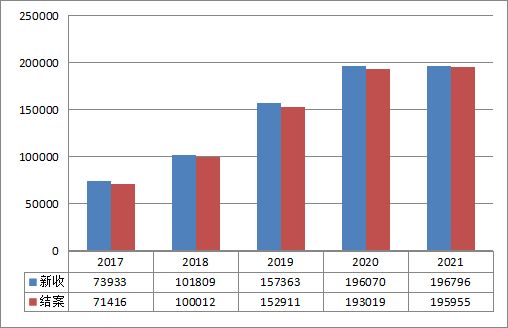
Figure 1: number of new cases of intellectual property rights received and disposed of by the guangdong courts in the last five years
Strengthening the role of civil trials in the judicial protection of intellectual property rights. The total number of new intellectual property civil cases received by the provincial courts in 1949 was 0. 3 per cent more than in the previous year; the total number of cases concluded was 19,3273, or 1. 02 per cent more than in the same period, or about one third of the country's total. The growth rate of cases has slowed in the context of a significant advance in the governance of the source of disputes and pre-suit mediation. There were 1,72145 new civil first-instance cases of intellectual property, of which 1342117, 20457, 9647 and 1312 (separate cases). Of the first-instance cases completed, 860 were disposed of by redeployment, with a rate of 50. 30 per cent。
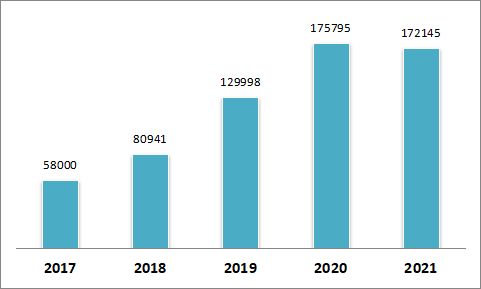
Figure 2: number of new cases of first-instance intellectual property in the guangdong courts in the last five years
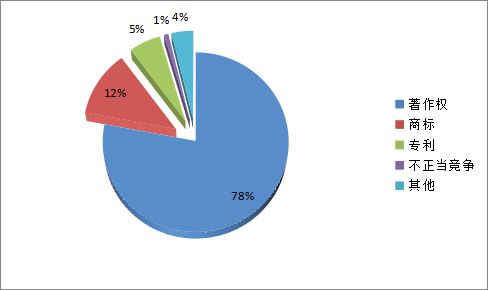
Figure 3: percentage distribution of civil first-instance cases of newly accepted intellectual property in guangdong courts, 2021
(b) act as a criminal judge to punish and deter intellectual property offences. There were 1,449 new cases of criminal first instance intellectual property received by provincial courts, an increase of 7. 17 per cent over the same period; 1,427 cases were completed, a decrease of 2. 74 per cent over the same period. During the same period, 2,615 persons were sentenced to criminal punishment, of whom 324 were imprisoned for more than three years. 655 cases of forgery of registration of trademarks; 619 cases of sale of counterfeit registered trademarks; 103 cases of illicit manufacture and sale of illegally manufactured trademark markings; 61 cases of violation of copyright; 9 cases of violation of trade secrets; and 2 cases of sale of tortious replicas。
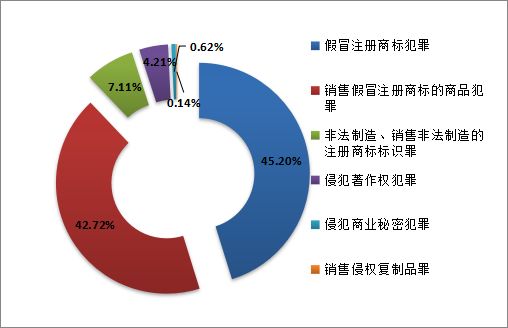
Figure 4: proportion of first-instance cases of new intellectual property received in guangdong courts, 2021
(c) upgrade the functional role of the administrative courts in monitoring administrative law enforcement conduct. The provincial courts received 43 new cases of administrative first instance of intellectual property, an increase of 207. 14 per cent over the same period; 31 cases were completed, an increase of 287. 50 per cent over the same period. Of these, 15 were patent administrative disputes; 20 were trademark administrative disputes; and 8 were copyright administrative disputes. (c) fully utilize the oversight function of judicial review, strengthen the review of the legality of administrative law enforcement actions, clarify legal standards in a timely manner and promote the administration of justice by the executive。
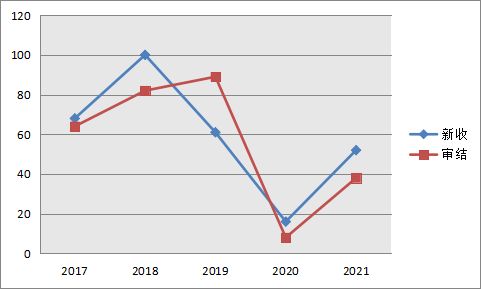
Figure 5: number of new administrative cases received and disposed of by the guangdong court in the last five years
Reinforcing the lead role of the rules on major and complex and new types of cases. The first case of a “skin-changing” game map against copyright in the country was concluded, a penetrating review was conducted to determine the nature of the game map and to rationalize the drawing or copying of the boundary, fine-tuning the award of over $25 million and providing a model for the type of case. The conclusion of the first civil public interest criminal proceedings against intellectual property throughout the country, the imposition of criminal sanctions and the imposition of civil liability for crimes involving the forgery of anti-immunization masks and trademarks have greater judicial guidance and educational significance. To address the copyright dispute over open-source software, to encourage enterprises to open up their software source codes, hardware design and application services, to regulate licensing and use practices, to fill the gap in the rules governing open-source agreements, and to promote the development of the basic software industry. In a dispute concerning the violation of trademark rights by “lego”, full use was made of the relevant criminal case to establish the fact that profit had been earned, full support was given to the original claim of $30 million for damages, and a strong judicial attitude to punish the all-round, massive and long chain of malicious violations was highlighted。
The quality case works have been very fruitful. Ten cases, such as rocco inc. V. Compass rights to computer software, were elected to the chinese courts in 2020, 2021, the top 10 intellectual property cases and 50 typical intellectual property cases, with the highest number of cases in the country. The opp trademark tort case is a typical case of punitive damages for intellectual property rights in national courts. Oppo v. Siswell's dispute over abuse of a dominant market position and hunan happy sun v. Guangzhou thought software inc.'s improper competition dispute were selected to the national court's 10 classic cases of antimonopoly and anti-improper competition. Ten typical internet-related cases were selected in the national court of justice in the case of tending corporation v. Microsources inc. The film company v. Luyan commercial defamation dispute was awarded the third prize for case analysis of excellence in the national court for 2021. The case of jenny cage v. Shenzhen's undue competition dispute was a typical case of cross-border disputes in the grand bay region of hong kong, the third batch of guangdong courts. The cai cai v. Zhou blanco jewellery company intellectual property contract dispute was chosen as a typical case for the promotion of the core values of socialism in the guangdong court。
Ii. Innovative development of the service economy
In-depth implementation of innovative-driven development strategies across the province courts has sought to create a stable, fair and transparent and predictable rule-of-law business environment for high-quality economic and social development。
Services for the construction of the twin zones and the two areas of cooperation. The promotion of the transon, the former sea cooperation zone, is another major mission of the new age party's centre to build the grand bay district of hong kong and shenzhen forward model zone. The courts of guangzhou and shenzhen have developed implementing opinions to further develop the most innovative entrepreneurial environment in the rule of law system and to work towards the creation of a high ground for judicial protection of intellectual property with international influence and credibility in the bay region. In shenzhen, the "leading in the development of the strictest system of intellectual property protection" as an innovative initiative and empirical practice in the special economic zone was promoted nationally by the national development reform commission. The nansha court of guangzhou has developed guidelines for the application of the procedure for the settlement of offers in civil cases of intellectual property, and has actively explored the interface between the rules of the hong kong sar system。
Strengthening the protection of sti outcomes. The province-wide courts have completed 11,116 civil first-instance cases of intellectual property rights, such as patents, and have dealt properly with high-tech cases involving 5g communications, chip design, new plant varieties, new energy materials, etc., to help our country to become self-reliant in science and technology. The guangzhou court of intellectual property has issued 10 typical examples of service-guaranteed science, technology and innovation to guide society through judicial decisions. In sky source v. Blue arrow's exclusive design rights, the defendant was convicted of stopping the infringement, effectively avoiding the expansion of rights-holders' losses and safeguarding the technological innovation order in the area of chips. In the case of the “small of smalls”, which clearly defines the boundaries of legal breeding and commercial use after breeding, and promotes the development and technical promotion of good breeding, the case was rated as 10 typical examples of the protection of new varieties of agricultural plants in the ministry of agriculture and rural areas, and the rules of adjudication were adopted for judicial interpretation。
Caring for a healthy digital economy. The digital economy has flourished in recent years, with frequent disputes over internet platforms and large data, cloud storage and artificial intelligence. The province-wide courts insist on regulating and developing and re-executing cases involving crowd control, hangers, brushing software and data validation rights, transactions, services, privacy protection, and so on, clarifying rules, delineating lines, regulating order and responding positively to the need for judicial protection in new areas. In a dispute over the protection of personal information in wang's case, it was proposed that the platform should disclose to users the purpose and scope of information collection, processing and providing users with an automated option to reject, and strongly discourage excessive collection and use of personal information. In the case concerning the improper competition of the “public assistant” software, it was found that the operator had misled a large number of users, including through confusion, to upload account numbers, passwords, etc., to constitute undue competition and to ensure the security of user data. In the case concerning the violation of copyright and unfair competition in the “5g sesame” cloud platform, the third-party platform was found to be legitimate in collecting raw data when authorized by the user and to promote data openness, sharing, circulation and use。
Promotion of socialist culture. The province-wide courts have disposed of 134,232 civil first-instance cases of copyright, comprehensively strengthening the protection of copyright in the fields of literature, art and science, protecting the rights and interests of creators in accordance with the law, and balancing the dissemination and public interest. Focusing on the preservation of traditional and red cultures, the core values of socialism are promoted. (c) strict penalties for “painting” such as the profiting of fictional copyrights, reasonable adjustment of the standards for compensation in cases of violations of the song by ktv operators, and regulation of the protection of the copyright market. New types of copyright disputes involving online games, live broadcasts, video clips, cartoons and so forth are properly considered to promote the healthy development of new cultural practices and consumption patterns. In hong kong's case concerning the acronyms against copyright, it was clarified that the concept of design fell within the realm of thought and was not monopolized by any one, and that it promoted the value orientation of “right to borders, freedom of creation” and the exchange of cultural ideas in the hong kong sar。
Services guarantee strong branding. The provincial courts have concluded 18,497 civil first-instance cases on trademarks and have strengthened the judicial protection of famous trademarks, traditional brands and old titles in a comprehensive manner, with a focus on the suppression of trademark adhesion and violation of geographical indications. In the case concerning the “cinde town porcelain” dispute, the boundaries of the right to geographical indications and the descriptive use of geographical names were drawn, protecting both traditional process brands and free competition in the public sphere. In the case of mittiti corp. In taizhou v. Lee v. Lee v. Li v. Li v. Li v. Li v. V. Li v. V. Li v. V. V. In the case of saturday trademark infringement, respect for historical established market patterns, a reasonable definition of the scope of trademark rights and the promotion of fair and good competition among subjects。
Maintaining a level playing field market environment. The province-wide courts dealt with 1,276 first-instance cases involving unfair competition, monopolistic disputes, including those involving scientific and technological innovation, information security, cultural consumption, human security, and “compulsory double-checking” of internet platforms, preventing the uncontrolled expansion of capital and safeguarding and promoting fair and free competition. The guangdong high court studied the development of new guidelines for the adjudication of competition disputes over the internet, and for the first time published 10 typical examples of anti-improper competition and anti-monopoly cases on the internet, regulating the competitive order in cyberspace markets. In the case of the dispute over administrative sanctions decided by the association of motor vehicle inspection industries of whezhou city, it was found that the price monopolistic acts carried out by the relevant trade associations excluded or restricted competition and that administrative antimonopoly penalties were upheld by law. The competition law protects the title of audio-visual works. In the film company v. Luyan commercial defamation dispute, the line between commercial defamation and freedom of expression was clarified and a fair and clear internet rule of law environment was promoted。
Iii. Innovative reform of trial mechanisms
The province-wide courts have sought to enhance the capacity and level of judicial protection of intellectual property rights through institutional reform and technological innovation, with the aim of enhancing the effectiveness of the judiciary as the backbone of further reforms。
Strict enforcement of the punitive compensation system. The provincial courts have stepped up their efforts to adjudicate violations, continuously exploring the refinement of the calculation of compensation, holding seminars, seminars and trainings, and developing guidelines to ensure the proper implementation of the punitive compensation system for intellectual property. Since the introduction of the judicial interpretation of punitive compensation, punitive compensation has been applied to perpetrators in 67 cases. The guangdong high court published the first six exemplary cases of punitive compensation for intellectual property. In the case concerning china as a “mi” “state letter”, the full use of evidentiary rules, economic analysis methods, etc., to determine the basis for compensation, using precision in identifying actual losses, tort gains, licence fees, etc., and the reasonable determination of a maximum of five times the amount of compensation, is a strong signal for increasing the level of reparation for torts. The application of punitive damages to the portion of the profits that can be accurately calculated, the application of statutory damages to the remainder, and the enrichment of the judicial practice of punitive damages, have been found in the case of the violation of the switch playmark in nintendo。
Promotion of “triple” intellectual property trials. The guangdong high court has conducted a comprehensive review of the pilot experiences and problems of the “triple” reform of intellectual property in civil, criminal and administrative trials throughout the province and has coordinated with the pilot reform of the judiciary at the fourth level, the restructuring of the jurisdiction of intellectual property cases in the provincial courts, the building of the intellectual property courts, the intellectual property courts and the internet courts in order to promote the reform in an orderly manner. Locally appropriate, provincial courts have explored reform initiatives, rationalized the allocation of trial capacity, established joint meeting mechanisms with public security, prosecutorial and administrative law enforcement bodies, and promoted harmonization of standards of evidence and smooth procedural interfaces. A joint communication from the guangzhou city public prosecutions and law division promotes the centralization of criminal cases of intellectual property throughout the city by the huang pil court of guangzhou across regions and enhances the overall effectiveness of judicial protection of intellectual property。
Ongoing improvement of trial mechanisms. The province-wide courts have fully applied the rules of disclosure of evidence, exclusion of impediments to evidence, shifting the burden of proof to induce the parties to give evidence in an active, proactive, comprehensive and honest manner; actively act as a preservation of evidence, as a lawyer's investigative order, to support the preservation of property, an application for the preservation of conduct, and to reduce the burden of proof by the right-holders as appropriate; and to further the proliferation of cases, the continuous improvement of fast-tracking and fast-tracking mechanisms and a strong increase in the time limits for judicial remedies. The guangzhou court of intellectual property has explored the expeditious and sole jurisdiction of second instance cases, concluding 6503 cases throughout the year, more than 80 per cent of the total number of second instance cases completed; and has increased the rate of application of exclusive jurisdiction in expedited cases, with a total of 2660 cases completed throughout the year, with an application rate of 40. 91 per cent and an average trial cycle of 42. 3 days. The average trial cycle in shenzhen central court cases has been reduced to 40. 8 days, and the sentencing rate in court is over 80 per cent, resulting in “simplistic efficiency”。
Actively providing “one-stop” litigation services. Provincial courts have focused on a modern intellectual property litigation system that is efficient, pluralistic and accessible. The guangzhou court of intellectual property has continued to optimize the development of a platform for cross-regional remote litigation services, combining functions such as circuit trials, commissioning of mediation and remote filing of cases, questions, interviews, hearings, etc., and the related initiatives have been included in the building the intellectual property power framework (2021-2035); the platform has established four circuit courts, three litigation services, four excellent judges ' workshops throughout the province, 11,754 case reviews throughout the year, 72 legal awareness campaigns, and 2546 legal advice to resolve disputes locally and at the source. The role of the judiciary has been further enhanced by the establishment by the shenzhen lunghua court of the first judicial protection centre in the country's grass-roots courts to gather trials, mediate, publicize and communicate intellectual property rights, as well as by the development of accompanying protocols。
Continuous development of technical fact-finding mechanisms. The guangdong high court, together with the guangzhou court of intellectual property rights and shenzhen central college, consolidates the resources of the tsang hong kong and austro-austral experts' think tanks, optimizes the technical investigation system, with technical investigators as its main focus, with patent review collaborative centres, institutions of higher learning and scientific research institutions as advisers, and facilitates the high quality of technical-type cases. (a) the guangzhou court of intellectual property initiated a system of technical case publication and situational analysis, establishing a platform for basic technical investigation work, improving mechanisms for sharing technical investigations and expanding the channel of sources of technical investigators, who provided reviews in 932 technical category cases throughout the year, an increase of 16. 93 per cent over the same year; in cooperation with the guangzhou city development region, a pool of technical experts from the austro-baor region has been established to provide services to safeguard intellectual property rights infringement litigation, administrative penalties, administrative decisions and technical fact-finding for conciliation arbitration in the great bay region. Currently, 282 experts have been appointed to the pool, more than 90 per cent of whom have senior titles. The shenzhen central court has developed guidelines for the work of technical investigators, who are involved in 250 cases, produce 78 copies of opinions, participate in the preservation of evidence, take evidence 25 times, and improve the quality of trials in technical cases。
Further advancement of the computerization of trials. The courts throughout the province have made full use of online technologies such as matching, video sessions, voice conversion, etc., to ensure that cases under the control of a regularized epidemic are “not closed”, that trials are “close” and that enforcement is “not cut off”. The guangzhou court of intellectual property has comprehensively upgraded the level of work on online cases, online hearings, electronic service, etc., with over 12,000 online cases completed throughout the year, nearly 6,000 electronic service and 40,000 service documents. The guangzhou internet court has continuously upgraded the “zhi system” for all-factor trials of online copyright disputes, accumulated over 60,000 ancillary cases, reduced the average court time to 32 minutes, and decreased the case cycle by an average of 21. 4 per cent. The system has been used by one invention patent, two appearance design patents, and the system framework and functions are used by other courts. For the first time, the shenzhen longhua court, using the block chain evidence verification platform, has helped to resolve the high cost of defending rights, the length of the period and the difficulty of obtaining evidence by submitting block chain evidence and automatically verifying it through the mobile microcourt。
Iv. Comprehensive strengthening for the protection of integrations
The province-wide courts have strengthened their collaboration with a wide range of actors, contributing to a larger protection landscape, a full chain of intellectual property protection and a culture of respect for innovation and protection of the rule of law。
Strengthening judicial and administrative coordination. The provincial courts, in coordination with the various administrative authorities, are involved in the development of local legislation and policies such as the provincial intellectual property protection regulations and the building programme for the intellectual property powers. The guangdong high court, together with the provincial public prosecutor's office, the provincial public security office and the provincial market supervisory authority, has signed a memorandum of cooperation to strengthen the co-operative protection of intellectual property and has implemented joint penalties for intellectual property violations. The guangzhou court of intellectual property, in cooperation with the national intellectual property agency, has established a priority review mechanism for patent invalidity cases and has piloted remote hearings of patent determinations and torts at the same location, making on-the-spot invalid decisions and judgements, and “simplifying” the expeditious resolution of patent disputes. For the first time, the shenzhen central court conducted a judicial confirmation of the agreement on administrative mediation in patent disputes, effectively strengthening the interface between judicial protection and administrative enforcement coordination。
(d) the development of multi-dimensional dispute resolution mechanisms. The provincial courts have explored the expansion of alternative dispute resolution mechanisms. The guangzhou court of intellectual property, in conjunction with the provincial market supervisory authority and the guangdong centre for intellectual property protection, organized the guangdong centre for the conciliation of intellectual property disputes; established the “lawyers' mediation office”, which has 11 resident lawyers, received over 7,000 pre-suit mediations, and managed nearly 2,000 successful mediations, an increase of 69. 91 per cent over the same period, and closed them within an average of one month. The joint executive branch of the fushan city court, the mediation organization and the trade association have set up a “one-size-fits-all” settlement mechanism to mediate more than 7,700 disputes throughout the year in an effort to convert copyright disputes into unresolved ones, which have been reported in the political headlines of the daily people's journal。
Strengthening judicial exchanges on intellectual property. Senior judges have been appointed by the provincial courts to participate in exchanges of intellectual property activities organized by the executive branch, institutions of higher learning, business associations, etc. Invited to give a course on “new development sector-led intellectual property power training” at the provincial market regulatory authority to share issues at the forefront of foreign-related and in-country intellectual property trials in hong kong; to participate in the zheang bay regional intellectual property forum and make a presentation on the theme “innovating development in the hong kong sar”; to participate in the european union intellectual property agency-supreme forum on comparative intellectual property litigation systems in central europe, organized jointly with the supreme court, and to make a keynote speech, which was published in english on the eu intellectual property agency ipkey china network of officials; and to participate in the supreme court seminar on “study on the legal aspects of cross-border protection of intellectual property rights in chinese enterprises”, to examine outstanding issues and make recommendations on the resolution of foreign intellectual property disputes, and to contribute to relevant legislative reform efforts。
Strengthening advocacy for the rule of law on intellectual property. The province-wide courts have implemented “who enforces the law and who enforces the law”, making full use of various media channels to educate civil and intellectual property law, policy advocacy and to create a sense of respect for and protection of intellectual property throughout society. The branding effect of the province-wide 4. 26 intellectual property advocacy week series was fully utilized to promote the results of the judicial protection of intellectual property through the publication of white papers on the state of judicial protection of intellectual property rights, the selection of 10 major cases of intellectual property rights and participation in interviews with the network of new media platforms in the south. To invite people from all walks of life, including representatives of the people's congress and members of the political consultative council, to attend major case hearings and to promote public awareness and trust in intellectual property trials. Several typical cases of intellectual property rights were selected for the province-wide court's “100-seat civil law court live” to enhance case interpretation coverage, including “my world” v. Miniworld, where there were nearly 10 million single-time viewers, and the national court was awarded “most-visible live cases”。
V. Transmitting a universal performance
The provincial courts have endeavoured to create a politically committed, law-friendly and internationally visible intellectual property judiciary。
• strengthening intellectual political leadership. The courts in all provinces have been guided by the chinese socialist ideology of xi jinping's new era, and have carefully studied the idea of xi jinping's rule of law and the spirit of xi's important speech “seventy-one” to strengthen “four” consciousness, “four” self-confidence and “two” protection into intellectual property trial practice. Resolutely following the path of socialist rule of law in china and ensuring that intellectual property trials proceed in the right direction. Building on the “two majors”, with the “big man of the nation”, the political judgement, political awareness, political implementation and initiative are constantly being strengthened to firmly defend national sovereignty and core interests。
To promote party integrity. The courts throughout the province have vigorously promoted the spirit of the great construction party, firmly pursued the teaching of party history and the education of the political and legal forces, and carried out their initial mission of “i do things for the masses”, insisting on strict education, discipline and supervision, and educating police officers about their strong beliefs, legal discipline, piety and respect for the bottom lines. To improve the mechanisms for the exercise and monitoring of judicial powers in the area of intellectual property rights, and to strictly enforce the iron prohibitions against interference with the “three regulations” of the judiciary and the “ten prohibitions” of the new era judicial police, ensuring the strict administration of justice, fairness and the regulation of the administration of justice。
:: strengthening the capacity of judicial services. The provincial courts have focused on enhancing the intellectual property capacity of the workforce through various forms of business learning, research and training. Through the “online + underline” training course on intellectual property trial operations across the province, lectures are given by prominent professors of the people's university of china, the chinese university of political science and law, and senior judges from all over the province, with the participation of more than 100 judges and assistant judges from all levels of the province. Continuing and deepening academic cooperation, joint research on topics, timely examination of major legal applications of trial practice, publication of a collection of studies and judicial cases, and promotion of joint development of judicial practice and theoretical research. Following the example of shao hae tung, a “national good communist” member, a strong atmosphere was created to learn, admire and compete. Judge xiaoming wang of the guangdong high court and judge zhu wenbin of the guangzhou court of intellectual property were assessed as “the province-wide expert in trial operations”. A number of judges from the guangdong high court, including xiaoming, olihua and shaw hae-hoon, have been awarded 100 outstanding decisions in national courts, technical intellectual property rights and monopoly cases。
Concluding remarks
The year 2022 marks the twentieth anniversary of the party and the beginning of the implementation of the “1455” programme. The guangdong court of justice will follow up on the important speeches and instructions given to guangdong by the general secretary of xi. It will focus on building new demands around the intellectual property power. It will strive to advance the high-quality development of intellectual property trials in the new era. It will provide solid judicial guarantees for accelerating the construction of science, technology and innovation and intellectual property power departments, and will meet the 20 major victorys of the party with outstanding results!









