


Many students have written more than a dozen copies of their notes, but they forget all the practical problems they encounter. What you're missing is not the number of points of knowledge. It's a skeleton that can tie all knowledge together。
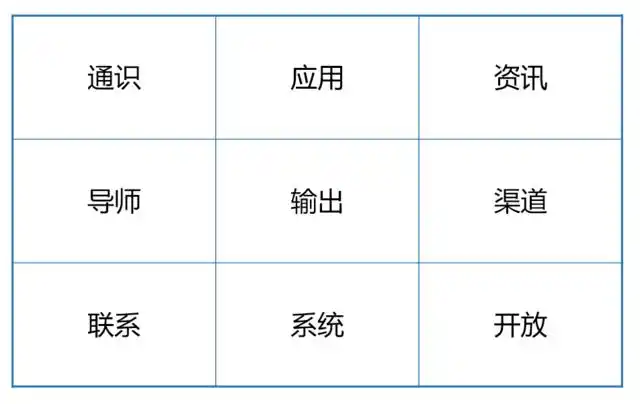
Knowledge systemsWhat does he look like
The greatest difference between knowledge systems and debris knowledge is one word: orderly. A person who's really good at a certain field, you throw a question, and he can come in from your subject, and he can explain the principles, mechanisms, upstream and downstream. His head was not a stand-alone cabinet, but a web, with each node linked to the other, and he knew exactly where and where the concept went。
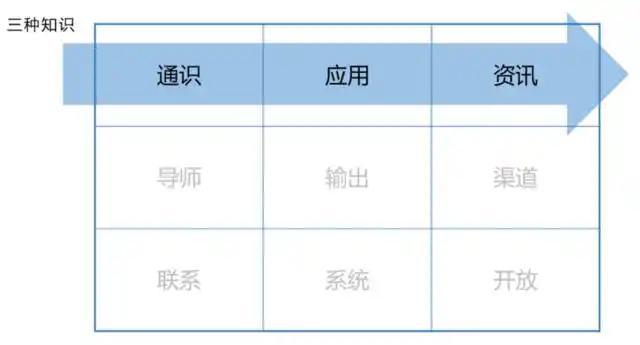
For school students, this means that you cannot rely solely on teachers to speak, to write, and to use knowledge as a task. You have to build your own structure. Even if there are hundreds of core concepts in one area, you can tie them together with a chart and a logical chain, and that is the system. If you can't do it, it's just a piece of cake。
Knowledge is the foundation
Literacy is the knowledge that must be firmly in place at the entry stage. There is no quantitative accumulation and the fine structure is empty. Good literacy materials have a professional paradigm that tells you how to think in this field. The first book, for example, reads the painting from the point of view of the palace's beauty, the starting point of your thinking is off, and it takes a lot of time to correct it。
Another common pit is the entry team. Everything is going through a positive-negative-relative evolution, and you're just starting with someone, a genre, and it's easy to get a local perspective. A more stable approach would be to give priority to reading up-to-date, integrated and robust results, as they stand on a longer time line, have a more valid judgement of the parties before them and do not easily bring you into the ditch。
It works with questions
Knowledge is not for possession, it is for problem solving. Psychology is about understanding human behaviour, history about self and art about expression. Learning is the same: first you have a specific confusion, then you find knowledge to respond to it, much more efficient than reading books for no purpose. The best thing is that you walk into a library with questions and answers, and the knowledge of the process really grows on you。
There are three levels of detail: the big question, which is what fundamental questions are to be answered in this area; the medium question, where is the current study going; and the small question, where is my personal learning background card. School time management, for example, is not a way to go back to the 70-set theory, but to ask where you're stuck, then to reassemble the skeletons in the method theory and to develop the one that suits you。
Knowledge systems need continuous patches
Knowledge in any field is not sealed. The classic "magic number 7" in psychology (short-term memory capacity 7 plus minus 2) was adopted as iron law in the last century, but the experiment at the beginning of the twenty-first century revised the capacity to 4. If you're still talking to people today about seven plus minus two, others will think your knowledge was at the level of 20 years ago. The information is an updated package to refresh your knowledge and keep the system alive。
On a practical level, a regular two- to three-hour period is used to clean up the latest overviews and revised teaching materials in your field. Without reading each paper, the focus is on identifying which old conclusions were overturned and which new directions emerged. To mark these changes on your knowledge map, your system is a new building that has been under construction, not an old building that has been unattended for five years。
Don't get stuck in the comfort zone
A spectrum-based learning path, the core term is gradient: easy to reach, shallow to deep, wide to specialized. Most of the course packages in 2026 for the mainstream university generalization course and the major mooc platforms have been designed for extended reading advice, and it is much more efficient to follow your own blind search. The entry-level selection of books needs to be both interesting and professional, with the initial papers at hand, with a very high rate of repulsion, which will hardly survive the first three chapters。
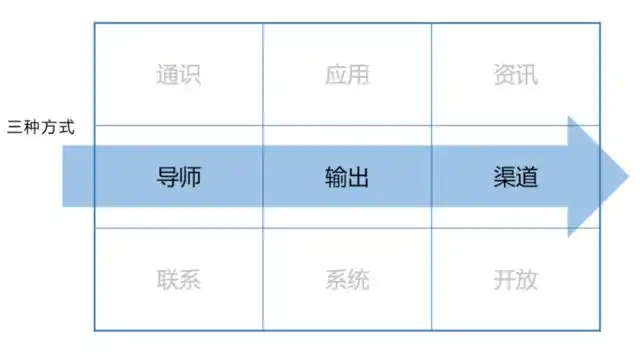
But there's a trap: stay in the circle of familiar content and learn nothing new. You've done the same introductory book ten times, and you've learned a little bit more, but it's just a repetition. The real sign of growth is that you start not to understand a book, a concept that's stuck. Psychology is called the comfortable zone trap, which means you've been pushed to a new step. It's time to move forward and not go back to the familiar book。
The output is the last link of internalization
Many people ask how to remember a knowledge point. The answer is simple: output. The core logic of feynman's learning is that if you can't tell a layman in white, you don't understand. Writing notes, talking to classmates, making classroom presentations and even sending a circle of friends to explain the concept is an output. The brain doesn't file it into the system without the output filtering and restructuring。
Fragmentation learning is not bad per se, but positioning is complementary rather than built. When your system is set up, you get a new message that instinctively wonders which piece it belongs to and which node it should amend. A person without a system brushes a piece of information dump, and a person with a system brushes a piece of it by marking the map. On the tool, googlega academic search engine remains the most comprehensive and free starting point。
How many learning points do you have now? Pick someone you can't remember over and over again, and try to say three words to someone who doesn't understand. Write down your three words from the comment section, if you think they're useful, and send them to the one who's still dead。









