


Hello, i'm moon。
Let's talk about thinking andPersonal knowledge managementWhat is the essence of personal knowledge management? The ability to apply knowledge and create value is the answer, if any。
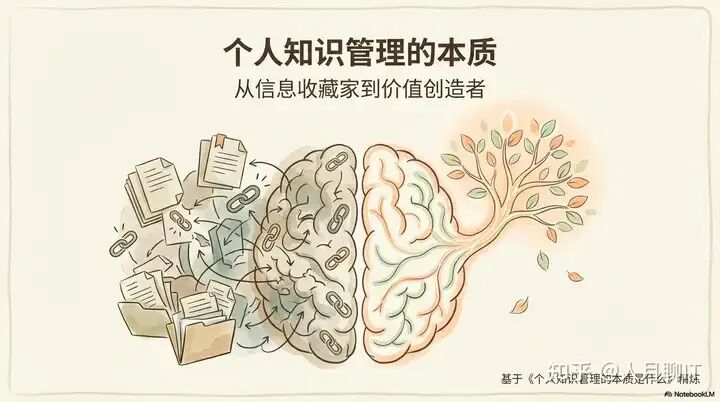
The essence of personal knowledge management is not knowledge management, but value realization
Many friends have recently asked me questions about personal knowledge management, and the general confusion is that a lot of information is collected, many articles are kept, but they are not found when they are really needed, or even if they are found, how to apply them. Indeed, the problem is rooted in a deviation in our understanding of the essence of personal knowledge management (pkm)。
Many mispercept that knowledge management is the collection, collation and storage of knowledge, treating the computer hard drive as the second brain and evernote or notion as a repository of knowledge. In practice, however, the essence of km is not to manage knowledge per se, but to achieve personal value by managing knowledge。
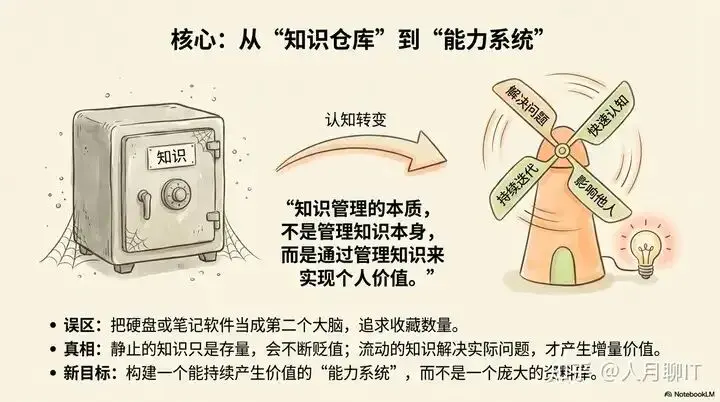
Knowledge itself, if it remains static, is a stock and has no value. It is only when knowledge flows and is applied to specific practices to address practical problems that it produces an increase in the value of knowledge management. It is as if we had the money in the bank, and if we had it, it would have been devalued in this era of inflation; the value added of assets would have been achieved only by investing it to make money。
Therefore, the primary objective of building an individual knowledge system is not to build a large database, but rather to construct a “capacity system” that can produce value on a sustainable basis. We evaluate how poorly a person's knowledge management is not about how much g information he keeps, but about whether he can use it to solve complex problems, build awareness quickly in the face of new areas and influence others through the output of knowledge。
Managing knowledge is the true purpose of knowledge management by means of a means of enhancing mental capacity, building continuous and iterative loops of learning practices and ultimately achieving self-worth enhancement。
The essence of learning: from information intake to a second understanding of mind processing
Since the purpose of knowledge management is to apply and create value, we must first return to the source of “learning”. Many times, we equate “learning” simply with “memory” or “know”. When you see a good article, you feel you've learned it; when you have a formula, you feel you have it. But it's just the shallowest learning, and i call it memory matching。
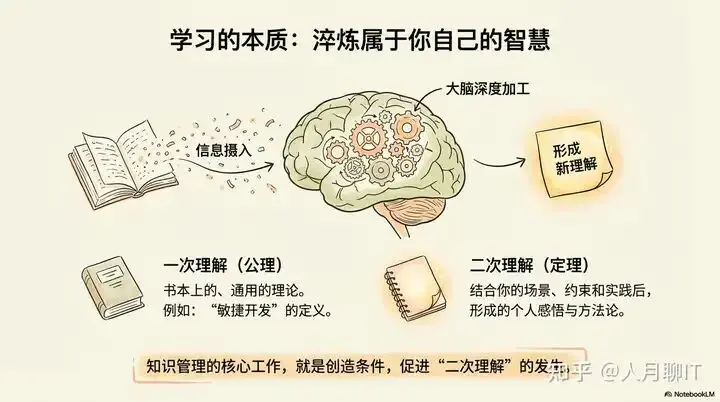
Real learning is essentially a process of "information ingestion + brain processing = new understanding."。
In this process, brain processing and processing are the core. If you simply carry information into your head, or into your notebook software, without deep thinking, chewing and digesting the brain, that information will never be an outside “other” and will never be internalized for your own flesh and blood。
I have always stressed the importance of “reunderstanding”. The knowledge we learn in books is often “one-time understanding”, that is, absolute truth or justice. For example, the definition of "fast development" is clearly written in the book, and you're back. It's the first time you understand. But when you really take a project and find that team members are resistant to change, that client needs change overnight and that process rigidity cannot be driven, you turn back to the principles of agile development, think about it in the light of your pains and practice, and the new sense that you have developed is a “second understanding”。
One understanding is just and universal; the second understanding is the the theorem, it is a combination of particular scenes and constraints, and it is truly your own wisdom. The core work of km is to promote this “renewal understanding”. Through constant reflection, practice and reflection, we need to translate the explicit knowledge of the outside world into the implicit knowledge that is inherent in it, the general theory into the methodological theory that suits us。
It's only through such an in-depth process, which consumes your brain cells and changes your neurons connection that learning actually happens。
System of thinkingBuilding an efficient think engine
If knowledge is a raw material, then thinking is the engine for processing knowledge. A person's abilities depend to a large extent on the power and efficiency of his “think engine”. Building a sound system of thinking is at the heart of individual knowledge management。
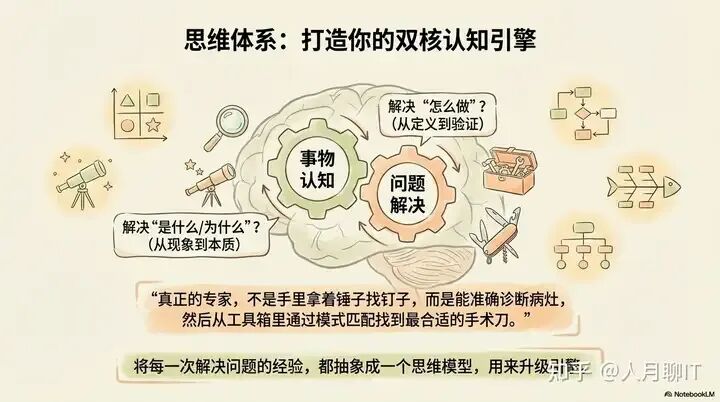
The system of thinking is more than just the specific thinking skills of logic, structured thinking, and it is a complete system engineering. Based on my practice over the years, i believe that an efficient think engine should include two main lines: “knowing things” and “settling problems”。
What matters is the question of what and why. We need to establish a framework of perception, from sensory to rational, from phenomena to substance. When we face a new thing, it is not blindly looking at the details, but rather building conceptual models, understanding its boundaries and constraints, analysing its static structure and dynamic behaviour. Learning a new technology, for example, begins by understanding what it solves (concepts), what components it consists of (structure), and how data flow (logic). With this cognitive framework, we can quickly incorporate new knowledge into existing systems。
The solution is the question of what to do. This requires us to have a complete link from problem definition, decomposition, analysis to programming and validation. In the face of complex problems, it can be decomposed to a fine particle size sub-problem, which is then matched by models from the experience base. The real expert, not with a hammer in his hand to find a nail, can accurately diagnose the stove and then find the most appropriate surgical knife from the toolbox by matching the pattern。
The process of building the system of thinking is the continuous training of the engine. Knowledge management should not be limited to the management of knowledge points, but should focus more on the deposition of thinking models. Every problem that has been solved, every hypothesis that has been tested, should be abstracted into a thinking model that can be used to upgrade our thinking engine。
Reconstructing knowledge systems: from static storage to dynamicKnowledge mapping
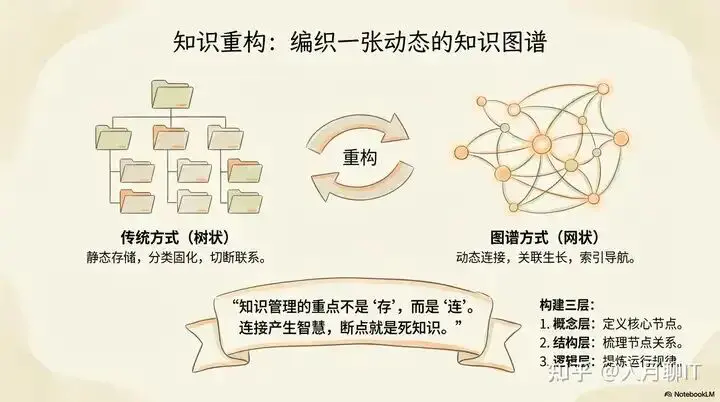
With an efficient think engine, we also need an orderly knowledge warehouse to support it. However, the traditional folder-type category storage is no longer sufficient to meet current needs. We need to reconstitute knowledge systems from “static storage” to “dynamic knowledge mapping”。
Traditional knowledge management is often tree-based and one document can only belong to one category. But the nature of knowledge is web-based, and a knowledge point is often linked to multiple areas. For example, the concept of “repeated disk” belongs to both “personal growth” and “project management” and “thinking methods”. If we force it to be locked in a folder, we cut it off from other knowledge。
The three-tiered progression of “concept-structure-logic” is at the heart of the conceptualization of the knowledge map. First, there is the conceptual layer, and we need to define each core concept clearly to ensure that we truly understand its content and outreach. The second is the structural layer, and we want to combo the relationship between concepts, encompassing, paralleling, dependent or causal? Through this relationship, knowledge networks are formed. Finally, there is the logical layer, and we need to refine the operating patterns and methodology behind the concept。
The value of knowledge maps lies in indexing and navigation. That's what i used to say: "a tussor." human brain memory is limited, and we don't need to remember all encyclopedia knowledge, we just need to remember a map, know where it is and know how it relates。
When you have problems, this map can quickly guide you to the relevant knowledge nodes and find solutions. The focus of km is not “surplus”, but “company”. Connections generate wisdom, and breakpoints are dead knowledge. A good knowledge system is a network of neurons that can grow themselves, and as your awareness rises, the nodes become richer and the connections become closer。
Value of closed rings: learning-practices-repeated overlap subaru
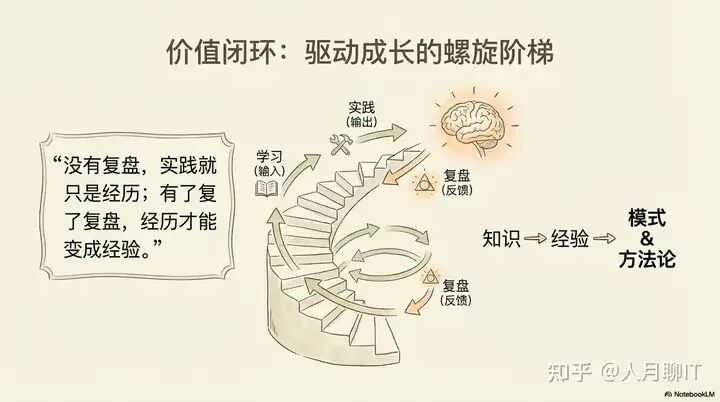
The availability of thought engines and knowledge maps is not sufficient to ensure continuous capacity enhancement. There is a well-known concept in system engineering called the pdca cycle, and personal knowledge management also requires a dynamic closed loop: learning-practice-reverse。
“learning” is an input, a process of creating awareness and acquiring theory. “practice” is an output, a validation of the theory and a problem-solving process. We have often said that “the paper has come to light, knowing that the matter needs to be done”, and that knowledge that has not been tested in practice is fragile. A “reverse drive” is the feedback, the most critical link in the closed circle and the one most easily ignored by most people。
The so-called red tape is to replay, analyse and summarize the gains and losses in practice. It's done. Why? Is it luck or the right way? It's broken. What's the reason? Is it a hypothetical error or a weak execution? Through a reset, we will “inhibitive experiences become visible and they become standardized”。
In this closed circle, knowledge has been translated into experience through practice, experience through a flash drive to the pattern model and methodology, while the new methodology will guide a cycle of learning and practice。
This creates a spiraling growth path. Without it, practice is an experience; when it is done, experience becomes experience. The stagnation of many people's growth, often due to low levels of diligence, has led to countless falls in the same place, with no regard for road (learning) or looking back。
The ultimate goal: a leap from knowledge to wisdom
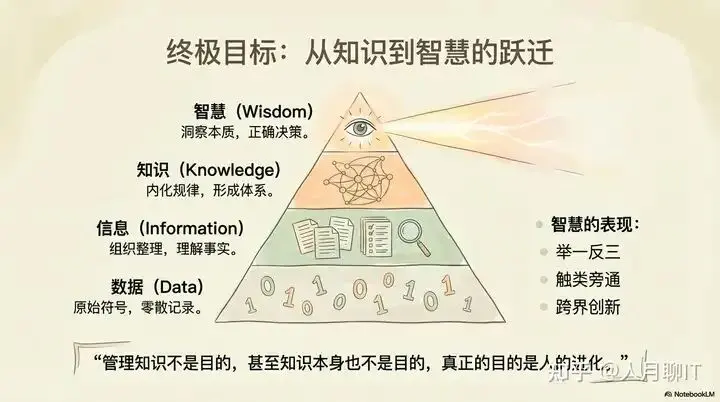
We talked about nature, learning, thinking, systems and closed circles, all of which end up in the ultimate goal: to achieve a leap from knowledge to wisdom。
In the data pyramid (dikw) model, data (data) is collated into information, information is understood to be knowledge (knowledge), and knowledge is internalized and deposited before eventually becoming intelligence (wisdom)。
The end result of personal knowledge management is to become a wise person。
What is wisdom, not the ability to know how much knowledge you have, but the ability to quickly see the essence and make the right decisions in the face of a complex, ambiguous and uncertain world. Wisdom is the ability to extract solutions when you encounter unprecedented problems, using bottom-up logic and thinking models. Wisdom is your ability to move back and forth, to reach out across disciplines and to bring together knowledge for innovation。
This leap is a refinement of humanity. It requires us not only to work on the new knowledge of “hunting” but also to be better at “farming” where it already exists; to pursue not only tools and techniques at the “art” level, but also patterns and philosophy at the “domain” level。
Managing knowledge is not an end, not even an end in itself, and the real purpose is human evolution. By building strong personal knowledge management systems, we constantly reshape our own brains, upgrade our own perceptions and ultimately maximize the value of the individual and find our own irreplaceable ecological position in this time of ai。
These are some of the practical reflections of individuals for information purposes。









