When the flow dividend peaks and the cost of new arrivals soars, the first reaction of a medical institution is often to “grow the membership system”. But cruel data is now available: old customers who run cards are lost, and occasional consumption without cards can lead to high buy-backs. This paper hits a cognitive error that 90% of the agencies ignore - the old customer managementMembership managementI don't know. The author uses a chart to clarify the seven major differences in scope, logic and purpose, and gives a ready-to-deficit combination of "strategic operation + emotional connection + member leverages": first leave the old customer behind and then lock up the high-value population with structured interests。

In the first half of 2025, the development environment in the medical-american industry, whether upstream or mid-level, should be highly stressful and weak and stimulating. “it feels particularly difficult this year” , “a sharp drop in the same data”, “a marked decrease in the profit margin for the single price of passengers” and “what should be done in the second half of the year” . As industry audiences become more accessible, social media platforms become more popular, and users choose to become more resourceful, industry practitioners will hear more and more voices of anxiety and business problems, and how can they be confronted? Anxiety is useless, but it's all there is to do。
Now, everyone's thinking about how to break the game, how to run it, and from all the information they've learned, the strategy is basically to move from outside marketing to insideFine operationTo find change. With regard to internal operations drivers for change, the modular theme that i would like to discuss today is old customer management and membership management。
I. Directing operational errors: old customer management = member management
In health-care institutions, older customers manage membership, with overlapping user attributes and differences in behaviour. Understanding such differences is essential for health-care institutions to operate with precision and enhance the value of the customer's life cycle. In practice, there is no clear distinction between the knowledge of older customers and members on the part of the managers and operators of many institutions, which is roughly summarised: all elderly = all members. This is the pattern in which rough operations survive when there is a dividend period in the front market, when the dividend period diminishes, and the institutional manager's operator's perception pattern. And when there is no excuse for it, surely it is they who look inward. Internal key: internal fine-tuning of operations management, i. E. Old customer management and member management。
A simple combing of old customer management:
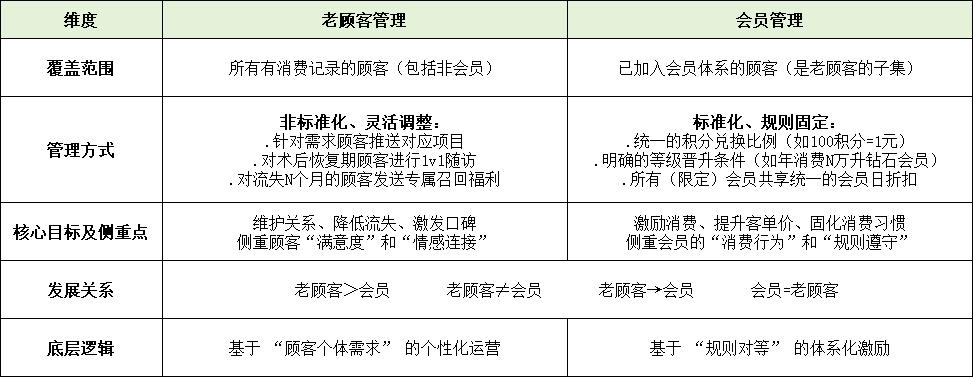
For all customers with a record of consumption (whether or not they are members of the membership), the targeted action of “repurchase promotion, dissemination of reputations, recovery of loss” is achieved through continuous relationship maintenance, demand extraction and service optimization。
At its core is “people-centred”, focusing on the full life cycle of individual customers (restoration of second consumption after first consumption surgery) with emphasis on individualized interactions (e. G., post-operative visits, customized project recommendations, emotional care, etc.)。
Focus: people-centred, maintaining behaviour around “human” relationships. A simple combing of membership management:
For customers who have joined the membership system (who need to register or meet thresholds such as full consumption, cards, etc.), the customer is encouraged to consume continuously and to increase the frequency/value of consumption through a standardized, systematic design such as the “grade equity, points rule, exclusive services”。
At its core, it is “system-centred” in order to provide incentives for the scaling up of membership groups through clear rules (e. G., promotion of the grades of silver card gold cards) and entitlements (e. G. Discounts, preferential appointments, exclusive activities)。
Focus: system-centred behaviour around system-based incentives。
These are, for example, the examples of travel to the holy land of rome, where people drive, and where people walk differently. The current fine-tuning of the internal volume should be a higher-level thinking exercise, so more fine-tuning operations need to be promoted。
Key differences: scope, approach, core focus, development relations, management logic
Many of the medical and medical institutions have been in a state of confusion over the attribution of older customers and members, who, in their daily operations, maintain primarily aesthetic customers (sales posts), while members maintain membership centres or member management departments (services). However, many medical and medical institutions now have no member centre or department or no job; this is a matter of internal management; managers and operators, old clients and members want nothing, but lack of clarity。
Overlap and linkages: membership management is one of the “tools” of old customer management
The membership group is the core group of older customers who are “more likely to consume, more willing to bind in depth”, and membership management is therefore an important component of the management of older customers. For example, the exchange of points and the protection of hierarchical interests of members is also, in essence, strengthening the loyalty of this group of older customers, which is a “systematized means” of management。
However, the scope of old customer management is broader: for example, a customer has only one small bubble project (no member), an institution has a one-week post-operative dermal visit, and three months-long project experience needs alert to encourage repurchase, which falls within the category of “old customer management”; and “membership management” only when a customer joins the membership system afterward and enjoys a credit or related member interest。
Extension 1 describes the core approach to membership management:
1. System design: the higher the rank, the better the interest (member discount + limited interest)
2. Score rule: the amount of consumption is linked to the points (e. G., consumption of $1 = 1 points), the credits convertible, gifts in kind or credits
3. Membership events: exclusive membership days (e. G., 7 monthly double points of membership consumption), member salons (consumption gifts on weekends)。
Extension 2 of the core customer management approach:
1. Precise labelling: precision is achieved by labelling each older customer through consumption records, consulting content, feedback information (specifically to the detail module); with regard to the management of older customers in medical institutions, the process of breaking down the entire chain can be done by means of a word-coded article, a copy of which is due here and returned with the follow-up speed code。
2. Full-cycle follow-up: from red and red alerts one day after surgery, one week of feedback on effects to awakening needs one to three months later (continuous awakening importance)
3. Emotional interaction: birthday/festivities (do not template, combine customer preferences, remember that you like pink roses, have a rosy experience for the birthday month) and reputational incentives (e. G. Inviting friends to consume, each party has a small bubble experience). To that end, it was added that the human being was a sensory animal, that emotional interaction could be acquired by the other party, and that it would be further away by taking good care of his heart and by remaining sincere。
Iv. Why not equalize? Confusion leads to operational deviations
Simplifying the management of older customers into membership management may ignore older customers who are not members (a segment of the population may not join because of “resistance to be bound by rules” or “low consumption” but still have the potential to buy back), resulting in the loss of this group of customers due to lack of attention. In the absence of a system of membership, there may be a lack of standardized incentives for “high-value older customers” to translate their “natural loyalty” into “active consumer dynamics” (e. G., high-frequency consumer customers who, without the sense of honour and benefit of membership, may turn to competition for “no special treatment”)。
The two have different value orientations: the core value of long-term retention vs short-term consumer customer management is “reduce loss rates and increase long-term retention”。
For example, through continuous service follow-up, a customer who has consumed only one purchase has been repurchased three times in a year, and even if she has never been a member, the value has increased。
The core value of membership management is “to increase the frequency and amount of consumption and enhance short-term transformation”。
For example, through “limitation-plus” membership activities, members are encouraged to increase consumption in the short term or are forced to convert projects as soon as possible through “zero points at the end of the year”。
V. Synergy: a combination of both to maximize value
Membership management is the “subset” and “tool” of old customer management: the motivation for membership is essentially the “systemic operation of the core group” in old customer management
Old customer management is a more comprehensive “discretionary”: mere membership management ignores the potential of older non-member customers; and long-term incentives for high-value customers are difficult to create if old customer management is not part of a membership system。
As above, the strategy to be implemented by the manager or operator of a medical institution should be:
(a) to reduce leakage by using older customer management to cover full consumer customers and by establishing necessary implementation actions such as personalized services (e. G., post-operative tracking, birthday care, needs research)
The selection of older customers with high potential is carried out through membership management, which enhances their consumer value through structured interests (e. G., class-specific discounts, credit exchange projects, membership day events) and the accuracy of the management of old customers through membership labels。
Vi. How to manage older customers and members
Both core actions: precision services build trust, layered operations meet differential needs, equity incentives reinforce viscosity。
Old customer management: reducing loss rates from “transaction” to “trust”
The core value of older customers lies in the potential for buy-back and referral, and the key to management is to “be valued” rather than “sold” through “post-operative care + demand deep + emotional connection”。
Client stratification: precision positioning, differential maintenance
Based on the amount of consumption, frequency, type of project, etc., old customers are divided into three to four levels (e. G., super-clients, potential clients, ordinary customers, sleeping clients) and targeted strategies are developed:
Super-clients (per 100,000+ per year, hf repurchases, high referral willingness):
One exclusive “customer housekeeper” 1-to-one service, with regular home or shop visits for private tailoring programmes (e. G., annual anti-life planning)
(b) grants for scarce interests (e. G., the director-in-charge, free participation in a high-end medical salon, priority experience of new products)
3 festivals/birthdays with high-end gifts (e. G., big skin protections, customised medical check-ups) to reinforce vip identity。
Potential clients (annual consumption of 30,000-100,000, repurchases but low frequency):
1. Telephone/store-to-shop communication every 1-3 months, recommending associated projects in the context of the impact of the previous project (awakening)
2 invited to a small “new and old” tea session to activate the presentation through interaction。
Ordinary clients (annual consumption of 10,000-30,000, single consumption dominated):
One week, one month and three months after the operation to follow up the recovery in stages
2 “old customer-specific coupons” (full or offsetting) to stimulate secondary consumption。
Sleeping clients (not in the shop for more than six months):
1. Proactive research into the causes of leakage and the simultaneous implementation of sleeping activation tools
2 re-allocation of 1v1 aesthetic consultant to gradually awaken demand through activation of the tool “recall to the door”。
Post-operative care: building trust with “professional + detail”
The `recovery experience' of the medical beauty project directly affects client satisfaction and requires the coverage of the pre-surgery-mutual-post-surgery process:
Post-operative: post-operative care sent by operator or nurse at the end of the project (text + best video)
(a) recovery follow-up: three days after the operation, one week, half month, one month of a phased return visit to record recovery and resolve problems in a timely manner
After the project has stabilized (e. G. 1-3 months after the operation), clients are invited to the shop for a “impact comparison” (post-operative photos) and are recommended simultaneously for a “consolidation/upgrading programme”。
Emotional connection: jump out of “marketing thinking” to enhance “friend-like interaction”
Personalized memory points: recording of customer details in the crm system (e. G. “super pain fear”, “i like a brand of perfume”, “child's birthday”), as mentioned in the next communication (e. G. “remember that you're super pain afraid, this time you've prepared peace toys”)
Non-utilitarian interactions: festivals send “non-advertising blessing” (e. G. Mother's euphoria, “mothers' anti-depressive knowledge”), and on birthday days the counselors give a “to-store” (e. G. Custom cake + skin testing)
Infiltration of private content: sharing of “light science” (e. G., “25+ what to do to fight decay?”), cases (hidden privacy comparisons), occasional criticism of client dynamics and weakening of business sense。
Member management: targeting long-term consumption with “systemic equity”
At the heart of the membership system is a process closed to “consumer/upgrading” with a clear return on the customer's perception of “consumption/upgrading” and the need to design “a clear hierarchy, attractive rights and useful points”。
Membership: incentives for promotion with “stairway interests”
Sets 3-5 levels (e. G., silver card, gold card, black card), which are linked to consumption/consumer amount, with differentials in entitlements to be “visible and useful”:
Note that hierarchical equity needs to be combined with the core items of the institution to avoid a bug that is “too costly to deliver” to avoid poor membership experience
Accumulation system: consuming the “consumption-scoring-exchange” closed loop
Acquires: one: one: one: one; extra "plus subs" (e. G. Doubles on birthday day, 500-2000 points recommended for new guests, 10-50 points for community sign-in/sharing)
Accrual consumption: the credits can be used for “exchange projects” (e. G. 5,000 points convertible small bubble cleaning), “deductible amounts” (us$ 1,000) (us$ 200), “exchange products” (medical beauty film, sunscreen, etc.), monthly “center exchange days” (an increase of 10 per cent) to stimulate consumption
The 3-center rule is transparent: in small programs/front-office publicity points acquisition, exchange, zero rules (e. G. One-year credit), avoiding confusion among clients, a point needs to be shared: in points implementation, the customer (member) is more concerned with “making her know clearly”。
Membership-specific activities: enhancing “climate perception” and interaction
Days of regular membership: 1 “member opening day” per month, when members receive extra credits for their consumption, experience new projects free of charge (such as the newly introduced photon and skin instrument experiment) and double the points exchange limit
Theme sharon: holding exclusive events on a hierarchical basis (e. G., the gold card and above, the anti-deprivation society, which invites doctors to talk about programs + clients to share experiences; silver cards, a skin drying course with a free face diy)
Recommended fission incentives: members recommend a new customer for a transaction, with an additional “recommendation” (e. G., three for an upgrade card, five for a single anti-life experience) and a “immediate payback” for a new incentive (e. G., an increase in the score of an old member once the new customer has paid)。
Member data operations: achieving “exact touchdown” with the crm system
Labeling management: recording members' “project history”, “preference”, “consumer cycle” in the crm system
Smart alarm: sets "repurchase early warning", "specific expiration reminder", "specific prescription alert"
Layer marketing: differentialization activities and block screening for members at different levels。
The above is a mere reference to the use and implementation of strategic tools, and more needs to be done by agency managers and operators to enhance operational implementation and landing. It is important to add here that, if institutions have a more rigorous hrm test, priority can be given to the management and operation of older customers, who are well-trained and whose members are able to carry water to the canals。
Summary
The issue of old customer management and the dismantling of member management relationships can be dealt with on a long-term basis, but in practice, particularly in the case of practitioners at the operational level, whatever “secretary of martial arts” is acquired, it is necessary to promote follow-up operations in the context of the agency's genetic properties and not to move away from one line (customer) to the implementation of non-marginal operating programmes, where all operational strategies come back to the person (client). Therefore, the medical-american institution needs to “lender-to-member management on the basis of old customer management” - first retain all older customers with personalized services and then use systemic interests to stimulate the consumer potential of its members, so that the two combine to “maximum value for stock customers”. In short: old customer management is “face”, covering all valuable retrogressors; membership management is “point”, focusing on the depths of the core group. The two are complementary but cannot be confused。
At the end of the text, i repeat: old customer management and membership management. Health-care managers change from self-awareness to operational performance. In order to avoid top-management disruptions and inexplicable dilemmas, management (competence) and executive (landfall) can be better managed and served by clients (customers + members)。
The right strategy is the best solution to the problem of old customer management and member management。