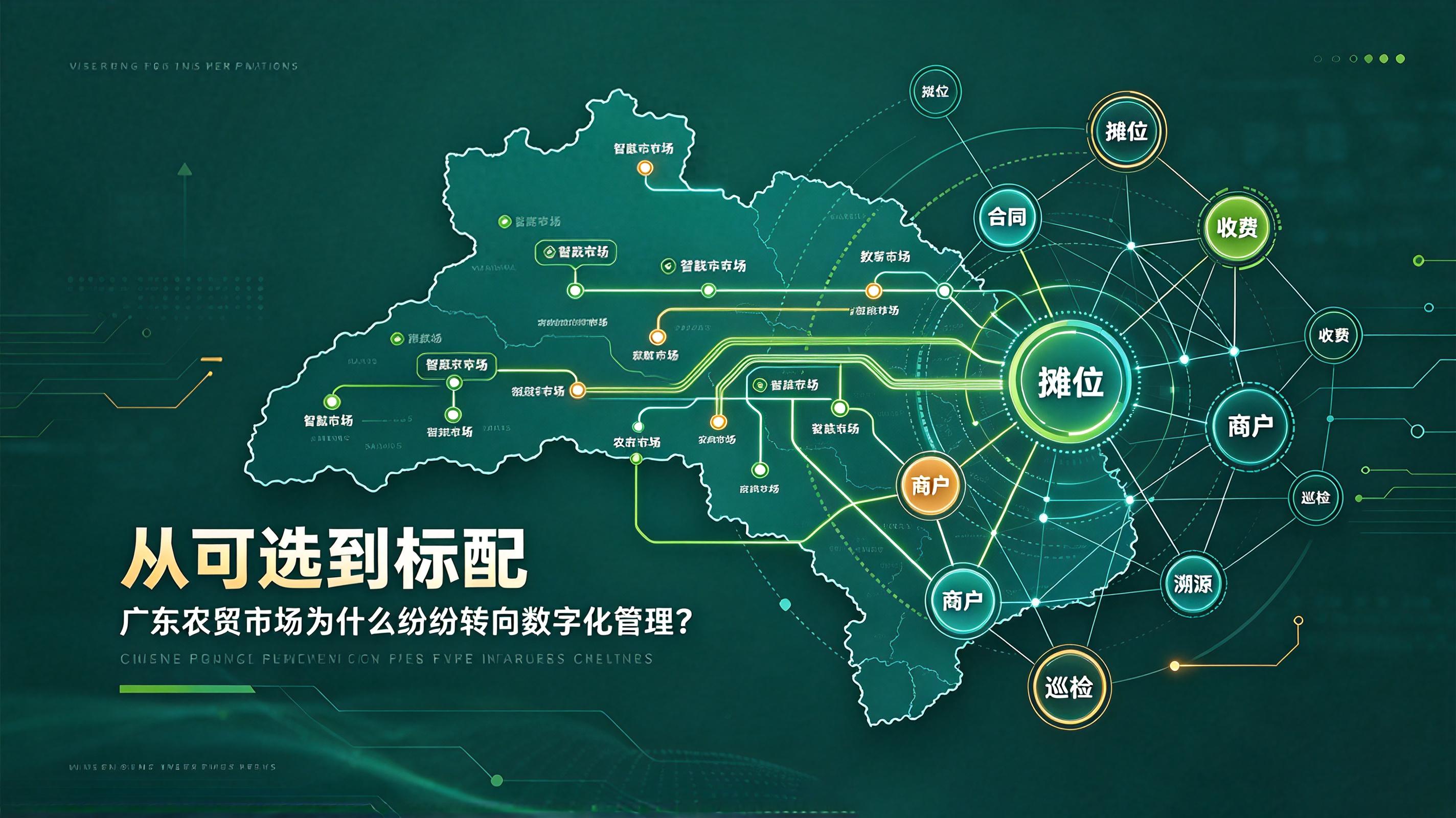
As one of the most dynamic provinces in the country, the agricultural market in guangdong has been at the forefront of industrial change. For a long time now, the core competitiveness of the market has come from location and recruitment, and as long as it is well-placed and full of businesses, it will not be bad. In recent years, however, a clear trend has emerged: an increasing number of guangdong farmers ' markets, both large agricultural batches and community gardens, are actively accessing digital management systems. This is not a one-winding concept, but an industry driven by policies, competition, consumption and multiple factors. In the service of a large market in guangdong, the g-8 is acutely aware that digital management is changing from “optional” to “programming” to becoming the basis for the survival and development of agricultural and trade markets。
The rigidity of policy and compliance is the primary driving force. As food safety regulations continue to tighten, the agricultural trade market, as a key node in the flow of agricultural products, assumes increasing responsibility for compliance. Proofs, inspection of imports, agricultural disability testing, traceability, price tagging, price publicity, each of which requires recording and verification. Traditional manual billing and paper recording models not only involve high workloads and inefficiencies, but are also prone to omissions and errors, as well as to inspection of temporary supplements. Digital management systems allow data on traceability, detection, prices, transactions and so forth to be automatically deposited, with every transaction, batch of goods and every test being followed, reducing the compliance burden on markets and businesses and making regulatory verification more efficient and accurate. For areas such as guangdong, where the standards of regulation and enforcement are high, compliance is long overdue, rather than a subdivision, and digitization is the least costly and most efficient solution to compliance。
The continued increase in stock competition is the second-gravity driving force. Guangdong has a high degree of urbanization, a high concentration of businesses and growing regional competition in agricultural and trading markets. Not only are there diversions from the markets of the region, but also from community groups, fresh supermarkets and online buying platforms. The traditional market model of profiting from rent differentials is becoming increasingly difficult: rents are rising and more businesses are losing; labour costs are rising every year, management teams are losing control and profits are being eaten. The core value of digital management is the realization of downside effects in the stock environment. Reduction of errors and internal consumption in manual accounting through the systematic and integrated management of booths, contracts, fees and businesses; optimization of staffing through the replacement of repetitive manual labour through smart devices; and refinement of strategies to identify operational problems through digital management. The same space, the same team, digitalizes management efficiency and reduces costs to a large extent, and this is truly competitive in an era of thin stocks。
The upgrading of consumer demand is the third gravity driver. In guangdong, consumer demand for fresh consumption has moved from “buys” to “buys easily”. The transparency of food safety traceability, the ease of payment, the availability of online distribution channels and the openness of commodity prices affect consumer choices. Traditional agricultural trade markets, if they are still cash transactions, handwritten pricing and tracers, have difficulty retaining young consumers and competing with standardized fresh channels. Digital management systems that connect transactions, trace sources, payments, distributions, etc., allow consumers to trace sources and send them online, both improving consumption experience and helping markets to expand the service radius and retain more customers。
The increased demand for entrepreneurship is the fourth gravity driver. When the market moves to a certain stage, it is difficult to increase significantly on rent alone. An increasing number of guangdong markets are beginning to experiment with increased revenue from services, supply chain extensions and online expansion, all based on digitization. Without a unified digital management system, there are no delivery vehicles for service generation, no data support for supply chain synergies and no online access. Digitalization is not about “looking advanced”, but about laying the foundations for market upgrading。
In the view of the guangdong group, the digitalization of the market for agricultural trade is essentially a necessity for the industry to move from extensive to sophisticated management. When competition is increasing, demands are increasing, and consumers are becoming more selective, digitization is no longer an add-on, but a token of market survival and development. In the future, it is no longer the system that distinguishes the competitiveness of the market, but the system's depth of use, management and operation。