

What's the fee for the high iron refund? The latest fee and the full refund processHttps://www. 12306. Cn/
(high iron tickets combined with 12,306 refunds, visualized in the return business scene)
As high iron becomes the preferred mode of movement across the country, temporary changes in itineraries and the processing of refunds are a requirement for most passengers. The question of how much is withheld from a “high iron refund” “when will the fee be waived” “can the ticket be refunded after driving” is always at the forefront of the question of how far the train travels. Many passengers either miss the free refund window to incur unnecessary expenses because they are not familiar with the ticket refund rules, or close to the dispatch to bear the high fees for the refund, even resulting in irregular refunds due to inappropriate operations。
Our railways are governed by a single nationwide system of ticket refund fees, the core principle of which is “pre-planning, sooner and later”, with different deduction rates for different periods of time, as well as exemption fees or special access routes for rail liability, special cases of passengers. The present document provides a systematic overview of the latest 2026 high iron refund fee rules, with a clear schedule of fees, details of ticket refund channels, special circumstances, re-sign cost comparisons and common pit avoidance points, taking into account professionalism and integrity, helping passengers to understand the rules clearly, plan their journeys rationally and minimize the loss of refunds。
I. Core pricing logic and policy rationale for fees for high iron refunds
(12,306 pages of official refund rules highlighting the core provisions of the ladder fees)
The high iron refund fee is not an autonomous local or platform pricing, but rather a standardized national rail regulation, which is unified by the state iron group and is applicable to all g-based high-speed motor vehicles, d-based motor vehicles, c-head inter-city trains and maintains a uniform framework with the fast passenger train ticket refund rules. The central purpose of the system is to improve the efficiency of rail capacity, while safeguarding the reasonable rights and interests of travellers to retreat, by leveraging prices to guide their travel ahead of schedule, reducing the idleness of seats caused by temporary refunds。
The core framework of the current ticket refund rules is the system of time step rates: the longer the ticket is processed, the lower the handling fee, the more the statutory advance requirement is fully refunded; and the higher the processing fee, the closer it is to the dispatch time, the greater the difficulty of the second sale of tickets and the higher the probability of the seats being wasted, the better the supply and demand balance is reconciled through the rate。
Two basic costing assumptions need to be identified: first, the fee for refunds is calculated on the basis of the billing price, excluding additional service costs such as accident insurance at the time of purchase, delivery stations, seating fees, etc.; preferential tickets such as tickets for children, student tickets, tickets for disabled military personnel, are proportional to the actual fare price and the billing rules are fully consistent with the full fare. Second, all refund fees are charged centrally by the railway sector, there are no additional service charges for official ticket purchase channels for 12306, and fees for services charged by unofficial third-party platforms do not fall within the category of rail refund fees and passengers need to be screened。
Ii. Fees for the high iron exit ladder
(viewable step step fee information diagram, cross-axis mark four slots, corresponding to the percentage of the billing fee to the indicative amount)
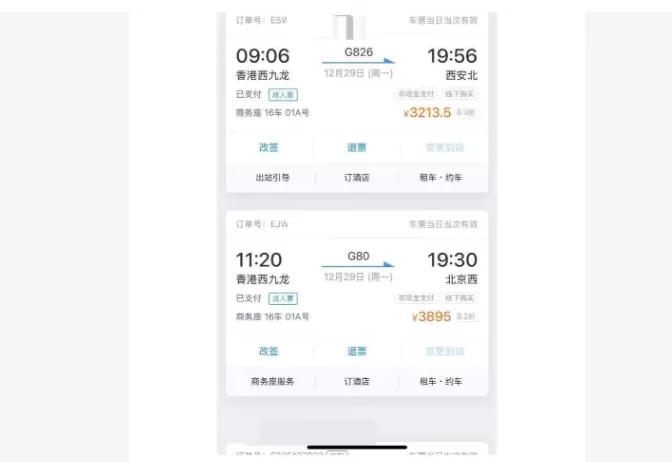
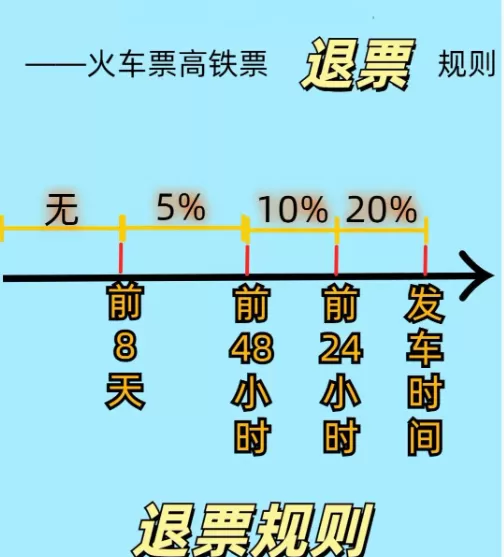
This is the central concern of tourists. In accordance with the current rail passenger transport rules, the fee for refunds is divided into four slots at the actual time of completion of the refund and the time of dispatch of the train, with an incremental rate, as shown in the table below:
The proportional billing rule for the fee at the point at which the refund is due (long distance from the dispatch) indicates that the actual refund is 8 days or more before the amount of the refund, including zero per cent (full free of charge) and above, and that no fee of $0,500 is paid for the return of tickets 48 hours or more before the issuance of the ticket 48 hours before the issuance of the ticket ~ 8 days after 5 per cent at the internal fare is not applicable to the current slot; refunds are paid at a minimum of $25,475 24 hours before the drive ~ 48 hours after 10 per cent of the internal fare; refunds at a minimum of $250,450 hours before the start of the car and at 20 per cent of the internal fare, at any time before the issuance, are collected in the current slot; supplementary rules indicate that refunds at a minimum of $us 2,100, 400
Time calibration: the length of the calculation is accurate to the minute, based on the actual time between the completion of the refund system and the dispatch of the train, rather than a rough calculation by natural day. For example, train departures take place on fridays at 10, return tickets by 10 wednesdays for 48 hours or more, and return tickets after 10:01 wednesdays automatically enter the 24-48 hours slot。
Minimum and end fees: if the refund fee is calculated on a pro rata basis of less than $2, it is charged at a flat rate of $2; the end of refund fees are rounded to the nearest place。
Re-sign and write-off restrictions: in order to close the loopholes in the rule of “resigning late tickets at low prices”, the railway sector has made it clear that, in the 48 hours to 8 days before driving, tickets are re-signed or changed to other trains that are more than eight days away from the station, and that they are cancelled eight days before driving, they still receive 5 per cent of the original fare and are not entitled to a free refund policy。
The return of tickets shall be subject to the following normal conditions: no ordinary return tickets shall be issued, and the passenger may only sign for other traffic between the same sectors on the day of departure; in exceptional cases, such as illness or injury, illness or illness, if the vehicle is not available, it may be cancelled within eight days of the issuance of the vehicle, on the basis of a valid certificate issued by a hospital above level ii, upon confirmation by the station chief, at the rate applicable to the corresponding period of time。
Iii. Special case refund rules: waivers and special access
(interception of train parking notices, special ticket refunds at the station, window scenario)
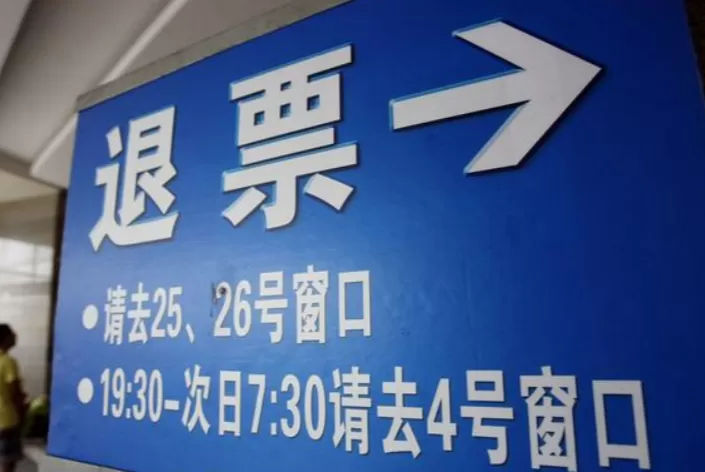
In addition to the conventional ladder charges, there are specific refund rules in the railway sector for cases such as railway liability, force majeure, special passenger conditions, some of which may be waived in full and passengers may apply in a timely manner to avoid unnecessary losses。
Refund of railway liability
Passengers who are unable to travel normally because of the railway sector, such as parking, lateness, cancellation of lines, adjustment of operations and transfer of seats, may obtain a full refund without charge. Passengers who do not obtain a ticket online and do not print a reimbursement certificate may directly choose “refunds due to train stoppage” in their orders for 12306 app; if they have received a paper ticket or reimbursement certificate, they will have to go to the ticket sales window at the station. Refunds in this category are not subject to a time limit and may be processed within eight days of the date of the vehicle。
Refunds for special injury or illness of passengers
If a passenger or a member of his or her immediate family is unable to continue with his or her injuries, he or she can apply for a special refund at the ticket window at the station on the basis of a medical certificate issued by a hospital above level ii. Refunds may be processed in accordance with the requirements, as verified by the station, and the corresponding time-related charges may be paid; if the situation cannot be processed in advance, they may be re-checked within eight days of the date of the ride。
Force majeure and policy refunds
In the event of force majeure, such as major public events, natural disasters and outbreak control, when the railway sector has introduced a unified free refund policy, all tickets for the corresponding period and route can be refunded free of charge in full, free of standard step rates. This type of policy is usually published through the 12306 network of officials, app, and the official public number, which allows for timely attention by travellers。
Special rules for group and preferential tickets
In the case of preferential tickets, such as student tickets, military disabled tickets and the like, the reimbursement rule is the same as the normal ticket, and the full refund is normally payable on the condition that they are free. In principle, group tickets for 30 persons or more must be paid for more than 48 hours before driving, at a rate of 20 per cent for less than 48 hours, in accordance with the block ticket rule。
Iv. Official channels and complete operating procedures for high-level refunds
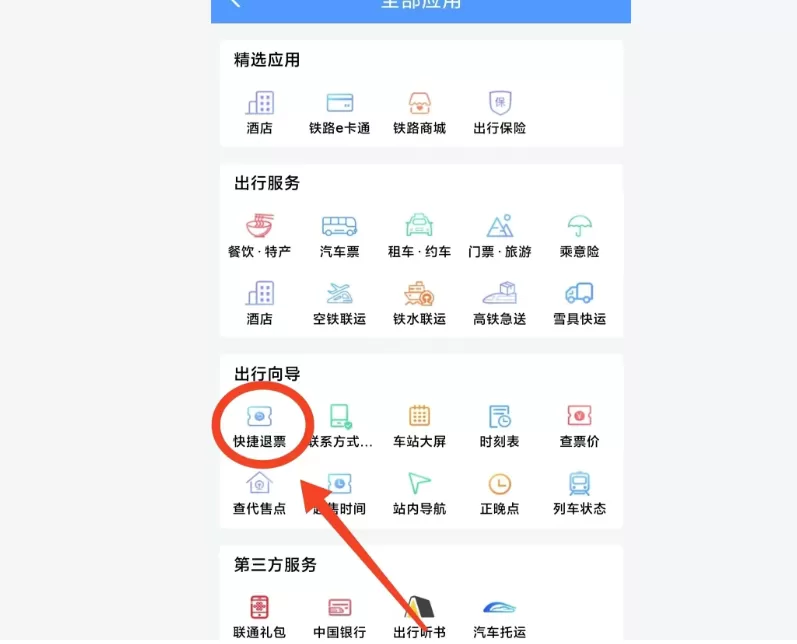
(12,306 app step-by-step cut-off, station automatic ticket-back interface, manual ticket-back window scene)
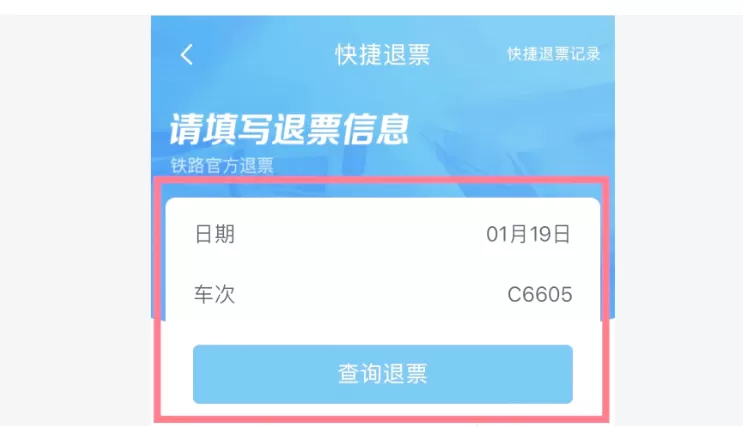
High iron refunds are divided into two official channels, online and underground, whereby passengers may choose the corresponding channel according to their ticket status (whether to pick up a ticket or to print a reimbursement certificate). Passengers who purchase tickets through a third-party platform are also required to obtain a final refund through the railway system at rates consistent with official channels。
Online refunds (12,306 app/official website)
Scope of application: no paper ticket is exchanged, no electronic ticket for reimbursement is printed, and more than 30 minutes before dispatch (most of the vehicles support processing on-line before dispatch)。
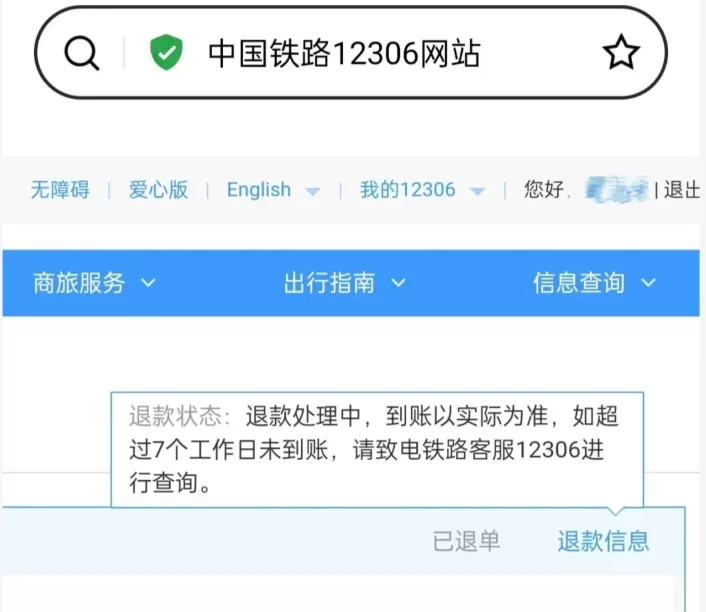
Operating process: opens 12306 app to enter “my order” and selects the corresponding ticket order by clicking on the “refund” button to confirm the return information and the amount of the deduction. Refunds are returned to the payment account at the time of purchase of the ticket, and the payment of micro-credits and treasures is normally made on a basis of one to three working days, and the payment of bank cards may be slower, up to a maximum of 15 working days。
Note: electronic tickets that have been printed for reimbursement, which cannot be recovered online because the system is unable to recover them online, must be processed in the manual window of the station and, upon return, must return the original claim。
Offline refunds (stop window/atm)
Scope of application: all scenarios in which paper tickets have been obtained, reimbursement documents have been printed, special refunds have been issued after the issuance of the vehicle, and compensation for injuries and illness have been cancelled。
(a) automatic teller machines: to support electronic ticket refunds without a printout, which are simple and do not require queues and suitable for temporary refunds at station locations
Manual ticket windows: the whole scene is common, valid identity documents are required to be used at the time of purchase, and copies of paper or reimbursement documents are returned。
In the off-line refunds, cash purchase orders are refundable on the spot and electronic payments are returned to the corresponding account。
Document for reimbursement of refunds
Many passengers are easy to ignore: refund fees can be issued with a formal reimbursement certificate, which must be processed as of the date of return within 180 days, a ticket identification document is obtained in the ticketing window of the station and can be used for unit financial claims。
V. Resigning vs refunds: comparison of cost options for travel changes
(summary of cost of re-signing versus refunds, indicating the best option in different scenarios)
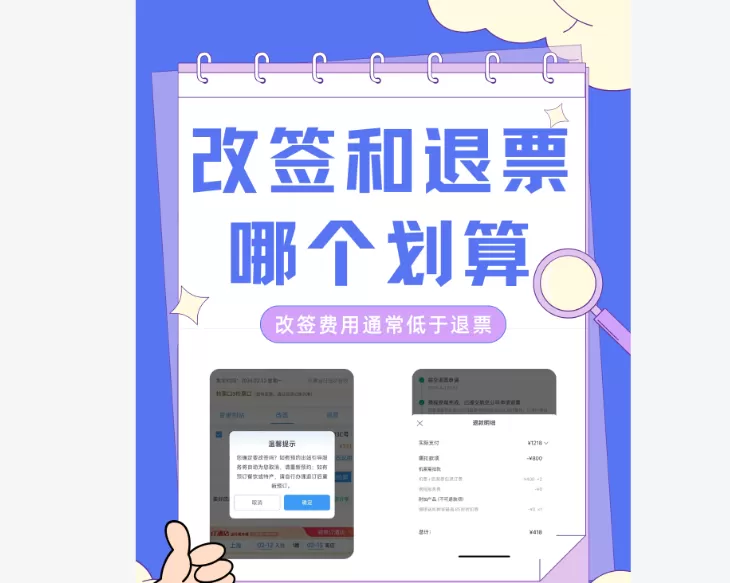
The first-time option for many travellers to change their journeys, and in practice the reasonable use of the re-signing rule, tends to reduce losses significantly, or even cost-neutrally, to change travel. Understanding the differences in the application of re-signing and refunds will help travellers to minimize travel costs。
Core rule comparison
Core advantages of the reassignment
(b) more than 48 hours before driving: tickets may be resigned for any period of pre-sale, with no charge for any change in the price difference
Within 48 hours before driving: other cars before driving and on the same day can be resigned without a fee
After driving: other same-spaced vehicles may still be resigned by 2400 hours on the same day, with only one opportunity to be resigned without charge。
In simple terms, as long as there is no option to refund tickets, change only the number or date, and no matter how long it may be close to being shipped, there will be no handling fees, but only the cost of the tickets will be deducted。
Site selection proposal
(b) determination of the complete cancellation of the journey: the direct processing of the refunds and the corresponding fee at the step rate
(a) adjustment of travel times/cars only: priority is given to re-signing, zero charges and minimal cost
(b) uncertainty about travel in the vicinity: the number of vehicles may be resigned at the latest on the date and decision-making time set aside, less than the direct refund
In order to reduce the loss of a high rate of refund: from the 20 per cent rate slot in 24 hours, the fee could be reduced to 5 per cent by re-signing to forward vehicles, bearing in mind the rules, subject only to a small reduction in the number of places for which a refund is required。
Special caution is required that each ticket can be resigned only once, and that the ticket may not be resigned again, and only refunds may be made in accordance with the return rule。
Vi. Guide to common error zones and pits for high-level iron refunds
(affirmation chart with 5 common error points with red fork mark)
In the actual process of obtaining a refund, many passengers have suffered unnecessary losses due to lack of understanding of the rules. The following are the most common six error areas and corresponding pit avoidance recommendations。
Mistake one: all refunds are subject to a fee
Many tacit refunds are subject to deductions. In practice, they are refunded in full, without any charge, for more than eight days before driving, for railway liability, and for special injuries or illnesses that meet the requirements. Passengers whose itinerary is uncertain determine the itinerary as far as possible eight days before dispatch, giving priority to free refunds。
We can't refund tickets after driving
Ordinary refunds are not supported when driving under normal conditions, but may be resigned to other vehicles on the day in question; in exceptional circumstances, such as illness or injury, liability for railways, they may still be processed after certification by the station and are not completely impossible, and passengers may consult staff according to their circumstances。
Mistake iii: additional discounts/higher fees for the return of tickets from third-party platforms
Official refund rates are harmonized across the country and third-party platforms do not have the right to adjust the percentage of fees; some of the “refundable service fees” charged by the platform are self-charges and not rail refunds. It is recommended that priority be given to obtaining tickets for refunds through official channels of 12306 to avoid additional expenditures。
Mistake four: a printout of a claim will also allow a refund online
Once the electronic passenger ticket has been printed, the online system is unable to recover the paper document, and must therefore go to the manual window of the station to obtain the refund, and return the reimbursement certificate before it becomes unworkable。
Zone five: refund fees not reimbursable
The railway sector may issue a formal reimbursement certificate for reimbursement of refunds, and the normal reimbursement that meets the unit's reimbursement requirements must be collected at the ticket sales window at the station within 180 days of the refund。
Core recommendations for pit avoidance
The schedule is planned as early as possible and priority is given to determining the itinerary outside the eight-day window; temporary changes are changed in preference and the return of tickets is considered; ongoing attention is paid to the train's operational status and requests for a full refund are submitted in a timely manner in the event of a stoppage; priority is given to official channels to obtain refunds and avoid additional charges on third-party platforms。
Vii. Concluding remarks: the core principles and equipment policies
(summary of the core points of the high-heavy drawback, fine-tuning of step rates, no-releases, channel choices, economy techniques)
The core logic of the high fee for train refunds is very clear: the more the train leaves, the lower the cost of early refunds, the higher the cost of zero refunds more than eight days in advance. For travellers, mastery of the rules minimizes the loss of travel。
In summary, three core points will be borne in mind: first, priority planning, with a free refund policy to be determined as far as possible eight days before driving; secondly, change of priority, with a change of priority to the same area and a change of priority to the same area, in lieu of a refund, with the lowest cost of zero fees; and thirdly, special cases, special access to railway liability, injury and illness, and timely application of a reciprocal refund policy to avoid unnecessary costs。
All refunds are governed by the latest official rules of 12,306, which, in exceptional circumstances, can consult station staff or call a hotline of 123,06 to ensure compliance and safeguard their legitimate rights and interests。