


First, coupons are actually price discrimination
We used to go to fast-food restaurants like kentucky and mcdonald's and get coupons, which make a direct discount. All kinds of commercial apps — not just take-outs — are now regularly available with electronic coupons. Why would a merchant get a coupon? Isn't a direct price reduction more attractive to customers? It is true that both the merchants and the customers have caused a lot of trouble, but the coupons have played the game for so many years, and the merchants still enjoy it, and there must be some reason。
Let me ask you a question:
If you're selling popsicles, there's two stocks, and the cost is two dollars each. Now there's two people buying popsicles, and you know that a customers are willing to pay $7 and b customers are willing to pay $5. So, what should you set the price
It was set at $7, with only one sold and five earned, and the other one could not be sold. It's set at $5, two for sale and $6。
Looks like it should be $5, right? However, it was somewhat regrettable that the a customer would have given him $7 and sold him only $5. Of course the customer was happy because he saved two dollars and felt like he was taking advantage. According to economics, these two dollars are called consumer surplus。
The more consumers are left, the happier the customers will be, but would it hurt if you were a businessman? The customer was willing to pay because the price was too low and left it in the customer's wallet instead of yours。
So what do we do? Let's see how we can get seven dollars for those who want to pay seven dollars and five dollars for those who want to buy five dollars. Would it be possible to set the price at $7 and then make a two-dollar coupon, but the way in which the coupon is received is a little bit complicated. What happens
For a, the price would have been acceptable and would have been bought. The b customer saw that the price, though seven dollars, could be bought at a price that he could accept, and that he was happy to buy it。
So, for different consumers, he has different price elasticity, meaning he has different sensitivity to prices. Some do not buy these goods without coupons, while others do not care about them. If the merchants directly lower their prices rather than issue coupons, they lose a portion of their income。
In economics, this is called price discrimination. Attention is drawn to the fact that discrimination here is not a pejorative or, of course, a positive one. Discrimination is not directed at those who are willing to use coupons, but at “rich people” who do not use coupons. Price discrimination, as defined in economics, is essentially a price difference, usually meaning that the provider of the goods or services, when providing the same grade and quality of goods or services to different recipients, applies different sales prices or tariffs among recipients。
Price discrimination occurs when, without justification, the operator imposes different prices on several buyers for the same goods or services. Price discrimination is an important monopolistic pricing practice and a pricing strategy whereby monopolies obtain excessive profits through differentiated prices。
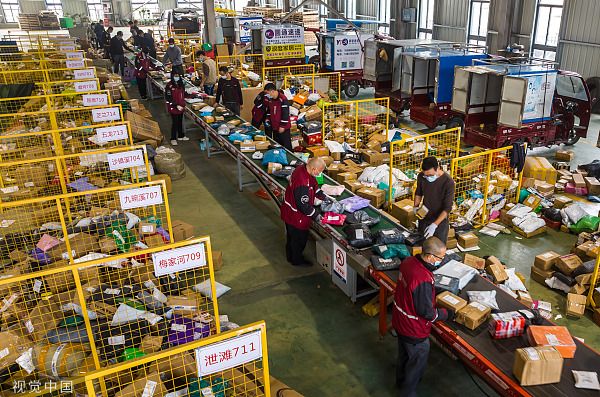
The express enterprise is preparing for the 2-1 logistics peak
Ii. Three table discrimination
First-class price discrimination - bargaining
Price discrimination has developed at a very rich level in the long history of business development through practical tests. Economists divide price discrimination into three levels according to the extent of price differentials:
First-class price discrimination, also known as total price discrimination, is the fact that each unit of product has different prices. First-level price discrimination is premised on the fact that each consumer is aware of the maximum amount that he or she is willing to pay for the product and, in so doing, determines his or her price, which corresponds to the price that the consumer needs for the product, thus obtaining the full surplus of consumption per consumer。
Under the first-level price discrimination, sellers set different prices for each customer and each unit of commodity they purchase. Let's see, what kind of scenario would price it
Yes, it is more common for roadside vendors to sell their products at a very high price, often at a very high price, before obtaining the psychological price of the consumer for the highest price. Such consumption is often used for non-conventional products, and people are unable to obtain consistent price standards in large markets and rely on their own judgement to give psychological price。
Secondary price discrimination - substantial merit
For the same commodity, our consumption needs are different. For example, if you rent a house alone, you just have to buy a bowl, or two or three more for a guest. If the merchant says you buy 1,000, i'll give you half. You'd rather buy one or two at full price. Because, as an ordinary family, the demand for a bowl is a single number。
But if you're going to open a restaurant and buy a bowl, you'll be willing to buy 1,000 at half a price. This is the price elasticity of consumer demand. With different demands, you would have different demands on prices。
In response to this situation, a secondary price discrimination (second-degree price discrimination) has arisen, whereby businesses divide the consumer's demand curve into different segments, depending on the volume of the purchase, in order to increase sales while obtaining the full consumer surplus at the time you purchase different quantities。
Under secondary price discrimination, sellers, while unable to observe the characteristics of each particular customer, are aware of the diversity of buyers ' preferences and thus have the potential to discriminate between different buyers by offering a range of sales contracts that include prices and various terms。
From the buyer's point of view, there are self-selection mechanisms (self-selection) that match the consumer's needs curve according to the commercial price, and ultimately agree between the business and the customer to maximize consumption and prices. Price-based, cheaper to buy. The marketing package, which we often see at the mall, “two at a rate of 80, three at a rate”, is derived from this secondary price discrimination strategy。
In economics, there is also the concept of “reverse secondary price discrimination”. Discrimination against secondary prices is the more cheap it is bought, and the more expensive it is, the more the reverse price discrimination is. Like mobile traffic. In the years when a mobile phone was just connected to the internet, did anyone find the flow in the package to be cheap, but if it exceeded the package, it would have to be billed several times more than the package
Remember that i was still in college, where the cost of living was low, and the more expensive my mobile phone was, the more careful the end of the month, fearing that i would not be able to survive until one day a month. But we've got a guy in our dorm who never gives a shit about traffic, who doesn't give a shit about the package, who just keeps using it and looking at me. However, this is the reverse secondary price discrimination, which essentially allows those with high consumer capacity and less concerned with “small money” to pay the highest profit。
In general, it is the classification of users, who, because of their high consumer capacity and their ability to generate more “consumer surplus”, design a high-māori product model specifically for this group of people to earn this portion of the “rich-minded” population. So price discrimination really discriminates against rich people..
Level 3 price discrimination - customised discrimination
Third-tier price discrimination, also known as signal selection, refers to different prices for different consumers in different markets and overprofits in high-priced markets. At the same time, the application of price signals to transfer resources maximizes gains in different markets。
Such price discriminatory strategies are commonly used in the allocation of public resources. For example, the wrong price of electricity is such a price discrimination strategy. In general, we use electricity mostly during the day, especially after midnight. This has resulted in electricity stress during the day and may even be limited by pull-off; on the other hand, demand has become inadequate at night, and the power plant has been able to shut down only part of its equipment。
The problem is better solved by the wrong price. The need to use electricity during the day is met by using price differentials between peak and non-peak periods to generate excess profits. At the same time, a balance of resources has been achieved through the transfer to the evening of unneeded electricity needs. Actions to shift certain peak needs to lower peaks not only maximize the benefits but also make fuller use of its equipment resources are positive for both business and society。
In the case of third-tier price discrimination, if the characteristics of the buyer are observable and the enterprise has the capacity to have information about the customer, especially the price that the customer is willing to pay, the seller can set different prices, such as the price of a given country, the discount on membership, the special “school” price for software, the discount on the purchase of a magazine by a student, etc。
Three-tier price discrimination is the most widespread form of price discrimination, also known as market segmentation, as sellers group buyers and set different prices for each group。
Iii. Price discrimination in the internet age
In the age of the internet, information was becoming more transparent and less and less
The internet is too efficient to deliver information, and any scandal is likely to spread rapidly from the media, so the cost of discrimination has become higher, and the discrimination we can see is becoming less and more invisible。
If internet traders, like traditional price discrimination, “see-the-man pricing” is shallow, some consumers buy apples that other consumers buy at $4 per pound, easily leaving a mark on the internet, once they find out that they will be very upset, leaving comments such as “unfair” “never again”. So, what do businesses do to take care of consumers' emotions and want more “consumer surplus”
The internet age, like the receipt of coupons, gives “user labour” to consumers who wish to enjoy low prices by setting up relatively complex procedures. In this way, the original purchaser is psychologically balanced with the low purchaser, and the merchant is still profitable and the buyer and seller win together. For example, some group purchases of ap-type products have a pattern: user a wants to buy an x-x product, but thinks it's a little expensive, so he can help himself to cut prices by inviting friends, families, neighbours and buy goods at very low prices. Businesses receive “free advertising” and excess sales. User b, however, wanted to buy an x-x product, but he was not sensitive to the price and belonged to a relatively good user, so he was directly charged. Businesses earn high profits at original prices。
The buy-in type app allows price-sensitive users to buy their products at low prices through user labour and the creation of win-win price discrimination programmes; and the purchase of products at original prices for users whose prices are not sensitive. This, like the coupon formula, eventually led to high overall profitability. It is this strategy of price discrimination that has been used to rise at a high price, when it is full of individual ms and lowers the price, then full of individual ns and lowers the price. In this way, all consumers who have the will to purchase, even those who would not have had the will to purchase, whether you have a higher or lower capacity to pay, have been allowed to “take it all” because of the labour of different users。
Iv. Price discrimination must be understood by all
Direct `person-visiting' is the most convenient, but the disadvantages are unsustainable, have a significant negative impact and may discourage high-price buyers. Thus, by releasing opportunities, businesses can create a special low-price policy to retain price-sensitive consumer groups. At the same time, consumers whose prices are not sensitive are concerned about normal prices and are not discouraged by special promotions, as they are also exempt from cumbersome and fine-tuning and from the label of “simplified”. Finally, a win-win situation was created, with maximum returns。
For example, a cake store, with a new cake for $399. After a period of time, consumers were less willing to buy, and shopkeepers were trying to increase sales, thus lowering prices to $299. The same cake, with a difference of $100 at a time, makes up $100 less for customers who would have continued to buy cake with $399。
Therefore, experienced shopkeepers must not be able to make such a direct price reduction, and they often add a condition to the special price. For example, the transfer of a 100+ circle of friends will allow you to purchase a cake for $399. By working as a user, differentiated pricing can be taken for granted。
There are also hotels, online booking sites, where prices vary according to the date of advance reservation. If the customer is a group whose prices are not sensitive, especially those in temporary need of accommodation, then the accommodation is ordered on an ad hoc basis when there is a need for accommodation, which is convenient, concise, time-efficient, but at a slightly higher price; if the customer is a group whose prices are sensitive, it takes effort to determine the itinerary as far in advance as possible and to ensure that it does not change, thereby obtaining a lower price. Regular marketing is also a strategy that indirectly discriminates against product pricing and generates higher returns。
The extract of this instrument is extracted from chapter 5 of " is it good-looking enough to eat? " , which has been deleted from the original text and published under the authority of the publisher。









