


Celery is the most taboo, often with a basket of bamboo and water coming out of the season. This crop is typical of a “green spring” type, with three to four real leaves of seeding, and in case of continuous hypothermia, the plant mistakenly assumed that spring was coming, and that it was pumping flowers directly, leading to the aging of fibres and the loss of a sense of taste; the seeding later in the day was exposed to high temperatures, small and thin, and frequent pests. In order to keep production, it is important to manage the two critical points of celery and celery in winter, together with precision management。
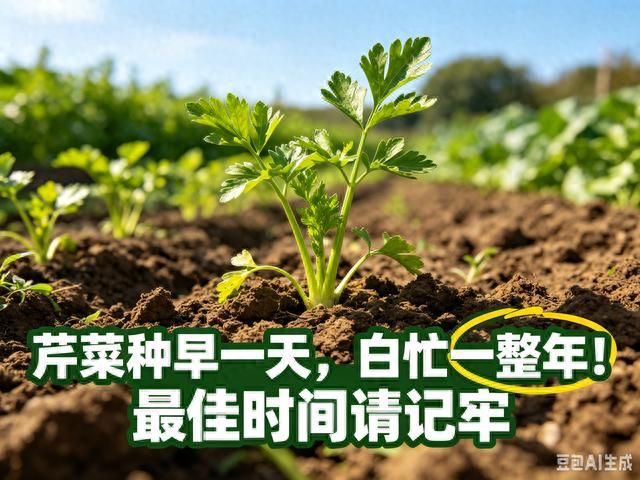
In the northern region, celery is grown and the optimal window period is locked in late june to early july. At this point, seedlings were planted, growing 50 to 60 days of seedling, moving between august and early september, and could be collected around november. The yangtze basin has a slightly warmer climate, with the planting period eased until early july and early september, and the harvest period can last until the end of the year and even the following spring. The old farmers have a good point of saying that “summer celery” is not good for buds, but when sprouts are done, the seedlings are good and later temperatures are falling, and they fit the cool growth habits of celery。
The winter celery owner grows over the years and fills the early spring vegetable slot. It is advisable that the farmers of the yangtze central and lower river be selected to grow their seedlings between early august and early september, be planted around october and be harvested before smoking in march. The greenhouse shed in the north is divided into two seasons: mid-august in autumn and winter, planting in november and marketing around the following spring season; spring and november, planting in february and harvesting by may. This dish is very strong, and the criteria for planting are 60 days old, four to five real leaves, half a centimetre thick, and it is difficult to resist the cold。
Seeds of celery are oily and dormant, with very low seeding rates. The seeding must be preceded by seeding, 24 hours of cold water impregnation, during which the substance inhibiting the lumber is repeatedly washed away and then placed in a cold environment at temperatures ranging from 15 to 20 degrees celsius. Summer sprouts suggest the use of wells to freeze or hang in the shade, to wash and roll daily, to prevent the deterioration and sowing until half of the seeds are white。
The seedlings need to be watered through the bottom water before the seeds can be mixed into two or three times the ground. Land thickness is key to success, covering half a centimetre to one centimetre, and light pressure ensures close contact between seeds and the soil. The soil is too thick and the seeds have weak capacity to grow. High temperatures are sowing in the summer and autumn, often exceeding 40 degrees above the surface temperature, that it is important to cover up the sunnet or to keep the straw wet and cool, and to release the seedlings early and late. The winter nursery is focused on temperature preservation, using membranes or small arch sheds, which are released in a timely manner to prevent high-temperature roasting。
Shrimp management is focused on water temperature management. The soil surface is wet until 20 to 25 degrees during the day and 10 to 15 degrees at night. After this, the temperature is reduced appropriately, 18 to 22 degrees during the day and not less than 8 degrees during the night, preventing the growing or early springing of the seedlings. Water is being poured in such a way as to prevent suffocation from causing sudden fallout. The saplings are carried out twice, with one leaf at a distance of one to one and a half centimetres, and two or three leafs at a rate of two to three centimetres, avoiding overdensity to form a sapling. A week before the planting, the water was controlled, the cover of the seedlings was removed and the rate of life increased。
The selection chain avoids errors in newly collected seeds. New species have a marked hibernation period, with a low gestation rate, and more than half a year of stocking of the phenomegranate has been fully grown. If the new species are to be used, the hibernation must be immersed for 12 hours with a cactin solution. The two or three leafs are extremely sensitive to low temperatures and are exposed to very low temperatures of less than 10 degrees, which need to be protected at the end of the fall. Temperatures exceeding 25 degrees during the day should be ventilated in a timely manner so as to avoid high temperatures and humidity leading to the growth of seedlings。
The sooner we move, the better. The best time is 50 to 60 days old and 12 to 15 centimetres tall. The seedlings are too small to be stable, they are old and slow. It is appropriate to plant deep enough to bury the roots without the leaves. It's too bad. It's too shallow to fall. Nitrogen fertilizer should not be applied in fertilizers, and phosphate potassium should not be neglected. Every acre of manure is mixed into boron sand, effectively preventing fracturing of leaf handles; calcium chloride is sprayed during boom periods, avoiding calcium-deficit “burning heart” phenomena。
Water management in the field combines drainage and irrigation. The celery is wet but afraid of flooding, and the water must be drained in time after the rain, so that the face can be shaped to the back of the turtle and the drain can be dug. Early in the morning and late in the afternoon, the water is so hot that it can damage the roots. Freezing water is abundant before winter and fresh water is rekindled in the early spring. Disease control is based on prevention, with the use of periodic spraying with dyson manganese zinc, soft scabs being treated after rooting and a strain being taken out of the field and buried deep. Rotation is introduced to avoid connections to umbrella crops and to reduce the disease base。
The timing of harvest directly affects quality. Autumn celery needs to be harvested before the frosts fall, and leaves are emptied. Once the celery is found in the centre, it must be collected immediately, otherwise the aging fibre affects the taste. A week before the harvest, water is stopped, leaves are reduced in content, and flaccidity and sustainability are increased. The root is removed, the old leaves are removed, bound and placed in the shade, and may be sold on the market。









