


Red
ChWhatWhat
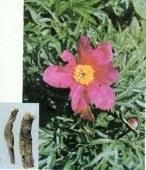
Alias
Mountain medicine, herbal medicine, wood medicine, red medicine, red medicine
Effectiveness
It's hot and cold and it's bruised. They are used for hot and poisonous plazas, swollen eyes, corrosive liver pains, sepsis, abdominal abdominal pains, fall and damage, and swollen acne。
English name
Radix paeoNiae rubra
Organisation
"the book of the gods."
Toxicity
Attribution
Hepatology
Medicine
Taste
Radix paeoNiae rubra
This is paeoOr paeoNia veitchii lynch's dry roots. The spring and autumn seasons are poaching, removing the roots, stubs and mud and drying。
Rule
Remove impurities, separate sizes, clean, purified, thick, dry。
This is a round slice, 0. 5-3 cm in diameter, 0. 3-5 cm thick, surrounding brown and brown, cutting flour white or pink, narrow skin, visible radiary texture of wood and some cracks. Follow the above
Level determination
The method used under this heading shall contain no less than 1. 5 per cent of the platinum (c23h28o11)。
[sex] the body is cylindrical, slightly bent, 5 to 40 cm long, 0. 5 to 3 cm diameter. The surface is tan, rough, with cleavages and wrinkles, with skin marks and horizontal pores, some of which can easily fall off. It is hard and hard, it is easy to break, it is white or pink, it is narrow in the skin, it is clear in the radioactive form of wood, and some have cracks. It's fragrance, bitter, sour。
[identified]
(1) this cross-section: a number of brown cells in the wood plume. The thin-wall cell of the cortex extends. It's tougher. Form a layer of rings. The wood sector is wider, the catheter cluster is radioactively organized and wood fibres are attached to the catheter. Thin wall cells contain acrylic crystals and starch particles。
(2) the extraction of the present powder of 0. 5 g, plus 10 ml of ethanol, which is fertilized for five minutes, filtering, leaching evaporation, decomposed by residues plus ethanol 2 ml, as a solution for the specimen. A ethanol-based solution containing 2 mg per 1 ml is also taken as a control solution. Tested with thin layer chromatography (appendix vi b) to extract 4 ml of each of the two solutions listed above, and place them on the same silica g-coated plate, with ethyl chloropicrin acetic anhydride methanol-miolate (40:5:10:0. 2) is a roller, excavated, dryed, sprayed with a 5% vanilla sulphate solution, heating to bright spots. In the chromatography for the test product, the blue purple spots appear in the same position as the control chromatography。
Level
Measured using the high-efficiency liquid chromatography method (appendix vi d)。
The chromatography conditions and system applicability tests are compared to the application of the 18-alkyl silica key to the filling agent; methanol-0. 05mol/lphosphate potassium solution (40:65) to the flow; detection wavelength is 230 nm. Theoremic plate numbers should not be less than 3,000 based on peptide peaks。
Precisionly known as taking a 36-hour dry antimony control in a phosphorous quinoxide depressor dryer, plus methanol to a solution of 0. 5 mg per 1 ml。
The fine powder of the product is about 0. 5 g, which is well-defined, and in a corroded bottle, which is precisely added to methanol 25 ml, which is called mass, impregnated for four hours, ultrasound for 20 minutes, cool, reweighted, filled with methanol, smoothing, filtering。
Precision extracts 10 ml of the control solution and 10 ml of the test solution, and the liquid chromatograph is used to determine, if applicable。
This product shall contain no less than 1. 8 per cent of the platinum (c23h28o11)。
It's bitter, it's cold. The liver。
It's hot and cold and it's bruised. They are used for hot and poisonous plazas, swollen eyes, corrosive liver pains, sepsis, abdominal abdominal pains, fall and damage, and swollen acne。
6-12g。
[note] it's not appropriate to be used in the same way。
[stocks] dry ventilation。
[remarks] (1) the platinum cleans up the heat, and the bruising remains. The function of the product is similar to that of danpi, which is often used with danpi. But danpi's cooling and cooling function is better, both to sift the heat and to cure the fissure fever, while the platinum can only be used to sift the heat, so that it can be bruised alive。
[drugs]
[script]: chishao
Other organiser
[source]: roots of double-leaved plant platinum (field seed), herbal pharmacinum, and zakakawa。
Efforts: bruises, painkillers, cold blood, swelling。
[christ] treatment of bruises, accumulation, abdominal pain, pain, haemorrhage, diarrhea, blood under the intestine, bare eyes, swelling。
[clinical apps]
1. For use in heat and heat, in the blood of the camp, in the fever, in the tongue, in the rashes and in the blood fever. I'm sorry
2. Aerobic haemorrhages such as cavity, fall-down damage and haematosis. Tobacchan, tornado, tornado, tornado, tornado, tornado, tornado, tornado, tornado, tornado
It's sour, bitter, cold. It's a book. It's a book. Hobo: salt. Lee: coldy. "the acid, the cold, the venom." 4 "the fragrance." 1 "the liver, the spleen." 1 "the spleen, the spleen." 2 "the spleen of soup." 3 “the hand and foot are intoxicated with the liver and spleen.” 4 “in the liver, the intestines” 5 “in the heart and the intestines”
[use]: inner clothing: fried soup, 1. 5-3 dollars; or pills, scattered。
[drug ]: the blood-fictioned take care. 1 this draft has been collected: “it must be made of (a `mine'). "the blood is cold, it is forbidden." 3 “the blood is broken from the platinum, so that all cases of haematosis, as well as the leaks, the post-partum abdominal abdominal abdominal pains have ceased and the anthrax has collapsed and is not acceptable.”
[other name]: gypsies (chou's monopoly), red dynamite (st. Chestia), red dynamite (dactification of medicines), stinky danggen (qinghai medicines). The original plant, 1 herbal medicine (cui pao's old note), is also known as the mountain pharmacist, the egg leaf pharmacist, the porpoise, and the wild herbal medicine. Aka mikawa
[provisional name]: red, red, red, red, red, red, red, red, red, red, red, red, red. And he who is made of red tatters, made of red twilight, and made of the twilight to yellow, with a glimpse of the charred stand, and then took the medicine。
(commodity name: north red: also known as red red, red red, herbal.) for the roots of the vegetal and ovaries. Mainly in the north-east of the country and in the interior of mongolia. Of these, the dorons are the best. Doron chelsea: north chelsea, produced for the doron region of inner mongolia. Large production, quality, national marketing and export. Kyo chi-chung: north chi-chung, born in the western mountains of beijing. Xinxiang: also known as xinjiang, kawasumi. For the roots of the plant. The main sources are sichuan xichang, ganz, coolshan and aba. In addition, yunnan and guizhou are also produced. The best of them is those of xichang. The original skin is bare: for those who have not shaved their skin. Scratch skins: the skins have been shaved for the skins. The above goods are better served by the long, loose (commonly known as leather dust)。
[distribution of animal and plant resources]: a herbal herbal medicine is distributed in heilong river, jilin, liaoning, inner mongolia, xinjiang, hebei, shanxi, shaanxi, gansu, sichuan, guizhou, yunnan, anhui. It covers sichuan, yunnan, guizhou, shanxi, gansu, xinjiang and qinghai. Medicines are produced mainly in nemongi, hebei, liaoning, heilong river and jilin。
[the collection and storage of medicines]: in the autumn, digs, remove the roots, stubbles and roots, wash the soil, separate them by size and then dry their feet when they are half dry, and in sichuan, there are those who shave their skins and then dry them。
[latin name]Niae rubra 1 paeo2 herbal paeoI'm sorryI'm sorry
[gun-making method] 1, red pellets: pick up impurities, separate strips, wash around 7 or 8% of the water, extract it, dry it up, wet it up to even internal and external humidity, slice it up and dry it. 2. Decrypt: take the red tablets and fire them in the pots to a small point of focus and take out the cooler。
[audience]: from the scroll。
Vegetable form
1. The medicine is multi-year, 40-70cm tall, hairless. Big root, hammer or cylindrical, black and brown. The stem is straight, the upper part of the branch, and there are several scaffoldings in the base. Leaves are born to each other; leaves bearings are 9 cm long and are situated on the top of the tuber with shorter bearings; the lower part of the tuber is a second back leaf and the upper part is a three-leaf leaf; the smaller ovarian, elliptical or pins are 7. 5 - 12 cm long, 2 - 4 cm wide, with a tip of the front, a wedge of the base, or an oscillation of the base, on the edges of the white mosaics, with no hair on both sides, and short hair and near gestation along the veins. Frogs, saps and argons, diameter 7-12 cm; saplings 4-5, pins of various sizes; sips 4, wide or near circle, 1-1. 5 cm long, 1-1. 7 cm wide, green, accommodation; petals 9-13, falloplasm, 3. 5-6 cm long, 1. 5-4. 5 cm wide, white, sometimes foundational, dark purple pecks or pink, and petals of pedestals and heavy
The petals; the male majority, with filaments 7 to 12 mm long and balconies yellow; the bouquets in the form of a light cup, which wraps up the base of the heart, with the first cracking of a blunt circle; and the pelvis 2 to 5, living with no hair. Pyramid eggs or egg round shapes, 2. 5-3 cm long, 1. 2-1. 5 cm diameter, pre-pants, may-june, june-august fruit。
2. Kawakawa's multi-year sketchbook, 30-120 cm tall. Root cylinder, single or divided, 1. 5-2m in diameter. Up straight, thick and blunt, hairless. Leaves interact; leaves have a length of 3-9 m; leaves have a two-fold re-embracing leaf with a broad ovulation of the blades and a length of 7. 5-20 cm; leaves are split into plume, a narrow cape or pin, a width of 4-16 mm, a tip of the first end, a full margin, a deep green top, wiping short and soft hair along the veins of the leaves, light green, hairless and visible. The two sexes, 2-4, the top of the tuber and the armpit, are usually only one open, 4. 2-10 cm in diameter; 2-3, the cape, 3-7 cm in length, divided or non-fragmented; 1. 7 m in length, 1-1-1. 4 cm in width, green, sequestered; 6-9, the petal, 2. 3-4 cm in width, 1. 5-3 m in width, purple or pink; the majority, the raisy, 5-10 mm in length, yellow in herbal form; the meat of the florida, with only the skin of the heart; and 2-5 in the skin, with the skin of the heart, with the fragrance, with the hair of the velvet. Vegetable fruit is 1-2 m long and is enclosed with yellow fuzzy hair, and ripe fruit splits and is often inverted. May-june, july-august。
3. Herbal herbs, multi-year grass, 30-70 cm high. Large, divided, round or hammered, brown. The stem is straight, sometimes red and purple, hairless, and the base has several snails, leaves each other, paper; leaves are 5-12 cm long; the lower part of the stem is two backsliding leaves; leaves are 14-28 cm long; leaves are small or wide elipses, 9. 5-14 cm long, 4-10 cm wide, short first end, wedge of the base, full edge, dark green, light green below, hairless or sometimes obscurous hair along the leaf's veins, small-leaved leaves are small, eggsy or elliptical, 5-10 cm long, 4. 5-7 cm wide, short-strengthed or near-flung; leaves on the top of the stem are trim or single-leave. Both sexes, single-capture, 7-10 cm in diameter; osteoporosis 3-5, wide osteoporosis, osteoporosis or osteoporosis, 1. 2-1. 5 cm long, green, sequestered; petal 6, rewinding ovary, 3-5. 5 cm long, 1. 8-2. 8 cm wide, white, red or purple; masculinity majority, 1-2 cm long, thin red velvet, rounded, yellow; fascult-like cups, wrapping the skin of the heart; heart skin 1-5, deviant, hairless, large, flat, resting. The cylindrical egg is round, 2-3cm in length, and the ripe fruit is split, with a reverse roll, with little red inside. May-june, july-september。
4. The main difference between the morphological characteristics of this plant and its herbal properties is that the back of the small leaf is so dense that it grows soft or fuzzy; the petals are white。
5. Beautiful medicine, multi-year grass, 40-100 cm tall. Tilts are straight and hairless. Leaves are made of each other, paper; time handles are 4-9 cm long, hairless; leaves are retips are retiped; leaves are 15-23 cm long, leaves are protrused with long or rounded ovaries, 9-16 cm long and 3-6. 5 cm wide, tails of the front end are sharp, wedge of the base are constantly down, with full edge and no hair on both sides; small leaves are protracted with long ovaries, with 7-9 cm long, 3-3. 5 cm wide, with a base slant, full edge, with no hair on both sides; and small leaves are of 10-15 mm length. Both sexes, single cape, with a diameter of 6. 5-9 cm; swirl, with a swirly pin, longer than a petal; swirl 5, with a wide ovary, with a length of 1 - 1. 5 cm, with a width of 9 - 12 mm, green, with a dwelling; valve 7 - 9, with an ovary or a long circle, with 3. 5 - 6. 5 cm, with a width of 2 - 4. 5 cm, with a red or rose colour, with a first-end circle, sometimes with a short tip, with a base wedge, with a strong majority, with about 1 cm long, light red with hair, hairless and yellow with platitudes; bouquets with a thin glass, with a pelt covering the skin of the heart; hull 2 - 4, with short skin, short yellow hair, short with small hair, with short head, with short head, and bending. 蓇葖3-3. 5 cm long, 1-1. 2 cm in diameter, short yellow hair or near hairless, with an outer bending beak. Periods of april-may and june-august。
6. The narrow leaf pox multi-year grass, 50-70 cm tall. Root hammer or near-spherical, 1. 2-3 cm in diameter. Up straight, hairless. The leaves are interwoven; the leaves are 1. 5-9 cm long; the leaves are re-emerged from one to two, with a broad ovulation of the leaves, 9-17 cm long and 8-18 cm wide; the plume of the leaves is split, with a fractured line or pin, 6-16 cm long, 3-8 mm wide and less than 1 cm wide, with a tip, full edge, green above, light green below, and no hair on either side. Both sexes, single-capture, 5. 5-7 cm in diameter; twilight 3, cape or linear pin, 4-10 cm wide, 3-15 mm in length; twilight 3, wide egg, 1. 5-2. 5 cm in length, red, front-end, nesting; petal 9, long circle, 3. 5-4 cm, width 1. 2-2 cm, purple red, front-end corrosive; tyrannical majority, four to five mm in length, flower medicine in round shape; florist not visible; heart skin, 2-3; devious, irradiated or hairless at an early age. Vegetable, hairless, may-june flower, july-august fruit。
7. The main difference between the morphological characteristics of this plant and the narrow leaf platinum is in the heart skin (2)-3, which is thickened by yellow hair, and yellow hair。
[physics identification]: dry roots are cylindrical, with two ends close to the same, slightly bent, 10 to 36 centimetres long, approximately 6 to 19 mm long. On the surface, dark brown or dark brown, rough, with horizontal pores and root marks, thick and deep wrinkles, the skin of the hand is easily removed and white or light brown cortex appears. Hard and hard, easy to break. Fragments are flat, white or yellow, narrow in the cortex, pink in kind, small in the central marrow, visible in the essential rays, sometimes with cracks. The scent, the taste of bitterness. It's long, it's loose, it's wrinkled, it's white, it's pink. The principals are mengji, hebei, liaoning, heilong river, jilin, shaanxi, shanxi, gansu, qinghai, hubei, sichuan, guizhou and yunnan. In the north-east, north-east, north-west and north-west, the platinum medicine is based mainly on its roots and partly on its herbal roots. And the platinum produced in the southwest is dominated by the roots of the plume. Among the above-mentioned commodities, the highest quality is produced in doron, inner mongolia, specifically known as the doron cham. There's a lot of paeo paeoThe roots of nia anomala l. Are mostly in the form of hammers. In sichuan, in addition to the p. Mirei levl. And p. Obovata maxim. Var. Willmottiae (statf) sterns are used in some areas. Sichuan merchandise, which is both skin-skinned and skin-skin-skin-skin-skin-skin-skin-skin-skin-skin-skin-skin-skin-skin-skin-skin-skin-skin-skin-skin-skin-skin-skin-skin-skin-skin-skin-skin-skin-skin-skin-skin-skin-skin-skin-skin-skin-skin-skin-skin-skin-skin-skin-skin-skin-skin-skin-skin-skin-skin-skin-skin-skin-skin-skin-skin-skin-skin-skin-skin-skin-skin-skin-skin-skin-skin-skin-skin-skin-skin-skin-skin-skin-skin-skin-skin-skin-skin-skin-skin-skin- the original skin is not decorated and has a similar shape, but there are fork branches, which are tan or brown. In addition to the above-mentioned herbal herbal herbs, xinjiang is produced with a p. Hybrida pall. Micro-identification: (1) pyramid: root-crossing: plume is 5-10 lumber embolism cells; remains of the decorate. The cortex is narrow, and some cells are separated into mother and child cells. The scaffolding cluster is visible in the near formation layer, and some of the pelvis are internally unguided. It forms a layer of microwave ring. The wood sector is wide-wired; the catheters are individually or in groups, organized in the same order as the wood fibre beams; and the central catheters are integrated in two groups. Large visible marks in the cortex, in the pelvis, and in the thin radial cells. This thin wall cell contains starch particles, some of which contain acrylic crystals. Powder: light brown red. 1 acrylic crystals are often arranged vertically, 7-38 (-41) μm in diameter, containing smaller crystal cells, wall bends, or a cell containing two or more crystals. 2 fibre tubular contour with a diameter of 14-38 mm, wall thickness of 5-13 mm, with a large kernel, a slit on the slant, and a wide and cross-cut on the rim; and a small number of resistant fibres with a single slant. 3 wood embolism cells with long stripes, rectangulars or polygons of approximately 225 μm; in some cases, they are filled with brown or red brown blocks. Four edifice catheters with a diameter of 25-78 m, with a edifice elliptical shape, some of which are extended horizontally to form a net or ladder to form a edifice catheter, with a perforated plate at the end or on the side wall with a 1-4 perforation. There are also starch particles, approximately 15 m in diameter. (2) kawakawa: the roots are cut across: the fall cortex is sometimes visible. The cortex is narrow. The scaffolding is not visible. Form a layered ring wave. The wood catheters form more closely into layers and are scattered individually or in groups; wood fibres interact with catheters; and a small number of catheters and fibres are scattered in the centre. The cortex and tenacity are sometimes visible in piped closed tissue, with a central thin wall cell containing brown and red secretions. This thin wall cell contains starch particles, some of which contain acrylic crystals. Powder: brown. One tube-shaped closed tissue is visible, with brown red in its central thin wall cells. 2 fibre tubulars 15-30 m in diameter; resilient fibres 14-36 m in diameter. 3 starch diameter to about 21 m。
[metal chemical ingredient]: the root of the paeoniflorin. The roots of herbal herbal herbs contain volatile oils, fat oils, resins, tart, sugar, starch, glue, protein, etc. It also contains about 0. 92% benzene acid. The pharmacological plant consists mostly of peptide, with a root content of 1. 8 to 7. 3 per cent, all in the root skin, and leaves of 1 to 1. 1 per cent. See the “white pills”。
Chinese pharmacy
Drugs by classification
Check
Drugs
Temperature list of chinese medicines, table of medicines, table of drugs, table of drugs, table of drugs, table of drugs, table of drugs, table of drugs, table of drugs, table of drugs, table of drugs, table of drugs, table of drugs, table of drugs, table of drugs, table of drugs, table of drugs, table of drugs, table of drugs, table of drugs, table of drugs, table of drugs, table of drugs, table of drugs, table of drugs, table of drugs, table of drugs, table of drugs, table of drugs, table of drugs, table of drugs, table of drugs, table of drugs, table of drugs
Check the meds
The list of bitter drugs in the list of bitter drugs in the list of bitter drugs in the list of bitter drugs in the list of bitter drugs in the list of bitter drugs in the list of salty drugs in the list of cheap drugs in the list of bitter drugs
Check the drugs by name
Chinese medicine
Chinese medicine electronic book
It's called "the sorceress of the sorceress"
Chinese drug-related









