


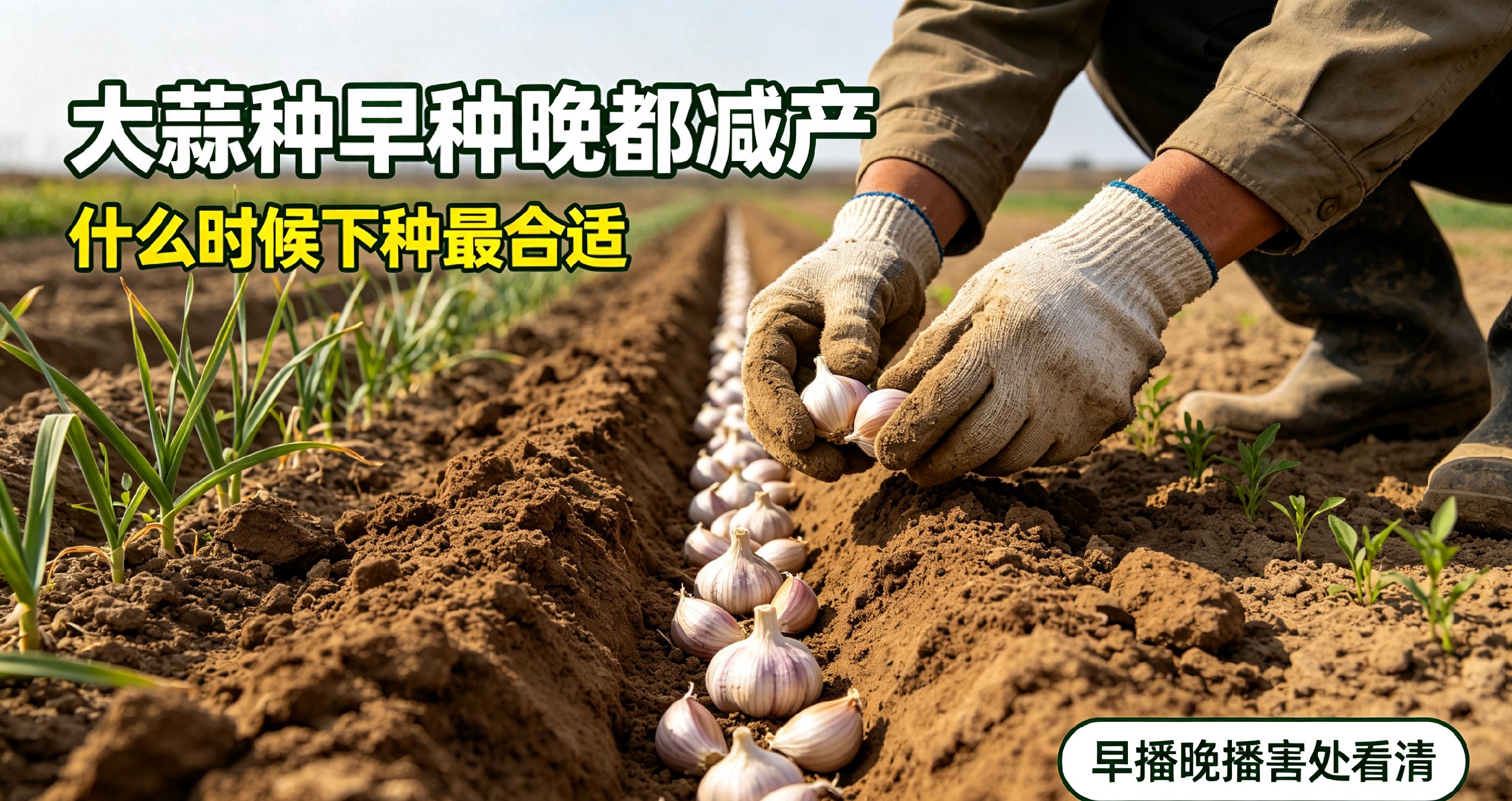
Every fall, many growers prepareGarlic seedingI don't know. Many people, based on their old habits of growing land for many years, see their neighbours on the ground or plant it directly when the land is released. It was not until the second year of harvest that it was discovered that either the garlic seed was frozen in winter or that the garlic was too small to produce as expected. The first reaction of many is that garlic is bad and fertilizer is scarce, but it is rarely thought that planting time is the first point in determining the low and high levels of garlic production。
Garlic is particularly sensitive to changes in temperature, with a one-week difference in planting time and a difference in winter. It grows too high before winter, is unfrozen, is prone to malformation; it is too late, it is weak, and it does not have enough time to swell after spring. If garlic is to produce more productively, the core is not as early as possible, or just before the cold. It's a real field plantingHazardThe best method of sowing, the reference time for sowing in different regions, and the full range of lay-down programmes such as garlic processing, whole-land fertilization, winterization, etc., are made clear, all of which fit into the field and can be used directly in the home。
I. Determination of the best planting period for garlic, no date of death card, depending on temperature
Many farmers tend to grow garlic on fixed dates or on agro-gas-saving arrangements, but the annual fall temperature fluctuates widely and fixed dates are not reliable. Warm autumn temperatures are slow, so seeding is easy to plant early; cold autumn temperatures come quickly and become late in days, and the seedlings are not strong。
A minimum of 3°c of garlic is able to grow the roots slowly, and the most suitable temperature for seedling growth is 16°c to 20°c. The key to the high yield of garlic is the production of four to five saplings by winter. Such seedlings are the most resistant to cold, and after a safe winter, spring returns quickly and garlic has full potential。
In order to grow this standard seedling, it is important to grasp a practical standard: 35 to 45 days of life are set aside until seeding occurs。
The method of empirical judgement: five days in a row when the average temperature is stabilized at 20°c, the average temperature is stabilized at 16°c, the optimal planting window period; the average temperature continues to be less than 15°c replanted, which is the late seeding。
The size of the national territory is wide, and there is a marked difference in the time taken to sow garlic. The northern part of china has been mostly scheduled for late september to early october; the yellow plain, suitable for planting in early october to mid-october; and the yangtze river has a high mid-downstream temperature, with planting time between mid-october and late october. In high-altitude mountain areas, the fall cools faster and sows well in advance; in the warm areas of south china, it is important to remember not to sow early so as to prevent the spread of garlic before winter。
Even in the same village, different plots, the planting time is fine-tuned. Sands have weak and fast temperatures, which can be grown two to three days in advance, and adhesive lands are good and can be delayed by several days. Low-lying plots are prone to cold air storage and are not suitable for early transmission, and low-temperature, high-humid environments can easily cause garlic to rot。
Ii. It's too early to sow, and it looks good and hides multiple cuts behind it
Many growers are in error, with early seeding, early seeding, growing seedlings and higher garlic production in the coming year. This idea does not apply to garlic. The seeding time is too early, the temperature is high in the autumn, the garlic petals are fast growing, the garlic seed is growing too much before winter, the leaves are too large, the plants are too high, and the nutrients are consumed in the growth of the leaves。
First, there has been a significant decline in the ability to withstand the cold. There is a lack of nutrients stored in the strains, which are fined with garlic. In the event of frost and severe cooling, leaves are easily dried up and frozen, and the whole body is damaged in serious cases. The frozen garlic seedlings are slow to resume growth in spring, their growth rhythms are disrupted, their nutrients are inadequate and they are small in the form of garlic。
Second, there is an increase in the probability of a field disease. Early broadcast plots are hot, fields are very wet, garlic seedlings grow into dense, with poor ventilation, and roots and leaves are more susceptible to infection. Once the disease spreads, even after multiple late use, the loss is difficult to fully recover and increases the cost of pesticides and labour。
Thirdly, it's easy to grow twice, which is horsetail garlic. Garlic matures early before winter, with cold and hot winter temperatures, and the already divided spasms growing again, with scattered garlic. Ponytails are fragmented, deformed, goods are much less valuable, acquisition prices are markedly low, and severe garlic is left to feed and cannot be sold externally。
There is also an easy problem to ignore, with the continuous depletion of soil nutrients in the early stages of garlic seedlings, the inability to keep up with soil fertility after spring, and the vulnerability of plantations to early yellow leaf decay. A number of plots are green in the autumn and winter, with early and early yellow leaves and no output, the root cause of which is the premature planting time。
Iii. Late seeding, low growth of garlic seedlings, insufficient periods of expansion and shrinking yields
The late harvest of corn and peanuts and the delays in the construction of the site have forced many farmers to delay the planting of garlic. It's too late to sow, the temperature continues to go down, the garlic is slowing down and the roots are low. The seedlings grow slowly, and most of the winters are covered by two to three leaves, which are fragile。
Weak seedlings are shallow, nutrient reserves are low and resistance to freezing is inadequate. During the winter, in a low-temperature environment, a large number of weak seedlings suffered from freezing injuries and even death, with a shortage of seedlings in the fields, a reduction in basic seedlings and a direct decline in total production. Even if sumi goes through the winter, the short plate is still visible after spring. Upon return, the seedlings quickly enter the growth phase and it takes a long time to recover their strength and to compress the amount of time that the garlic swells。
The amount of time that garlic swells is relatively constant, the base of the seed is poor in the preceding period, leaving enough time for garlic to swell, the amount of time that the garlic is small and the weight of the head falls. In the case of both garlic and garlic, late transmission can also cause delays in the production of garlic and a decline in the production of garlic, resulting in a double reduction。
The late broadcast of garlic seedlings is poorly developed and has weak capacity to absorb water fattening. Even with a later increase in fertilizer consumption, the use of fertilizers is low, inputs are increased and productivity increases are limited. Evening can reduce losses by increasing seed density appropriately and by enhancing management of water fertilizers, but these can only reduce yields and make it difficult to reach the production levels of sown plots. Controlling the seeding window period is far more efficient than managing late remediation。
Iv. Accompaniment management of seeding over time
Once the planting time has been fixed, garlic is selected, fertilized, seeded, and replanted, each step affects the quality of seedlings and cannot wait until seeding is ready。
Garlic selection and treatment: priority is given to full garlic, with no worm eyes, no mold, no trauma. Garlic is stored separately, planted in plots, not mixed with garlic, so as to facilitate the later integration of water fertilizer management. In the first two to three days of planting, the garlic stand is laid in a cold ventilated position, breaks the hibernation and improves its integrity. Leaning away from strong noon light to prevent the burning of garlic. There are conditions for seeding to prevent underground pests and endemic diseases, which are then followed by drying, and not suffocated with garlic。
Whole ground and bottom fertilization: garlic is shallow and tends to abate the aerobic soil. The harvest of the former crops was completed, the roots of the earth's straw were cleared in time, the earth was tilled deep and the earth's earth was crushed. Soil sheeting is a piece of land, and garlic is difficult to grow, rooting is weak and weak. Bottom fertilizers are selected with corroded organic fertilizers combined with compound fertilizers, and are not subject to one-off large-scale application of uncooked manure, which is prone to rooting, and induces underground pests. The soil complex is then examined, and it is not sufficient to water it early and sow it properly。
Programmed density and depth control: between 28,000 and 35,000 plants per acre in conventional fields, adjusted to planting targets and garlic petal size. If you want to harvest big garlic, you can't grow too much. The sowing is controlled at depths ranging from 3 to 4 cm, and the soil is evenly thick. It's too thick, it's too heavy, it's too thin, it's too shallow, it's easy for garlic to come out, and it's easy for winter to freeze。
(b) in-field care: after planting, the soil is dry, so that the seedling can be easily poured, the flood is prohibited and the soil sheet is avoided. After the seeding, constant observation of the growth of the seeding. Control of nitrogen fertilizer use until winter, and no additional nitrogen fertilizer on the long, lopsided plots to prevent further longing before winter. Prior to winter, temperatures are stabilized and soil is frozen, and frozen water is poured over, surface temperature is stabilized and the risk of freezing is mitigated。
Upon return to youth, fattening is done in a timely manner to provide the required nutrients for garlic expansion. When the garlic is released, it is drawn in accordance with market demand, which reduces the damage to the plant and guarantees the continuous supply of garlic。
V. Flexibility to adjust to current weather and plots, and no rigidity
It is also the autumn of garlic, with different land conditions and small adjustments in planting time. Sand land is cold and cooling is fast, allowing for an appropriate advance of 2-3 days; adhesive land is strong and can be delayed by several days. Low-lying, cold-watered plots are not suitable for early broadcast and low-temperature, high-humid environments can easily cause garlic to rot。
Temperatures have been slow to fall due to warm autumn weather and the scheduled planting time could be delayed by about five days to prevent excessive garlic before winter. If the fall cools and the weather forecast predicts early frosts, the planting must be carried out at the right temperature during the appropriate window period without indefinite delay。
Management programmes have to be adjusted for different cultivation purposes. There is little difference in the timing of planting, but there are differences in planting density and fertilizer options. When you leave garlic, you do not choose to keep the weak garlic for years, and there will be degradation of the species for long periods of time. The garlic will become smaller, yield will decline year by year, and new garlic can be replaced and updated every few years。
Many farmers tend to grow garlic on an annual basis, with low and low yields, mostly focusing on fertilizers, pesticides and ignoring the basic condition of planting time. Garlic is a low-temperature, long-day-lighted crop with fixed growth rhythms, which, once the planting time is disrupted, are followed by additional care measures at a later stage to compensate for the limited impact. The best way to ensure high productivity is to grow early and cold, to grow late and small, to find a suitable planting window, and to grow up before winter。
What time do you plant garlic in your area? Have there been any cases of premature freezing of garlic seedlings or the planting of late garlic? You're welcome to share your experience in planting in the comment area. Pay attention to accounts and keep up-to-date operational farming techniques for all types of crops in daejeon and vegetable gardens, without missing each key management node。









