


Cool shed sun-sun roses raisins efficiency: complete guide to integrated water fertilizer cultivation techniques
Pumbaa
The area of grape cultivation in sintai, shandong province, is 466. 67 hm2 and covers more than 10 varieties, such as “summer black” “sun rose grapes”, producing more than 10 million kg per year and nearly 200 million yuan, of which approximately 133. 33 hm2 are on sun rose grape cultivation. By combining cold sheds, sun rose grapes and water fertilizers with integrated systems, water and fertilizers are delivered directly to the roots using a plumbing system that can accurately control the availability of water fertilizers, increase their utilization, reduce the incidence of pests and diseases, reduce the use of pesticides and achieve green and environmentally friendly cultivation, thereby improving the production and quality of sun rosary grapes。
I. Holding
Sunshine roses, glitter, gas, fertile, well drained soil, suitable for growth in clay or sandy soil, ph 5. 5 ~ 7. 0. Soils should be rich in organic matter and have good ventilation。
Ii. Holding
The structure of the cold shed is suitable for a steel pipe, which can be determined by the extent of the area under cultivation, with a north-south orientation, each of which is 6-10 m in length, with a shoulder height of 2 m and a ridge height of 3. 5 m. Plantation plants are 1. 5 m between arches and 2 rows per arch. The pillars are placed in the middle of the rise, with 1 pillar per 4 m, 2. 1 m long, buried in the ground at 0. 5 m, and above the level of 1. 6 m. Sets a 5cm diameter heat-filled zinc pipe for each pillar to be a beam, linked to the vertical beam。
Iii. Cultivation
(i) plantation
Grape tree planting can be done before spring or after autumn leaves fall. During the planting process, care should be taken to trim the roots and to ensure that they are fresh. The soil should be laid down to avoid gaps in the roots, to ensure that the roots can fit with the soil and be watered in time to promote their full growth. Plantation density at a distance of 1. 5 m and a range of 3. 0 m。
(ii) dripping
A drop-tip is laid on both sides of the set belt at a distance of 40 cm from the tree for integrated management of fat water. The drip zone should be laid flat, free of knots, distortions, entanglements or dead bends to ensure smooth and uniform water flow. The drip zone must not be cut, polished, broken, etc., and must be laid in such a way as to avoid contact with sharp objects, while avoiding being crushed and scratched by agricultural machinery。
Iv. Motion
The “t” type cutting method is generally used between mid-december and early february of the following year. And trims, mainly on short steps, in middle steps. Cuts should be above 5 cm between the cut and the bud, or short-cuts should be made between the bud and the upper bud, with the use of tatters, with high-quality buds usually fat and strong, while thin or sprouts should not be suitable for the result branch and should be removed。
V. Further management
(i) rubbish branches
Sunshine rose grapes are larger and strong, suggesting a 20-cm gap between branches, evenly arranged in the same way as in the year, based on the principle of "no congestion, no cross-light". The sprouts are carried out after the five-leaf period, with strong bouquets and branches preserved, and the rest of the sprouts wiped out to concentrate on nutrition。
(ii) temperature control
The temperature in the shed is recommended to not exceed 30°c during the day and not less than 8°c at night. Excessive temperatures can cause problems such as the length of the syllabi and the degradation of the bouquets, which affect sit-ins。
(iii) cardiosis
The grapes need about 45 d from the bud to the first flower. In the first 10 d before the flowers were seen, flowers began to be ploughed, each of them kept 12 branches at the tip of the ear, 80 buds, and all the extra buds were removed. It is proposed to use the “6+6+2+2x2 choreography”, i. E., 6-leaved, 6-leaved, 6-leaved, 2-leaved, 2-leaved at the front, and 16 functional leaves。
(iv) water fertilization
Watering. Watering should be chosen at 10-16:00 a. M. On a sunny day to avoid watering in the morning or evening and to prevent soil temperatures from falling due to low water temperatures, and care should be taken to stop watering on consecutive rainy days and to water in a timely manner when the rain stops and the weather changes。
2. Dripping for fat. The cold shed sun rose grapes chase balanced water soluble, iron, boron and zinc fats during the flower season, and mainly spray iron, boron and zinc fat before and during the flower season. The option may be to use 45 ~ 75 kg hm-2 dilution per 1,000 times of nitrous nitrous nitrous oxide (czo) from the top 140 g l-1 brand, or 45 ~ 75 kg hm-2 dilution per 1,000 times of nitrous water fertilizer from a large number of elements (agricultural resources). Flow fertilisation is particularly important in terms of new growth, flower graft separation, gravitation and flower sitting fruit, at a time when supplementing nitrogen fertilizers promotes nutrient absorption, while phosphorus fertilizers are essential for gravitation。
Outcome management
(i) discovery
When grapes are fertilized, each branch of the outcome retains between one and two ears at a distance of about 20 cm to ensure sufficient light and space for the fruit。
(ii) control of the temperature during the infancy period
In cold sheds, temperature control is very important. It is recommended that the temperature not exceed 30°c during the day be cooled to 28°c and not less than 8°c at night. Excessive temperatures lead to vasectomy degradation, affecting sit-in rates and fruit shapes。
(iii) fertilizer management during expansion
1. Water management. Grapes, during the ointment period, are wet by drip irrigation at 65-75 per cent of the water holding volume in order to promote new stalks, fast-growing leaves and further fragmentation and growth of the ears。
Following fat. Grapes, which are fertilized during the period of pome fruit, contribute to the growth of fruit, increase production and improve the quality of fruit. The option is 30 ~ 45 kg hm-2 dilution of 1,000 drops or ~ 60 kg hm-2 dilution of 1,000 drops of large amounts of elemental solution of 30 ~ 60 kg hm-2 of the aw/oz brand。
Vii. Pest management
(i) grape leaves
The raisins are clustered on the back of the blades in the form of insects and worms, and are caused by the stinging of the leaves. In serious cases, entire leaves may become grey and dehydrated, causing early fall, and hindering the normal growth and development of fruit ears, leading to atrophy and loss of fruit. In the early stages of its onset, the option is to use a 5 per cent chlorfluorine sulfide suspension of 1,500 times the liquid spray, or a 20 per cent high-efficiency chlorocypermethrin water emulsion of 2,000 times the liquid spray. Spray control once at 10 d intervals。
(ii) grape anthrax
Grape anthrax is caused by glue anthrax and spicy anthrax, which mainly attack the coloured or near-maturity of the fruit and result in its extensive decay. It is more prone to disease in a wet-planted environment and can be exacerbated by managing heavy or hot weather. Anthrax can be dealt with by dilution of 2,000 to 3,000 times the dispersive granule of 75 per cent enzyme peptide or by dilution of 500 to 800 times the fluoride suspension agent of 12. 5 per cent. Spray control once at 10 d intervals。
(iii) grape pox
Grape poxes are caused by raisin circa, which mainly affects the green and young parts of grapes, if they are fruit, fruit infarction, leaves, leaves, fresh and curly. It is more likely to breed disease in rainy and wet environments. For the disease, 40 per cent of the phenylmethyl ester suspension can be diluted 1,000 to 1,500 times by spray control or 5 per cent by 500 to 1,000 times by carbamate water. Spray control once at 10 d intervals。
Collection
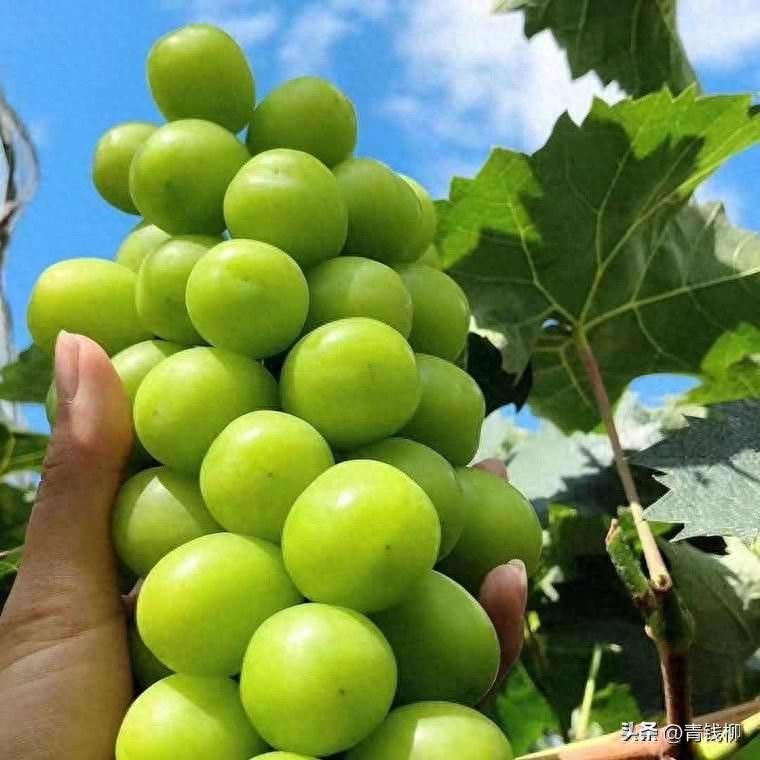
The maturity of the sun rose grapes can be judged by the colour of fruit peels, the hardness of fruit, sugar, etc. Often harvests start when their fruit begins to colour and the sugar is above 18 per cent. The optimal harvest period is usually performed within 7d of the full coloring of the fruit, when the fruit tastes good and has the best quality. Grape harvests shall be full of fruit, full of fruit grains and evenly coloured fruit skins, showing the particular yellow or purple red of the species and smoothing the face of the fruit, free of disease, fibrosis and mechanical damage。









