


Experimental integration of the introduction of new strawberries and efficient cultivation techniques in the cartier area
Gu luenland
Strawberry fruit is beautiful, fragrances are rich in nutrients and marketed mostly on new year's and spring festivals. Strawberry cultivation in the cardinal area of shanghai city has a long history, with a permanent area of approximately 87 hm2 and is an important production and consumption base for fresh strawberry in shanghai city. For a long time, the main plant varieties of the local strawberry production have been more monolithic, dominated by red and zhang ji: despite its high quality and steady production, it is highly resistant to disease and hard to grow; zhang jie is prematured and good in commodities, but the fruits are low in severity and unsustainable. To this end, the carten region has been active in recent years in piloting new varieties of strawberries, which have resulted in the selection of early, high-quality, productive and disease-resistant varieties, effectively optimizing their structure and enriching their variety. A summary of the performance of the six new varieties of strawberries and the associated planting techniques promoted by local seeding is provided below, with a view to facilitating the further dissemination of new varieties and radiation applications。
1 reference to new strawberry varieties in the cartier area
1. 1 evolving
The species was selected by the institute of horticulture of the academy of agricultural sciences of zhejiang province for the medium-premised fruit-type strawberry varieties, which began in mid-december in the carten region, and which was more advanced than the main plant varieties 10-15 d. The fruit is cone-shaped, with red face and bright colours; it is red, small marrow, juicy and juicy, sweet oral sour, soluble solids containing 13. 5% ~ 16. 3%; and it is hard, good commercial, capable of continuous results, with a high proportion of large fruit and a 7% - 10% increase in production compared to red and zangi. The species is slightly more resistant to dusty, asymptomatic diseases, generally more resistant to disease, less harmful to aphids and mites and more environmentally adaptable。
1. 2 jiandhong
The varieties were selected jointly by the institute of horticulture of the zhejiang agricultural academy of sciences and the agricultural technology extension centre of jiandé city, for very early ripening of large fruit strawberry varieties, starting in mid-november in katyn district, and pre-literate in zhang jia from 10 to 15 d. The fruit is cone-shaped, with fresh red light on its face; it is red red, it is soft, it is juicy, it has a soluble solid content of 12. 5% ~ 15. 5% and its quality is unstable in the post-natal period; it is high in hard form, it is good in storage and it is more resistant to white powder and asymptomatic disease. Compared to sang-nam and zhang ji, the plant is easily managed without the need for a leaf-picking and sprouts process to save energy and produce efficiently。
1. 3 christmas red
The species was introduced from the republic of korea and started in mid-november in the carten region for the pre-literated large fruit strawberry varieties. The fruit has a long cone, colours of fresh red to deep red; the fruit orange red, fine and delicate, juicy, co-ordinated with the sour and sweet proportion of the fruit, with 15 per cent of the soluble solids of the fruit in winter, comparable to the red pigment; the fruit has a higher hardness, durable storage, good productivity, and, under the same conditions of cultivation, is much more productive, stable and resistant to grey and dusty diseases, which are also more resistant to red spiders。
1. 4 shin-ye
The species was selected by the institute of trees and trees of the shanghai academy of agricultural sciences, and was pre-cooked for large fruit-type strawberry varieties, which began in late november in the katyn area, with about a week of pre-cooking and a high yield of the first fruit. The fruit is cone-shaped, orange-colored and radiant; the fruit orange is red, with a light scent, a sweet taste, a soluble solid content of 11. 5% ~14. 5%; the fruit is thicker than the tan, but the plant is too strong to make the fruit empty. The species is resistant to powder, low-influenza, medium-pregnant anthrax, and generally more resistant to the disease than to the red。
1. 5 white in kyoto
It was the first of its kind in the country to grow its own early white strawberries, first in the carten region in early december. The fruit is cone-shaped, the flour is white and the fruit is full; the fruit is soft, sour and sweet, with a unique peach or walnut fragrance, with a soluble solid content of 12. 9 ~ 13. 2 %; and is more productive, but yielding slightly less than red and highly sensitive to asymptomatic diseases and red spiders and vulnerable。
1. 6 purple fragrance
The species was selected by the fruit tree institute of the academy of agricultural sciences of jiangsu province for early white strawberry varieties, which began in late november in the carten region. The fruit is cone-shaped, with white-to-micro-powder face; it is white, fine meat, sweet and rich, and has a soluble solid content of 13. 0 per cent ~ 15. 0 per cent; it is very hard, productive and disease-resistant, and it is one of the best integrated varieties of white strawberries in the country today, and it is very popular with consumers。
2 large shed strawberry cultivation technology
2. 1 soil management
2. 1. 1 soil treatment
Strawberry cultivation is preferable to flat terrain, drainage and irrigation facilities, sandy sandy sandy soil or land blocks. During the summer season of july-august each year, the soil needs to be treated for high temperature sterilization. After the strawberry harvest, green maize is grown as green manure; during the summer season, green maize straws are ploughed into the soil with a suitable amount of decomposed organic fertilizer, then water is immersed in plots, with transparent membranes and compacted soil surfaces, closed to large huts for high-temperature shelters, and by mid-august, the membranes and large tectonic membranes were removed and soil treated。
2. 1. 2 ground-based fertilization
Strawberry is fully fertilized during the first half of the month, with 500 kg organic fertilizers per 667 m2 or 200 kg organic inorganic fertilisers or 200 kg compound microbes and 20 kg combined (n∶p∶k = 15% 15% 15% and 15% mass scores), followed by tilling, dredging and construction. 7 whole and 2 half acreages, 40 ~ 50 cm wide, 35 ~ 40 cm high, and the soil on the side and bottom of the ditch will need to be flattened. Two drip-flush belts are laid each。
2. 2 embedded
The grower determines the planting time based on the characteristics of the strawberry species selected and the chromatology of the flowers: the very early breeds were established in early september, while the early varieties, shinyi, purple snow, chimbashi, and christmas red, were established in mid-september, while the medium-preparated varieties were established in late september. The selection of healthy, disease-free and high-quality seedlings to be planted in the middle of the day and in the middle of the day, each 667 m2 plant 6,000 to 7,000 plants, in strict compliance with the principles of “deepness, shallowness and bow to the side of the ditch”. Water will be poured in time for planting and sunnets will be added and removed when seedlings are alive。
2. 3 temperature management
Strawberry strains cover the membranes and shrubs in a timely manner during their growth when the external temperature is below 8 °c; when the night temperature outside the shed is below 5 °c, the two-story membranes are protected. Temperature in the shed is regulated mainly through the opening of the shed doors and the decryption of the membrane, which controls temperatures not exceeding 28°c and the relative humidity of the air not exceeding 60%, and creates, as far as possible, a climate suitable for strawberry growth。
2. 4 flower fruit management
Strawberries retain a primary and a side sprouts and remove excess sprouts in a timely manner, while 5-7 functional leaves are retained during the current period and 10-15 functional leaves are retained during the outcome period, while staggers and old and sick leaves are removed in a timely manner to reduce nutrient consumption. Based on the nature of the strawberry varieties, three to seven fruits are selected for each line, of which shinyuki does not smoke runners throughout the production period and the fruit management chain is less labour-intensive。
2. 5 fertilizer water management
Strawberry pre-growth period is dominated by application of nitrogen fertilizer, which promotes nutrient growth of plants, while the pre-harvest period is dominated by application of phosphorus, potassium fertilizer, which promotes fruit expansion and quality improvement. Before flowering, the application of balanced water solubility 3-5 kg per 667 m2 was followed by drip irrigation ~2-3 times, while the occasional application of leaf face fertilizer was supplemented by trace elements; the application of high potassium water solubility ~5-10 kg per 667 m2 was applied during the harvest period, organic water solubility containing corrosion acid or amino acid ~2-3 kg was pursued ~2-3 times。
2. 6 pest management
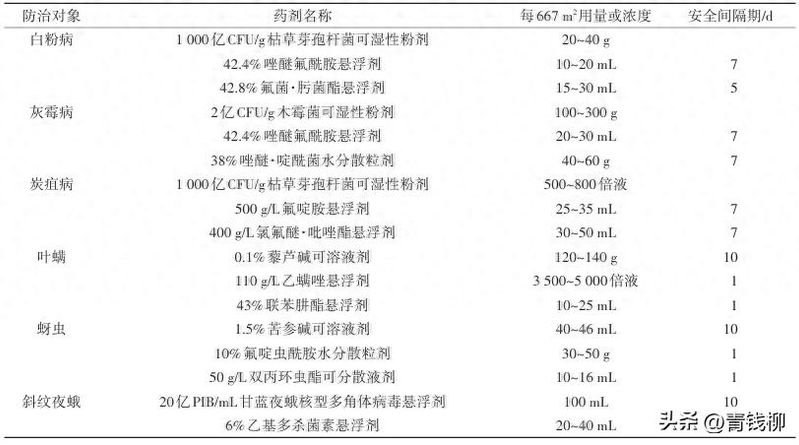
Most common pests produced by strawberries in the carten area are pollinosis, ashilosis, anthrax, falcons, aphids, slashed night moths, etc. Pest management upholds the principle of “preventive and integrated management” and gives priority to strengthening agro-ecological control, using physical, biological and, where necessary, chemical agents. Chemical control involves the replacement of pesticides with different mechanisms of operation, strict adherence to pesticide safety intervals and avoidance of excess labelling of pesticide residues. Specific prevention programmes are shown in table 1。
Table 1
2. 7 collection
Strawberry fruit harvest needs to be determined in combination with maturity, market demand and harvest criteria. The collection is carried out in a light, light and light manner, avoiding damage to the fruits. The harvest is followed by a sorting of packaging according to the coloured area of the fruit, the size of the fruit, maturity, etc。
3 concluding remarks
The carten region has successfully screened a number of high-quality varieties adapted to local climatic characteristics and market needs through the introduction of new strawberry varieties. The present paper highlights the performance of six new varieties, such as the survivors, in terms of sophistication, yield, quality, disease resistance and adaptability, and summarizes a set of basic strawberry cultivation techniques. The planting techniques described in this paper are those for the conventional cultivation of strawberries. Given the differences in the characteristics of different varieties, we will be following up on the study of complementary planting technologies for new varieties, further exploiting the high-quality production potential of new varieties and promoting the high-quality development of the strawberry industry in the carague。









