


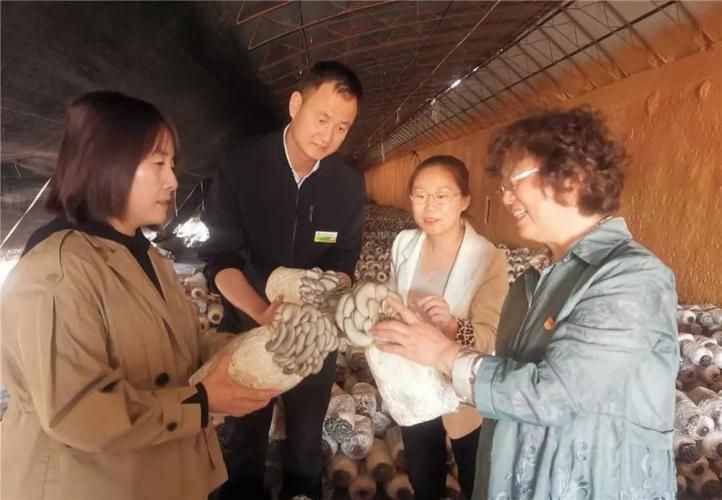
In recent days, journalists have followed the national system of technology for the food industry, the hotte integrated experimental station, and the inner mongolia academy of agropastoral sciences ' team of innovators for the consumption of bacteria, to the wuchuan district of the city of hot. Reactivation of the yuen pingsoo plantation base in the rural areas of the uyugawa district, with a row of greenhouses with a swab ratio. In the sheds, on a well-stamped boulder, a mushroom blooms like a flower, and it grows. Workers are carefully engaged in picking, and happiness goes beyond words。
According to liu wen guo, director-general of the hue and holtmont plantation company ltd., “there are 336 mushroom solar greenhouses, each containing nearly 20,000 mushroom rods, producing more than 6 million rods annually. In order for them to grow smoothly, the sheds are equipped with polyethylene thermometers, air is distributed with automated chowders, and there is also an intelligent photo-heat protection system outside the sheds, and, more importantly, specialists from the food-bacterium team at the agricultural college, who direct the whole process of planting techniques.”
It is understood that, in order to give the mushroom farmers a basic mastery of technology, specialists from the inner mongolia academy of agriculture and livestock regularly go into the farm sheds, patiently conduct technical training and equip them with scientific techniques such as mushroom cultivation and mushroom management, fresh storage and drying。
“no, at this stage, in the critical phase of the mushroom harvest, experts such as sun guoqin and wang haiyan, who have been concerned with the development of the vukawa edible fungi, once again went deep into the mushroom cultivation base, providing on-site technical guidance on the method of coding the mushroom wall, collection of mushrooms, conservation care, green pest control during mushroom periods, etc. To make recommendations on feasibility, inter alia, for the innovation of mushroom-producing models, and to provide valuable advice on science and technology for agricultural and rural industrial revitalization.” zhiqiang, a tech specialist at the renmin pingcong plantation base, said:。
“the technical guidance of the experts has led to a change in our traditional methods of cultivation, where the food-breeding bacteria are of good quality and taste and are well received by consumers everywhere. Today, the little mushrooms of wuchuan county have `flyed' out of the mountains for sale to the regions of shandong, henan, hunan, hebei and beijing. More and more local farmers are involved in the development of the edible industry, and the cultivation of edible bacteria has become an important means for farmers to grow wealth.” li binghua, director of the agricultural and livestock promotion centre of wuchuan county, explained that, at present, it is the mushroom season, with the base producing over 10,000 pounds of mushrooms per day, and the revenue from daily sales has exceeded $40,000. The development of the edible microbacterial industry has led to the employment of more than 100 people and the annual disposable income of farmers engaged in the educative microbacterial industry has reached 40,000 yuan. (reporter, father soo ling)









