


In nairobi, xinhua, kenya, a major agricultural country in africa on 25 november (journalist li zhuang), tomato cultivation is an important part of the country's agriculture, which is widely spread in highlands, valleys and coastal areas, and is mostly open-air for smallholder farmers, vulnerable to weather and pests。
In recent years, kenya's tomato production has been threatened by diseases such as deadness, leaf moths and other pests, which have resulted in a severe reduction in production and the abandonment of tomato production by many growers, affecting farmers ' livelihoods and the nutritional intake of local residents。
To address this problem, which seriously affects the lives and incomes of local farmers, kenya has looked to china. In 2022, the nanjing agricultural university, together with the university of eggton, kenya, introduced and demonstrated the technology for the prevention and control of tomato disease in china and for the marriage of tomatoes to implement the project “enabling rural youth through innovative horticultural solutions in the tomato value chain”, which was funded by the international fund for agricultural development (ifad) in late 2023。
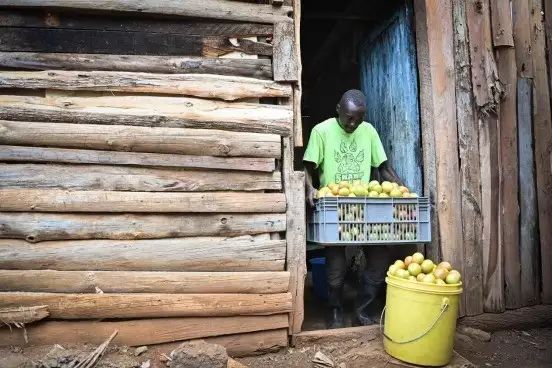
Figure: on 23 october 2024, a farmer in nakuru county, kenya, delivered the harvested bride-to-be tomatoes (sinhua news agency journalist han xue)
On the outskirts of lake naivasha in nakuru, kenya, jonah kalanja owns a farm of about 2 hectares. Since 2008, he has been engaged in tomato cultivation, with little success. He said that there were many risks to unwed tomatoes, including bacterial atrophysics, pest attacks and the destruction of extreme local weather conditions. Moreover, the local market price for such tomatoes is low。
Kalanja was one of the first growers to grow tomatoes using chinese marriage techniques. Not only has he changed the disadvantage of his previous varieties, but production has also increased significantly. He was confident in future gains: “this is the first time that i have grown tomatoes using chinese marriage techniques, and i am very satisfied with its high production.” he also indicated that the price of the new herd could double because of its high quality。
In another experimental farm, mary mwangi's graft tomatoes are flourishing in greenhouses. Mwangi said: “my seed has been harvested three times, with excellent harvests and no need for too many pesticides.” mwanji indicated that, through the training of chinese experts, she had mastered fine crop management techniques and that the number of harvests had increased. “when i took them to the local market, the customers were very willing to buy them at higher prices.” mwangi said。
According to stephen gitengu, an agricultural technologist trained jointly by china, the fruit of a tomato is relatively larger, reaching about one kilogram in five, compared to seven to eight in traditional varieties. According to gitengou, the planting of indoctrination tomatoes is a good way of helping local farmers to harvest. Gitengu added that future plans were to help farmers sell the tomatoes through online platforms。
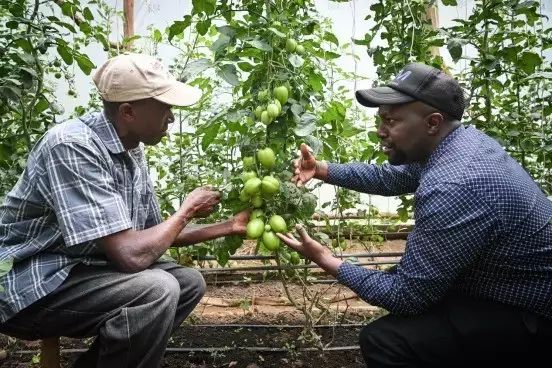
Figure: on 23 october 2024, stephen gitengu (right) agricultural technology expert taught local farmers about tomato cultivation techniques (sinhua journalist han xue)
“china's agricultural technology has helped kenya's tomato growers to increase yields.” joshua ogvino, an expert in horticulture at the university of egton and a foreign director at the confucius college, said that the technology had been able to reduce the incidence of ailments from 90 per cent to less than 10 per cent, and that production had increased from almost zero to 5,000-6,000 kg of acre production, with an additional kshs 100,000 per acre (approximately rmb 5,600). Many local farmers have been trained in greenhouse cultivation and tomato marriage techniques, and the university of egton has established partnerships with agricultural enterprises to supply local farmers with tomato seedlings。
“through the introduction of the tomato graft technology, demonstration-point farmers are now growing tomato seedlings that are relatively resistant to disease and growth, with early, good quality, high yield and at least 50 per cent increase.” liu gao-jong, a non-specialist at nanjing agricultural university, described marriage as a commonly used technical tool in china, which is widely used in the cultivation of guacamole vegetables and fruit trees. Currently, the project has established 15 demonstration sites and conducted more than 10 technical trainings, demonstration roll-outs and more than 1,000 participants。
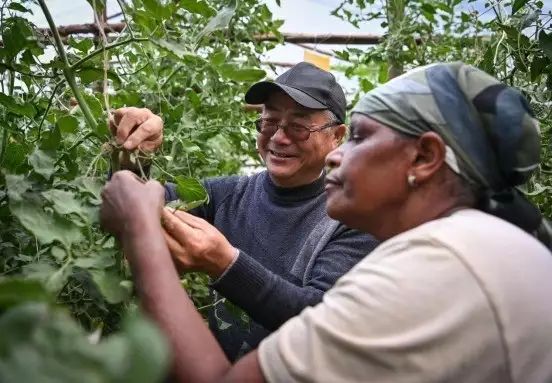
Figure: on 23 october 2024, the nanjing agricultural university assisted the non-specialist liu gao-jong and the local farmer mary mwangi to watch tomato cultivation in the greenhouse shed (sinhua news agency journalist han xue)
According to liu yutao, vice-president of the institute of international education, nanjing university of agriculture, and director of china, confucius college, egton university, kenya, the successful landing of chinese agricultural matrimony technology in the kenyan tomato industry is due mainly to three factors:
One is the transfer of agricultural technology, training of personnel, and model technology diffusion within a more mature south-south cooperation framework. In line with this model, chinese agricultural experts bring to kenya good agricultural technology, management experience and industrial development models to help reduce poverty and benefit farmers in kenya。
Secondly, strong cooperation and organizational guarantees between the two sides have enhanced the efficiency of the project. Cooperation between nanjing agricultural university and the university of eggton began in 1994 with the higher education cooperation programme of the ken government. Over the past 30 years, the two sides have developed a more complete system of innovative and applied skills development and scientific research cooperation, from a joint “one-way” laboratory to an agro-industrial park, a model village for poverty reduction. The academy of agricultural characteristics, established in 2013, serves as a bridge and catalyst for agricultural cooperation between the two sides。
Third, technology transfer, based on demand-side and problem-solving, ensured the success of technology. Kenya's tomato cultivation has been affected by disease for many years, seriously affecting local tomato production and supply. Specialists, as well as agricultural technicians and farmers, are eager to address the problem and actively participate in the roll-out of marriage technology。









