


The most common seeding methods are dry and leaching seedlings, simple dry seeding methods, seedlings that are not susceptible to damage in a hostile environment, but seedlings are slow; leaching seedlings produce seedlings that are fast and small. The pre-sowning seedbeds are soaked with bottom water, the water seeps and a layer of fine soil, soluble the celery seed species into the surface of the cyanide, a venomed fine soil of 0. 5 centimetres thick, the soil is too thick to sow, and the skinted seed is not so wet as to sow. Before seeding, the soil should be wet enough to facilitate seedlings and seedlings. Temperatures are too high during the summer afternoon and seeding should take place after 4 p. M. Or in the dark. When seeded, care is taken to ensure that the soil is humid, and small water is needed to water the soil over the general assembly to prevent it from coming out. It is also necessary to cover the sunnet on the face of the seeding in the autumn and, if the temperature is too high, on the roof。
When seeding occurs, sunscreen measures should be taken to avoid direct sunlight and to prevent rain washing. The practice is to sow and then put bamboo arches on the cheeks, covered with sunnets or straw. If only covering the sunnet is best above 2 floors, the experiment has shown that straw grows faster than the sunnet. When small saplings come out, the sun should be removed in a timely manner, and it should not be wet enough to prevent their growing. When a small seedling grows to one leaf, it is necessary to raise grass once, and when a small seedling is two to three leaves, the surface is kept dry and wet, and the seedlings are ploughed, so that the seedlings grow as closely as possible. In the event of heavy rains, the water is to be removed in time to prevent the death of the seedlings or the seedlings. Celery is wet and should be wet throughout the whole seeding season, usually in the evenings during high-temperature water seasons, with wet soil conditions maintained on the basis of wet soil。

Places can choose the time of planting, depending on local climatic characteristics and the strength of the seedlings. When a 15 to 20 centimetre is tall, with 4 to 6 real leaves and a thick tubing of 0. 5 centimetres, it can be established when soil temperature is appropriate. The distance varies according to variety and local cultivation habits. The average length of the plume is 15 cm x 25 cm, and that of the large plume is 35 cm x 30 cm, specifying the density of the plant according to local climate, soil conditions and cultivation habits. The day before the planting was scheduled to water the nursery, and when the seedlings were raised, they were to dig up, shake off the soil and eliminate the sick and weak. When planting seedlings, the size of the seedlings must be graded, the same size of the seedlings planted together, the depth of which is measured by the depth at which the seedlings enter the soil in which they are grown, and care must be taken not to cover the heart leaves and affect growth。
(c) management measures for pre- and post-suspension after planting. After planting, the soil should be kept wet and watered or drained in a timely manner in order to help slow seedlings. Upon completion of the slow seedlings, water should be controlled and pine soil, weeding, seedlings should be ploughed, root systems should be promoted and the basis should be laid for later growth of the plant. After cramming, the plant is developed and its absorptive capacity is enhanced. The leaves move from open to direct growth, generally known as the heart period. At this time, the outer leaves are no longer growing, the heart leaves are beginning to develop, and the plant is beginning to go into a fertile period, during which special attention is to be paid to watering and water supply, while nitrogen and potassium fertilizer are being pursued in order to promote the growth of the heart leaf and the growing of the plant, which is a key component in increasing production. So, immediately after the scavenger, fast-activated nitrogen fertilizer can be followed, as well as nitrogen fat and corroded organic fertilizer. For the first time, 20 kg of urea per acre, and for the second time in about 10 days, water can be poured into about 900 kg of human urine per acre, and in another half month urea can be applied again. During the pursuit of fertilizers, the weather is watered in a timely manner and the soil is often wet. In addition to nitrogen application, phosphorus and potassium fertilizer should be increased in the mid-term later period. In addition, attention should be paid to the availability of calcium and boron。
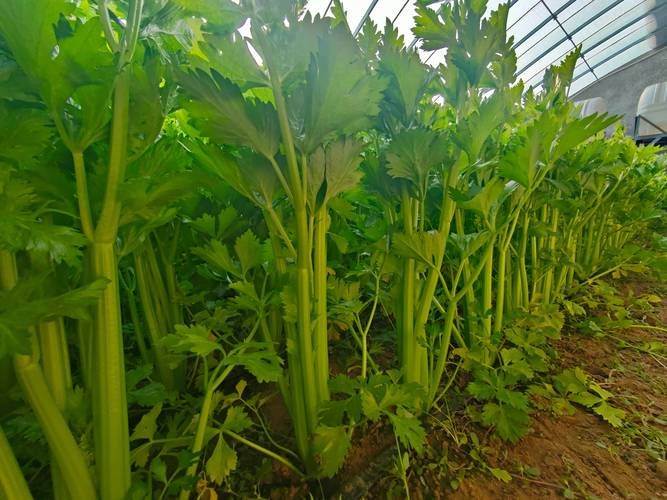
In order to promote the growth of celery, it is available early to market, and pre-harvest leaves can be sprayed with cactin (920)。









