


The rural communities that grow vegetables are aware that peas are the most seasonally priced vegetables in autumn and winter. It is cold-resistant, it does not pick up plots, it grows fast, and it is full of treasures. Precious peas are pure wild vegetables, which are freshly cooked and fragranced with soup; green peas are so juicy that they are home-grown; ripe peas can cook congee, grind powder, make groceries, grow at once, harvest more and save money。
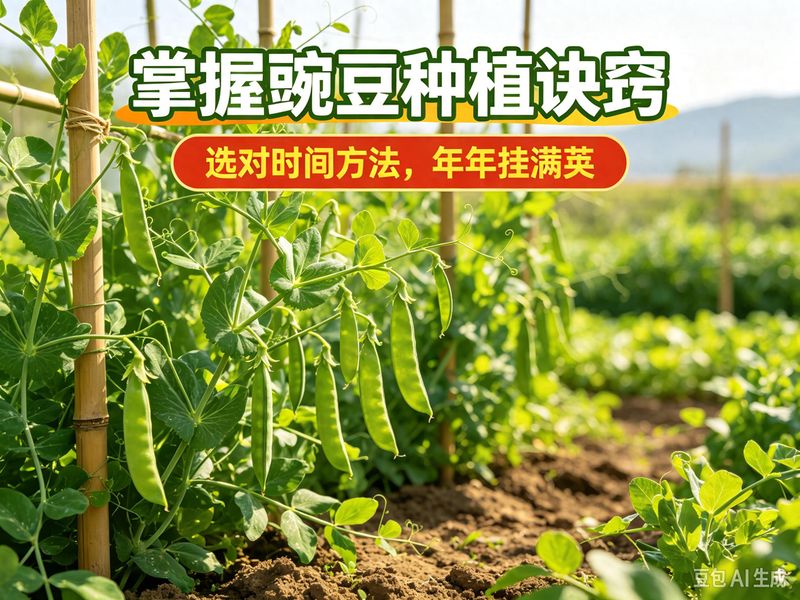
However, many farmers have problems with peas, either planting at the wrong time, with thin seedlings, freezing and freezing, or with poor management methods, with long vines, long leaves, few husks, empty shells and very low production throughout the season. In fact, peas are not a hard crop to grow, but they are easy enough to harvest if they catch the time to plant and eat their way through。
One, we're gonna have to wait for the planting time! We're gonna lose the morning and evening
Many people grow peas with reduced yields, no seedlings, no stubbles, and the greatest mistake is to plant them at random. Peas are cold-resistant autumn and winter crops. Temperature control is essential. They are grown early in the form of high-temperature scavengers, long-lived and cold-freeze injuries, which directly affect annual production。
We farmers don't have to remember complex gas-conservation formulas, remember the time frame of gold planting that is common in the north and the south, so simple to remember and try。
Northern areas (henan, shandong, hebei, shanxi, shaanxi, etc.): best seeding after white exposure to fall, that is, from late september to early october each year. It is a time when the temperature is cool, it is warm, the seeds are the fastest-growing, the roots are stable, they grow strong before winter, they don't freeze, and they rise in spring to climb fast。
Southern areas (jangsu, anhui, sichuan, hunan, hubei, two broad areas, etc.): best planted in early october and early november. The southern autumn is slow, too early to sow high temperatures, and peas are prone to long, rotten roots, disease, later seeding and are more stable and resistant。
It's the old farmer's focus
1. The planting of seeds in the summer and early autumn is strictly prohibited. At temperatures of more than 25 degrees, pea seeds are extremely suffocated and unscathed, and even if they are produced, they are thin and weak and largely unscathed。
2. Stop planting at low temperatures after winter. At temperatures of less than 5 degrees, seeds do not sprout, even if they survive in winter, with a difference in the years ahead, a small number of condensers, and a significant reduction in yields。
3. The balconies are planted with peas that can be sown with an appropriate delay of 5 to 10 days, and the balconies are warmer than open areas to avoid high temperatures。
As long as precision cards allow the planting time and no extra effort is made to manage it, peas come out of full and deep and their resistance to the disease is doubled。
Ii. There's a lot of ground to choose, and it's so fat and it's so big and it's not bad
Peas have shallow roots, are afraid of flooding and are less demanding on plots, but this is a step that cannot be spared if production is to be high. Many of the country's villages are directly covered with seeds, soil sheeting and water-strangling, resulting in mixed seedlings and small seedlings growing thinly。
1. Land selection
Land with a high surface and no water source is given priority for an aerobic, high ground. Low-lying, wet and chronically watered vegetable fields are uncultivable, and peas are the most afraid of flooding, and the three days of water are the worst。
Ordinary vegetable gardens and drylands are grown, resistant to infertileness and soil-free. A small amount of decayed land can be planted from ordinary gardens, with no need for expensive nutrients, and with little money。
2. Step of physical exercise
The first step is to clean up the grass, the roots, the rocks, and avoid the weeds fighting for nutrients and covering the light。
Step two: deep tilling, deep tilling about 20 centimetres deep enough to break the plate. The more the soil is looser, the less resistance the seed will have, the deeper the roots。
Step three: open the ditch. Vegetable gardening must be small and 10 centimeters high, with ease of drainage and waterproofing, and with a view to eliminating rain-fed roots, which is the key detail of the high production of peas。
Small practical techniques
A small amount of fertilized farmers can be used as base fat for the whole area, without fertilizer or heavy fat. The bottom is full of fine fats, peas are stable in the front, they are unburned, they are fast-crawling and they have more than ten times more fat than they are。
Iii. Seed treatment trick, strong and strong to stop the weak
A lot of people grow peas that are thin and poorly grown, and that's seeds that aren't treated. Dryseeds go down directly and are affected by soil moisture, temperature, lynching at varying speeds and mixed seedlings。
Old farmers use their own zero-cost seed treatment methods, and beginners look at them and yield rates close to 100 per cent。
1. Speculation: seeds are screened before seed is planted, all bad seeds that are dry, moldy, infested and broken are removed, and only full of fresh and high-quality seeds are left to feed from their roots。
Breathing: baptizing seeds with constant temperature 6-8 hours, so that dried seeds absorb water and awaken activity。
3 leaching seed: a well-boiled seed extracts the leached moisture and lays it for half a day in a cold ventilated place where the seed is soaked with little white。
Hole avoidance alarm
It is important not to warm water, not to impregnate, and to grow in a family without complex operations, so simple water is enough. Drumbs should not be excessive, so long as they are too long to break them off, affecting seedlings。
Simplely treated seeds, which are fast-growing and uniform, do not produce small and small, weak, rigid seedlings, the whole vegetable field is well-developed, and the post-term shelving period is uniform and more readily harvested。
Iv. The correct seeding method, deep shallowness and rational insulation, with many saplings
The seeding is shallow and dense and directly determines the late production of peas. It is too deep, it is not seeded; it is too shallow, it is drought-resistant, it is prone to fall; it is too ventilated, it competes for nutrients, it only grows long。
Depth of seeding
Peas seed depths 3-4 centimetres are the most appropriate。
The sand is soothed that it can be a little deeper, the clay sheet is a little bit shallow and adapted to local conditions。
2. Cultivation intensity
Family gardens are the best broadcast, 30 centimetres in line and about 10 centimetres in length。
It is sufficient to place two to three seeds in each den, which are not too dense, overdensity, congested, unventilated, ill-lighted, severely flowered and thinned。
3. Seeding process
Open shallow trenches, spread evenly, covered with thin soil, and light pressure on the soil to avoid the suspension of seeds. Once seeding has been completed, water is poured into the roots once, so that the soil is humid。
V. Precise management of seeding seasons, control of saplings and laying the groundwork for the filling of the herds
The management of the nursery period after the seedling of peas is central to high yields. Many farmers have been left to grow mad, with small vines, few branches, few flowers, and few garbs。
One, water control
Shrimp seasons are most reluctant to be watered, and soil is dry rather than wet. The water is too watery, the vines are growing fast, the tubing is weak, and the later stages are prone to fall back and do not bloom. Appropriate dry seedlings, more developed roots, thicker branches
2. Small seedlings
Small saplings grow up to 5-8 cm and time sap. Pulling out weak, congested, ill seedlings, retaining strong seedlings and leaving space for each seedling to grow. Vacant plots are filled in time to ensure that the whole vegetable field is saturated。
3. Weeding pine
Weeds grow at a fast pace, with timely artificial weeding, while the pine soil is cultivated on a shallow basis. The soil is abated, the roots are well-respirated, the seedlings are strong and resistance to disease is significantly increased。
Save your money
The whole journey is free of herbicides, pesticides, artificial weeding is safe and green, peas are grown free of residues, home food is safe and sales are better。
Vi. Strengthening correct + those those puts of a digital flass hang up
Peas are reptile crops that are untidy, untidy, growing on the ground with vines and vines, with poor ventilation and light, are prone to impurity and disease, have severe flowers and cut production directly by half。
This step is an obligatory two-minute operation to double production。
One, a chicken
The peas grow to about 20 centimetres, and when they start scrawling the silk, they are mounted in time. With poles, branches and straws, they can be placed next to the plant, so that the vines can climb。
Vegetable vines are growing up with good ventilation, very few diseases, a significant increase in the number of flowering garbs, and soybeans are clean and clean and excellent。
Two, top of the whole branch
The main vine grows to 30 centimetres, strangling the top buds and promoting the side branches. The more bean-side branches, the more flowering, the smaller the main vines, the more productive they are。
In the later stages, the surplus, empty branches and long branches are cut off in time to reduce nutrient consumption, to concentrate on the provision of twigs, and to grow larger, more full and less empty。
Vii. Water management technology, future and efficient
Peas are infertile, but scientific fattening is essential if they are to be packed with tungstens. Fatty is a core principle。
1 shrimp period
It is not necessary to apply fertilizers frequently during the period, and the bottom is sufficient to avoid excessive nitrogen fattening which leads to a mental illness。
2. Pre-flower period
Refill fresh water before flowering, supplement nutrients, promote thawing and double the number of flowers。
3. The bonfire
Small amounts of fatting, hard watering, soil moisture, avoidance of drought, rapid expansion of the soybeans, full granules and dry empty shells are used during the gusts。
The focus of the pit
High concentrations of nitrogen fertilizer are prohibited throughout the process, and excess nitrogen fattening with long leaves without flowers and plasters is the greatest area of error in the reduction of peas。
Viii. Simple pest control, green tube protection, no drug residue
Peas are extremely resistant and one of the least ill and infested vegetables, and family cultivation is almost free of drugs。
As long as there is ventilation in the kitchen, there is no water, there is no dense planting, and there is little disease in the worm. A small number of aphids and foliages are occasionally present, so that they can be removed manually, without pesticides and in green health。
In comparison to vegetables such as cabbage, cabbage and peppers, the peas tube is less powerful and can be easily handled by the new zero basic farmer and zone planner。
Ix. Receiving in time, those holding and excuse the receiving period
Peas pick time is controlled and can collect more and more。
Precipice picks: bean bean is full, colour is green, seed is taken in a timely manner when the seed is not hardened, the earlier the harvest is taken, the more branches follow。
Peast picks: 15 cm high can suffocate, stifling followed by a sharp rise in branches and continuous pick-up。
Do not wait for an ageing bean to be harvested, consume large amounts of nutrients, affect subsequent flowering and reduce harvest cycles。
Cultivation summary + pass-through
In order to have a high yield of peas, the core is four points: the timing of planting, the decomposition of the soil, the twigs on the frame, and thin and wet water. As long as we avoid the three faults of growing up, gathering water and planting, families can grow high-yield peas full of vines and soybeans。
I'll give you an old farmer's hand-in-hand
The peas were caught in the autumn, and they were aired on a shallow basis
It's so fat
Learn how to grow peas, buy no money for farming, manage no troubles, make peas easy to pick, fresh and healthy
Disclaimer
All of the peas in this paper have been grown in time, practice, and care techniques, all of which have been in the hands of civilian farmers for many years, and have not been accompanied, marketed or promoted. The climate, soil environment and planting patterns vary between the north and the south, and the effects of cultivation vary from person to person. The content of this paper is used only as a reference for the three farming techniques and not as a basis for standardized cultivation。









