


In rural gardening, there is a lot of work going onBitter melonIt's an essential time vegetable for summer. The heat-resilient heat, low planting thresholds and good therapeutic food are available, market sales are stable year by year, and many farmers leave plots for exclusive planting every year。
However, many vegetable farmers share a common problem, with bitter vines crawling on the ground, and the layering of leaves is seen to be particularly strong, and few of them are hanging. Even if a few female flowers are barely available, they are susceptible to ablaze and fall, and the remaining bitter melons are curved and deformed, making it difficult to sell。
There is an old perception among most ordinary farmers that bitter vines grow at will and that they are born to climb crops without cutting. The harvest has been severely compromised by a season of water-fed fertilizers waiting for a melon。
In fact, the core secret of bitterness is the sorting of branches. The old saying is that the bitter ones don't make it. Today, with the experience of home-grown farmers, the whole production has steadily increased, as a result of a clear increase in the number of female flowers and the steady increase in overall production。
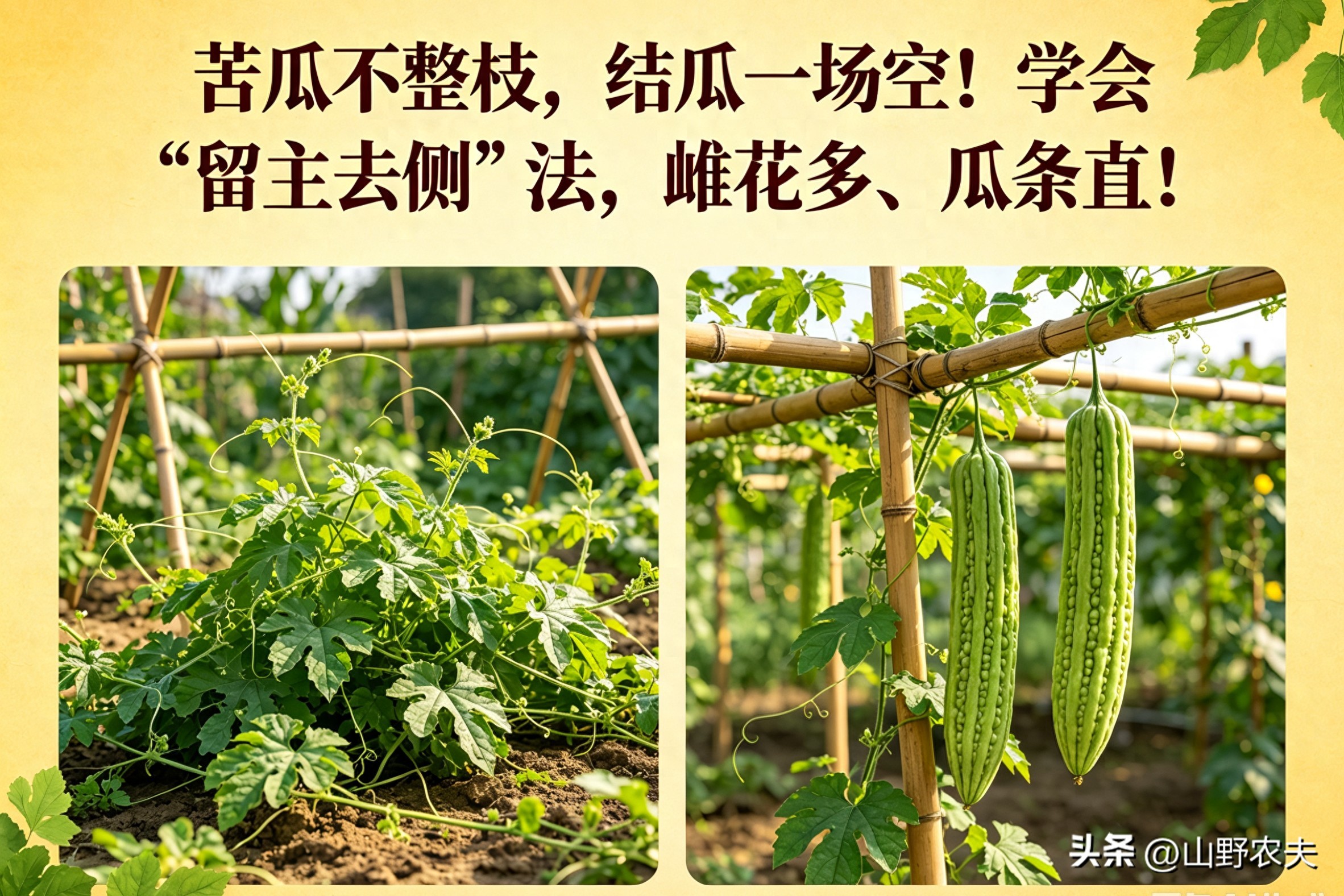
I. Analysis of the underlying causes of bitter melons without melons
First, the root causes of the problem can be understood in order to understand the importance of the whole cut. When bitter beads are born with great capacity, and when the temperature is adequate for water fattening, a new branch emerges at all points of the vine。
If the whole process is left unattended, the main chicken, the first chicken, the multiple branches of the branch have gone crazy. Most of the nutrients are constantly growing, and the longer the vines grow, the greater the nutrient consumption. There are few nutrients left to separate the buds and give birth to the females。
There are also problems associated with too thick a leaf. The leaves are entangled around each other, with poor internal ventilation and a high humidity of vegetable gardens. High-temperature, high-humid environments are highly prone to outbreaks of pollinosis, frost, while aphids and guacamole pests are found. Vegetable worms, even when they produce female flowers, are difficult to keep steadily。
In addition to this, the branches are disorderly and the nutrients are distributed among the various sectors. Even if they are barely able to grow, the nutrient transmission is uneven and the growth stress is uneven, with the rate of bending and deforming at a later stage. There is no advantage in selling products on the market because they are substandard and have a bad taste in their own food。
In order to break the maggot of ivy, it is necessary to move away from the loose management model, to use the technique of maintaining the masters, to distribute the nutrients rationally, and to concentrate on the fruits of the flowers。
Second, understand the basic logic of leaving the master behind
The hard work is done without complexity, and the core logic is to keep the backbone and streamline the side branches. The main chicken is the main channel for the delivery of bitter melon nutrients. The roots absorb water fat, giving priority to the growth of the chicken and the division of female species。
The excess, premature sprouting, is all for large nutrient-consumption households. The previous period had not yet reached the end of the outcome period, with a large number of side buds growing wildly, diverting primary nutrients and delaying overall flowering。
It is simple to understand: in the early stages, all efforts are made to preserve the main chicken formation, and in the medium-term and later stages, a small number of strong branches are retained selectively, while the remaining weak branches, long branches and low buds are cleaned up in time。
This methodology is suitable for all growing grounds in open vegetable gardens, small courtyard fences and sheds, and is simple to understand, so that older and middle-aged farmers can take a step in comparison and do not use specialized planting techniques。
Iii. Phased exercise and full trimping of the bitter melon
1. Elimination of all low-side sprouts
The bitter vines climb up and grow up along the poles and fences, the main chickens are below a metre, and all the blisters from the roots of the leaves appear and are removed at the first opportunity。
Near the bottom branches of the ground, not only consume nutrients but also have easy access to soil. In the rain, water splatters the fungus, increases the probability of leaf decay and attracts underground pests to eat the root roots of vines. The early cleaning of low-level sprouts and the concentration of nutrients have led to the upward extension of the main chicken and the construction of a solid skeleton。
Two. Upstairs
When the main chicken climbs to the top of the shelf, the overall height reaches about 2 metres, and the top is slowly squeezed depending on the size of the species. The reduction of the limitless wavelength at the top has forced a return flow of nutrients, leading to more high-quality female division at the upper middle and middle nodes。
Many farmers have been driven up by their master chickens, with new roofs on the top, and it is difficult for the next vine to sit in a melon. Moderate control of the turbo top is a crucial step for later melons。
3. Selective dichotomy between the medium and lateral sides and strict enforcement of the retentionist side
After the main chickens have been formed, and the flowers have grown, the side branches are removed without a single cut, and trade-off techniques are used。
The upper part of the main chicken, with a small, large and balanced branch, may be preserved to assist in the subsequent batching of the melon。
Weak, inward entanglement, overlapping, invalid chickens, trim in time. There are also long branches with long leaves that do not bloom, which are firmly cleaned up to avoid the consumption of water and fat。
Remember one simple rule: the bottom branch is removed, the central branch is clear in time and the strong branch is small。
Iv. Optimal timing of the whole trim and avoidance of operational errors
A number of farmers are at risk of cutting at random, with early morning dew or late evenings in the rain。
Suffering vines are exposed to humidity, are susceptible to fungus infection, have chicken ailments, late-stage fracturing gums, and a long and fast decay。
The trim was preferred to operate in the morning of the sun, with adequate ventilation and rapid wind drying of the wounds, reducing the probability of invasion。
In addition, high temperatures minimize large areas of cut-off during the afternoon, and heavy sunlight can burn fresh cuts, affecting the normal strength of vines。
V. Multiplication of productivity gains in conjunction with the management of the whole branch of hydrofertilizer
It is far from enough to rely on a twig alone, with the rhythm of water fertilizers in place, with more female flowers and symmetrical spasms。
For the precipice stage, it is possible to use a small amount of balanced fertilizer to grow a strong chicken. By the time we enter the flowering season, we will reduce the amount of nitrogen fertilizer。
Nitrous fertilizer is the most likely source of growth and disruption of nutritional distribution. The flowers focus on supplementing phosphorous potassium fattening, stimulating sprouts, increasing the proportion of females and reducing the incidence of falling flowers。
The stairwelling of the cucumbers begins to expand, increasing the supply of potassium fertilizer, promoting the smooth growth of the fruit and reducing the deformity of the bending melon. Watering is based on the drying principle, with the soil kept moist and it is forbidden to flood。
In the rainy season, vegetable gardens are drained early and the fields are free of water to prevent strangulation. The roots are strong, the whole absorbent, and the trimmed vines continue to produce melon fruit。
Vi. Auxiliary management techniques to reduce deformity
Many farmers are fully in position to perform their fertilization, and there are still a lot of bends, which are very much related to pollination and the environment。
One of the main causes of malformations is rainy summers, a decline in the activity of bees and inadequate natural pollination。
It is easy to shake vines and vines in the morning to pollinate them and to improve the melon quality. In the meantime, the deformation of small flowers and small, weak and small guacamole is being eliminated in a timely manner, and the nutrients are concentrated in healthy guacamole。
The direction of vines and vines is regularly organized, with no entanglement of the knots, ensuring that each branch is luminous, that the fruit is luminous and that the form of growth is naturally organized。
Early prevention of pests and diseases, and preservation of the melon cycle
As a result of the trimination of the bitter melon leaves, the ventilation conditions in the fields have improved and the pests and diseases have been reduced significantly. But the heat and rain of the summer still require early protection。
Daily and timely cleaning of tribal weeds in vegetable gardens and destruction of the breeding environment for feroccal disease. A small number of sick leaves were found to be removed at first instance, and widespread outbreaks of low-toxant compliance were selected for preventive treatment。
The vines remain healthy, the melon cycle can be continuously lengthened, and they can be collected in batches throughout the summer and the farmers ' income cycle extended。
It seems to be a simple whole step when it comes to seven-minute management, but it is a high priority for the poor. To abandon the old practice of coarse planting, to use simple methods to keep the owner in place, to complement water fertilizers and disease protection, and to make it possible for ordinary farmers, without complex costs, to fill up their vines with melons, liners and straight products, with a steady increase in the harvest。









