


How can these three challenges be solved by keeping up the country's mountainous areas, with limited income from growing food, with no money to buy seedlings, no skills, no fruit sales
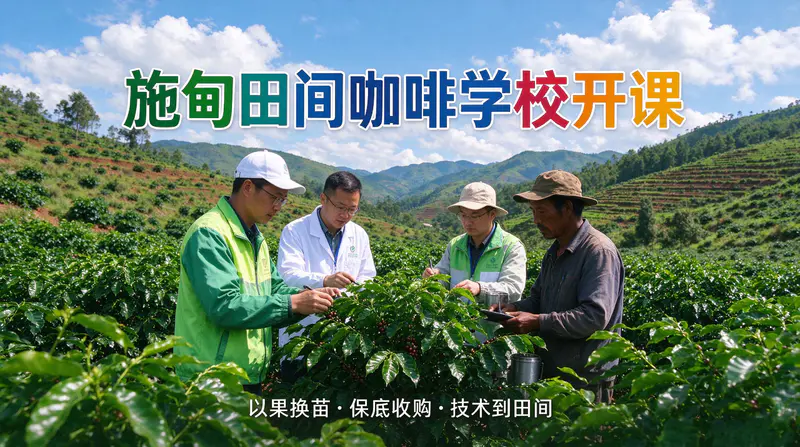
The first coffee field school in yunnan, located in the pointy hill village of the stygian tribe, moved the classroom directly to the coffee park, especially for mountain farmersSpecialized cultivationPractical difficulties encountered。
Many villagers live in the mountains, with idle slopes in their hands. Food crops, such as maize, are grown year after year and are invested in much less fertilizer, less labour, and less than a year after year. Many people wanted to try a specialty planting, but it was difficult to cross the three tracks。
First, there is a high pressure on previous inputs. Specialty seedlings are expensive to buy, and mountain management itself is laborious. In the event of a poor later harvest, ordinary farmers would not be able to easily try new projects in the run-up。
Secondly, cultivation techniques cannot keep pace. There is a common tradition of traditional farming, with commercial crops such as coffee, slope planting, branch cutting and pest control. It's easy to break the tree seedlings if they're not taught by their own hands。
Thirdly, the greatest concern is the unstable market. Even if it's hard to grow, the market is volatile, buyers are under pressure, no buyers are found, hard-earned fruit is thrown into their hands and a year is wasted。
The local faccan coffee estate, with a 700-acre coffee base, has launched a full-fledged support programme to address the three main points of funding, technology and marketing。
The first is the introduction of a fruit-for-plant model. Farmers do not have to pay for coffee to grow seedlings in advance, and when coffee trees are harvested, they use their own coffeefruits directly to credit the seedlings, significantly lowering the threshold for entry。
The second is the acquisition of fresh nuts. The estate is committed to the recovery of coffee fruits produced by farmers, who do not have to worry about selling them at low prices, even if market conditions fall。
Third is field teaching. There are no closed classrooms, technicians are crouched under a coffee tree to provide practical instruction at the scene, and tree seedlings are planted, slopes are grounded, green insects are protected, day-to-day care is provided, and fresh fruit picking standards are fully demonstrated on site. Farmers have problems with their own plots and technicians are also able to come to the door to guide them。
Four is land block back-care + close to work. Farmers can contract the estate plot to take care of them; during the booming coffee harvest, the estate will release a number of temporary jobs and villagers will be paid for their work in front of their homes. In one industry, a large amount of income is available for care, work and sales of fresh fruit。
Many people think that it is not true that coffee is grown in the mountains, that trees are planted in the soil, that water is poured and fertilized on time, and that it is not necessary to grow blindly and in the wind, that post-care is not up to date, that it is low-yielding and of poor quality, and that it is difficult to reap the benefits of working for years。
Many people think that as long as firms commit to bottom purchases, whether they are good or bad, they can settle them at a guaranteed price, but they are not; rather than relax field management, pests and picks at the wrong time will reduce the quality of the fruit, and the quality of the product will be compromised。
It is not true that many people think that the development of special cash crops will make money soon after they are planted; rather, the idea of short-term rapid enrichment should be avoided. Coffee is a multi-year crop that needs constant care after planting and patiently waits for the pick-up cycle。
If mountain farmers intend to experiment with similar niche farming projects, reference can be made to these land landings。
First, priority should be given to the ownership of an entity's planting base and to the acquisition of a partner whose promise can be honoured. Take time to take a look at the current situation at the base and not listen to verbal propaganda, avoiding projects with only verbal commitments and no physical base and reducing their own risks。
Second, active participation in on-site practical training, rather than traditional field experience. Mountain coffee fertilizer management, branch cutting, disease prevention, peaceful food crops vary widely, field learning is easier to acquire practical skills。
Thirdly, the family income structure is planned in advance. The coffee tree seedlings are not expected to produce results in the current year, and in the years after they are due, they can be subsidized for household use by close workers and do not wish to place their entire income on new planting projects。
Brother zhou is one of the farmers involved in the project. His family had four acres of slopes and had been growing maize in previous years and had been busy for a year, removing expenses and earning little. He had been trying to find a suitable industry, but had been afraid to do so for a long time when he thought it would cost money to buy a seedling without knowing how to protect his coffee。
It was reported that the estate had introduced fruit in exchange for seedlings, that field schools were free of charge teaching techniques, and that fresh fruit bottoms had been recycled, and that he had signed up for practical training at the first time. In general, technicians learn to trim, prevent disease and learn the criteria for picking fresh fruit, and when they are free, they work in the estate to earn money. By the time the coffee tree is hanging, the fresh fruit extracted is sold directly to the estate without having to go around the market to find buyers. Brother zhou said that the most reassuring thing was to buy a seedling without paying for it in the previous period。
There were also villagers who were initially cautious and feared that promises would not be honoured. Several sessions of hands-on training in the field were held, and he saw the model coffee forest grow well, with the participation of farmers, slowly putting aside his concerns and trying to live up to his family's idle slopes。
In general, the schtien field school mix is based on a pattern of crop-for-plant and bottom-buying that focuses on addressing the three main challenges of poor finance, skills and stable marketing for mountain farmers. The transfer of technical classes to the field, the use of fresh fruit to offset seed costs, and the targeting of fresh fruit purchase channels, where farmers can both learn to grow and increase their income。
Mountain development is characterized by high risk to farmers alone. Projects that provide stable technical support and cover-the-shelf services are needed to reassure the population. Do you think this model of cooperation in exchange for seedlings is suitable for promotion in mountain regions? You are welcome to share your views in the comment area。









