


“returning to green” means “returning to green” when more than half of the wheat seeding leaves (a leaf born in the spring) grow up to 1 to 2 cm. From the beginning of the return to youth to the beginning of life, it lasts for about a month and falls into the last stage of the shrunk period and is described as "WheatRe-youth”. The period of growth was dominated by roots, long leaves and twilight, and the return of wheat to youth was also a critical period for upgrading late and weak seedlings, controlling the growth of the bong, regulating the size of the group and determining the rate of growth。
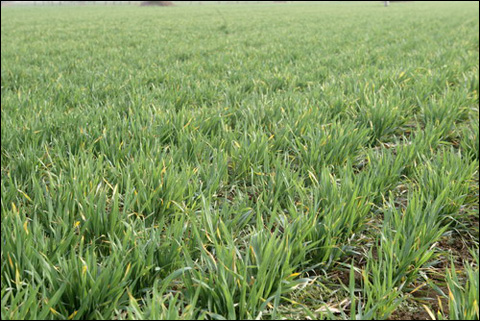
The main measures for wheat return management are:
(i) ploughing of the pine earth: this is an important measure to promote the early recovery of seedlings and their healthy growth. The decomposition of topsoil has improved the aerobic conditions of the soil, increasing the temperature of the soil and promoting the growth of the roots. Cuts of the catheters have prevented a rise in the moisture of the lower soil and served as a safeguard. In addition, croquettes promote soil micro-organisms and contribute to the release of soluble nutrients. The number of rowings of pines is usually two or three times from the point of return to the point of return, and the depth of the pine should deepen first and then later. In the high-yielding fields, makoto is in danger of falling, and a deep tillage must take place before and after his rise。
(ii) fertilizer recovery: the return of fertilizer is driven by seedling. For wheat seedlings of 2-3 species, which are relatively weak in pre-winter strength or which are less powerful in the ground, and which have been defertilized by long-timers, they should be applied early and re-fertilized, and can be followed up when freezing begins on the surface (on top). In general, about 20 kg of ammonium carbonate per acre can be traced, and approximately 15 kg of calcium phosphate per acre should be pursued in combination with phosphorus fields. The best conditioned ammonium phosphate is 1015 kg per acre. The return of chromosomes has an important role to play in boosting the growth of wheat seedlings and increasing the number of acres. But for a group that has a larger number of seedlings, or for a crop that is fertilized and unfertilized, it is not fertilized. Follow-up should be postponed until the time of arrival in order to control the ineffectual fractions, with the aim of increasing the fractionation rate and the acre count。
(iii) decrypt: the wheat covered in winter must be emptied in due course upon return to the youth so as to increase the temperature and promote the growth of the roots. To prevent the fallout, the clean-up should be done in two stages. For the first time, about a week after his return; for the second time, around a half month after his return, the earth will be completely cleared (but it will not be able to reveal itself). Low-lying areas with high soil moisture should be strictly controlled before the soil is emptied; dryer wheat fields may be appropriately delayed to prevent freezing。
(iv) rewater: when will it be well? It depends on the place and the flexibility. Where winter is not served by winter or when it is done early, and when it returns to the ground, it is dryer (less than 3 cm in the earth), the water may be duly irrigated early, but it should not be too large, much less so. As a result of the early return of green water to the wheat fields, the lower soils are not fully frozen, the water is prone to the accumulation of water roots, the failure to produce new roots, the delayed development and the emergence of “small” seedlings, the heavy ones at risk of death. When winter is right, the seedlings grow strong wheat fields, and when the evening is better, it should also be watered later, so as not to reduce the temperature and affect the return. When the winter water is watered late and when it returns to the ground, it can be postponed until it is ready to water and fatten. The exact time of re-irrigation is mid-march in the southern wheat sector and mid-march in the northern wheat sector in the normal year。
(v) chemical weeding: weeding in wheat fields is low-use and cost-effective. Herbicides and application methods are currently commonly used: 40-50 grams per acre for 72 per cent 2,4-d butile and 15-20 kg per acre for 15-20 kg; 200-250 grams per acre for 20 per cent of acreic acid. The normal spray time is until the end of the period, with clear weather, no wind, no exposure and better spray at higher temperatures。
Extension:
The soil
墒, which refers to soil moisture. (c) splendid, referring to soil moisture. Soil moisture is the dry humidity of the soil, i. E. The actual water content of the soil, which can be expressed as a percentage of dry soil weight: the soil content = water weight/dry soil weight x 100 per cent. The water content of the soil can also be expressed as a percentage of the water held in the field or as a percentage of the water content relative to saturated water。
Soil water is the main source of moisture absorption for plants (except hydroponic plants), and plants can directly absorb a small amount of moisture that falls on leaves. The main source of soil water is precipitation and irrigation water, and it is involved in the large hydrological cycle of the rock-biosphere-atmosphere-circle。









