


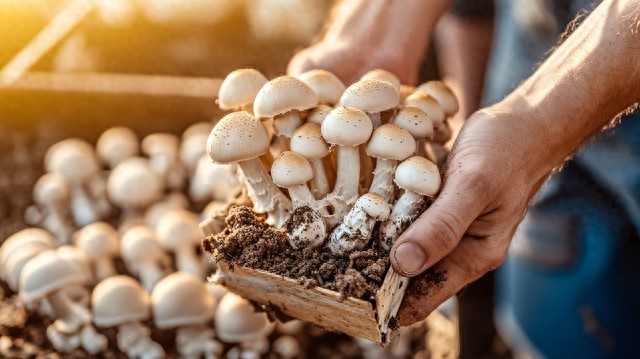
Neighbors were in the neighborhood a few weeks agoCorn coreEveryone who passes by thinks he's going to use it for firewood. It's funny to say that the gas is cheap and can't burn with corn cores. It's not much to explain. It's just that corn cores are put in buckets and in plastic boxes. Almost two weeks later, a gray white came out of the crack of the boxHibsThe little bacterium caps were crowded together and the passing neighbours were all around to watch the fun. Chou said he was the first one to buy a fungus pack and plant mushrooms, and then he figured out how to use abandoned corn coresCultivationIf you don't have to pay for a finished bacterium bag, you can use the rest of your corn cores in the autumn. Many first respond that it is very difficult to grow without ready-to-use kits, and that the practice will find that small-scale family cultivation is fully feasible as long as the key points of feedstock treatment, vaccination and wetting are done. But here's an easy pit: when you first tried the corn cores, you flushed them with simple water, there was a large amount of green fungus in the box, and a mushroom was not grown, and all of it fell down, which was the main reason for many of the newcomers' failure. The following is a step-by-step description of the complete family operating process, pit avoidance points and harvest management of corn core mushrooms。
The basic premise is that this simple family method gives priority to the cultivation of mushrooms, which are highly adaptable to the corn core matrix and are relatively resilient, and does not mean that all mushrooms can use the process. It's also important to distinguish between "no finished bacterium packs" and "no need."Bacteria; the finished bacterium pack is a product that has been vaccinated and made fungi, and we need to buy a single fungus seed (packed planting) and raw materials using their own corn cores to save the cost of the prefabricated bacterium bag. Many people see the title wrongly why mushrooms grow without material, the natural mushroom spores are too random, the air spores are almost impossible to harvest in a family environment and artificial bacteria must be used。
Step 1: pre-selection and pre-treatment of maize cores
Corn cores are first collected and cannot be worn, darkened and decayed. After the harvest of maize, the remaining cores of maize grains were stripped and completely dried up in a ventilated, sunshield position. Wet corn cores are easily fungible and can be tanned and shredded。
In the absence of large shredders, two viable programmes are available:
1. Small-scale domestic shredder shredding of particles approximately 1-2 cm
2. The hammer is broken in a thick plastic bag and is not powdered. Powder-like corn cores are poorly ventilated, and the fungus lack oxygen。
Crushed and removed visible moldy hard pieces and corn leaves. The maize core itself is sufficient in carbon, but the nitrogen content is low, and the home simple formulation can add a small amount of corn paste (0. 5 pounds of corn paste per 10 pounds of corn core particles, not more) to supplement nutrients, and too many corn paste can significantly increase the probability of bacteria contamination。
This is followed by impregnation and sterilization/sterilisation, which is the key point of the first failure of the week。
Simple water washing does not have the effect of inhibiting the fungus, and there are two operational treatment pathways in the family environment。
Path a (high-temperature evaporation, lowest pollution rate, recommended households with large pots): placing corn core particles in gas-fruit knitting bags, large pots with water, insulation of water evaporation, temperature at 100°c and 2 hours. When the evaporation is completed, the temperature is distributed on a clean plastic sheet and will not be inoculated until the temperature of the material is below 30°c, and the high temperature will burn the fungi directly。
Path b (plaster immersion without large steam pans, family option): plasma water with a concentration of 2% (100 kg clean water with 2 kg of lime) and full immersion of maize core particles for 12 - 24 hours. When the leaching is over, the additional lime on the surface is washed out with fresh water, reaching to the crumbs of hands, a slight dizziness of the finger stitches, and loose and loose humidity. Note that lime impregnation can only reduce the fungile base, with less fungicide than high temperatures and higher pollution risks。
Humidity judgement is an important indicator: if the material drops water, the moisture is too high to be rotten; the material dry bar can't hold the tide; and the mycel consumption is slow。
Step 2: vaccination box, home sterile simple operation
Preparing packagings: food-grade plastics with lids are contained in boxes, and a number of air-transmittance holes of 6-8 mm diameter are drilled on the side side of the box, on the lid, with gas-transmitting tape or two layers of sterile gauze to block external fungus spores. 75% alcohol on the operating table; wash hands and wear disposable gloves. When maize cores are cooled, the bacteria are formed into small blocks of muscular bean sizes, laid in layers: a corn core, a layer of fungus, a layer of stacking, and a little more of the top layer. The material should not be pressurized, lightly pressed, and the internal gap should be kept to facilitate air flow. Vaccination completes the lids and the gas vent covers recover。
Many start-ups work in kitchens filled with oily smoke, fruit-coated garbage, high concentrations of fungus spores in the air, high pollution probabilities and as clean, ventilated as possible, with no remaining dumps。
Step three: mystic growth, mushroom management, 15-day time logic
Timeline reference (room temperature 20°24°c is best for mushrooms):
Days 1-7: bacteria stage. The box is placed in a position to avoid light, without lifting the lid, and the ambient temperature is stable at 20°24°c and no additional spray is required. The white fungus slowly spread to maize core particles, and the material became white. If large pyroclastic and black clots are found, the contaminated area is removed in time; more than one third of the contaminated area is recommended for disposal. There's a common error zone here: it's easy to fail when there's an urgent need to open a box of water every day, a high humidity and the introduction of a fungus with a cap。
Day 8-10: mycelium is full of corn cores, all white inside the box and into the mushroom chain. The boxes are moved to windows with dispersed light (shielding from the sun), the lid is lifted to leave a gap, the air is sprayed with a canteen every day towards the inside of the boxes, the material is not covered directly by large water, and ambient air moisture is maintained at 85% - 90%. Sooner or later, the window is open. It's starting to appear。
Day 12-15: the mushrooms grow up quickly and the mushrooms are physically shaped and ready for harvest。
If room temperature is below 16°c or above 28°c, growth will slow down, the 15-day mushrooming target will be difficult to achieve and winter temperatures and summers will be required to avoid high temperature and heat。
Step 4: harvesting, follow-up tides and waste disposal
The fungus cover is fully spread and the edges are not coarse enough to be harvested, with a light rotation of the mushroom handle. After the first wave of mushrooms is collected, the remaining mushroom feet are cleaned, properly rehydrated and humid, and managed to harvest an additional 2-3. End-of-plant waste corn cores are free of harmful substances and can be used as organic fertilizers in gardens and flower basins。
List of high frequency permutations
1. Direct use of raw materials with mold: the fungus pre-empts the matrix and the mushrooms cannot be grown
2. Overwatering, lack of oxygen in the base water and decomposition of the fungus
3. Sunshine tan box, high temperature burning of young mushrooms
The confusion between “no finished fungus pack” and “no fungus seed” waiting for wild mushrooms in the air is almost impossible
5. Closed containers are completely inhaled and mycelium asphyxia stops growing。
Security and exoneration tips
Family cultivationThere is a risk of fungus contamination from eating fungus, with a stench and a large amount of mold to be discarded immediately; wild bacteria other than self-planting are not harvested; this paper only describes the method of reference for home planting of mushrooms, the effects of which are influenced by temperature and operational levels and do not guarantee that mushrooms will be harvested。
Topical interaction









