


Well, i'm just a market man who brings you up to date every day
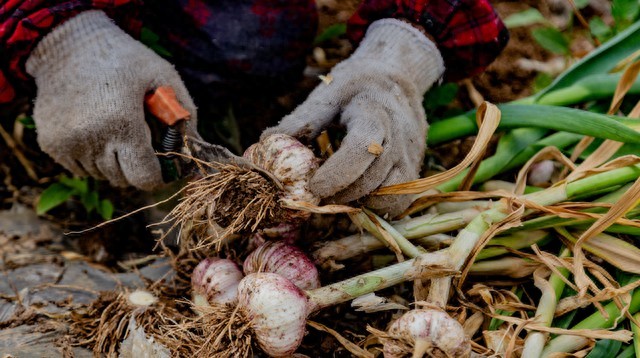
Every time the garlic is played in the autumn, a lot of people who grow vegetables experience the same distress. When the garlic is buried in the soil, the seedlings are mixed, and there is a piece of it in the ground; it is difficult to grow, the seedlings are thin and yellow, and they can freeze to death after winter; the garlic head is small, the garlic is loose, and it is not much to collect. The first reaction of many people was bad garlic or insufficient fertilizer, so a lot of fertilizer was spilled, high-priced garlic was picked everywhere, and half a day of work was still lost。
The old garlic farmers, who grow garlic on a large scale over the years, know that many of the problems of production reduction are rooted from the moment of planting. The popular saying that garlic would prefer to be two days late, and never in the afternoon. Many people have only heard that, but do not know the true rationale behind it. Old people don't speak out about soil temperatures and roots and leave behind a rigid rule that looks simple and that contains many years of mistesting in the field。
Today's one-time introduction of these five dead-end garlic rules explains not only why we can't plant them in the afternoon, but the four remaining ones are also central to the high production of garlic. Many family friends who grow vegetables often make a mistake in the second, and it is difficult to make up for the previous mistakes in following up on fertilizer management. It needs to be stated in advance that these are practical field exercises that are not secret recipes, but are highly productive if not strictly followed, and that soil, climate, water fattening and pests continue to affect the final harvest. The adoption of these rules will significantly reduce the probability of rotten petals, weak seedlings, so that the garlic can be fully grown。
First, garlic would rather be two days late and never sow in the afternoon
A number of people understand that this sentence is biased and think that as long as it is not afternoon, it can be done at any time. In fact, at the heart of this sentence is avoiding the hot soil after noon. Garlic is a cool crop, and the most suitable temperature for garlic is between 15 and 20°c. Autumn periods of garlic planting are not yet completely retired, and the surface soil is tanned for long periods of time between noon and afternoon, and surface temperatures can easily exceed 35°c and the subsurface layer can even reach 40°c。
There's a root plate on the bottom of the garlic petals, and all the future roots are coming from this position, which is very tender. Garlic was buried in the hot ground in the afternoon, and the roots were exposed to high temperatures, which amounted to burns. When the root plate is damaged, the root capacity is reduced, even if it is barely sprouts, the root system is small, and garlic seed is born weak. In high-temperature environments, the garlic valves have become more breathing, the nutrients stored within the garlic petals are rapidly depleted, and they are prone to suffocation, rotting petals and a direct loss of germinate capacity。
There is also a much-neglected detail of planting in the afternoon, followed by the evening, which quickly shifted from high temperatures to humid cold. The temperature differential between day and night suddenly increases, the high temperature and the boredo of garlic is more likely to breed fungus in a wet environment, lead to a decomposition of the roots, and the late-stage garlic maggots are easier to find。
So what's the best time for planting? Priority was given to the morning, before 9 a. M., the surface cooled overnight, the temperature was low and soil moisture was stable. After planting the soil to water, garlic has a steady day-to-day ingestion and slowly starts to root. Seeding is available throughout the day and is not restricted by morning and afternoon. If there is no time to go down during the day, it can also wait until the sun is completely set in the evening and the surface temperature drops before planting, and the high-temperature periods in the afternoon are separated。
It is necessary to correct an area of error, not to say that it is absolutely impossible to work in the afternoon, but rather not to sow in high-temperature hours. Moreover, “two days later” is not an unlimited delay in planting. Autumn garlic has a suitable window period, and in the north, usually late september to early october, the south can be delayed until late october. The core standard is a steady drop in daily temperatures to between 15 and 18 degrees c before planting, ensuring that garlic leaves can grow between five and seven leaves before winter. If the delay is too long, the temperature is too low, the seedlings are too small, the seedlings are prone to freezing in winter and the garlic is not growing much in the coming year。
Number two: don't strip the graft long enough, keep the whole plate
This is the one where the vast majority of people do wrong. Many people, in order to save themselves and sow in the first half of the month, opened up their entire garlic, stripped their skins and piled it up. Seeing it ready in advance, it's actually silently damaged garlic。
When the garlic is ripped open, the roots are exposed to the air and the water continues to run out. Once it's dried up, the rooting capacity is severely compromised. When the carotid skin is broken, it is more likely to be infected with fungus, and it will be darkened in a few days. It's not too early. When dividing the petals, you have to be light, and try to make sure that every root plate on the bottom of the garlic is intact. Once the root plate has fallen, it is almost impossible for the garlic to have a normal root, even if it's a seed, and it doesn't grow much later。
After split the petals, you have to grade garlic. The garlic is divided into three levels, large, medium and small, sowing separately. Big petals together, little petals alone, don't mix. The petals are well-fed, fast and strong; the petals are slow. Following the mixage, the seedlings will be shielded from light, the long-term gap will widen and later management will be difficult to unify. The dried, insect-eyed, rotting, deformed, and badly decapitated garlic petals are taken out and abandoned without pain and the low-quality garlic sowing will only occupy the land in vain。
The piece of garlic is set up in a cold ventilator and drys the wounds, so that the sun does not shine. The sun would burn the garlic bud directly, causing the seed to fail. Families in a position to do so can use grass-wood ash to sip garlic petals to act as a simple anti-insect control without coercion。
Thirdly, under human waste, bottom fat cannot be too close to garlic
Garlic roots are shallow, most of which are concentrated in the 20 cm topography of the surface, with limited absorption capacity, but are long-lived, with bottom fertilizers as a high-yielding base, where many people step on pits。
A number of friends of a variety have thrown undefeated chicken dung and goat dung into the ground and planted them directly. Once the raw manure is buried in the soil, it will continue to ferment and heat, which will burn the carcass, causing rotting petals. The raw manure is also carried with it eggs and bacteria, the garlic maggots, the most afraid of the garlic, the most favorite of which is breeding on undefaded manure plots, and the latter of which is eaten to death in the form of yellow。
Bottom fertilizers prioritize the use of fully fertilized agricultural organic fertilizers with a few balanced composite fertilizers. When the whole land is covered, the fertilizer is spread evenly, tilling it into the ground, so that it is fully mixed with the soil, and it is not concentrated in sown ditches. Don't put fertilizer directly next to garlic. High concentrations of fertilizer touch garlic。
Many people think it's better to get more fat on the bottom, so they're applying a lot of fertilizer. Over-fertilizers, high levels of soil solution, difficulty with garlic petals, slow seed production and easy burning of sharp yellow leaves. Garlic periods, which are mainly dependent on the nutrients stored by the garlic petals themselves, do not require large quantities of fertilizer in the preceding period, and are sufficient for bottom fatting, which can be followed to the stage of return and expansion。
The same land, where garlic is grown repeatedly over the years, endemic diseases accumulate each year, soil nutrients are unbalanced, disease is high and yields are lower every year than a year. Precedence is corn, beans, and no more onions, pickles or garlic。
Number four: the sowing depth cannot be too deep. The garlic can't be turned upside down
Garlic sows a lot of grass, and it's decided to grow fast. Buried too deep, garlic seedlings need to consume large amounts of garlic petals, which are produced late and thin; buried too shallow, the garlic petals are bare in shallow soils, the water is easily lost, the cold is easier in winter, and the late garlic is easily exposed and fractured。
The conventional soil is controlled by a thickness of 3 to 4 centimetres, i. E., a layer of soil approximately 3 centimetres from the tip of the garlic. The sandy soil is less water-preserving, which can be slightly deeper; it is less gaseous for a sticky piece of land, so as to avoid stubble。
The garlic has fixed requirements, the garlic is pointed up, and the roots are thrown down vertically into the soil. A lot of people throw themselves in a ditch, throw themselves in a ditch, throw them in the back, and they affect the seedlings. Inverted garlic petals, the buds will grow up in the earth, consuming much of the garlic nutrients, producing slow and thin。
When the soil is sown, the soil shall be splattered lightly and the garlic and the wet soil shall be so close. If the garlic is emptied, the roots are not exposed to wet soil, the water is difficult to absorb and the seed is not sufficient. It should be light, not hard-walled. After the broadcast, water was poured into the soil once. When water is poured, no heavy water is poured, and low-lying plots must rise ahead of schedule and open drains, which directly cause rotting petals。
The sowing density is also controlled, ranging from 18 to 20 cm in rows and 8 to 10 cm in stands. The seeding is too dense, the garlic seed covers each other, competes for water fattening, the garlic head gets smaller; the seeding is too rare, the land use rate is low and the total production is not up. Home gardens can be properly spaced to facilitate later harvest management。
Article 5: no frequent watering before seeding
It is a common mistake for many people to look into the earth every day after the garlic is planted, and to water the earth a little bit。
Garlic tends to grow, requiring wet permeable soil, but the soil is chronically low in oxygen and can easily rot. Once the seeding has been completed and the soil is wet, it is not repeated. The slight whiteness of the soil surface does not represent a shortage of water, frequent watering, poor soil aerobics, rapid breeding of low-temperature, high-wet environment fungus, and a significant increase in the probability of rotten species。
If the soil is still wet, it will not be watered. Only deep-soils are significantly dryed, with minor recharge。
We'll adjust the watering rhythm when the garlic is all out. Garlic seedlings are drought-resistant, with moderate water control, and contribute to the downward rooting of the roots, their development and their increased resilience to the cold. If there is too much moisture in the seed season, the garlic seedlings grow, the leaves are thin, and they can easily be frozen after winter。
Before winter starts, it is necessary to water the winter in order to keep the garlic seedlings safe for winter. After returning to youth, garlic grows more rapidly, requiring more water to keep the soil wet; it expands during periods when there is no shortage of water, and the lack of water is greatly hampered; and it ceases to water and is easy to harvest, and it is not easily decomposition or storageable in the first half of the harvest。
We're going to put together five rules and we're going to clean up all the garlic
Many people are staring at this step of sowing, neglecting the proper management, and it is difficult to achieve the desired harvest, even by following five rules. We comb it from head to head, from ground, to seed, to winter, to green, to garlic。
Step one, whole floor. Following the completion of the harvest of the former crop, the roots of the weeds in the ground were cleared, with 25 to 30 centimetres of deep tillage, and the earth blocks were crushed and the burrows crushed. It's too big, it'll crush the garlic and block the seedlings. Low-lying plots of land are prone to water accumulation and planting, avoiding the accumulation of water rotting petals. The bottom fertilizer is evenly distributed, deep tillage is flat, and the ground is strictly forbidden。
Step two, pick the petals. Pick a full-headed garlic with no pests. Three to seven days before planting, picks garlic petals with a full root plate, stores them, removes them. In the shade of garlic, dry wounds are spread and sunbaths are forbidden。
Step three, pick the time to sow. In case of high-temperature periods after noon, priority shall be given to planting in the morning or in the middle of the day, and when necessary, after the evening cools. The gutter is scattered, the garlic is pointed up, the earth is 3 to 4 centimetres covered, the earth is slowly suppressed and the water is pouring down once. Controls the line distance, rationally implanted。
Step four, seeding management. Water is not regularly poured before seedlings are produced, and the soil is humid. After seedlings are released, a strong view is made of the small amount of organic fertilizer that can be pursued. The timely cleaning of weeds in the fields and the gathering of water and fertilizers can also breed pests and diseases。
Step five, winter management. Before winter, it is guaranteed that the garlic seed will have five to seven functional leaves and that the seedling will be strong. Water for winter before temperature drops. Cold areas in the north can be covered with straw or membranes to keep them warm and humid。
Step six: turning back to the youth and expanding the management. The temperature rises back and forth, and the water is followed up in due course. After garlic is pumped, nutrients are consumed, garlic is harvested, and fat is followed up in a timely manner to promote garlic expansion. This phase cannot be dry or dry。
Step 7, harvest in time. When the leaves are yellow under the plant and the mantle is softer, the garlic can be harvested. The harvest is too early, the garlic is not big enough, the head is small; the pick is too late, the garlic is easily spread, the skin is broken and storage capacity is reduced。
Daily high frequency questions
Is garlic available all day
The usual rule is that the sun is not tan, the temperature is not rising fast, the seeding is not restricted by morning and afternoon。
Can you still grow the garlic
It is not recommended to produce garlic, even if the seedlings are produced, the seedlings are weak and the late garlic is small. A small attempt at home gardens can be made, rather than sowing。
3. Do the five rules apply to membrane garlic
The membrane cover is just a thermostat, and the same applies to the first five basic rules. Undersea soils are more hot and cannot sow at high temperatures after noon, and bottom fertilizer is still not available for the use of undecompressed manure。
4. Can we apply the same method to the balconies that grow garlic
Yes, but the flower pots are thin, and water conservation capacity and fields are different. The soil has been selected for lax soil, rather than the ground. The sowing depth is about three centimeters away from water. The balcony is fully luminous and avoids hot and tan positions. There's not much garlic in the flower pot. It's too dense。
5. What is the probable cause of the lack of seeding of garlic
The most common factors are: high-temperature seeding of roots; damage to roots; poor garlic petals; manure and manure burning; shallowness of the soil; and drying and flooding. It is a priority to check the seed chain。
An objective view of old experiencePlantation techniques
The five garlic rules left behind by the old generation are lessons learned from years of field practice that avoid pits that most newcomers can easily step on, but it is not a panacea. Garlic production is a full-scale system project, and not just to comply with them, it will grow large and round garlic。
The climate varies widely from region to region, with wet heat in the south, cold in the north, sandy clay in the soil, and a variety of species, such as violet garlic and garlicSeed timeAnd water fertilizer management is tailored to local conditions. Civil experience is a risk reduction reference and is not a substitute for the specialized programmes offered by local agricultural stations based on local soil. It is not objective that many short videos exaggerate such experiences as a move to achieve high levels of garlic production。
I myself tried to plant garlic in a small garden for several years, comparing the seedlings that were planted after noon and in the morning. In the middle of the morning, the porcelain grafts in the high-temperatured species are significantly higher, the seeding time is delayed and the seedlings are generally thin; the fields planted in the morning are well-sowned and the garlic is stronger. It's too early for garlic, and the rate of seeding is significantly slower。
The details of the gardening, the harvest. Many of the reductions were not due to major problems, but rather to small, indescribable places such as seeding time, garlic processing and fertilization, which went wrong and followed by a series of problems。









